Act I
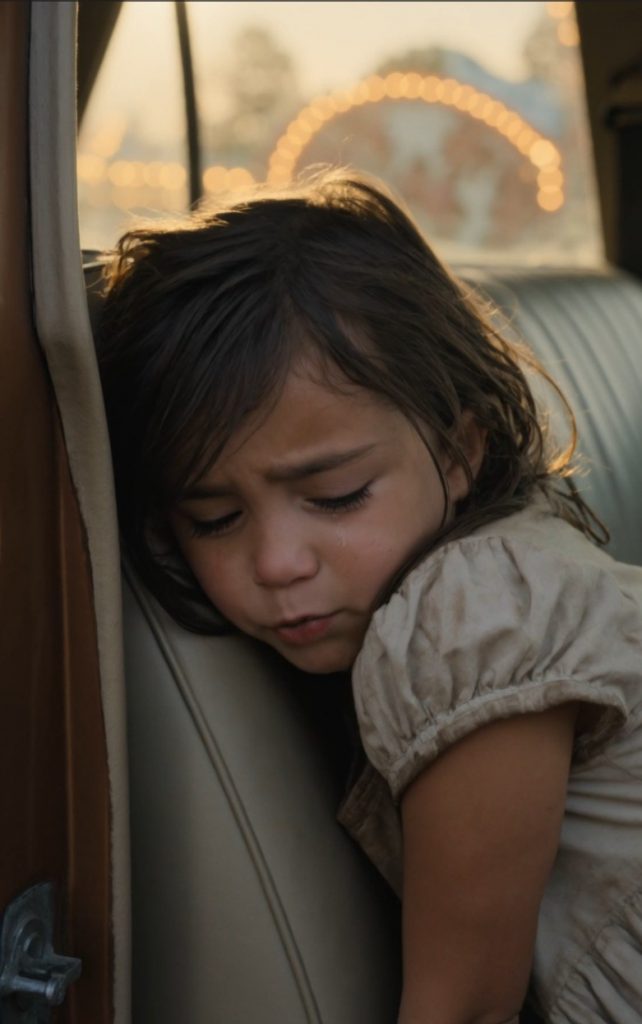
The carnival lights were still glowing when Lily climbed into the car and begged to go home.
She sat in the front passenger seat of the old brown sedan, knees pulled close, dirty beige dress bunched around her legs. Her messy brown hair stuck to her tear-streaked face. Dust and grime marked her cheeks like she had fallen somewhere no child should have been.
Outside, the carnival carried on.
Music jingled from a carousel. Children laughed near the ring toss booths. Strings of yellow bulbs swayed above the gravel lot, turning the evening warm and beautiful in a way that made Lily’s fear look even more wrong.
“Dad,” she whispered, voice shaking. “Can we just go home please?”
Ethan Vale froze beside the open passenger door.
For two hours, he had been searching for her.
One minute she had been near the cotton candy stand, holding a paper ticket and smiling at the Ferris wheel. The next, she was gone. Security said children wandered. A vendor said she had probably run toward the games. A woman from the carnival office told him not to panic.
But Ethan had panicked anyway.
Now Lily was back in his car, barefoot, trembling, and unable to look him in the eye.
Ethan knelt on the gravel beside the open door.
“What’s wrong, baby?”
He reached gently for her shoulder, but Lily stiffened.
Not because his hand hurt her.
Because she was afraid he would see something.
Ethan pulled his hand back immediately.
“Lily?”
She looked toward the carnival behind him, then toward the dark space between the tents.
Her lips trembled.
“Dad, I need to show you something.”
Ethan’s heart began to pound.
“But please don’t get mad.”
The words hit him harder than if she had screamed.
“Mad at you?” he said softly. “Never.”
Lily stood slowly from the passenger seat, still staying close to the open door like the car was the only safe place left in the world. She turned her body slightly, pulling the torn fabric away from her left shoulder.
Ethan saw the mark.
Dark. Irregular. Alarming against her small skin. Not a scrape from falling on gravel. Not dirt. Not paint from a carnival game.
A symbol.
A black crescent inside a circle, smudged at the edges, angry-looking where it had been pressed too hard.
Ethan stopped breathing.
Lily whispered, “She said it meant I belonged to her now.”
Behind them, the carnival music kept playing.
And Ethan Vale finally understood that his daughter had not wandered away.
Someone had taken her.
Act II
The carnival had been Clara’s idea.
Everything bright in Ethan’s life usually was.
His wife had loved old things: old cars, old songs, old diners, old county fairs where the Ferris wheel creaked and the popcorn tasted slightly burned. Every October, she dragged Ethan to the traveling carnival outside town, bought too many tickets, and made him ride the carousel with Lily even after he protested that grown men did not belong on painted horses.
Clara laughed every time.
“Then be less grown,” she would say.
After she died, Ethan stopped going.
He stopped doing many things.
Grief did not make him dramatic. It made him quiet. He kept the house clean. Packed Lily’s lunches. Fixed appliances. Signed school forms. Paid bills. Read bedtime stories in a voice that did not sound like his own.
But joy became a room he avoided.
Then, one morning, Lily found an old photo in Clara’s jewelry box. It showed Clara at the carnival with wind in her hair, one hand on Lily’s stroller, the other resting on Ethan’s shoulder.
“Can we go?” Lily asked.
Ethan wanted to say no.
Instead, he looked at his daughter’s hopeful face and realized he had mistaken protecting her from sadness for protecting her from life.
So they went.
The old brown sedan had been Clara’s favorite. Ethan polished it that afternoon like an apology, then drove Lily to the fairgrounds at dusk while she pressed her face to the window and counted lights.
For the first hour, everything felt almost possible.
Lily won a plastic ring at a duck pond game. Ethan bought her lemonade. They stood near the carousel, and for one brief second, he could almost hear Clara laughing beside them.
Then Lydia appeared.
Clara’s older sister moved through the crowd in a cream coat, hair pinned neatly, smile soft enough to fool people who did not know her. Ethan had not seen her in months.
Lydia Vale never approved of him.
Not when Clara married him. Not when he refused money from her family. Not when Clara’s estate named Ethan sole guardian and placed Lily’s inheritance in a protected trust until adulthood.
After Clara’s death, Lydia began visiting with gifts and concern.
Then came comments.
Ethan looked exhausted.
The house was too small.
A little girl needed a woman’s stability.
By the time Lydia filed her first petition for shared custody, Ethan understood her grief had turned into ownership.
The court dismissed it.
Lydia did not forgive him.
At the carnival, she hugged Lily too tightly and looked at Ethan with polished sympathy.
“I’m surprised you brought her here,” she said.
“It was her mother’s favorite place.”
Lydia’s smile thinned.
“Yes. Clara always trusted the wrong things.”
Ethan ignored it.
He had become good at ignoring Lydia for Lily’s sake.
That was his mistake.
Because twenty minutes later, while Ethan stood in line for tickets, Lily disappeared.
And when she returned, she carried a mark on her shoulder that matched the black crescent logo Ethan had seen hanging above one place at the carnival.
The Lost Children tent.
Act III
Lily told the story in pieces.
Ethan did not rush her.
He sat on the gravel beside the open passenger door, his body low, his voice careful, his hands visible. He wanted to tear through the carnival until someone confessed, but rage would not help Lily speak.
So he stayed still.
“She said you were mad,” Lily whispered.
“Who?”
“Aunt Lydia.”
Ethan’s face went cold.
Lily stared at her lap.
“She said you told her to take me because I was being bad.”
“I never said that.”
“I know.”
Her voice broke on those two words.
Ethan closed his eyes for one second, forcing himself not to let fury show too quickly.
“What happened after she took you?”
Lily swallowed.
“She brought me behind the tent. There was a man with papers. He said I had to be quiet because you were in trouble. Then Aunt Lydia said if I loved Mom, I would stop making everything hard.”
Ethan felt something inside him tear.
Lily pulled the sleeve farther from her shoulder.
“She put this on me. It hurt.”
Ethan looked again at the crescent mark. Up close, he could see ink smudged at the edges, pressed into irritation. A stamp. Not a wound from an accident. A mark used to identify her.
“Did they say what it meant?”
Lily nodded.
“The man said, ‘This is the transfer mark.’”
The word transfer turned the warm carnival air into ice.
Ethan stood slowly.
Lily grabbed his wrist.
“Please don’t leave me.”
He looked down at her.
“I won’t.”
He took his phone out and called 911 first.
Then he called Marisol Reyes.
Marisol had been Clara’s best friend since high school and now worked as a deputy in the county sheriff’s office. She answered on the second ring.
“Ethan?”
“I found Lily,” he said.
Marisol exhaled sharply.
“Thank God.”
“She was taken. Lydia’s involved. There’s a mark on her shoulder. A crescent. Something about a transfer.”
Silence.
Then Marisol’s voice changed.
“Do not go to the carnival office alone.”
Ethan looked toward the glowing tents.
Too late.
Across the gravel lot, Lydia stepped from behind a ticket booth, scanning the rows of cars. Beside her stood a man in a dark vest holding a clipboard.
Their eyes found the open passenger door.
Lydia began walking toward them.
Ethan opened the back door and guided Lily inside.
“Lock it,” he whispered.
“Dad—”
“Lock it, baby.”
She did.
Lydia reached the car wearing the same soft smile.
“Ethan,” she said, breathless. “There she is. We’ve all been worried sick.”
Ethan stood between her and the sedan.
“Don’t come closer.”
Her smile faded.
“You’re making a scene.”
He looked past her toward the carnival lights, the laughing families, the children holding balloons.
“Good,” he said. “Then people will see you.”
Act IV
Lydia tried to use her gentlest voice first.
That was how she had always moved through the world. Money behind softness. Threats wrapped in concern. Cruelty polished until it sounded like responsibility.
“Ethan,” she said, “you’re upset. Lily wandered off. We found her. That’s all.”
The man with the clipboard stepped forward.
Ethan turned to him.
“Who are you?”
“Carnival safety coordinator.”
“Name.”
The man hesitated.
That hesitation answered enough.
Ethan lifted his phone.
“Deputies are on the way.”
Lydia’s expression hardened.
“You called the police?”
“My daughter has a transfer mark on her shoulder.”
The clipboard man backed up half a step.
Lydia did not.
“She’s dramatic. Clara was like that as a child too.”
Ethan’s voice dropped.
“Do not speak about my wife.”
Lydia glanced toward the car.
Through the window, Lily watched them with both hands pressed together, eyes wide.
For the first time, Lydia seemed irritated that the child was still close enough to be seen.
“You are unfit,” Lydia said. “Everyone knows it. You live in that old house. You drive this broken car. You spend your life pretending grief makes you noble, but Lily needs stability.”
Ethan almost laughed.
The old sedan behind him was not broken.
It was Clara’s.
That was why Lydia hated it.
Because it proved Clara had chosen a life outside the Vale family’s money and never regretted it.
Blue lights flashed at the entrance to the gravel lot.
Lydia saw them and straightened.
Her face became calm again, but too late.
Marisol arrived with two deputies and a uniformed officer from fairground security. Ethan opened the back door only when Lily nodded. Marisol crouched beside her carefully, saw the mark, then looked at Lydia with a fury she did not bother hiding.
“What did you put on this child?”
Lydia lifted her chin.
“I did nothing.”
Lily spoke from inside the car.
“Yes, you did.”
Everyone turned.
Her voice was tiny, but clear.
“You said if I told Dad, you’d make sure he never saw me again.”
Lydia’s face paled.
The clipboard man stepped farther away.
Marisol noticed.
“Don’t move.”
The deputies searched the Lost Children tent first.
Inside, they found a folding table, blank incident reports, a stack of temporary custody affidavits, and a stamp pad marked with the same crescent symbol as Lily’s shoulder. In a locked case beneath the table were copies of documents bearing Ethan’s forged signature.
One form stated he had voluntarily surrendered Lily to Lydia’s care due to “emotional instability.”
Another authorized transport to a private facility two counties away.
Lydia claimed she knew nothing.
Then Marisol found Clara’s letter.
It was folded inside Lydia’s leather folder, creased from being read too many times.
Ethan recognized his wife’s handwriting instantly.
Lydia, if you ever love my daughter, love her enough not to own her. Ethan is her father. Do not use my death to take what was never yours.
Ethan stared at the letter until the carnival lights blurred.
Clara had known.
Somehow, before she died, she had seen what grief might make Lydia become.
Lydia tried to snatch the folder back.
A deputy stopped her.
The man with the clipboard finally broke.
He said Lydia paid him to process Lily as an “abandoned minor” if Ethan was delayed long enough. The mark was meant to identify the child to a driver waiting near the service road.
The service road was searched immediately.
A black van was found there with its engine still warm.
The driver was gone.
But the plan was not invisible anymore.
Neither was Lydia.
Act V
Lily slept in Ethan’s arms that night.
Not in her room.
Not alone.
On the living room couch beneath Clara’s old quilt, one hand holding the collar of Ethan’s gray T-shirt, the other tucked under her cheek. Every time Ethan tried to shift, she stirred.
So he stayed still.
The hospital had cleaned the mark and confirmed it was a harsh chemical stamp that would fade with care. The doctor spoke gently. Marisol took photographs for evidence. A child advocate sat with Lily and asked questions slowly, giving her breaks, letting her hold a stuffed rabbit from the emergency room shelf.
Ethan answered what he could.
For everything else, he simply stayed where Lily could see him.
Lydia was arrested before dawn.
The charges came in layers: attempted custodial interference, forged legal documents, child endangerment, conspiracy, and false reporting. Her attorneys called it a misunderstanding born from grief.
The court did not.
Neither did the town once the documents became public.
The Vale name had always sounded elegant in courtrooms and charity halls. But paper tells the truth if someone reads it closely enough. Bank transfers connected Lydia to the man with the clipboard. Phone records showed calls to the private transport company. Draft petitions revealed she had planned to claim Ethan abandoned Lily at the carnival.
All she needed was one night.
One missing child.
One panicked father who could be made to look unstable.
But Lily came back to the car.
She found the one place she still believed was safe.
And she told the truth.
The hardest part came later.
People expected Lily to be better once Lydia was gone.
Children do not work that way.
For weeks, Lily asked before leaving the room. She cried when Ethan stood in line anywhere too long. She refused to wear dresses with sleeves that showed her shoulder. She woke from dreams whispering, “I didn’t belong to her.”
Ethan answered the same way every time.
“No, baby. You belong to yourself. And I am right here.”
He got help.
Not because he was failing.
Because love needed tools.
Lily began therapy with a woman who kept colored pencils in a basket and never forced eye contact. Ethan joined some sessions and sat through others in the hallway, learning how fear could hide inside ordinary things: open doors, carnival music, the smell of popcorn, a woman’s soft voice saying trust me.
The mark faded first.
The memory took longer.
When Clara’s birthday came in spring, Ethan expected Lily to want to stay home.
Instead, she stood in the kitchen wearing yellow sneakers and said, “Can we go see the carousel?”
Ethan stopped drying a plate.
“You sure?”
“No.”
He waited.
“But Mom liked it.”
Ethan set the towel down.
“Yes,” he said. “She did.”
The carnival was gone by then, replaced by an empty fairground with patches of grass growing through gravel. The old carousel had been stored in a county building after the investigation closed the traveling company for review.
Marisol arranged for them to visit before it was moved.
The building smelled of dust and wood polish. The carousel horses stood still beneath dim lights, paint chipped but beautiful. Lily walked slowly beside Ethan, her hand wrapped tightly around his.
Then she saw the white horse with the blue saddle.
Clara’s favorite.
Lily touched its mane.
“Did Mom ride this one?”
“Every year.”
“Did she make you ride too?”
Ethan smiled.
“Every year.”
Lily looked at him.
“Were you scared?”
“Of the horse?”
“Of being happy after sad things.”
Ethan did not answer right away.
Then he crouched beside her.
“Yes,” he said. “I think I was.”
Lily nodded like that made sense.
“I am too.”
He brushed a strand of hair from her face.
“We can be scared and still take one turn.”
The carousel did not run that day. There was no music, no spinning lights, no crowd. But Ethan lifted Lily carefully onto the white horse, and she sat there with both hands on the pole, breathing slowly until her shoulders softened.
Then she looked down at him.
“Dad?”
“Yeah?”
“I showed you.”
He knew what she meant.
The shoulder.
The mark.
The truth.
His throat tightened.
“You did.”
“You didn’t get mad.”
He shook his head.
“No.”
“You came back.”
Ethan placed his hand over hers.
“I never left.”
A year later, the fair returned under new ownership with stricter safety rules, background checks, and county oversight that made carnival operators complain until Marisol told them complaints were free and compliance was required.
Lily decided to go.
This time, she wore a blue jacket that Clara had embroidered years earlier with a tiny yellow star near the pocket. The shoulder beneath it had healed. Only Ethan knew where the mark had been.
They drove the brown sedan again.
The passenger door creaked the same way when Lily opened it.
For a second, both of them remembered dusk, gravel, tears, and the horrible sentence that had changed everything.
She said it meant I belonged to her now.
Then Lily took Ethan’s hand.
They walked toward the lights.
Not because the past had vanished.
Because Lydia had failed to turn one terrible night into the rest of Lily’s life.
At the carousel, Ethan bought two tickets.
Lily looked up at him.
“You’re riding?”
He sighed dramatically.
“Your mother would haunt me if I didn’t.”
Lily laughed.
It was small at first, then real.
The sound moved through Ethan like sunlight through a window that had been closed too long.
Around them, the carnival glowed.
This time, the lights did not hide danger.
They lit the way forward.
And when the carousel began to turn, Ethan stood beside his daughter on the wooden platform, one hand on the pole, the other steady near her back.
Not holding her down.
Not claiming her.
Just there.
Close enough for her to know that if fear ever found her again, she could show him anything.
And he would believe her.