Act I
The alley smelled like rain, rust, and fear.
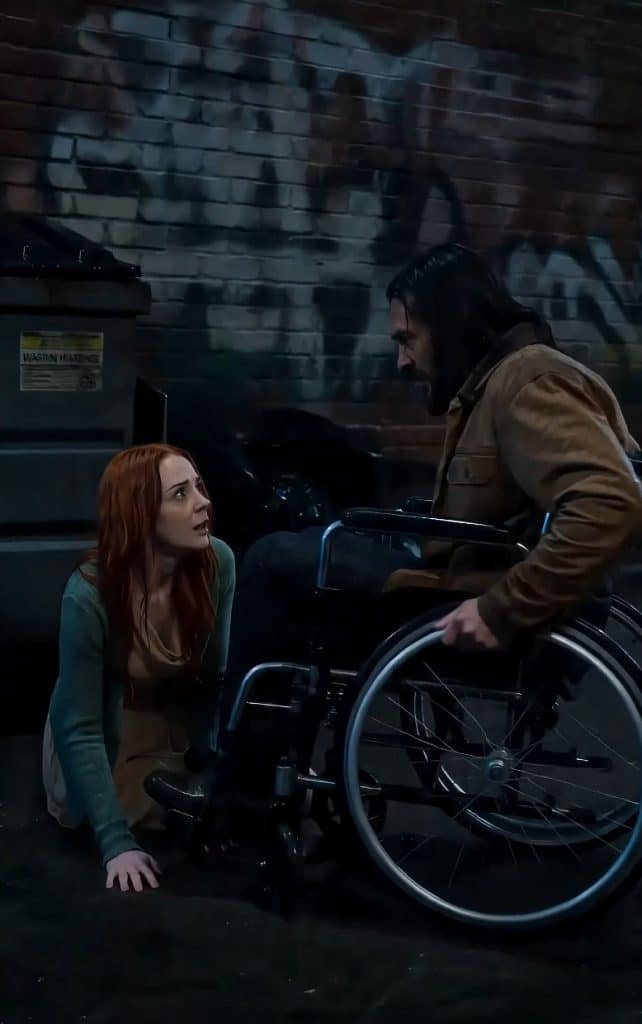
Red neon shimmered in the puddles, bending across the wet pavement like something wounded. Dumpsters crowded the brick walls. Trash clung to the curb. Somewhere above, an old sign buzzed and flickered, throwing broken light over three men standing around a woman on the ground.
She had fallen hard.
Her green cardigan was damp at the sleeves, her beige dress streaked where it had scraped the pavement. Long red hair clung to her face as she pushed one hand against the ground, trying to rise.
One of the men laughed.
“Come on,” he said. “You were so brave a minute ago.”
The woman looked toward the mouth of the alley, but the street beyond it was empty.
The tallest man stepped closer.
She flinched.
That was when a voice cut through the rain.
“Hey.”
The men turned.
A wheelchair rolled out of the shadows.
The man sitting in it had long dark hair, a beard, and a brown jacket darkened by rain. His hands rested calmly on the wheels, but his eyes were fixed on the men with a steadiness that made the alley feel smaller.
“Leave her alone,” he said.
For one second, nobody moved.
Then the lead harasser smiled.
He stepped forward, boots splashing through a puddle.
“Or what?”
The other two men laughed.
The lead man looked down at the wheelchair, then back at the man’s face.
“You can’t even stand up, loser.”
The insult hung in the air.
The man in the wheelchair did not blink.
He reached inside his jacket.
The laughter faltered.
He raised a handgun upward, not at them, not toward anyone’s body, but into the empty strip of sky between the brick walls.
One shot cracked through the alley.
The sound exploded against metal and stone.
The three men recoiled as if the ground had opened beneath them. Their courage vanished instantly. The lead man stumbled backward, then turned and ran. The others followed, splashing through puddles, their footsteps fading into the rain-slicked darkness.
The woman on the ground shook so badly she could barely breathe.
The man lowered the gun, secured it, and rolled toward her slowly, careful now, gentle now.
“It’s okay,” he said. “You’re safe.”
She looked up at him through rain and tears.
“Thank you.”
His expression softened, but only slightly. He looked like a man who had learned not to trust quiet moments too soon.
“You need an ambulance?”
She shook her head, then winced.
“No. Not for me.”
He frowned.
“What does that mean?”
She stared at his wheelchair.
Then at his hands.
Then back into his eyes, with a strange certainty that did not belong in an alley after midnight.
“You saved me,” she said. “Now let me help you.”
He almost laughed, but something in her face stopped him.
“Help me how?”
The woman’s voice steadied.
“I can help you walk again.”
The rain kept falling.
And for the first time in three years, Gabriel Mercer was afraid to hope.
Act II
Gabriel Mercer had learned to hate miracles.
People loved the word because it cost them nothing.
They said it when he survived the crash. They said it when he woke from surgery. They said it when he moved two fingers, then sat upright, then learned how to transfer himself from bed to chair without falling.
Miracle.
As if surviving was the same as being restored.
Before the accident, Gabe had been a firefighter with hands burned rough by work and a laugh that filled rooms before he entered them. He climbed ladders, carried strangers out of smoke, and ran toward danger with the arrogant belief that his body would always obey.
Then came the warehouse fire on Morgan Street.
A trapped night guard. A collapsing mezzanine. A beam that fell wrong. One second, Gabe was moving through heat and smoke with another man’s arm over his shoulder. The next, the world was noise, weight, and darkness.
He saved the guard.
That was the part everyone liked to remember.
The city gave him a medal. The department held a ceremony. Reporters called him a hero while he sat in a hospital chair with half his body numb and the other half burning with pain no one could see.
His spine was injured.
Not severed completely, the doctors said. Incomplete injury. Complex prognosis. Intensive rehabilitation.
Words that sounded like doors opening until each door led to another locked room.
For months, Gabe fought.
Then he fought the fighting.
Then he stopped letting people watch.
His fiancée left gently, which somehow hurt worse than if she had slammed the door. His friends visited less often after they ran out of brave things to say. His father told him God had a plan, and Gabe told him not to come back until God explained it personally.
By the third year, Gabe lived above a closed pawnshop on Ashburn Street, worked nights reviewing security feeds for a storage company, and moved through the city like a man nobody expected much from anymore.
That alley was part of his route home.
He knew which puddles hid broken glass. Which doorways collected trouble. Which neon signs flickered even after the bars closed. He carried protection because the city after midnight had taught him that being seated did not make him invisible to danger. It made certain men think he was easy.
They were often wrong.
The woman he saved did not look easy either.
Even on the ground, trembling, she had the eyes of someone who had been running toward something before she was forced down.
Her name, she told him, was Dr. Rowan Vale.
Not just Rowan.
Doctor.
That word changed how Gabe looked at her.
She saw the change and gave a tired, humorless smile.
“Don’t worry. I’m not that kind of doctor.”
“What kind are you?”
“Neuro-rehabilitation. Biomedical mobility research.”
Gabe stared at her.
The rain ticked off a metal fire escape overhead.
“Of course you are.”
“I know what that sounds like.”
“Do you?”
Rowan tried to stand. Her knees shook. Gabe reached out, then stopped, letting her choose whether to take his hand.
She did.
Her fingers were cold.
When she was upright, she leaned against the brick wall and looked down the alley where the men had fled.
“They were after my bag.”
Gabe noticed then that one strap of her leather satchel had torn. The bag lay half under a dumpster, soaked but closed.
He rolled to it, picked it up, and handed it to her.
“What’s in it?”
Rowan held the bag to her chest like it contained a heartbeat.
“Proof.”
Gabe waited.
She closed her eyes.
“And the only trial data that can keep my patients from being erased.”
The word patients struck him harder than proof.
“What patients?”
Rowan looked at his wheelchair again.
“People like you.”
Act III
Gabe should have left.
He told himself that later.
He should have called the police, handed Rowan the bag, and rolled home before her impossible sentence could crawl under his skin and make a home there.
I can help you walk again.
Cruel words, if spoken carelessly.
Dangerous words, if spoken by someone who needed something.
But Rowan did not look careless.
She looked exhausted, terrified, and furious in a way Gabe recognized. Not the fury of someone wanting revenge. The fury of someone trying to protect a truth powerful people wanted buried.
They took shelter under the awning of a shuttered laundromat while Rowan called a number from memory on Gabe’s phone. Hers had been smashed. She spoke in clipped phrases.
“I still have the drive.”
A pause.
“No, not the police yet. Internal security may be compromised.”
Another pause.
“I’m with someone who intervened.”
Her eyes flicked to Gabe.
“Yes. He’s safe.”
Gabe raised an eyebrow.
Rowan looked away.
After she hung up, he said, “You don’t know I’m safe.”
“You aimed up.”
“That’s your test?”
“It told me enough.”
He did not know what to do with that.
Rowan sank onto the edge of a concrete planter, the satchel on her lap. She opened it and pulled out a small hard case, then pressed her palm against it as if making sure it had survived.
“My lab was shut down tonight,” she said.
“By who?”
“HelixBridge Medical.”
Gabe knew the name.
Everyone did.
HelixBridge ran glossy ads with children taking first steps, veterans climbing mountains, grandparents dancing at weddings. Their commercials turned medical devices into hope set to piano music. They had donated equipment to the rehab hospital where Gabe spent the worst year of his life.
“They fund your work?”
“They own the building. They own the patents. They think they own the patients too.”
Gabe’s jaw tightened.
Rowan continued.
“We were running a small mobility restoration trial using spinal stimulation, robotic gait assistance, and adaptive nerve response mapping. It doesn’t work for everyone. It isn’t magic. It’s painful, slow, expensive, and uncertain.”
“Great pitch.”
“It’s the truth.”
He looked at her.
That was rare enough to matter.
She wiped rain from her cheek.
“Some patients responded better than expected. Not walking like before. Not perfect. But voluntary movement. Assisted standing. Steps with support. Enough to change lives.”
Gabe felt something twist inside his chest.
He hated her a little for saying it.
He hated himself more for listening.
“Then why shut it down?”
“Because the success data exposes a problem with one of HelixBridge’s commercial devices. A device they pushed into hospitals before it was ready. If our data goes public, lawsuits follow. Recalls follow. Executives lose money.”
“And your patients?”
Rowan looked at the hard case.
“They lose their chance.”
The rain softened.
A siren wailed somewhere far away, then faded.
Gabe leaned back in his chair, face unreadable.
“Why did you say that to me?”
“What?”
“That you could help me walk.”
Rowan studied him carefully.
“Because I recognized your name.”
His body went still.
“My name?”
“Gabriel Mercer. Morgan Street fire. Incomplete thoracic spinal injury. Referred to St. Agnes Rehabilitation three years ago.”
He stared at her.
“My medical records are not public.”
“No. But your case was reviewed by my mentor for trial eligibility before HelixBridge buried the program the first time.”
Gabe’s mouth went dry.
“What mentor?”
“Dr. Elias Ward.”
The name hit him like a hand to the chest.
Dr. Ward had been the only specialist who looked Gabe in the eye and said, “You are not a lost cause.” Then, two months later, Ward left the hospital suddenly. Gabe was told funding had changed.
He never heard from him again.
Rowan’s voice softened.
“He died last year. Before he passed, he left me a list of candidates he believed had been abandoned for financial reasons.”
Gabe could barely speak.
“I was on it?”
Rowan nodded.
“At the top.”
Act IV
The men came back before dawn.
Not the same three from the alley. These were cleaner, quieter, and more dangerous because they did not need to laugh to feel strong.
Gabe and Rowan had made it to his apartment above the pawnshop. It was not much: brick walls, narrow kitchen, old couch, ramps he had installed himself, and a window overlooking Ashburn Street. Rowan used his laptop to upload copies of the trial data to three encrypted locations while Gabe sat beside the door with his jaw clenched and one hand on his phone.
“You need police,” he said.
“I need the right police.”
“That sounds like something people say right before everything gets worse.”
Rowan did not look up from the laptop.
“My brother is federal health fraud enforcement. I called him before the men found me. He’s on his way.”
“Of course he is.”
She glanced at him.
“You’re very sarcastic for someone who just saved a stranger in an alley.”
“You’re very calm for someone being hunted by a medical corporation.”
“I’m not calm.”
Her hands trembled on the keys.
That silenced him.
Then came the knock.
Three soft taps.
Both of them froze.
Gabe looked through the small security monitor beside his door. Two men in dark coats stood in the hallway.
One held up a badge.
“Mr. Mercer,” the man called. “Police. We need to speak with Dr. Vale.”
Rowan’s face went pale.
“Not them.”
“You sure?”
She nodded.
“HelixBridge security hires off-duty officers. They use real badges for private intimidation.”
Gabe’s eyes hardened.
The knock came again.
“Open the door.”
Gabe rolled silently to the side cabinet and pulled out a small remote. He pressed one button. Downstairs, the pawnshop security shutters slammed shut with a metallic roar.
The men outside cursed.
Rowan stared at him.
“You live like this?”
“I told you. Not everyone sees a wheelchair and thinks harmless thoughts.”
The men began forcing the lock.
Gabe moved fast, not with panic, but with the practiced efficiency of someone who had rebuilt his life around angles, reach, weight, and timing. He pulled a metal brace across the door, then tipped over a shelving unit in front of it.
Rowan grabbed the hard case and laptop.
“What now?”
“Fire escape.”
“You can use it?”
“No.”
She stared.
Gabe gave her a grim smile.
“But you can.”
“I’m not leaving you.”
The door frame cracked.
Gabe’s voice sharpened.
“Rowan.”
She flinched, then straightened.
“No. You saved me. I’m not saving data and abandoning the person Dr. Ward wanted to help.”
The door bucked again.
Then sirens cut through the street below.
Real ones.
Blue light washed across the ceiling.
A voice from outside shouted, “Federal agents! Step away from the door!”
The men in the hall froze.
Rowan exhaled like her bones had been holding their breath.
Gabe looked at her.
“Your brother?”
“My sister, actually.”
The door did not open until an agent on the other side identified herself as Mara Vale and told Rowan the name of their childhood dog, which seemed like the strangest password Gabe had ever heard.
Within minutes, the hallway filled with federal agents, city police, and medical fraud investigators. The two men were detained. The three alley harassers were picked up later from security footage near a parking garage, still wet, still frightened, and suddenly eager to explain who had paid them.
HelixBridge called everything a misunderstanding.
Then Rowan’s upload went live to regulators, patient advocates, and federal prosecutors.
Misunderstandings rarely came with encrypted trial files, suppressed adverse-event reports, internal emails, and a list of patients denied access to treatment after their cases became financially inconvenient.
By sunrise, the company’s stock had begun to fall.
By noon, its executives had stopped answering questions.
And Gabe sat in his apartment, watching Rowan give a statement beside his kitchen table, wondering whether the sentence he feared most was still waiting for him.
I can help you walk again.
Act V
Rowan did not promise him a miracle again.
That was why Gabe believed her.
Three weeks after the alley, she met him at a secured rehabilitation wing connected to a university hospital, not a secret lab, not a glossy corporate tower. The walls were plain. The coffee was terrible. The therapists looked tired and serious.
Gabe liked that.
Hope with fluorescent lighting and paperwork felt more honest than hope with music.
Rowan sat across from him with a folder between them.
“I need to say this clearly,” she told him. “I don’t know what your outcome will be.”
Gabe looked at the folder.
“Then why am I here?”
“Because Dr. Ward believed you had measurable residual pathways. Because your injury profile matches early responders. Because you were denied review when funding shifted. Because you deserve the choice they took from you.”
He stared at her.
The word choice hurt more than walk.
For years, he had thought the dream was stolen by bone, nerve, fire, bad luck, God, fate, whatever name people gave to the thing they could not fight.
Now he learned part of it had been stolen by paperwork.
By money.
By men in rooms who never had to look him in the eye.
He almost left.
Rowan seemed to know.
“If you say no, I’ll still testify. I’ll still release everything. I’ll still owe you my life.”
“You don’t owe me that.”
“I know.”
“Then why say it?”
“Because gratitude is easier than asking you to trust me.”
Gabe laughed once.
Not because it was funny.
Because it was true.
He signed the consent forms two days later.
The trial was not cinematic.
There were no sudden scenes of Gabe rising from the chair while violins swelled. There was pain, sweat, disappointment, tiny signals on screens, adjustments, failed sessions, exhausted silence, and therapists saying, “Again,” until the word became both enemy and prayer.
Rowan did not hover.
She worked.
She calibrated equipment. Reviewed nerve maps. Argued with surgeons. Slept too little. Snapped at reporters who wanted to turn Gabe into a symbol before he had even finished the first phase.
Gabe hated the harness most.
It suspended him above the treadmill like a man caught between earth and memory. His legs, thin from years of disuse, were guided by robotic supports while stimulation pulsed through implanted leads. At first, nothing happened that felt like his.
Then one morning, his right foot twitched.
Not much.
Barely enough for anyone else to notice.
But Gabe felt it.
A command leaving his mind and reaching something below the injury line.
He looked at Rowan.
She had gone completely still.
“Did you see that?” he asked.
Her voice was careful.
“Yes.”
“Was it me?”
She swallowed.
“Yes.”
Gabe broke then.
Not loudly. Not the way people might expect.
He simply lowered his head and cried into his hands while the harness held him upright.
Rowan turned away to give him privacy, but he reached out and caught her sleeve.
“Don’t,” he said.
So she stayed.
Months passed.
HelixBridge unraveled in courtrooms and hearings. Patients testified. Families testified. Rowan testified for nine hours and never once softened the truth to make powerful men comfortable. Her sister’s investigation exposed bribery, suppression, and the deliberate shelving of patients whose improvement might threaten profits.
Gabe testified too.
He rolled into the hearing room, looked at the executives seated under bright lights, and told them what it felt like to be turned into a loss calculation.
“You didn’t just delay treatment,” he said. “You delayed lives.”
By then, he could stand for forty-seven seconds with support.
Forty-seven seconds was not a miracle to strangers.
To Gabe, it was a continent.
The first step came almost a year after the alley.
A parallel bar on each side. Braces locked. Rowan on one side, a therapist on the other. Gabe sweating through his shirt, furious with fear.
His right foot moved first.
Then the left.
Assisted. Uneven. Fragile.
A step.
The room did not explode into applause.
Rowan had warned everyone not to.
Gabe needed the moment to belong to his body before it belonged to anyone else.
He took another.
Then another.
Three steps total.
On the fourth, his knee buckled and the harness caught him.
He laughed so hard he scared the therapist.
Rowan covered her mouth, eyes wet.
Gabe looked at her.
“You said you could help me walk again.”
She smiled through tears.
“I said a lot of dramatic things in that alley.”
“You were bleeding and being chased.”
“I was still right.”
He nodded.
“Yes,” he said. “You were.”
Gabe never became the man he was before the fire.
That man was gone.
But the new one was not less real.
He still used his wheelchair most days. He still had pain. Still had limits. Still had mornings when his legs felt like distant rumors. But he also stood at his kitchen counter sometimes, one hand braced on the edge, making coffee badly and grinning like a thief.
He and Rowan remained linked in a way neither of them knew how to name at first.
Not romance born from rescue.
Not gratitude mistaken for love.
Something slower.
Trust built in rehab rooms, court hallways, late-night phone calls, and the strange honesty of two people who had seen each other terrified before either had the chance to pretend otherwise.
One year after the alley, Gabe returned there.
Not alone.
Rowan walked beside him under the same red neon sign, now repaired and humming steadily above the wet pavement. Rain had fallen earlier, leaving puddles that reflected the city in broken color.
Gabe used forearm crutches that night, with his wheelchair folded in Rowan’s car nearby. Every step took effort. Every movement was measured.
But he was upright.
He stopped near the spot where she had fallen.
“This place is uglier than I remember,” he said.
Rowan looked around.
“It was never charming.”
He glanced at her.
“You really weren’t scared of me that night?”
“I was scared of everyone.”
“Fair.”
“But you aimed up,” she said.
He smiled faintly.
“You mentioned that.”
“It mattered.”
The alley was quiet now.
No footsteps. No mocking laughter. No men mistaking vulnerability for weakness.
Gabe looked down at the puddle near his feet. In it, he saw the reflection of his crutches, his legs, Rowan standing beside him, and the red neon trembling in the water.
“I hated you for saying it,” he admitted.
“That I could help?”
He nodded.
“I thought hope was just another way to get hurt.”
Rowan’s voice softened.
“Sometimes it is.”
He looked at her.
She did not pretend otherwise.
That was why he reached for her hand.
She took it.
The first time they met, Gabe had saved Rowan from men who thought a woman on the ground was powerless and a man in a wheelchair was harmless.
They were wrong about both.
They did not know the woman carried evidence strong enough to break a corporation.
They did not know the man had survived fire, steel, loss, and silence.
They did not know that one warning shot would echo far beyond the alley.
Or that one impossible sentence, spoken through rain by a woman with blood on her lip and certainty in her eyes, would lead a man back to the edge of a life he thought had been buried.
Gabe took one more step.
Slow.
Painful.
Real.
Rowan stayed beside him, not pulling, not rushing, not turning the moment into a miracle for anyone else to admire.
The rain began again, soft against brick and neon.
And this time, when Gabe looked down at the wet pavement, he did not see the chair first.
He saw his feet.
Still moving.