Act I
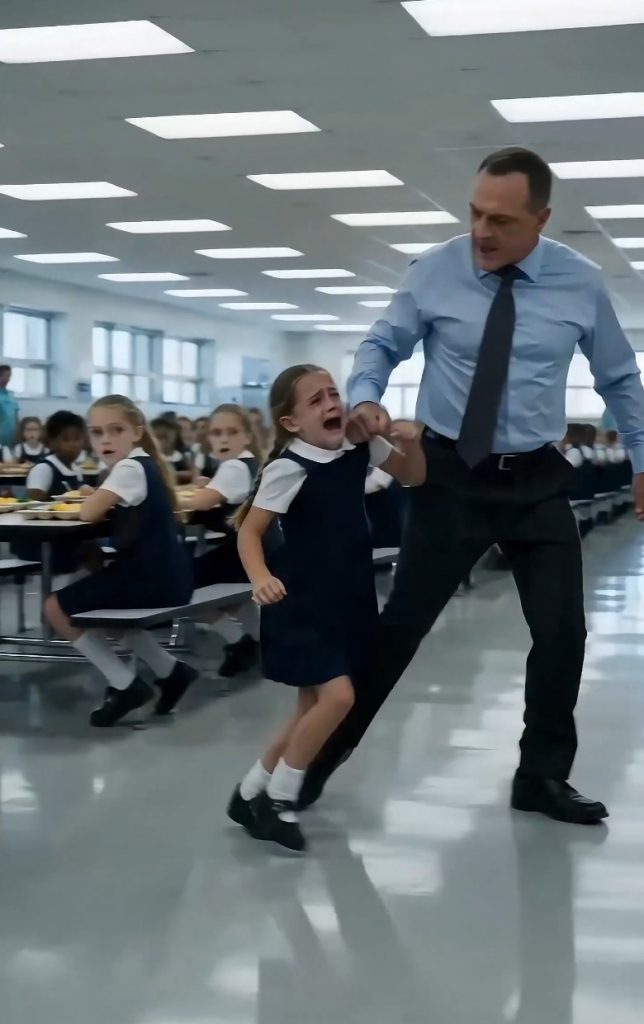
The macaroni and cheese was still warm when the principal grabbed her.
Eight-year-old Lily Turner had been sitting at the long white cafeteria table with both hands folded beside her lunch tray. A small milk carton stood unopened next to broccoli she had pushed carefully into one corner. Around her, children in navy uniforms talked softly, traded fruit cups, and tapped plastic forks against trays.
Then the room changed.
Principal Warren Pike strode between the tables in a light blue dress shirt and dark tie, his face tight with anger. He did not call Lily’s name like an adult speaking to a child.
He reached down and took hold of her collar.
“How dare you disobey me?”
Lily’s eyes went wide.
The first sound she made was not a scream.
It was a tiny broken breath, like she had already learned screaming did not help.
Then he yanked her from the bench.
Her chair scraped backward. Her milk carton toppled. The fork on her tray jumped with a plastic clatter. Every child at the table froze as Lily stumbled forward, one small hand grabbing at his wrist while he dragged her toward the serving counter.
“Please,” she cried. “I didn’t do anything.”
Principal Pike did not slow down.
His shoes struck the polished gray floor in hard, rapid steps. Lily’s feet struggled to keep up. Her navy jumper twisted at the shoulder where he held her, and her face turned red with panic and tears.
The cafeteria went silent.
No one was eating now.
Dozens of children watched as the man who gave morning announcements and smiled beside school banners dragged a crying child through the middle of lunch.
Then Mrs. Alvarez stepped out from behind the serving counter.
She was older, gray hair pinned into a bun, teal uniform shirt beneath a white apron. For twelve years, the children had known her as the lunch lady who gave extra apple slices, remembered food allergies, and called everyone baby when she forgot their names.
But when she saw Lily’s face, something in her hardened.
She moved faster than anyone expected.
“Let her go.”
Principal Pike stopped.
“This is none of your concern.”
Mrs. Alvarez reached forward and pulled Lily behind her apron.
The girl collapsed into her side, sobbing.
That was when the sleeve of Lily’s white shirt shifted.
Mrs. Alvarez looked down.
On the child’s forearm were five dark horizontal marks, lined close together, stark against her skin.
The lunch lady’s face drained of warmth.
Then filled with fire.
She leaned across the metal counter, eyes locked on the principal.
“What happened behind your office doors?”
The whole cafeteria stopped breathing.
Principal Pike’s jaw clenched.
Slowly, his hand slid into his trouser pocket.
And every child in the room understood that whatever he reached for, it was not an apology.
Act II
Lily Turner had not always been afraid of the principal.
At the beginning of the school year, she had drawn him a picture.
It showed the cafeteria, the playground, and Principal Pike standing in front of the school with a giant yellow sun above his head. He had pinned it to the office bulletin board for one week.
Her mother had been proud.
“That means you’re settling in,” Grace Turner told her, smoothing Lily’s hair before the bus arrived. “New schools take time.”
Grace worked two jobs and still looked tired in a way Lily was too young to name. She cleaned offices at night and answered phones at a dental clinic during the day. Hawthorne Elementary was supposed to be the good school. The safe school. The place with polished floors, bright classrooms, and a principal who shook parents’ hands at drop-off.
But schools can look safe from the outside.
Lily began changing in October.
She stopped asking for second helpings at dinner. She stopped sleeping with the hallway light off. She started crying on Sunday nights and saying her stomach hurt before school.
Grace asked teachers.
They said Lily was quiet.
She asked the school counselor.
The counselor said transitions were difficult.
She asked Principal Pike.
He smiled gently and told her Lily was “sensitive to correction.”
That phrase followed Lily around like a shadow.
Sensitive to correction.
It meant when she cried, adults assumed she had been disciplined.
It meant when she flinched, people called her nervous.
It meant when she said she did not want to go to the office, everyone thought she was being stubborn.
Mrs. Alvarez did not.
She had been watching Lily for weeks.
Not because she was trained in investigations. Not because anyone had asked her to. Because lunch ladies see things other adults miss.
They see which children eat too fast because food is scarce at home.
They see which children hide bruised feelings behind jokes.
They see who sits alone, who pretends not to be hungry, who goes pale when certain adults enter the cafeteria.
Lily went pale whenever Principal Pike appeared.
Two days before the cafeteria incident, Mrs. Alvarez found Lily standing near the trash cans with her lunch untouched.
“You okay, baby?”
Lily nodded too fast.
Mrs. Alvarez crouched slightly, keeping her voice soft.
“You know you can tell me if something’s wrong.”
Lily looked toward the office hallway.
Then she whispered, “He says nobody believes little kids.”
Mrs. Alvarez felt those words settle in her chest like a stone.
Before she could ask more, the bell rang.
Lily ran.
That afternoon, Mrs. Alvarez did something she had not done in years. She opened the old contacts in her phone and called Denise Hart, a former school nurse who now worked for child protective services.
“I need advice,” Mrs. Alvarez said.
Denise listened.
Then she said, “Document what you see. Do not confront him alone if you can avoid it. And if the child is in immediate danger, you act.”
Mrs. Alvarez thought about that sentence all night.
If the child is in immediate danger, you act.
At lunch the next day, Lily did not come through the line.
Mrs. Alvarez looked for her.
Nothing.
The day after that, Lily appeared again, smaller somehow, sleeves pulled down over her hands despite the warm cafeteria. She sat quietly at the table, staring at her macaroni and cheese without taking a bite.
Then Principal Pike entered.
Lily’s body changed before he touched her.
Her shoulders rose. Her chin dropped. Her fingers curled against the lunch tray.
Mrs. Alvarez saw fear move through that child like a storm through a window.
And when he grabbed her, the lunch lady stopped being a cafeteria worker.
She became the wall between Lily and whatever waited behind the office door.
Act III
Principal Pike’s hand stayed in his pocket.
Mrs. Alvarez did not move back.
Behind her, Lily clutched the white apron with both hands, crying into the fabric. The marks on her forearm were partly hidden now, but half the cafeteria had seen enough.
The principal’s eyes moved around the room.
Children stared at him.
Teachers at the far tables stood frozen.
A cafeteria aide whispered, “Oh my God.”
Pike’s face tightened.
“You are creating hysteria,” he said.
Mrs. Alvarez’s voice dropped.
“No. You did that when you dragged a child across the lunchroom.”
His hand shifted deeper into the pocket.
A few students gasped.
Then he pulled something out.
Not a weapon.
A phone.
Mrs. Alvarez’s eyes narrowed.
Principal Pike unlocked it quickly and tapped the screen.
“Security,” he said into it, voice cold. “I need assistance in the cafeteria. A staff member is interfering with student discipline.”
Lily made a small sound against Mrs. Alvarez’s apron.
Discipline.
That word again.
Mrs. Alvarez reached behind her and placed one hand gently over Lily’s shoulder.
“No one touches this child,” she said.
Pike smiled without warmth.
“You have no authority here.”
A voice from the far end of the cafeteria answered.
“She does now.”
Everyone turned.
Ms. Holloway, Lily’s second-grade teacher, stood beside the milk cooler with her phone in her hand and tears in her eyes.
“I recorded you dragging her,” she said.
The principal’s expression cracked.
Only for a second.
But Mrs. Alvarez saw it.
So did the children.
Pike straightened his tie.
“You should be very careful, Ms. Holloway.”
The teacher’s hand shook, but she did not lower the phone.
“I was careful for too long.”
Something moved through the cafeteria then.
Not courage all at once.
Courage rarely arrives that cleanly.
It came in pieces.
A fourth-grade boy whispered, “He took Marcus to his office too.”
A girl at the next table said, “And Olivia.”
Another child began crying.
A teacher near the doors stepped forward.
“Mr. Pike,” she said, voice trembling, “what is going on?”
Pike turned toward her with a look so sharp she stepped back.
Mrs. Alvarez understood then.
This was not one child.
This was a pattern protected by fear, polished floors, and the assumption that principals could not be dangerous because they wore ties and spoke at assemblies.
Lily lifted her face from the apron.
Her eyes were swollen and red.
“He took my note,” she whispered.
Mrs. Alvarez looked down.
“What note, baby?”
“The one for my mom.”
The room seemed to tilt.
Principal Pike’s jaw tightened.
Lily swallowed hard.
“I wrote that I didn’t want to go to his office anymore.”
Pike snapped, “That is enough.”
Mrs. Alvarez turned fully toward him.
“No,” she said. “It’s just beginning.”
Act IV
Security arrived, but not the way Principal Pike expected.
The first person through the cafeteria doors was not the school guard.
It was Nurse Campbell, followed by two officers and Denise Hart from child protective services. Mrs. Alvarez had called Denise the moment Pike entered the cafeteria and moved toward Lily’s table.
She had not known exactly what would happen.
But she had known enough to be ready.
Principal Pike went pale.
Denise crossed the cafeteria quickly, her eyes moving from Lily to Mrs. Alvarez to the children watching from the tables.
“Lily,” she said gently. “My name is Denise. I’m here to help.”
Lily pressed closer to Mrs. Alvarez.
Denise did not force her away.
Good, Mrs. Alvarez thought.
Someone understands.
One officer spoke quietly to Principal Pike. Another asked Ms. Holloway for the video. Nurse Campbell came to Lily’s side and crouched, careful to keep her hands visible.
“Can I look at your arm, sweetheart?”
Lily looked at Mrs. Alvarez first.
Mrs. Alvarez nodded.
Only then did Lily extend her forearm.
The nurse’s face changed, but she kept her voice calm.
“We’re going to take care of you.”
Principal Pike tried to interrupt.
“This has been blown completely out of proportion. The child has behavioral issues.”
Denise turned to him.
“Then you should have no problem explaining why multiple children appear afraid of being taken alone to your office.”
His mouth closed.
The cafeteria doors opened again.
This time, Grace Turner ran in.
She had come straight from work, her dental clinic badge still clipped to her sweater, hair half falling from its bun. She stopped when she saw Lily behind Mrs. Alvarez, pale and crying.
“Lily.”
The child broke.
“Mommy!”
Mrs. Alvarez released her carefully, and Lily ran into her mother’s arms.
Grace dropped to her knees and held her daughter so tightly the whole cafeteria seemed to exhale.
“I tried to tell you,” Lily sobbed. “He took the note.”
Grace closed her eyes, pain crossing her face.
“I’m here now. I’m here.”
Denise stepped beside them, speaking softly.
No one rushed the child.
No one told her to stop crying.
No one called her sensitive.
Across the room, Principal Pike was still trying to stand like a man in charge, but the room no longer belonged to him. His phone was in an officer’s hand. The office keys had been taken. A custodian was sent to preserve hallway camera footage. Teachers were asked to stay with their students until parents were notified.
Then a fifth-grade girl stood up.
Her tray trembled in her hands.
“He has a drawer,” she said.
Everyone looked at her.
She pointed toward the office hallway.
“In his desk. He keeps notes there. The ones kids write.”
Principal Pike’s face went blank.
Not angry.
Not defensive.
Blank.
That was worse.
Within the hour, officers opened the locked drawer in the principal’s office. Inside were folded notes, confiscated drawings, written complaints, and parent contact forms that had never been sent. Some were from Lily. Some were from children who had left the school months earlier.
Each one told the same truth in a different child’s handwriting.
I don’t want to be alone in the office.
Please call my mom.
He said I’ll be in trouble if I tell.
Mrs. Alvarez stood in the hallway when the first evidence bag came out.
She covered her mouth with one hand.
Then she lowered it, because grief could wait.
Protection could not.
Act V
By the next morning, Principal Warren Pike was gone from Hawthorne Elementary.
The district called it administrative leave.
Parents called it not enough.
Police and child protective services called it an active investigation.
The children called it, quietly, the day Mrs. Alvarez yelled.
That was how stories survive in schools. Not through official statements. Through lunch tables, whispered retellings, and the memory of one adult standing in front of a child while another adult reached into his pocket and lost control of the room.
Lily did not return to school for two weeks.
No one pushed her.
Grace stayed home with her when she could and arranged family help when she couldn’t. Denise checked in. Nurse Campbell called twice. Ms. Holloway mailed a packet of classwork with stickers on every page, not because Lily needed stickers, but because she deserved something gentle from school.
Mrs. Alvarez sent soup.
And a note.
No hurry, baby. Your seat will be here when you’re ready.
Lily kept the note under her pillow.
The investigation widened.
Once the drawer was found, more parents came forward. Children who had been called dramatic were interviewed again, this time by people trained to listen. Teachers admitted they had noticed fear but had explained it away. Staff confessed that Pike discouraged complaints, intercepted messages, and turned his office into a place children dreaded.
Nothing had been hidden perfectly.
It had simply been hidden behind authority.
That was the part that haunted Mrs. Alvarez.
She replayed every cafeteria lunch in her mind. Every child who looked down when Pike walked by. Every tray left untouched. Every sleeve pulled over a wrist.
She knew guilt could swallow a person if she let it.
Denise told her, “You acted when the moment came.”
Mrs. Alvarez answered, “I wish it had come sooner.”
“It always should have,” Denise said. “But sooner starts now.”
So Mrs. Alvarez made sure it did.
When Lily returned, the cafeteria was different.
Not in the way adults tried to make things different with banners and slogans. The tables were the same. The lights still buzzed. The broccoli was still overcooked.
But the office hallway door stayed open now.
A new rule was posted beside it: No student may be disciplined alone behind a closed door.
Another sign appeared in the cafeteria: Any student may ask to speak to a trusted adult. No note will be taken away.
Lily walked in holding her mother’s hand.
The whole cafeteria went quiet.
For one terrifying second, she thought everyone was staring because they blamed her.
Then Mrs. Alvarez stepped from behind the counter holding a tray.
Macaroni and cheese.
Broccoli.
Fruit.
Milk carton.
And beside it, two chocolate chip cookies.
Lily blinked.
“We only get one cookie,” she whispered.
Mrs. Alvarez leaned down.
“Today the rules and I are having a disagreement.”
Lily smiled.
Small.
Real.
The cafeteria did not clap. Mrs. Alvarez had warned the staff not to turn Lily into a spectacle. Instead, the children returned to their lunches slowly, giving her the ordinary thing she needed most.
A normal seat.
A normal tray.
A normal lunch.
Grace kissed the top of her daughter’s head and left only after Lily nodded.
Mrs. Alvarez stayed near the serving line, watching without hovering.
Later, when Lily brought back her tray, she paused.
“Mrs. Alvarez?”
“Yes, baby?”
“Were you scared?”
The older woman looked down at her.
“Yes.”
Lily seemed surprised.
“But you yelled.”
Mrs. Alvarez smiled sadly.
“Sometimes scared people yell the truth.”
Lily thought about that.
Then she whispered, “I was scared too.”
“I know.”
“But I told.”
Mrs. Alvarez touched one hand to her heart.
“Yes,” she said. “You did.”
The district eventually released a report full of formal language, but everyone understood the simple version. A principal had used his authority to frighten children. A system had protected his image longer than it protected them. A lunch lady saw a child’s arm, heard a child’s sob, and refused to let the title principal mean more than the word child.
Months later, Mrs. Alvarez received an award at a school board meeting.
She hated every second of it.
She stood under bright lights in her teal uniform while adults in suits praised her courage. When they handed her the plaque, she looked out into the rows and found Lily sitting with Grace.
Lily raised one hand in a tiny wave.
Mrs. Alvarez forgot the speech she had planned.
So she told the truth instead.
“I didn’t do anything special,” she said into the microphone. “I did what every adult in a school should do. I believed a child looked afraid for a reason.”
No one spoke.
Mrs. Alvarez held the plaque awkwardly against her apron.
“And if we need awards for that, then we have more work to do.”
That line made the local paper.
But Mrs. Alvarez preferred the drawing Lily gave her the next day.
It showed the cafeteria, the long white tables, and a woman in a white apron standing between a little girl and a tall man in a blue shirt.
Above them, in purple crayon, Lily had written:
Mrs. Alvarez is the door.
The lunch lady framed it and hung it in the kitchen, right beside the serving counter.
Every day after that, when students lined up for lunch, they saw it.
Some asked what it meant.
Mrs. Alvarez would glance at the drawing and say, “It means nobody gets through if they’re coming to hurt one of my kids.”
And the children believed her.
Because they had seen it happen.