Act I
“Say it again.”
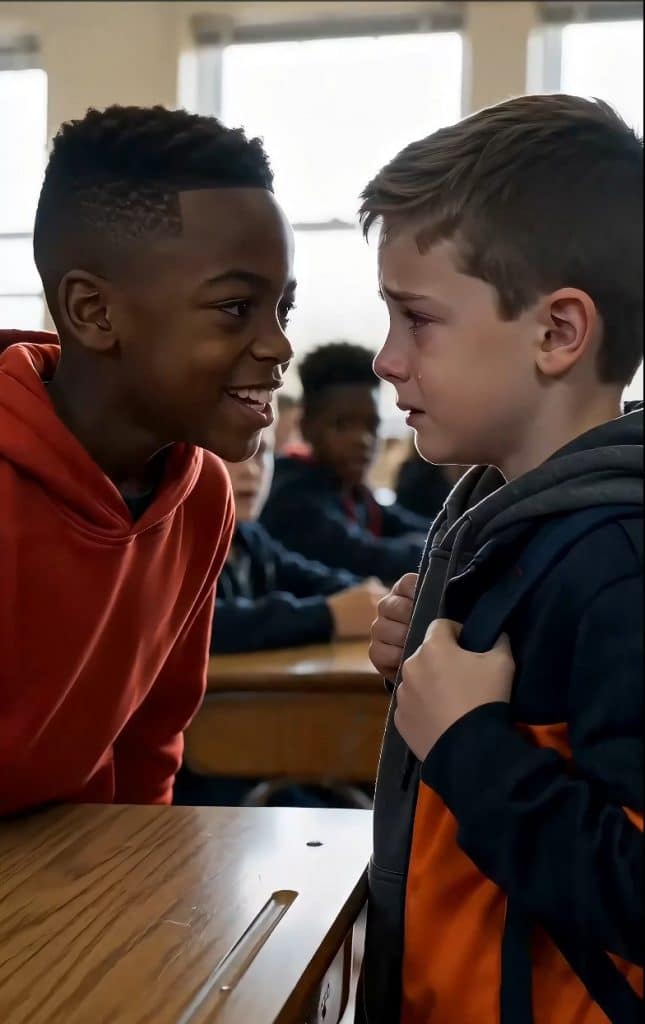
The boy in the red hoodie leaned so close that Ethan Fawcett could feel his breath on his face.
The classroom had gone quiet in that dangerous way children understand before adults do. Not silent exactly. Desks creaked. Someone whispered. A pencil rolled off the edge of a wooden desk and clicked against the floor.
But nobody moved.
Darren Cole stood over Ethan with a grin that begged the room to laugh. He was bigger than most boys in seventh grade, louder than all of them, and confident in the way kids become when they realize others are afraid to challenge them.
“Tell everybody what you said,” Darren demanded.
Ethan’s hands tightened around the straps of his backpack.
His face was already wet with tears, but he lifted his chin anyway.
“My dad’s a hero,” he said.
The words came out small.
They still carried.
A few students looked down. A girl near the chalkboard stopped smiling. Someone in the back gave an uncomfortable laugh, then swallowed it.
Darren threw his head back.
“If your dad’s a hero,” he shouted, turning toward the class like a comedian on a stage, “then my dad is Jesus!”
This time, more students laughed.
Not all of them because it was funny.
Some laughed because not laughing felt risky.
Ethan’s eyes dropped to the floor.
He hated that his hands were shaking. He hated that everyone could see. Most of all, he hated that his father’s name was being dragged through the room while he stood there too scared to make his voice bigger.
Darren’s grin faded.
Maybe the laughter wasn’t enough. Maybe Ethan’s quiet pride still bothered him. Maybe cruelty always needs to go one step further to prove it is in charge.
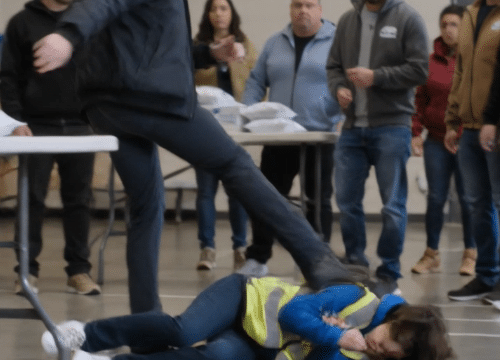
He stepped forward and slapped Ethan across the face.
The sound cracked through the classroom.
Ethan’s head snapped sideways. His backpack twisted under his shoulder. He stumbled, tried to catch himself on the edge of a desk, missed, and fell hard to the floor.
The laughter died instantly.
A few students gasped. One whispered, “Darren, stop.”
Darren stood above him, breathing fast, his red hoodie bright against the green chalkboard behind him.
Ethan lay partly tangled in his backpack, cheek stinging, eyes burning. He tried to push himself up, but humiliation pinned him down heavier than the fall.
Then the classroom door clicked open.
Every head turned.
A man stepped inside from the bright hallway.
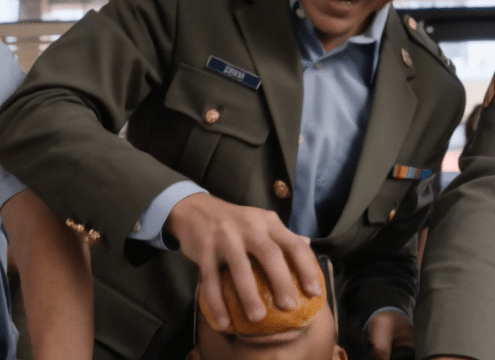
He wore a full military dress uniform. Dark jacket. White cover cap. Rows of medals and ribbons across his chest. Polished boots that struck the floor once, twice, then stopped in the center aisle.
His face was stern.
His name tag read FAWCETT.
Darren’s mouth fell open.
Ethan looked up from the floor, tears still running down his face.
And for the first time that day, the room understood that the boy had not been lying.
Act II
Ethan had not told anyone his father was coming.
He barely believed it himself.
For most of the year, Colonel Daniel Fawcett had been more rumor than person inside Ethan’s life. There were photos on the mantel. A folded flag in a wooden case from Ethan’s grandfather. Newspaper clippings his mother kept in a drawer. Medals Ethan was not allowed to touch without washing his hands first.
But the actual man had been gone.
First deployed.
Then hospitalized.
Then recovering in another state where the doctors knew how to help people relearn how to sleep without waking to sounds that were no longer there.
Ethan’s mother said his father needed time.
Ethan understood time the way children understand storms. He knew it existed. He knew he had to wait through it. But he still hated how long it lasted.
At school, absence became a target.
At first, the questions were harmless.
Where’s your dad?
Is he really in the military?
Did he ever fly a helicopter?
Then Darren heard something from someone whose older brother knew someone at the high school. Something about Ethan’s dad “coming home messed up.” Something about him being “too broken” to attend the Veterans Day assembly last year.
The teasing changed after that.
Darren called him “fake soldier boy.”
He said Ethan’s father probably polished trophies and told stories that never happened. He said real heroes came home standing tall, not hiding from middle school assemblies.
Ethan did not answer at first.
He told himself silence was stronger.
But silence, in a classroom full of children waiting to see who had power, often looks like permission.
So Darren kept going.
He knocked Ethan’s books off his desk. He saluted him in the hallway with two fingers and a smirk. He asked if Ethan’s dad had “saved the world yet” every time Ethan wore the navy-and-orange jacket Daniel had mailed him from base two years earlier.
Ethan stopped wearing the jacket for a while.
Then one morning, his father called before school.
Not a video call. Just voice.
Rougher than Ethan remembered, but still his.
“I’m coming today,” Daniel said.
Ethan sat on the edge of his bed, gripping the phone.
“To school?”
“If that’s still okay.”
The school had invited Daniel for a short talk during a civic service unit. The principal wanted the students to hear from a decorated officer, but Daniel had agreed only on the condition that Ethan could decide whether to tell people ahead of time.
Ethan had chosen not to.
He did not want Darren to ruin it before it happened.
He did not want to spend the whole morning defending something sacred.
So he carried the secret quietly.
Through math.
Through lunch.
Through the cruel little comments Darren tossed like pebbles, waiting for one to break glass.
By last period, Darren cornered him between the desks.
Someone had seen Ethan looking at an old photo of his father in uniform, tucked inside his notebook. That was enough.
Darren took the photo.
Held it up.
Laughed.
Then said, “He doesn’t look like a hero. He looks like a guy pretending for a parade.”
Ethan’s fear cracked.
“He is a hero.”
That was the sentence Darren made him repeat.
That was the sentence that brought the slap.
And now the man in the photograph stood in the doorway, real enough to turn every lie in the room to ash.
Act III
Colonel Fawcett did not rush to his son.
That was what made the moment more frightening.
He moved with control.
One step into the classroom. Then another. His boots sounded too heavy for a room full of children and wooden desks. His eyes swept the scene once: students frozen, teacher absent, boy in red hoodie standing over Ethan, Ethan on the floor with his backpack twisted beneath him.
Daniel’s jaw tightened.
“Ethan,” he said.
His voice was low.
Ethan tried to stand too quickly and winced, embarrassed by his own tears.
Daniel crossed the room then, kneeling beside his son with a carefulness that did not match the steel in his uniform.
“Are you hurt?”
Ethan shook his head.
It was not true, but it was the answer boys give when pain feels less dangerous than attention.
Daniel’s eyes moved to his cheek.
Then to Darren.
The room seemed to shrink around that look.
Darren stepped back half a pace.
“I didn’t know he was your kid,” he blurted.
The words came out before he understood what he had confessed.
Daniel helped Ethan sit upright.
Then he stood.
“You didn’t know he was my kid,” Daniel repeated.
Darren swallowed.
“I mean… I didn’t mean—”
“Yes, you did.”
The classroom was so quiet that someone’s phone buzzing in a backpack sounded loud.
Daniel turned to the class, not raising his voice.
“Who is the teacher in this room?”
A girl near the windows whispered, “Mrs. Larkin went to the office. She said she’d be right back.”
Daniel closed his eyes for one second.
When he opened them, the anger was still there, but disciplined.
That was worse.
He looked at Darren again.
“Pick up his photograph.”
Darren stared.
Daniel did not move.
“Pick it up.”
Darren bent slowly and lifted the photo from the floor where it had landed near a desk leg. His fingers trembled now. The same students who had laughed were watching him with wide, guilty eyes.
“Bring it to him,” Daniel said.
Darren stepped toward Ethan and held out the picture.
Ethan took it without looking at him.
Daniel’s voice stayed calm.
“Now apologize.”
Darren’s face tightened. Pride fought panic across it.
“Sorry,” he muttered.
Daniel’s eyes did not soften.
“That was a sound. Try an apology.”
Darren looked at Ethan, really looked at him for the first time since the bullying began.
“I’m sorry,” he said, quieter. “For hitting you. And for what I said about your dad.”
Ethan clutched the photo.
He did not answer.
He did not owe Darren comfort.
The door opened again, and Principal Meyers stepped inside with Mrs. Larkin behind her. Both women froze at the sight of Colonel Fawcett standing in the middle of the room, Ethan on the floor, Darren pale beside him, and twenty students sitting like witnesses in a courtroom.
Principal Meyers found her voice first.
“Colonel Fawcett, I’m so sorry. We were expecting you in the auditorium.”
Daniel looked at her.
“I found my son on the floor.”
No one spoke.
Then Daniel asked the question that made every adult in the room go still.
“How long has he been asking for help?”
Act IV
Ethan looked down at his backpack.
His mother had asked that question twice.
His father had asked it once over the phone.
Ethan always said he was handling it.
He thought that was what brave meant.
Handling it.
Swallowing it.
Waiting for it to hurt less.
But now his father was standing in uniform in front of everyone, not because he wanted to impress them, but because he had walked into the room at the exact moment Ethan could no longer pretend.
Mrs. Larkin covered her mouth.
Principal Meyers looked from Ethan to Darren to the students.
“Ethan,” she said gently, “has this happened before?”
Ethan’s throat tightened.
Darren stared at him with desperate warning in his eyes.
That look used to work.
It did not now.
“Yes,” Ethan whispered.
The room changed.
One word can do that when everyone already knows it is true.
Principal Meyers knelt beside him. “How many times?”
Ethan shrugged, ashamed.
Daniel crouched again, but did not touch him without asking.
“Ethan,” he said softly, “look at me.”
Ethan lifted his eyes.
“You do not protect me by letting someone hurt you.”
The sentence broke something open.
Ethan’s face crumpled.
“He said you weren’t really a hero.”
Daniel’s sternness cracked for the first time.
For a moment, he was not a decorated officer. Not a name tag. Not a row of medals. Just a father watching his child carry a wound meant for him.
He sat on the floor beside Ethan.
In full dress uniform.
In front of everyone.
“I know who I am,” Daniel said. “I needed you to know you were allowed to be safe.”
Ethan began to cry harder then, and Daniel pulled him close.
No one laughed.
Not a single student.
Darren stared at the floor, his red hoodie no longer making him look powerful. It made him look young, cornered, and suddenly aware that the room he had controlled through fear was now full of people remembering what they had allowed.
Principal Meyers stood.
“Darren, office. Now.”
Darren’s face flashed with anger again, but it died quickly when he looked at Daniel.
Mrs. Larkin opened the door.
Before Darren left, Daniel spoke.
“Wait.”
The boy stopped.
Daniel rose slowly.
“I’m not interested in scaring you,” he said. “Fear is easy. You already know how to use it.”
Darren’s eyes stayed down.
Daniel continued.
“What I want is harder. You will tell the truth. To your principal. To your parents. To every person who asks. Not the version that makes you look less cruel. The truth.”
Darren swallowed.
“Yes, sir.”
“And you will learn this now, while you are still young enough for it to matter. A person does not become strong by making someone else feel small.”
Darren said nothing.
But several students looked down as if the words had found them too.
The rest of the day did not go as planned.
There was no auditorium speech. No polite applause. No students asking prepared questions about service and sacrifice.
Instead, Principal Meyers asked Daniel if he would speak to Ethan’s class.
Just them.
Just this room.
Daniel stood in front of the green chalkboard, medals shining under classroom lights, and looked at the children who had laughed, watched, stayed silent, or wished someone else would stop what they were too afraid to stop.
“I was invited here to talk about courage,” he said.
His eyes moved briefly to Ethan.
“I thought I was going to talk about battlefields. I won’t.”
No one moved.
“Courage is not being the biggest voice in the room. It is not winning every fight. It is not never being afraid.”
He looked at the desks, at the faces.
“Sometimes courage is saying, ‘This is wrong,’ before the crowd agrees with you.”
A girl near the window began to cry quietly.
Daniel’s voice softened.
“And sometimes courage is telling someone you trust that you need help.”
Ethan looked down at the photograph in his lap.
For the first time all year, he did not feel ashamed of needing rescue.
Act V
By morning, the story had spread through the school.
Not the internet version.
There was no viral video. Principal Meyers made sure the students deleted what they had recorded and called parents before rumors could turn Ethan’s pain into entertainment.
But everyone knew something had happened.
They knew Darren had been suspended.
They knew Colonel Fawcett had walked into the classroom in full uniform.
They knew Ethan had not lied.
That last part should not have mattered as much as it did, but it did.
Middle school can be brutal that way. Truth often needs witnesses before children are allowed to keep it.
Darren’s parents came in the next day. His mother cried in the principal’s office. His father looked angry until he saw the written statements from classmates who finally admitted what they had watched for months.
Darren did not come back for a week.
When he did, he was quieter.
Not redeemed.
Not magically kind.
Just quieter in the way a person becomes when consequences make noise impossible for a while.
Ethan’s life did not transform overnight either.
His cheek healed before his trust did.
For days, he expected laughter when he entered the room. He expected Darren’s friends to whisper. Some did. Most did not. A few students apologized in awkward, clumsy ways that proved they had never practiced being brave.
“I should’ve said something,” one boy muttered near the lockers.
Ethan did not know what to say.
So he nodded.
That was enough for the first day.
Mrs. Larkin rearranged the seating chart. Principal Meyers started a reporting system that did not require students to stand alone in front of classmates and name the person hurting them. The school counselor began visiting Ethan’s class every Friday, though everyone pretended it was just part of the social studies unit.
Colonel Fawcett returned two weeks later for the speech he never gave.
This time, Ethan sat in the front row beside his mother.
Daniel walked onto the auditorium stage without dramatic music, without a spotlight, without any of the movie-like silence Ethan remembered from the classroom door.
He looked older than the photo.
That was the truth.
His shoulders were strong, but tired. His eyes held things Ethan still did not fully understand. His medals shone, but they did not make him invincible.
They made him human.
Daniel stood at the microphone.
“My son once said I was a hero,” he began.
Ethan’s face warmed as hundreds of students turned slightly toward him.
Daniel smiled faintly.
“I love him for that. But I need you to understand something. Heroes are not people who never fall. They are people who get back up, and people who help others get back up too.”
The auditorium stayed quiet.
Daniel continued.
“I have seen brave people in uniforms. I have seen brave people in hospital beds. I have seen brave people in classrooms.”
His eyes found Ethan.
“And sometimes the bravest person is the one who tells the truth while his voice is shaking.”
Ethan blinked hard.
His mother squeezed his hand.
After the assembly, Daniel did not leave right away. He stayed outside the auditorium while students passed. Some thanked him. Some saluted awkwardly. Daniel returned each greeting with patience.
Then Darren appeared.
He stood several feet away, hands in his hoodie pocket, eyes on the floor.
Ethan stiffened.
Daniel noticed but did not step between them immediately.
Darren looked at Ethan.
“I’m sorry,” he said.
Ethan stared at him.
Darren swallowed.
“I know I already said it. But I’m saying it again because Principal Meyers said the first time doesn’t count if you only did it because you were scared.”
That sounded so much like Principal Meyers that Ethan almost smiled.
Almost.
Darren looked at Colonel Fawcett.
“I’m sorry to you too.”
Daniel nodded once.
“Apologies matter when they become behavior.”
Darren nodded quickly.
“Yes, sir.”
Then he walked away.
Ethan watched him go.
“Do I have to forgive him?” he asked quietly.
Daniel crouched beside him.
“No.”
Ethan looked surprised.
Daniel’s voice was gentle.
“Forgiveness is not a homework assignment. Safety comes first. Trust comes later, if it comes at all.”
Ethan breathed out, relieved in a way he did not expect.
Months passed.
The classroom returned to ordinary things. Quizzes. Homework. Posters curling at the corners. Rain tapping against the windows. Desks scraping too loudly when students packed up.
But it never returned to what it had been.
The students remembered the day the door opened.
Not because a military officer entered.
Because the truth entered with him.
One afternoon near the end of the school year, Ethan found a younger student crying in the hallway outside the cafeteria. Two boys were laughing nearby, not touching him, just circling with words sharp enough to leave marks no adult could see.
Ethan stopped.
His heart beat hard.
For a second, he was back on the classroom floor, cheek stinging, backpack twisted beneath him.
Then he heard his father’s voice.
Courage is saying, “This is wrong,” before the crowd agrees with you.
Ethan walked over.
“Leave him alone,” he said.
The two boys turned.
One rolled his eyes. “What are you gonna do?”
Ethan’s hands shook.
But he did not back up.
“I’m going to get an adult,” he said. “And I’m going to tell the truth.”
That was enough.
The boys left, muttering.
The younger student wiped his face and looked at Ethan like he had done something impossible.
Ethan sat beside him on the floor.
“You okay?”
The boy nodded, then shook his head, then started crying harder.
Ethan stayed.
He did not give a speech.
He did not pretend everything was fine.
He simply sat there until the counselor came.
That evening, when Daniel picked him up, Ethan told him what happened.
His father listened without interrupting.
When Ethan finished, Daniel put one hand on his shoulder.
“I’m proud of you.”
Ethan looked down at his shoes.
“Were you scared when you did brave stuff?”
Daniel laughed softly.
“Every time.”
Ethan smiled.
For the first time, the word hero felt different to him.
Less like a statue.
More like a choice.
The next morning, Ethan wore the navy-and-orange jacket again.
Not because Darren was gone.
Not because everyone believed him now.
But because the jacket belonged to him. The story belonged to him. His father’s honor did not depend on a bully’s approval, and neither did his own.
When he walked into the classroom, a few students looked up.
No one laughed.
Ethan sat at his desk, placed his backpack by his chair, and took out the old photograph.
For a moment, he studied it.
His father younger. Stronger-looking. Smiling in a way Ethan barely remembered.
Then Ethan turned the photo over.
On the back, Daniel had written something after the assembly.
For Ethan, who stood up even when he was afraid.
Ethan traced the words once with his thumb.
Then he tucked the photo safely inside his notebook.
Outside the classroom, boots no longer echoed in the hallway.
The door stayed closed.
No dramatic entrance came to save the day.
But Ethan sat a little straighter anyway.
Because the day his father walked in, he had learned something more important than the fact that his dad was a hero.
He had learned that heroes do not always arrive in time to stop the first slap.
Sometimes they arrive in time to make sure it is the last.