Act I
The slap silenced the entire ballroom.
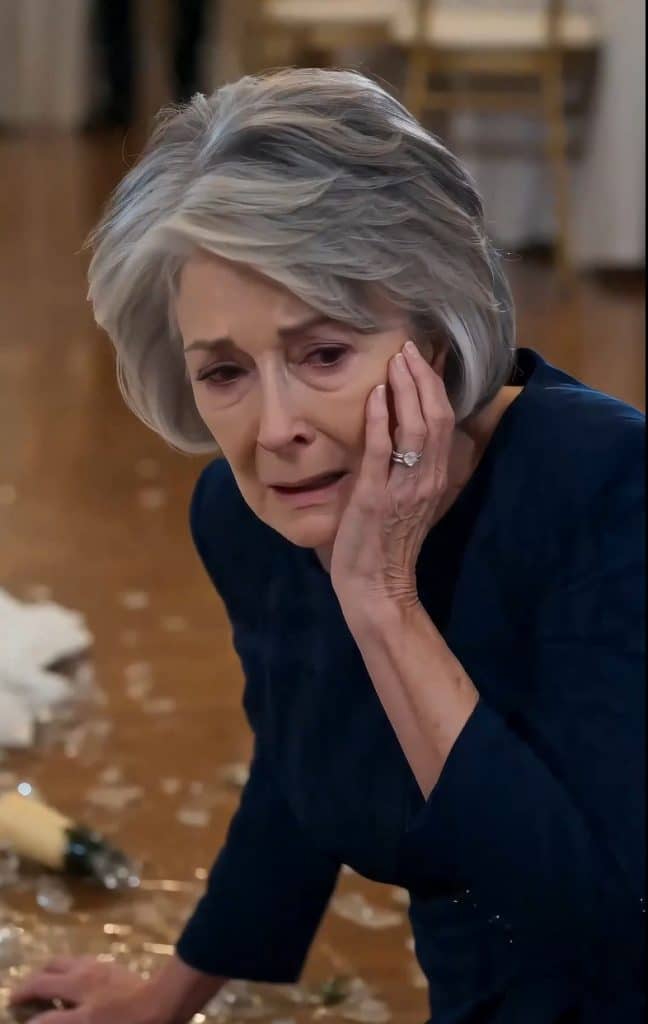
One moment, champagne glasses trembled beneath the chandelier while guests in black tie whispered over polished tables and white roses. The next, Marian Whitaker’s head turned sharply to the side, her gray hair catching the warm light as her hand flew to her cheek.
The groom stood in front of her with his palm still raised.
Preston Vale wore a white tuxedo jacket, a white bow tie, and a boutonniere pinned neatly to his lapel. He looked like a man dressed for vows.
But his face held no love.
Only rage.
Marian staggered backward, her dark blue dress brushing against the reception table behind her. Her heel slipped on the polished floor. Before anyone could reach her, she crashed into the champagne tower.
Glass collapsed in a glittering cascade.
Champagne spilled across the linen. Crystal shattered at her feet. Guests recoiled, gasping, as the elegant reception broke apart around the elderly woman now standing stunned among the wreckage.
Preston did not help her.
He stepped closer.
“Hand over the farm keys,” he snapped. “Now.”
Marian looked at him through tears.
Then she looked at her daughter.
The bride stood beside him in lace and pearls, her veil falling around her shoulders like something sacred that no longer belonged in the room. Her hands shook near her chest. Her eyes were wide, wet, terrified.
“Mom,” the bride pleaded, voice cracking. “Please, just do it.”
That wounded Marian more deeply than the slap.
For a second, she seemed unable to breathe.
Around them, guests held their phones up. No one stepped forward. No one told Preston to stop. They only watched, dressed in silk and diamonds, as a mother was humiliated at her daughter’s wedding.
Then a blonde woman in a silver off-the-shoulder gown lifted her champagne glass and sighed.
“Really, Marian,” she said coldly. “This backwoods drama is unnecessary.”
Her diamond necklace flashed under the chandelier.
Preston’s mother, Vivienne Vale, smiled without warmth.
Marian lowered her hand from her cheek.
The red mark was visible now. So were the tears. But something in her expression changed. The pain did not disappear. It hardened into something quieter.
She looked once more at her daughter.
Then at Preston.
Then at the broken champagne on the floor.
And without giving him the keys, without begging, without explaining herself to a room full of cowards, Marian turned away.
She walked toward the large wooden double doors at the far end of the ballroom.
Preston shouted after her, “Don’t you dare walk out.”
Marian kept walking.
The pianist stopped mid-note.
The guests parted for her in silence.
As the doors opened, a deep hush rolled through the ballroom, and Preston Vale stood among broken glass, still believing he had won.
He did not know the farm keys were never the real prize.
Act II
The Whitaker farm sat thirty miles outside the city, past two-lane roads, old fences, and fields that turned gold in late summer.
To Preston, it was land.
To Marian, it was a lifetime.
She had buried her husband there. Raised her daughter there. Mended fences during storms, delivered calves before sunrise, and sold vegetables from the back of a pickup when money was tight. Every inch of that place had been paid for in work, grief, and stubborn love.
Her daughter, Evelyn, once knew that.
As a little girl, Evelyn ran barefoot through the pasture and slept with barn kittens tucked under her arms. She named every apple tree and cried when the old tractor finally died. She used to tell Marian she would never leave.
Then she turned eighteen and discovered how people in the city looked at farm girls.
Preston Vale arrived in her life three years later.
He was handsome, polished, and poisonous in ways that did not show at first. He called Evelyn “different from the girls I grew up with,” and she took it as praise. He brought flowers to Marian on his first visit to the farm and shook her hand with both of his.
Marian distrusted him immediately.
Not because he was rich.
Because he looked at the house before he looked at the people inside it.
His eyes measured the barns. The acreage. The tree line beyond the west pasture. The old stone well. The locked door to the office where Marian kept her late husband’s papers.
“Beautiful place,” Preston had said.
Marian heard the hunger beneath it.
The Vale family had money, but not the kind people imagined. They had appearance. They had credit. They had a name that still opened doors because most people did not know how much debt stood behind those doors.
Vivienne Vale knew.
So did Preston.
That was why they needed the farm.
Not for sentimental reasons. Not because Evelyn loved it. Not even because it was valuable as farmland.
The Whitaker property bordered the proposed route for a private luxury resort development. If Marian sold, the developers could connect two parcels and build a full gated estate complex. If she refused, the project stayed broken into useless pieces.
For months, offers came.
Then pressure.
Then threats disguised as advice.
Preston told Evelyn that Marian was being selfish. Vivienne said the farm was “sentimental dirt” and that Evelyn deserved a better future than mud, fences, and unpaid taxes. They called Marian stubborn. Backward. Unreasonable.
But Marian never signed.
So Preston changed tactics.
He convinced Evelyn the farm was already hers in spirit. He told her marriage meant merging family futures. He said Marian could live comfortably in a smaller house after the sale, maybe even near them.
Evelyn wanted to believe him.
Love made her blind at first.
Fear kept her blind later.
The wedding had been planned at the Bellemont Grand, a ballroom so elegant it made Marian feel underdressed before she even entered. Preston insisted she bring the farm keys because, he claimed, he wanted to “include a symbolic blessing” during the toast.
Marian brought them.
But not because she trusted him.
She brought them because two weeks earlier, she found Evelyn crying in the pantry at the farm, clutching her phone, whispering, “I don’t know how to stop this.”
That was when Marian understood.
Her daughter was not choosing Preston freely anymore.
She was trapped inside the kind of life that smiles in public and threatens in private.
So Marian came to the wedding with the keys in her purse, a bruise already forming in her heart, and one final hope that Preston would reveal himself before the vows became a prison.
He did.
In front of everyone.
But what Preston did not know was that Marian had also brought something else.
A sealed envelope.
And by walking out of the ballroom, she was going to deliver it.
Act III
Evelyn found her mother in the hallway outside the ballroom.
Marian stood near a tall window overlooking the hotel garden, one hand resting against the wall, breathing slowly through the pain in her cheek. Behind the closed doors, the reception had become a low roar of panic, whispers, and damage control.
“Mom.”
Marian did not turn immediately.
Evelyn’s voice broke.
“Mom, please.”
Only then did Marian look at her.
The bride looked smaller without the crowd around her. Her veil was crooked. Mascara had gathered beneath her eyes. The pearl necklace at her throat seemed too tight.
Marian’s face softened despite everything.
“My girl,” she whispered.
That nearly destroyed Evelyn.
She covered her mouth and began to cry. “I’m sorry. I’m so sorry. I shouldn’t have said that.”
“No,” Marian said. “You were scared.”
Evelyn shook her head. “He said if you didn’t give him the keys tonight, he’d cancel the wedding and make sure everyone knew it was because you hated me.”
Marian’s eyes closed.
“He said the farm was the only way we could start over,” Evelyn continued. “He said his family had already spent too much. He said I owed him.”
Marian reached for her daughter’s hand.
“Listen to me. You do not owe a man your inheritance. You do not owe him your fear. And you never owe him your mother.”
Evelyn sobbed once.
Then the ballroom doors opened.
Preston came out with Vivienne behind him.
His cheekbones were sharp with anger. His white tuxedo jacket was still perfect, except for one drop of champagne near the cuff.
“There you are,” he said.
Marian moved Evelyn gently behind her.
Preston laughed.
“You’re going to make this worse?”
Vivienne stepped forward, her silver gown shining like ice.
“Marian, enough. You embarrassed yourself in front of two hundred people. Give my son the keys, and we can all pretend this was an emotional misunderstanding.”
Marian looked at her.
For years, people like Vivienne had mistaken politeness for weakness.
Not anymore.
“There will be no pretending,” Marian said.
Preston’s expression tightened.
“You think anyone in there cares about your little farm?”
“No,” Marian replied. “That is exactly why I invited the people who do.”
Preston frowned.
At the end of the hallway, the elevator opened.
Three people stepped out.
The first was Sheriff Daniel Mercer, still wearing his dress uniform from the ceremony because Marian had asked him to attend as a guest. The second was a woman in a dark suit carrying a leather folder. The third was an older man with silver glasses and a face Evelyn recognized from the farm office.
Marian’s attorney.
Preston looked from one to another.
“What is this?”
Marian reached into her small blue evening bag and removed the sealed envelope.
“My answer.”
The attorney took it from her with a nod and opened the flap.
Vivienne’s calm finally cracked.
“Marian, don’t be dramatic.”
The attorney read aloud.
The document was not a sale agreement.
It was a petition to place the Whitaker farm into a protected family trust and conservation easement, effective immediately upon attempted coercion, fraud, or forced transfer. Marian had signed it days before the wedding.
Preston stared.
“That’s not legal.”
The attorney looked at him over his glasses.
“It is very legal.”
The sheriff stepped forward.
“And so is assault, Mr. Vale.”
For the first time that night, Preston looked toward the ballroom doors and remembered the phones.
All those witnesses.
All those recordings.
All that polished marble and chandelier light capturing exactly who he was when he thought an old woman had no power.
Vivienne whispered, “Preston, say nothing.”
But Evelyn stepped out from behind Marian.
Her voice trembled, but she spoke clearly.
“No. Let him talk.”
And with that, the bride became the witness Preston never thought she would dare to be.
Act IV
The ballroom was no longer a wedding reception.
It was a courtroom without a judge.
When Marian walked back inside, the crowd parted again. But this time, their silence felt different. Less curious. More ashamed.
Broken glass had been swept into a glittering pile near the champagne table. A hotel worker stood beside the stain with a towel, frozen mid-cleanup as everyone turned toward the returning bride, her mother, the sheriff, and the attorney.
Preston followed last.
He looked cornered now.
That made him dangerous.
“This is insane,” he said loudly, trying to reclaim the room. “She’s manipulating everyone because she doesn’t want her daughter to be happy.”
Evelyn flinched at the old rhythm of his voice.
Marian felt it.
She took her daughter’s hand.
“No,” Evelyn said.
The word was small.
Preston turned toward her.
“What did you say?”
Evelyn lifted her chin.
“I said no.”
The room stopped breathing.
Preston’s eyes darkened. “Evelyn, don’t humiliate me.”
She almost laughed through tears.
“You slapped my mother in front of everyone.”
“She was stealing our future.”
“She was protecting me from yours.”
A murmur moved through the guests.
Vivienne stepped in quickly.
“My dear, you’re overwhelmed. This is a stressful day.”
Evelyn looked at the woman who had spent months teaching her to doubt her own instincts.
“You told me if I loved Preston, I would make my mother cooperate.”
Vivienne’s smile stiffened.
“You misunderstood.”
“You told me poor women cling to land because they have nothing else to offer.”
The crowd reacted then.
Not loudly, but enough.
Vivienne’s diamond necklace suddenly looked less like elegance and more like armor.
The attorney opened the folder again.
“For clarity,” he said, “the farm cannot be sold, transferred, mortgaged, or used as collateral by anyone other than Mrs. Whitaker. Under the new trust, it will eventually pass to Evelyn only if she chooses to preserve it. If she does not, it becomes protected community land under the Whitaker Foundation.”
Preston’s face changed.
“The what?”
Marian looked at him.
“The Whitaker Foundation.”
Vivienne went pale.
She knew the name.
Most of the room did not.
The attorney continued.
“Mrs. Whitaker’s late husband left additional assets connected to mineral leases and land rights. Those assets were never publicized. The farm is not failing, Mr. Vale. It has been quietly funding rural scholarships for eleven years.”
The guests whispered louder now.
Preston stared at Marian as if she had transformed in front of him.
All this time, he had thought she was a poor widow sitting on land she did not understand.
He had been wrong twice.
She was not poor.
And she understood everything.
Marian stepped closer, careful not to step on the last bits of glass.
“You wanted my keys because you thought everything valuable was locked in the farmhouse office.”
Preston said nothing.
“The deeds you wanted are copies,” she said. “The originals are already with my attorney.”
Vivienne gripped her champagne glass too tightly.
Marian turned to her.
“And the developer you promised my land to will be receiving notice that any offer made through intimidation will be turned over to the state attorney’s office.”
The sheriff looked at Preston.
“Along with the video of tonight.”
Preston’s mouth opened, but no words came.
Then Marian reached into her bag and removed the farm keys.
For one wild second, Preston’s eyes flashed with hope.
Marian walked to the nearest table and set them gently in front of Evelyn.
Not Preston.
Her daughter.
“These were never his to demand,” Marian said. “They were always yours to refuse.”
Evelyn looked down at the keys.
Then she removed Preston’s ring from her finger.
The diamond clicked softly against the table.
“I refuse.”
Act V
The wedding ended without a final dance.
Guests left in clusters, speaking in low voices, their phones full of footage that no public relations team could soften. The floral arch still stood. The cake remained untouched. The chandelier kept shining over a celebration that had collapsed under the weight of its own lie.
Preston was escorted out by the sheriff.
He was not dragged. He did not shout. That would have given him too much dignity. He walked stiffly between consequences, watched by people who had toasted him less than an hour earlier.
Vivienne followed, her silver gown flashing under the ballroom lights, her face carved into humiliation.
For once, she had no condescending line left.
Evelyn sat in the bridal suite afterward, still wearing the lace dress she no longer wanted to look at.
Marian sat beside her.
Neither spoke for a while.
Then Evelyn leaned forward, elbows on her knees, veil spilling across the carpet.
“I almost married him,” she whispered.
Marian’s chest tightened.
“But you didn’t.”
“I begged you to give him the keys.”
“You were trying to survive the moment.”
Evelyn looked at her mother’s cheek, where the mark still showed faintly.
“I should have protected you.”
Marian took her hand.
“You still can.”
Evelyn broke down then, not like a bride whose wedding had been ruined, but like a daughter who had finally reached the shore after nearly drowning in someone else’s control.
Marian held her.
She did not say I told you so.
Love does not need victory when the person it loves is already bleeding.
In the weeks that followed, the story spread farther than anyone expected.
Not because Preston slapped an elderly woman.
Though that was the part people replayed.
Not because the bride took off the ring.
Though that was the part people cheered.
The real reason people remembered was Marian’s walk through the double doors.
That quiet exit.
That refusal to collapse for an audience.
That moment a woman everyone underestimated chose dignity before revenge and still returned with truth sharp enough to cut through a dynasty.
Preston’s family denied everything until the recordings became impossible to dispute. The developer withdrew from the project. Vivienne’s charity board quietly removed her name from the annual gala. Preston faced charges for the assault, and several former girlfriends came forward with stories that made Evelyn understand how close she had come to becoming one more silent woman in his history.
The Vale name survived.
But it no longer frightened people the same way.
As for the farm, spring came early that year.
Evelyn returned before the apple trees bloomed.
She arrived in jeans, boots, and no ring, carrying two coffees and a shame she did not know where to put. Marian was mending a fence near the east pasture when she saw her daughter standing by the gate.
For a moment, both women froze.
Then Evelyn lifted the keys.
“I don’t know if I deserve these,” she said.
Marian walked toward her slowly.
“Deserving isn’t the question.”
Evelyn’s eyes filled.
“What is?”
“What you do with them now.”
So Evelyn stayed.
Not forever at first. Just a weekend. Then a week. Then longer.
She learned the accounts. The foundation. The land agreements. The names of the students whose scholarships had been paid by soil Preston thought was only worth selling.
She learned that her father had designed the trust before he died, but Marian had protected it quietly because she never wanted wealth to change the way people treated them.
She learned that strength sometimes looks like silence until the exact moment it needs a voice.
Months later, the ballroom felt like another life.
There was no white dress now. No champagne tower. No chandelier reflecting broken glass.
There was only Marian and Evelyn walking the west fence line at sunset, the farm keys in Evelyn’s pocket, the grass moving around their boots.
Evelyn stopped near the old barn.
“Mom?”
Marian looked at her.
“I’m sorry I didn’t believe you sooner.”
Marian watched the light settle across the fields.
Then she said, “You came home.”
It was not full forgiveness yet.
It was the beginning of it.
That was enough.
At the far edge of the property, the old farmhouse windows caught the last gold of the day. The land stretched wide and living, no longer a prize in Preston’s game, no longer a bargaining chip for a marriage built on fear.
It remained what it had always been.
Home.
And somewhere far away, in a city ballroom still remembered for the night the champagne tower shattered, people continued telling the story of the groom who slapped the bride’s mother for a set of keys.
They always ended with the same part.
He thought the keys would make him powerful.
But the woman he humiliated already knew the truth.
A key is useless in the hands of a man who has no right to open the door.