Act I
The black sedan cut across the street like the road belonged to it.
Noah Mercer saw the car too late.
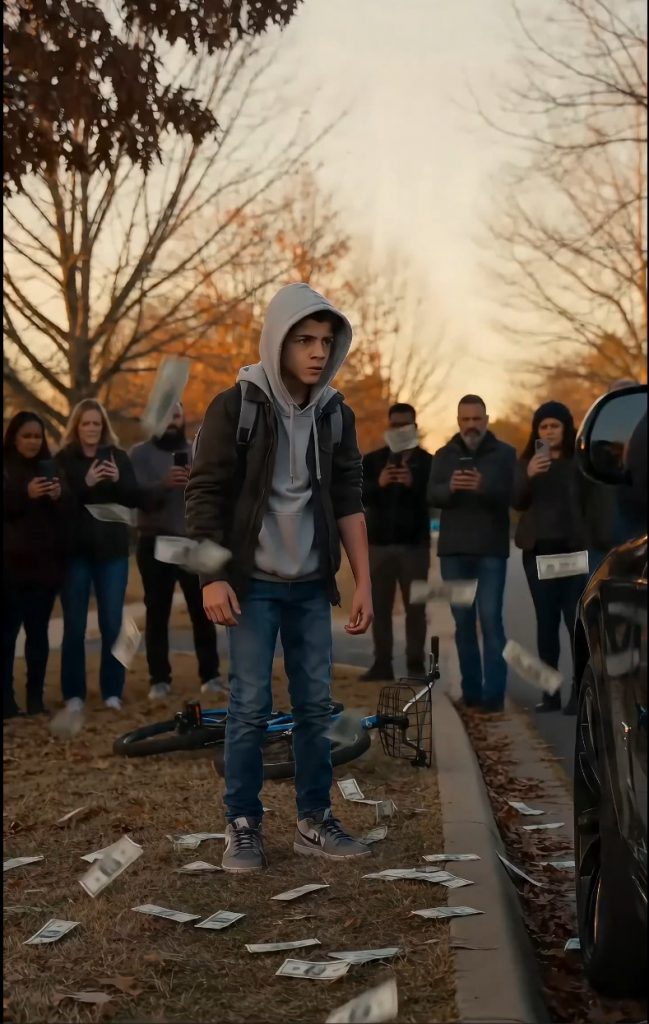
One second, he was riding his bicycle down the quiet suburban road, backpack bouncing against his shoulders, the last orange light of dusk slipping through the autumn trees. The next, polished black metal swerved toward the curb, tires screeching so sharply that every head on the sidewalk turned.
Noah yanked the handlebars.
The bike slid.
His front wheel jumped the edge of the asphalt, and he crashed hard onto the grassy verge.
For a moment, there was only the taste of dust in his mouth and the ticking spin of the bicycle wheel beside him. His left forearm burned where it had scraped the ground, and his breath came out short and stunned.
The black sedan stopped a few feet ahead.
Its window rolled down.
The man inside leaned out slowly, as if the whole thing amused him.
He was in his forties, dressed in a black suit and white shirt, gold-rimmed aviator sunglasses reflecting the sunset. A luxury watch flashed at his wrist. A wedding ring shone on one hand as he rested it casually on the window frame.
“Watch where you’re riding, kid.”
Noah looked up, still kneeling in the grass.
A few neighbors had stopped along the sidewalk. One woman lifted her phone. Two men stood by a parked car, silent. Nobody moved forward.
Noah pushed himself up, clutching his injured arm.
“You almost hit me!”
The man smiled.
“Almost doesn’t cost anything.”
Noah stared at him.
The driver reached into his suit jacket and pulled out a brown leather wallet. He made a show of opening it, sliding out a handful of cash, and shaking his head like Noah was an inconvenience he could settle with spare paper.
“Here,” he said.
Then he flung the bills out the window.
They scattered across the road, some landing in the grass near Noah’s shoes.
The man laughed.
“That bike is worth less than my tires.”
The onlookers murmured.
Noah did not bend for the money.
He stood there in his gray hoodie and dark jacket, jeans smeared with grass, backpack crooked, blood bright but shallow along his left forearm. His face was pale with pain, but something in his eyes changed.
The driver noticed.
His smile thinned.
Noah reached into his pocket with his uninjured hand and pulled out his phone.
The man’s laughter returned, louder this time.
“What, calling your daddy?”
Noah looked directly at him.
Then he tapped one number.
The line connected.
Noah’s voice was steady when he spoke.
“Mom,” he said. “It’s the same car.”
The rich man’s smirk began to die.
And from the crowd behind Noah, someone whispered, “Oh no.”
Act II
Three months earlier, Noah had stood in almost the same place with flowers in his hand.
Not for a funeral.
Not yet.
For a protest.
The neighborhood had gathered at the corner of Alder and Brook after twelve traffic complaints, four damaged fences, two injured cyclists, and one accident that put Noah’s older sister, Emily, in the hospital for six weeks.
The driver had never been charged.
Everyone knew the car.
A black luxury sedan with tinted windows and a vanity plate that people remembered because it looked like arrogance stamped in metal.
VY-1.
Victor Yates the First.
Victor Yates owned half the commercial property downtown and wanted the other half. He donated to campaigns, sponsored charity dinners, and smiled in glossy magazines beneath headlines about “revitalizing communities.” In private, he drove through neighborhoods like speed limits were suggestions for poorer people.
Noah’s family lived on Alder Street in a small blue house his father had painted twice because his mother hated how the first shade looked after sunset. Their mailbox leaned slightly. Their porch light flickered when it rained. It was not a house people like Victor Yates noticed unless they wanted the land under it.
Victor wanted it.
He had been buying properties one by one, pushing homeowners to sell before his new luxury development broke ground. Noah’s mother, Dana Mercer, had refused every offer.
Then Emily was hit.
She had been crossing on her bike after work, helmet clipped under her chin, reflective tape on her backpack. The sedan came around the bend too fast, clipped the back wheel, and kept going.
Emily survived.
Barely, at first.
She came home with a brace, a limp, and a fear of traffic she tried to hide with jokes. But what broke the family was not only the accident. It was what happened afterward.
No camera had caught the plate clearly.
The driver’s lawyers said the witnesses were confused.
Victor Yates released a statement through a spokesperson saying he had not been in the area.
Two days later, a delivery driver who had sworn he saw the black sedan changed his story.
A week later, a city maintenance camera near the corner was “unavailable due to system error.”
Noah watched his mother age five years in one month.
Dana did not scream. She did not collapse. She got organized.
She collected footage from doorbell cameras. She wrote down every complaint. She created a map of where the black sedan had been seen speeding through residential streets. She built a folder so thick Noah once joked it needed its own zip code.
But a folder was not a conviction.
Victor Yates kept driving.
Kept smiling.
Kept sending letters through his lawyers offering to buy the Mercer house “at a generous price during a difficult time.”
Noah hated him for that more than anything.
So when the sedan swerved toward him at dusk, Noah did not see a random reckless driver.
He saw the same black car.
The same gold-rimmed sunglasses.
The same man who had sent flowers to Emily’s hospital room with no signature, as if guilt could be decorative.
Now Victor was staring at Noah’s phone like he had just heard a door lock behind him.
Noah kept the call on speaker.
His mother’s voice came through thin and sharp.
“Noah? Are you hurt?”
“I’m okay,” he said, though his arm throbbed. “He cut me off. People saw it.”
Victor’s jaw tightened.
“Turn that off.”
Noah did not move.
Dana’s voice changed.
“Is it Yates?”
Noah looked at the sedan’s plate.
VY-1.
“Yes.”
The crowd shifted.
Phones rose higher.
Victor pushed open the driver’s door and stepped out, adjusting his suit jacket as if dignity could be repaired by fabric. He was taller than Noah expected. Bigger. The kind of man used to people making room before he asked.
“You’re making a mistake,” Victor said.
Noah lowered the phone slightly but did not end the call.
“No,” he said. “You made it when you came back.”
Act III
Victor looked at the onlookers first.
Not at Noah.
That told everyone who he feared more.
“Stop recording,” he snapped. “You don’t have permission to film me.”
No one stopped.
A woman near the mailbox said, “This is a public street.”
Victor turned on her.
“This is a traffic misunderstanding.”
Noah almost laughed.
His bike lay twisted in the grass. Cash fluttered near the curb. His arm was scraped and shaking. The sedan’s tire marks curved across the asphalt like a signature.
A misunderstanding.
That was how people like Victor survived.
They renamed things.
A threat became a conversation. A bribe became generosity. A hit-and-run became an unfortunate allegation. A boy on the ground became an obstacle.
Dana’s voice came through the phone again.
“Noah, listen to me. Keep him there.”
Victor’s face sharpened.
“Who is that?”
Noah answered before his mother could.
“The woman whose daughter you hit.”
The street went silent.
Victor removed his sunglasses slowly.
His eyes were cold.
“You have no idea what you’re saying.”
Noah stepped closer, still several feet away from the car.
“I know exactly what I’m saying.”
Victor pointed at him.
“You’re a child repeating things you heard from angry adults.”
“I’m the brother who watched Emily learn to walk again.”
The words landed harder than Noah expected.
Not because Victor cared.
Because the crowd did.
Faces changed.
The passive shock became something else. Recognition. Anger. Shame. People who had been filming from a safe distance began stepping closer, not enough to start a fight, but enough to make Victor look surrounded by witnesses.
A man in a baseball cap picked up one of the bills Victor had thrown and held it in the air.
“You dropped your apology,” he said.
A few people murmured.
Victor’s expression darkened.
“This is harassment.”
The woman by the mailbox laughed once.
“No. This is accountability.”
A white SUV turned onto the street at the far end.
Noah saw it and felt his knees nearly weaken with relief.
His mother was driving.
Behind her came a second car.
Then a third.
Neighbors.
People from the traffic safety group.
People who had sat in folding chairs at the community center while Dana showed them maps, photos, plate numbers, and the same black sedan appearing again and again at the edge of trouble.
Victor saw the vehicles too.
For the first time, he looked uncertain.
Dana parked crookedly near the curb and got out before the engine fully settled. She was still in her work blouse, sleeves rolled, hair pinned messily, face pale with fear until she saw Noah standing.
Then she ran to him.
She stopped just before touching his injured arm.
“Oh, sweetheart.”
“I’m okay,” he said again.
She looked at the scrape, the bike, the cash, the sedan.
Then she looked at Victor.
There was no panic left in her face.
Only the kind of anger that had been waiting patiently for proof.
“Mr. Yates,” she said.
Victor lifted his chin.
“Mrs. Mercer. I suggest you call off this little performance before it becomes defamation.”
Dana held up her phone.
“It already became evidence.”
Victor’s eyes narrowed.
Dana tapped the screen.
The video opened.
Not from tonight.
From three months ago.
Grainy doorbell footage from a house across the street, newly recovered after the owner returned from a long overseas trip and found Dana’s note in his mailbox.
The clip was not perfect.
But it was clear enough.
A black sedan. A sharp turn. A cyclist falling. Red taillights leaving.
And when the frame paused, the plate flashed for half a second.
VY-1.
Victor went still.
Noah watched the color drain from his face.
The street had finally seen what his family had known all along.
Act IV
Victor tried to leave.
That was the worst possible choice.
He turned toward the sedan, but two neighbors stepped closer to the front of the car. Not blocking him with violence. Not touching him. Simply standing there, phones raised, eyes steady.
Dana’s voice cut through the air.
“The police are already on their way.”
Victor spun back.
“You people don’t understand who you’re dealing with.”
Noah thought his mother might flinch.
She did not.
“Yes, we do,” she said. “That was the problem for too long.”
Victor looked toward the onlookers, searching for the old world where money made silence easy. But the old world had changed in the last five minutes. Too many phones. Too many witnesses. Too many people who had watched him throw cash at an injured teenager and laugh.
The young woman filming near the tree spoke up.
“I have the whole thing. Him swerving. The cash. Everything.”
“So do I,” said the man in the baseball cap.
“Me too,” said another voice.
Victor’s jaw flexed.
Then he made his second mistake.
He reached into his wallet again.
Noah saw Dana’s expression shift from fury to disbelief.
Victor pulled out a business card and held it toward her.
“Let’s be reasonable,” he said, lowering his voice. “You want medical costs covered? Fine. A private settlement can be arranged. For your daughter and for whatever this is.”
He gestured toward Noah’s arm.
Whatever this is.
Dana stared at the card.
Then she looked at the bills still scattered on the road.
“You think every injury is an invoice,” she said.
Victor’s eyes hardened.
“Everyone has a price.”
Noah stepped forward.
“My sister didn’t.”
Victor looked at him with contempt.
“You don’t know how the world works.”
Noah’s voice was quiet.
“I know how a bike sounds when it hits pavement. I know how my mom sounded when the hospital called. I know my sister stopped singing in the shower because she was scared you’d get away with it.”
Victor said nothing.
Noah’s hand tightened around his phone.
“And I know you came back to the same street because you thought nobody here mattered.”
Police lights appeared at the end of the block.
Blue and red washed over the trees, the parked cars, the fallen bike, the cash on the asphalt.
Victor watched them approach.
His confidence cracked cleanly now.
The first officer stepped out. Then another. Dana walked to them with the steadiness of someone handing over not a complaint, but a case.
She gave them the old video.
The new videos.
The names of witnesses.
The plate records.
The traffic complaint folder she had carried in her bag for weeks, just in case the truth ever needed to move quickly.
Victor tried to interrupt.
“Officer, I’m Victor Yates. I’m happy to cooperate, but this woman has been harassing—”
The officer looked past him at Noah’s bike.
Then at the cash.
Then at the recording still playing on three different phones.
“Sir,” he said, “please step away from the vehicle.”
Victor blinked.
“Excuse me?”
“Step away from the vehicle.”
The sentence was not loud.
It did not need to be.
For the first time that evening, Victor Yates obeyed someone who was not impressed by him.
Act V
Emily arrived twenty minutes later.
Noah did not want her to come, but his mother had called before he could object. She stepped out of the passenger side of a neighbor’s car with her brace hidden under wide jeans and her hand gripping the door longer than she wanted anyone to notice.
When she saw the black sedan, she stopped.
Noah understood.
For weeks after the accident, Emily could not look at black cars without freezing. She joked about it because that was what Emily did when something hurt too much to say plainly. But now there was no joke left.
The car was real.
The man was real.
And he was not driving away.
Noah crossed the street toward her.
“I’m sorry,” he said.
Emily frowned.
“For what?”
“For making you come here.”
She looked past him at Victor speaking tightly to an officer, his sunglasses gone, his suit no longer looking powerful under the flashing lights.
Emily’s face trembled.
Then she shook her head.
“No,” she said. “I needed to see this.”
Dana came to stand beside them.
For a moment, the three of them simply watched.
It was not dramatic like Noah had imagined justice would be. Nobody shouted a confession. Nobody fell to their knees. The police did not solve everything in one perfect scene beneath the autumn trees.
But Victor Yates was no longer a shadow behind lawyers.
He was a man on a public street, surrounded by witnesses, standing beside the car he had used to hurt people and the money he had used to insult them.
That mattered.
The videos spread by morning.
By noon, the local news had the story.
By evening, the first article used the phrase “pattern of reckless intimidation.” That phrase came from Dana’s folder. Noah knew because she cried when she saw it, not loudly, just one hand over her mouth at the kitchen table.
Within days, more people came forward.
A delivery cyclist. A crossing guard. A retired teacher whose mailbox had been hit by a black sedan two weeks before Emily’s accident. A father who said Victor had nearly clipped his stroller at a corner and then shouted at him for crossing too slowly.
Victor’s lawyers called it a smear campaign.
The videos made that harder to sell.
The city reopened Emily’s case.
Victor lost his development hearing pending investigation.
His company issued a statement about “taking concerns seriously,” which everyone in the neighborhood knew meant they were scared. For the first time, the offers to buy homes stopped arriving.
The bills he had thrown at Noah became part of the story too.
Someone photographed them lying in the wet grass near the fallen bike, and that image traveled farther than any legal argument. Not because the money was important.
Because everyone understood what it meant.
A rich man had looked at a hurt kid and thought cash could replace decency.
A month later, Noah’s arm had healed into a thin mark he barely noticed unless the light hit it. His bike was repaired by the man in the baseball cap, who owned a garage and refused payment.
Emily started riding again first.
Only around the block.
Only with Noah beside her.
The first time they passed the corner where she had fallen, she stopped. Her hands gripped the handlebars. Noah waited without speaking.
Then Emily took a breath and pedaled forward.
Noah rode beside her.
That was not justice either.
But it felt like recovery.
The hearing came in winter.
Victor Yates entered the municipal building in a dark overcoat, no sunglasses this time. He looked smaller indoors, away from the sedan, away from the road where he had once believed he controlled the story.
Dana spoke first.
Her voice shook in the beginning, then strengthened. She did not call him a monster. She did not exaggerate. She read dates. Locations. Complaints. Injuries. Witness statements. The facts did the work.
Emily spoke next.
She described the sound of the car leaving.
Noah stared at the table until his eyes burned.
Then it was his turn.
He walked to the microphone with his phone in his pocket and his mother’s folder in his hand.
He looked at Victor.
For a second, he was back on the grass at dusk, arm burning, cash falling around his shoes, the rich man laughing through the car window.
Then Noah looked at the board.
“He asked if I was calling my daddy,” Noah said. “I wasn’t. I was calling my mom because she told me that when people with power try to make you feel alone, the first thing you do is stop being alone.”
Dana lowered her head.
Emily reached for her hand.
Noah continued.
“He thought I wanted money for my bike. I didn’t. I wanted him to stop hurting people and calling it an accident.”
The room stayed silent.
Victor did not look up.
In the end, the consequences came in pieces.
Charges. Civil suits. Suspended licenses. Lost contracts. Public hearings. Insurance investigations. Things with paperwork, signatures, and long delays.
It was not as satisfying as a single perfect ending.
But it was real.
The neighborhood changed too.
Speed bumps appeared on Alder Street. A protected bike lane was painted near the school. The city installed cameras that actually worked. A sign went up at the corner where Emily had fallen.
Drive Like Someone Lives Here.
Noah saw it every morning.
Sometimes he still thought about the money fluttering around his shoes. How badly he had wanted to throw it back. How close he came to shouting until his throat gave out.
But the phone call had done more.
It had brought his mother, his neighbors, the witnesses, the truth.
It had turned one injured boy on the roadside into a whole street that refused to stay quiet.
Months later, Noah rode past the same bend at sunset. Leaves dragged across the asphalt. Houses glowed warmly behind their windows. Somewhere, a dog barked. Somewhere, a mother called a child in for dinner.
No black sedan came around the corner.
No one laughed.
No money fell in the grass.
Noah kept both hands on the handlebars and rode on.
The rich man had thought the boy was alone because he looked ordinary.
That was his mistake.
Ordinary people remember.
Ordinary people record.
Ordinary people answer the phone.
And when enough of them stop looking away, even the loudest engine in the neighborhood finally goes quiet.