Act I
The boy screamed before anyone understood why.
At first, it looked like an attack.
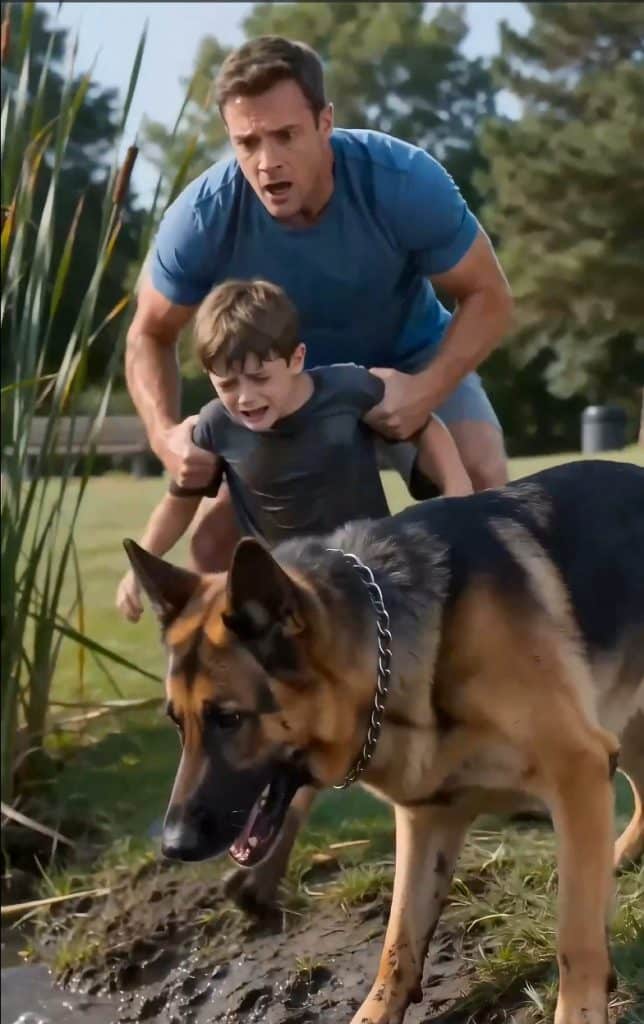
A huge black-and-tan German Shepherd came charging across the sunny park, mud flying from its paws, chain collar flashing at its neck. It hit the muddy bank near the pond with terrifying speed and lunged straight for the child in the dark gray T-shirt.
The boy was eight years old.
His name was Ethan Walsh, and one second earlier, he had been crouched near the reeds trying to retrieve a red plastic sailboat he had dropped in the water.
The next second, the dog had its mouth clamped around the front hem of his shirt.
Ethan screamed so loudly that people on the far walking path turned.
“HEY!”
His father, Mark, sprinted from the grassy slope, his blue T-shirt darkening with sweat, his gray athletic shorts streaked with dirt as he stumbled downhill toward the pond. His face twisted with panic.
“GET AWAY FROM HIM!”
The German Shepherd did not obey.
It dragged Ethan backward through the mud.
The boy kicked, sobbed, and clawed at the ground, believing with every terrified breath that the animal was hurting him. Mud smeared across his arms. His sneakers scraped deep lines into the bank. His small hands grabbed at reeds, grass, anything that might stop the pull.
But the dog did not bite skin.
It held only fabric.
It pulled again.
Harder.
Urgent.
Deliberate.
Mark was almost on them now, arm raised, ready to throw himself at the animal. All he saw was his son beneath a huge dog, screaming in the mud beside a pond that had always seemed harmless.
The dog released Ethan’s shirt.
Then it did something Mark did not expect.
It stepped over the boy and turned toward the water.
Its body lowered. Its ears pinned forward. A deep warning bark ripped from its chest, not at Ethan, not at Mark, but at the tall reeds bending over the pond.
Mark grabbed Ethan under the arms and yanked him away.
“Ethan! Ethan, look at me!”
The boy clung to him, shaking, gasping, covered in mud.
The dog barked again.
Then the pond moved.
Not a ripple.
Not wind.
The water near the reeds suddenly caved inward, churned, and exploded outward in a heavy splash. Muddy bubbles rose in thick bursts. The reeds shook as if something underneath had struck them from below.
Mark froze with his son in his arms.
The German Shepherd planted all four muddy paws between them and the pond, growling so fiercely that every person nearby stopped running.
Only then did Mark understand.
The dog had not been dragging Ethan into danger.
It had been pulling him out of it.
And whatever was beneath the reeds had almost taken his son.
Act II
Before that afternoon, Mark Walsh hated that dog.
He had seen it around Hawthorne Park for weeks, always near the pond, always watching children too closely.
It belonged to an old man named Victor Hale, a retired park groundskeeper who lived in a small brick house on the edge of the maintenance road. Victor had worked at Hawthorne for nearly thirty years before the city outsourced the job to a private landscaping company. After that, he still came every morning with the German Shepherd, walking the same paths as if the park still belonged to him.
The dog’s name was Ranger.
That name made some parents laugh.
“He’s not a ranger,” one mother had said once. “He’s a lawsuit waiting to happen.”
Mark had agreed.
Ranger was too big, too intense, too quiet until he suddenly wasn’t. He watched the pond with a focus that made people uncomfortable. If a child wandered too close to the reeds, Ranger barked until an adult pulled them back.
People complained.
Victor always gave the same answer.
“He knows that bank better than you do.”
No one listened.
To most of the parents, Victor was just an old man who didn’t understand that public parks had changed. There were picnic blankets now, yoga classes, birthday parties, drone photographers, and mothers pushing designer strollers along the path.
Nobody wanted a muddy German Shepherd ruining the peaceful view.
Mark especially did not.
He was already carrying enough fear without admitting it.
Since his divorce, weekends with Ethan had become the only part of his life that still felt like something he could do right. He planned them carefully. Pancakes on Saturday. Soccer drills in the morning. Park time if the weather was good. No phone calls from work unless absolutely necessary.
But children have a way of finding the one place adults tell them not to go.
That afternoon, Ethan brought his red plastic sailboat, the one Mark had bought from a toy store near the river. It was cheap, bright, and impossible to steer, but Ethan loved it because Mark had promised they would test it “like real sailors.”
They set it loose near the shallow edge.
For a while, everything was perfect.
Sunlight flashed across the pond. Ducks drifted near the far side. Tall reeds whispered in the breeze. Ethan laughed every time the boat spun in circles instead of sailing forward.
Then the little boat drifted toward the darker water near the reeds.
Mark was answering a work message when Ethan stepped down the muddy bank.
Just for a second.
That was all it took.
Ranger saw it first.
From across the grass, the German Shepherd’s head snapped up.
Victor turned, following the dog’s gaze.
“No,” the old man whispered.
Then Ranger ran.
By the time Mark looked up, the dog was already charging toward his son.
All Mark saw was danger with teeth.
He did not see the water tremble.
He did not see the red sailboat jerk backward against the current.
He did not see the reeds bend toward the center as if pulled by an invisible hand.
Ranger saw all of it.
And he reached Ethan first.
But once Mark saw the pond boil where his son had been kneeling, the whole park seemed to tilt into a different story.
Because Victor Hale had been warning them for years.
And everyone had called him crazy.
Act III
The first police officer arrived twelve minutes later.
By then, the pond had gone calm again.
Too calm.
That was what made the parents whisper.
The water that had churned so violently now sat flat under the afternoon sun, innocent and greenish-brown, with only a few broken reeds marking the place where something had moved. Ethan sat wrapped in a stranger’s picnic blanket on the grass, his face streaked with muddy tears.
Ranger refused to leave the bank.
Victor stood behind him, one hand on the dog’s collar, breathing hard.
Mark had apologized three times and still felt like the words were too small.
“I thought he was attacking him,” Mark said.
Victor did not look angry.
That made it worse.
“Most people do,” he said quietly.
The officer crouched near the reeds, frowning at the mud. “You said something came out of the water?”
“No,” Mark said. “Not out. Under.”
The officer looked at him.
“It was moving under the surface,” Mark said. “The water pulled inward first. Then it just… erupted.”
Victor stared at the pond.
“It wasn’t an animal.”
Everyone turned toward him.
His voice was rough, tired, and certain.
“It’s the old intake.”
The officer stood. “What intake?”
Victor’s jaw tightened.
“The drainage line under the north reeds. Built before the park renovation. They were supposed to seal it ten years ago.”
A woman nearby whispered, “Drainage line?”
Victor pointed toward the far end of the pond, where a new luxury apartment complex rose beyond the trees.
“When they built those towers, the contractors redirected stormwater through old infrastructure. City signed off. Company said it was inactive. But every time the pump cycles wrong after heavy rain, it creates suction near that bank.”
Mark looked down at Ethan.
His son was staring at the reeds, trembling.
“How many people knew?” Mark asked.
Victor’s mouth hardened.
“Enough.”
The officer did not like that answer.
“Sir, have you reported this before?”
Victor gave a humorless laugh.
“I reported it after the first dog disappeared. Then after the ducks started vanishing near the reeds. Then after a teenager got pulled waist-deep two summers ago and the city called it ‘unsafe horseplay.’”
Mark felt cold despite the sun.
“Why isn’t there a fence?”
Victor finally looked at him.
“Because a fence would mean admitting there was something to fence off.”
The words settled over the grass.
Parents began pulling their children closer. Someone called the local news. Another person filmed the reeds from a safe distance. The officer spoke into his radio with a different tone now, no longer treating it like a strange dog complaint.
Ranger barked once.
Low.
Warning.
The pond surface pulsed again.
Not as violently this time, but enough.
A slow circle widened from the reeds, pushing mud outward in a dark ring.
Ethan made a small broken sound and buried his face in Mark’s shirt.
Mark held him so tightly he could feel his own heartbeat shaking through both of them.
Then Victor said the sentence that changed everything.
“This isn’t the first child Ranger pulled out.”
Act IV
The city closed Hawthorne Pond before sunset.
Yellow tape went up around the bank. Park officers pushed people back. A crew arrived with equipment, and for the first time in years, officials in clean shoes stood in the mud where Victor had stood alone.
Mark did not leave.
Neither did Ethan.
He sat in the back of an ambulance with a blanket around his shoulders, one hand resting on Ranger’s head. The dog had finally stepped away from the reeds only after Ethan whispered, “I’m okay.”
That was the moment Mark nearly broke.
Because Ethan had stopped fearing the dog before Mark had forgiven himself.
Victor sat on the ambulance step beside them, his old hands wrapped around Ranger’s chain collar. He looked older now than he had that morning, as if being believed had exhausted him more than being ignored.
Mark turned to him.
“What did you mean?” he asked. “About another child?”
Victor looked toward the pond.
For a long moment, he said nothing.
Then he spoke.
“Her name was Lily Mercer.”
The name meant nothing to Mark, but it meant something to one of the paramedics. Her expression changed. She looked away.
“She was six,” Victor said. “Seven years ago. Before your apartments went up, before the fancy signs and the new benches. She slipped near the reeds during a birthday party.”
Mark’s throat tightened.
Victor quickly shook his head, as if stopping the story from going somewhere too dark.
“She survived,” he said. “Barely. My old dog, Samson, pulled her jacket until her father reached her. Same place. Same kind of current.”
Ethan looked up.
“Like Ranger did?”
Victor nodded.
“Samson was Ranger’s father.”
The boy’s muddy fingers curled gently into Ranger’s fur.
Victor continued.
“After that, I pushed for the intake to be sealed. The city promised a review. The developer promised repairs. Then the report disappeared. I retired. They told everyone the pond was safe.”
Mark stared at the water.
All afternoon, he had thought the danger was wild, mysterious, unknowable.
But it was worse than that.
It was paperwork.
It was neglect.
It was adults choosing convenience until a child paid the price.
A black SUV pulled up near the park path. A woman stepped out in heels unsuited for mud, followed by two men in city jackets. She introduced herself to the officer as Deputy Parks Commissioner Elaine Porter.
Victor’s face changed when he saw her.
Mark noticed.
“You know her?”
“She signed the closure denial,” Victor said.
Porter approached with a practiced expression of concern.
“We’re very relieved the child is safe,” she said. “This appears to have been an unfortunate animal-related incident combined with unstable shoreline conditions.”
Mark stood slowly.
“No.”
Porter blinked.
“I’m sorry?”
“It wasn’t an animal incident.”
Her eyes flicked to Ranger.
Mark stepped between her and the dog.
“The dog saved my son.”
A camera phone was already recording.
Porter lowered her voice. “Sir, I understand you’re upset, but we need verified information before assigning—”
“The water pulled him.”
The words came from Ethan.
Small.
Shaking.
But clear.
Everyone turned.
Ethan looked at the woman in the clean shoes.
“My boat got stuck,” he said. “Then the water pulled it down. Then it pulled my hand. Ranger pulled me away.”
Porter’s face tightened.
Victor reached into the pocket of his old jacket and took out a worn folder sealed in a plastic bag.
Mark stared at it.
Victor handed it to the officer.
“Copies of every report I filed,” he said. “Photos. Dates. Names. Maintenance maps. And the letter your office sent me saying further warnings would be considered harassment.”
The officer opened the folder.
Porter went pale.
The pond behind them began to churn again, louder this time, as if the hidden machine beneath the reeds had chosen that exact moment to testify.
And for once, the whole park was watching.
Act V
By morning, Hawthorne Park was on every local channel.
But the headline was wrong at first.
Dog Attacks Boy Near Pond.
Mark saw it on his phone while sitting beside Ethan at the kitchen table. His son had barely slept. Mud still clung under his fingernails despite two baths, and every time water moved in the sink, his shoulders jumped.
Mark looked at the headline and felt something hard settle inside him.
He called the station.
Then he called another.
Then he sent the video.
Not the edited clip of Ranger dragging Ethan through the mud.
The full video.
The one that showed the dog pulling Ethan away from the waterline.
The one that showed Ranger releasing him and turning toward the reeds.
The one that showed the pond exploding seconds later in the exact place Ethan had been.
By noon, the headline changed.
Dog Saves Boy From Hidden Pond Hazard.
By evening, the story had become bigger than one rescue.
Reporters found Victor’s complaints. Parents found old city meeting minutes. A former maintenance worker came forward and admitted the intake system had failed inspections twice, but repairs were delayed because closing the pond would have hurt the opening season for the apartment complex nearby.
Elaine Porter resigned before the investigation finished.
The developer denied everything until the maintenance maps in Victor’s folder appeared on television.
Then no one denied much of anything.
Divers and engineers eventually confirmed the truth in careful official language. Beneath the reeds was an old drainage intake connected to a faulty pump system that could create sudden dangerous suction after certain pressure changes.
To Mark, the explanation sounded too clean.
Too technical.
Too late.
His son could have disappeared into a sentence like that.
A “hazard.”
A “failure.”
An “incident.”
But Ethan knew the simpler truth.
“The pond tried to grab me,” he told his mother that night.
And then, after a pause, “Ranger grabbed me first.”
The city built a barrier around the pond within a week.
Real fencing.
Warning signs.
Emergency shutoff systems.
A full investigation followed, and Victor Hale, the old man they had dismissed for years, was invited to speak at the city council hearing.
He brought Ranger.
The room was packed.
Parents stood along the walls. Reporters lined the back. Mark sat in the second row with Ethan beside him, the boy’s hand resting in Ranger’s fur.
Victor walked to the microphone slowly.
For a moment, he only looked at the officials seated above him.
Then he said, “You called my dog dangerous because he reacted to danger faster than you did.”
No one interrupted.
“You called me difficult because I kept warning you after you decided silence was cheaper than repairs.”
Still, no one interrupted.
Victor’s hand tightened around the leash.
“That dog did not save Ethan because he was trained by the city. He saved him because animals remember what people pretend to forget.”
Mark looked down at Ethan.
The boy was crying quietly.
Not from fear this time.
From recognition.
When the hearing ended, Mark knelt in front of Victor in the hallway.
“I owe you more than an apology,” he said.
Victor shook his head.
“No. You owe him a good life.”
He nodded toward Ethan.
Then, after a pause, he looked at Ranger.
“And maybe a steak.”
Ethan smiled for the first time since the pond.
It was small, but it was real.
Weeks passed.
The mud dried from Ethan’s shoes, but Mark never washed the torn gray T-shirt. He folded it and placed it in a box with the little red sailboat, which workers had found wedged against the old intake grate after the pond was drained.
Ethan asked once why he kept it.
Mark said, “Because sometimes proof looks like something broken.”
The park changed after that.
The pond bank was rebuilt. The reeds were cut back. The old intake was sealed under public supervision, with cameras, inspectors, and enough angry parents watching to make sure no one hid behind paperwork again.
A small sign appeared near the new fence.
It did not mention lawsuits.
It did not mention city negligence.
It simply read:
In honor of Ranger, whose courage saved a child’s life.
The first time Ethan saw it, he stood very still.
Ranger sat beside him, tail brushing the grass.
“You’re famous,” Ethan whispered.
Ranger leaned against his leg.
Mark stood behind them, remembering the terrible moment when he had run toward the dog with anger in his chest, thinking he was saving his son from the very creature already doing it.
That shame had not fully left him.
Maybe it never would.
But it had become something useful.
Now, whenever someone in the park pulled their child closer because Ranger looked too big or too intense, Mark told them the story. He told them about the shirt, the mud, the water, the reeds. He told them how the dog placed himself between a boy and a danger no one else could see.
He always ended the same way.
“I thought he was attacking my son,” Mark would say. “He was the only one protecting him.”
One late afternoon, months after the rescue, Ethan returned to Hawthorne Park with a new sailboat.
This one was blue.
He did not take it near the reeds. He placed it carefully in the shallow model pond the city had built for children on the safe side of the field. Ranger watched from the grass, ears alert, eyes scanning everything.
Ethan looked back at him.
“It’s okay,” he said softly. “This water’s safe.”
Ranger did not move.
Not at first.
Then he lowered his head onto his paws, still watching, still guarding, because heroes do not stop being heroes just because the danger has passed.
Mark sat beside Victor on the bench.
The sun moved through the trees. Children laughed in the distance. The park looked peaceful again.
But not innocent.
Never innocent.
Because the truth of that day remained under everything, like the sealed concrete beneath the reeds.
A boy screamed.
A father misunderstood.
A dog refused to let go.
And somewhere beneath calm water, a hidden danger reached for a child and missed only because a German Shepherd knew the difference between fear and warning before any human did.