Act I
The rain was so loud that Nathan Reed almost didn’t hear the first slap against the window.
He was sitting in the driver’s seat of a blue sedan on the side of a gray suburban road, one hand still on the steering wheel, the other hovering over a message he had not yet sent. Water streamed down the windshield in thick, nervous lines. The wipers dragged back and forth, losing their fight against the storm.
Then came the second slap.
Harder.
Nathan turned.
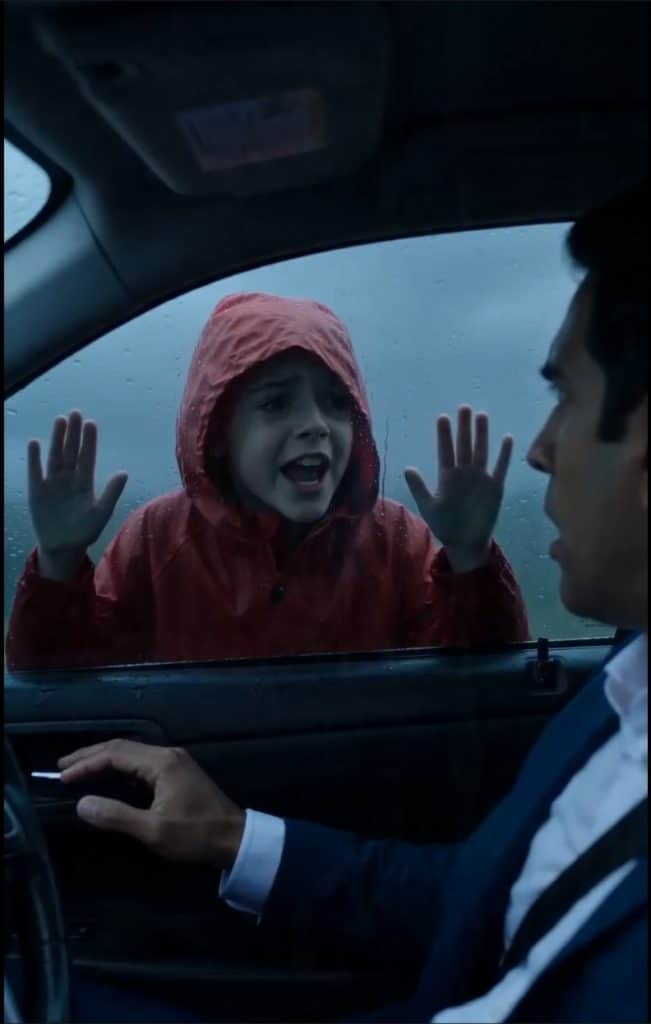
A little girl stood outside the passenger-side window in a bright red raincoat, both palms pressed to the glass, her hood trembling under the downpour.
“Sir!” she screamed, her voice muffled by the rain and the closed window. “Get out of this car now!”
Nathan stared at her.
She could not have been more than seven. Her cheeks were wet, her eyes wide with a kind of fear no child should know. She slapped the window again, so hard her sleeves stuck to the glass.
Nathan looked past her toward the empty roadside.
No adult. No stranded car. No obvious accident. Just rain, blurred headlights in the distance, and a child who seemed to have appeared out of the storm.
He lowered the passenger window.
The moment the glass slid down, cold rain rushed into the cabin.
“What?” he shouted over the storm. “What are you talking about?”
The girl leaned toward the opening, breathless and shaking.
“Your car’s going to explode in two minutes!”
Nathan froze.
For one absurd second, he almost laughed. Not because it was funny, but because his mind refused to accept it. He was a rational man. A lawyer. A man who built arguments from evidence and destroyed panic with facts.
But the girl was not pretending.
She pointed down the road with her whole arm, her red sleeve cutting through the gray rain.
“I saw it! Under the car! You have to go!”
Thunder cracked somewhere beyond the trees.
Nathan looked in the direction she was pointing. At first, he saw nothing but the silver curtain of rain.
Then came a low, muffled boom.
Not thunder.
Something deeper.
Something wrong.
The girl screamed one word.
“GO!”
Nathan’s hand tightened on the steering wheel. His pulse slammed in his throat. The car suddenly felt too small, too warm, too sealed around him.
He threw open the driver’s-side door.
Rain hit him like a wall.
His shoes splashed onto the wet asphalt, his navy suit soaking instantly as he stumbled out. The girl was already moving, waving him away from the sedan, her tiny figure fierce against the storm.
“Run!” she shouted.
Nathan ran.
He did not know from what. He did not know why. He only knew that a child in a red raincoat had looked him in the eyes and spoken with the certainty of someone who had already watched disaster happen once.
And behind them, the blue sedan sat alone in the rain.
Waiting.
Act II
Nathan Reed had not meant to stop on that road.
He was supposed to be downtown by noon, standing in front of a federal safety board with a sealed file in his briefcase and a decision that could destroy the company that had made him rich.
For twelve years, Nathan had been the clean face of Hartwell Motors.
He was not an engineer. He did not design engines or test fuel lines or crawl beneath cars with grease on his hands. He was the legal architect, the man who made ugly problems look manageable. He wrote statements. He buried liability in careful language. He made juries believe corporations had hearts.
He used to be proud of it.
Then the letters started arriving.
The first one came six months earlier, folded into a plain white envelope with no return address.
Mr. Reed, there is a flaw in the V-17 fuel system. People will get hurt if you keep pretending the reports are incomplete.
He almost threw it away.
Anonymous warnings were common in his world. Angry ex-employees. Competitors. People who wanted money. People who wanted revenge.
But the second letter included internal test numbers that had never been released.
The third included photographs.
The fourth included a name.
Elena Morales.
Nathan remembered Elena. Everyone in the legal department did.
She had been a safety technician at Hartwell’s private testing facility. Quiet. Brilliant. Stubborn in a way executives found inconvenient. She had raised concerns about the blue sedan model months before launch, insisting that under certain conditions, a cracked fuel connector could turn a routine electrical fault into a catastrophe.
Hartwell buried her report.
Then Elena disappeared from the company.
The official version was clean. Personal reasons. Resignation. No wrongdoing.
Nathan signed off on the public statement himself.
He told himself he was only doing his job.
But guilt has a way of learning your schedule.
By the time the final letter arrived, Nathan could no longer sleep through the night. It was not typed like the others. It was handwritten, uneven, and smeared at the corner like someone had cried over it.
My mother was right. Please don’t let them say she lied.
There was no signature.
Only a small red sticker of a ladybug pressed at the bottom of the page.
Nathan had stared at it for a long time.
That morning, he had packed the letters, the internal memos, and the hidden test results into his briefcase. He planned to deliver them to the board, admit what he knew, and accept whatever came next.
Then his phone rang.
The voice on the other end was calm, familiar, and cold.
“Turn around, Nathan.”
It was Victor Hartwell, founder of the company, a man whose smiling portrait hung in dealerships across the country.
Nathan pulled over beneath the storm-dark sky, heart pounding.
“I’m done,” Nathan said.
Victor sighed like a disappointed father.
“You don’t understand what done means.”
The call ended.
A minute later, Nathan noticed the warning light on the dashboard.
Then the engine made a strange low hum.
Then a little girl in a red raincoat began pounding on his passenger window.
Now he was running through the rain with her.
The boom came behind them before they reached the ditch.
Nathan grabbed the girl by the shoulder and pulled her down behind a low concrete barrier as a bright flash opened in the rain behind them. Heat rolled across the roadside for one breath, then vanished into the downpour.
The sound hit after.
A heavy, violent crack that shook water from the trees.
Nathan covered the girl with his body until the echo faded.
When he looked back, the blue sedan was no longer just a car.
It was proof.
The girl was crying now, but not like a frightened child who had imagined danger.
She cried like someone whose worst memory had returned wearing a different face.
Nathan crouched in front of her.
“What’s your name?” he asked, voice shaking.
She wiped rain from her face with one sleeve.
“Mia.”
Nathan went still.
There had been a name in Elena Morales’s employee file.
One dependent.
One daughter.
Mia Morales.
Nathan looked at the child who had just saved his life, and the storm around him seemed to fall silent.
Because suddenly, he knew exactly who she was.
Act III
The police arrived first.
Then the fire trucks.
Then the black corporate SUV Nathan recognized before it even stopped moving.
Hartwell’s people had always been fast when evidence needed managing.
Mia stood wrapped in a foil blanket beside a patrol car, her red hood pushed back, wet curls stuck to her forehead. She refused to let go of Nathan’s sleeve.
Every time someone moved toward the burned-out sedan, she flinched.
Nathan stayed beside her.
He had spent years standing on the wrong side of frightened people. For the first time in his life, he understood how small they must have felt looking up at men like him.
A detective asked him what happened.
Nathan opened his mouth.
Before he could answer, a tall man in a charcoal overcoat stepped between them.
Victor Hartwell smiled through the rain.
“Nathan,” he said softly. “Thank God you’re alive.”
The words sounded warm.
His eyes did not.
Nathan looked at the SUV behind him. Two company security men stood near it, pretending not to watch the police. One of them had a tablet. The other kept glancing toward Mia.
Nathan shifted so the girl stood behind him.
Victor noticed.
His smile thinned.
“And who is this?”
Mia’s fingers tightened around Nathan’s sleeve.
Nathan’s answer came slowly.
“Elena Morales’s daughter.”
For the first time, Victor Hartwell’s face changed.
Only a flicker.
But Nathan saw it.
Victor turned his attention to the child, and his voice became gentle in the way powerful men sound gentle when they want witnesses to doubt themselves.
“You poor thing,” he said. “You must be very confused.”
Mia shook her head.
“I’m not confused.”
Victor crouched slightly, not enough to ruin the crease in his coat.
“Children sometimes misunderstand what they see.”
“She saw enough,” Nathan said.
Victor stood.
The warmth disappeared.
“Nathan, you’ve been under pressure. You were in shock. Let professionals handle this before you say something reckless.”
That word landed exactly where Victor wanted it to.
Reckless.
Nathan had used the same word in settlements. Reckless claims. Reckless accusations. Reckless grief from people who had lost too much and had no polished language left.
He hated how familiar it sounded.
The detective looked between them.
“You two know each other?”
Nathan nodded.
“He owns the company that made that car.”
Victor gave a soft laugh.
“Owned by shareholders, technically.”
“And he knew the fuel system was defective.”
The rain seemed to sharpen.
Victor’s eyes locked on Nathan.
“Nathan.”
It was a warning.
For years, that single word had been enough.
Not anymore.
Nathan reached for his briefcase.
It was gone.
His stomach dropped.
He turned toward the roadside where he had left the driver’s door open. The car was ruined now, soaked and smoking under the rain. The briefcase had been in the passenger footwell.
Victor followed his gaze.
A small smile touched his mouth.
Mia tugged Nathan’s sleeve.
“Not there,” she whispered.
Nathan looked down.
“What?”
She glanced toward the ditch beyond the barrier.
“I took it before I knocked.”
Nathan stared at her.
Mia swallowed, still shaking.
“I saw the man put something under your car. Then I saw your bag on the floor when I looked through the window. Mom always said grown-ups don’t listen unless paper talks.”
Nathan could not speak.
Mia pointed toward the muddy ditch where a soaked black briefcase lay half-hidden beneath wet grass.
Victor saw it too.
His face hardened.
One of his security men moved.
“Stop,” the detective ordered.
The man froze.
Nathan walked to the ditch, picked up the briefcase, and carried it back through the rain.
The lock was damaged, but the file inside had survived in a waterproof sleeve.
Victor’s voice dropped low enough that only Nathan could hear.
“Think carefully. That file ruins more than me.”
Nathan looked at Mia.
Small. Shivering. Brave beyond anything a child should ever have to be.
Then he looked back at Victor.
“No,” Nathan said. “It ruins what you built.”
And for the first time in twelve years, Nathan Reed opened the file in public.
Act IV
The first page was enough to change the mood of the road.
The detective took it from Nathan’s hand and read in silence. His expression tightened. Then he called another officer over. Then a federal investigator, already en route because of Nathan’s scheduled testimony, was contacted directly from the scene.
Victor Hartwell stopped smiling entirely.
The file contained what the company had denied for months: internal test failures, suppressed warnings, altered inspection dates, and a memo ordering legal review before safety review.
Nathan’s signature was on some of it.
He did not hide from that.
When the detective looked at him, Nathan said, “I helped bury the early complaints.”
Mia looked up at him.
Not with hatred.
With something worse.
Disappointment.
Nathan forced himself to keep going.
“I told myself the engineers were divided. I told myself the risk was theoretical. I told myself it was my job to protect the company until the facts were certain.”
His voice broke.
“They were certain. I just didn’t want to pay the price of knowing.”
Victor scoffed.
“A dramatic confession in the rain doesn’t make you noble.”
Nathan turned to him.
“I’m not trying to be noble.”
“Then what are you trying to be?”
Nathan looked at Mia again.
“Useful.”
That word hung there.
Victor’s security men were separated from him. The detective asked for their phones. One refused until another officer stepped closer. The roadside, once chaotic with flashing lights and rain, began to settle into something colder.
Procedure.
Evidence.
Consequences.
Then Mia spoke.
“My mom had another file.”
Every adult turned.
Victor’s eyes narrowed.
Nathan crouched to her level.
“What do you mean?”
Mia pulled the red raincoat tighter around herself.
“She said if anything happened, I had to remember the ladybug.”
Nathan thought of the sticker on the letter.
The small red ladybug at the bottom.
Mia reached into the inside pocket of her raincoat and pulled out a tiny plastic keychain. It was shaped like a ladybug, scratched from years of being held in a child’s hand.
“My mom gave me this before she went to the hearing,” Mia said.
Nathan’s chest tightened.
“What hearing?”
Victor spoke sharply.
“She’s a child. She doesn’t know what she’s saying.”
Mia looked at him then.
Really looked.
For all his money, all his lawyers, all his polished authority, Victor Hartwell could not make that little girl look away.
“She said you would say that.”
The detective held out his hand gently.
Mia placed the keychain in his palm.
It was not just a toy.
Inside the plastic shell was a microSD card.
The federal investigator arrived seventeen minutes later.
By then, Victor Hartwell was no longer giving orders.
He was making calls no one answered.
The card was loaded into a secure device inside a patrol vehicle. Nathan stood outside, rain running down his face, while the investigator listened through headphones.
He watched the man’s expression change.
First concentration.
Then disbelief.
Then anger.
When the investigator stepped out, he looked directly at Victor.
“Mr. Hartwell, we need you to remain on scene.”
Victor’s voice turned icy.
“On what grounds?”
The investigator held up the tiny ladybug keychain.
“On the grounds that Elena Morales recorded her final meeting with your legal and engineering teams.”
Nathan felt the blood drain from his face.
Elena’s final meeting.
The one Hartwell claimed never happened.
The one Nathan had been told was canceled.
The one after which Elena’s warnings were dismissed, her reputation quietly damaged, and her daughter left carrying a truth no one believed.
The investigator continued.
“She named the defect. She named the altered report. And she named the people who pressured her to withdraw her findings.”
Victor looked at Nathan.
This time, there was no threat left in his eyes.
Only calculation.
Then fear.
Mia whispered, “My mom wasn’t lying.”
Nathan knelt in front of her, rain-soaked and ashamed.
“No,” he said. “She wasn’t.”
Mia’s chin trembled.
“Then why didn’t anyone listen?”
Nathan had defended himself from judges, journalists, grieving families, and his own conscience.
But he had no defense against that.
Only the truth.
“Because people like me made it easier not to.”
Act V
By evening, the storm had softened into a cold drizzle.
The road was still blocked. The blue sedan was covered. Investigators moved around it carefully, photographing, measuring, collecting what the rain had not washed away.
Victor Hartwell left in the back of an unmarked vehicle, not handcuffed in front of cameras, not dragged dramatically through the mud, but stripped of the one thing he had valued most.
Control.
Nathan watched him go without satisfaction.
Justice did not feel like victory when it arrived late.
Mia sat in the ambulance with a blanket around her shoulders and a cup of hot chocolate untouched in her hands. A social worker had been called. So had her aunt, who lived two towns over and had been searching for her since Mia slipped out after seeing the company SUV pass their street.
She had followed it in the rain.
A seven-year-old girl had followed the men her mother feared because no adult had moved fast enough.
Nathan stood near the ambulance doors.
“I’m sorry,” he said.
Mia looked at him.
“You said that already.”
“I know.”
“Does saying it fix anything?”
“No.”
She nodded like she had expected that answer.
For a while, neither of them spoke.
Then Nathan reached into his coat and pulled out the envelope with the ladybug sticker. The final letter. The one written in a child’s uneven hand.
“I think this was from you,” he said.
Mia took it carefully.
“My aunt helped me mail it.”
Nathan’s throat tightened.
“You saved my life today.”
Mia looked past him toward the covered sedan.
“My mom tried to save lots of people.”
“Yes,” Nathan said. “She did.”
This time, Mia’s eyes filled with tears.
“And they called her crazy.”
Nathan lowered his head.
“I know.”
“Will they still say that?”
“No.”
The answer came faster than any he had given that day, because for once, he was certain.
“No,” he repeated. “They’ll know she was right.”
The federal investigation became national news within forty-eight hours.
Not because Nathan wanted attention. He didn’t. He gave his statement, turned over every document, and resigned before the board could ask him to. His name appeared in headlines beside words like cover-up, testimony, negligence, and whistleblower.
He did not argue with any of them.
He deserved worse than print.
But Elena Morales’s name appeared too.
That mattered more.
Her recording forced Hartwell Motors to admit the defect publicly. Thousands of vehicles were recalled. Families who had been dismissed received calls from investigators instead of corporate lawyers. Engineers who had been pressured into silence came forward with their own records.
Victor Hartwell’s empire did not collapse in one dramatic night.
It cracked.
Then the cracks spread.
And at the center of it all was not Nathan Reed, or the ruined sedan, or the men in suits who thought they could bury danger beneath paperwork.
It was a little girl in a red raincoat who had remembered what her mother told her.
Grown-ups don’t listen unless paper talks.
Three months later, Nathan attended the dedication of a safety research fund created in Elena Morales’s name. He stood at the back of the room, away from the cameras, while Mia sat in the front row beside her aunt.
She looked smaller without the storm around her.
Just a child in a blue dress, swinging her feet beneath a chair, holding the ladybug keychain in both hands.
When her aunt spoke, the room listened.
When Elena’s final report was displayed on the screen, no one called it incomplete.
When Mia walked up to place a framed photo of her mother beside the podium, every person stood.
Nathan stood too.
Not because applause could repair what had been done.
Because silence had done enough damage.
After the ceremony, Mia found him near the exit.
“You look sad,” she said.
Nathan gave a small, tired smile.
“I probably am.”
“My aunt says sad is okay if it makes you tell the truth next time.”
Nathan looked down at her, stunned again by the simple force of her.
“She’s right.”
Mia held out the ladybug keychain.
For a second, he thought she was giving it to him.
Instead, she opened her palm just enough to show it.
“I’m keeping it,” she said.
“You should.”
“She said it was for emergencies.”
Nathan nodded.
“It was.”
Mia looked toward the rain tapping softly against the building windows.
Then she said, “I don’t like storms anymore.”
Nathan crouched so he was not towering over her.
“I don’t either.”
For the first time, Mia almost smiled.
Then her aunt called her name, and she ran back, the keychain closed tight in her hand.
Nathan watched her go.
Outside, the sky was gray, but the rain was gentle now.
No pounding on glass. No screams through thunder. No child forced to stand in front of a car and beg a grown man to believe her.
Just water running down windows.
Just the world continuing, imperfect and bruised, but changed.
Nathan stepped into the rain without opening his umbrella.
He thought of Elena Morales, who had told the truth when it cost her everything.
He thought of Mia, who had carried that truth through a storm in a red raincoat.
And he thought of the blue sedan, abandoned on the roadside, waiting to become either another buried secret or the moment everything finally broke open.
In the end, it had not been Nathan’s file that saved him.
It had not been his title, his training, or the expensive suit now ruined by rain.
It had been a child no one powerful would have believed.
Until she made the truth impossible to ignore.