Act I
“Get away from my mother!”
The shout cracked through the intensive care unit so sharply that even the nurse beside the monitor flinched.
Richard Hale grabbed the boy by the arm and pulled him back from the hospital bed, his dark navy suit wrinkling at the shoulder as he stepped between the child and the fragile woman beneath the white sheets. His face was pale with exhaustion, but his voice was full of fury.
No one blamed him at first.
His mother, Evelyn Hale, had been unresponsive for three days.
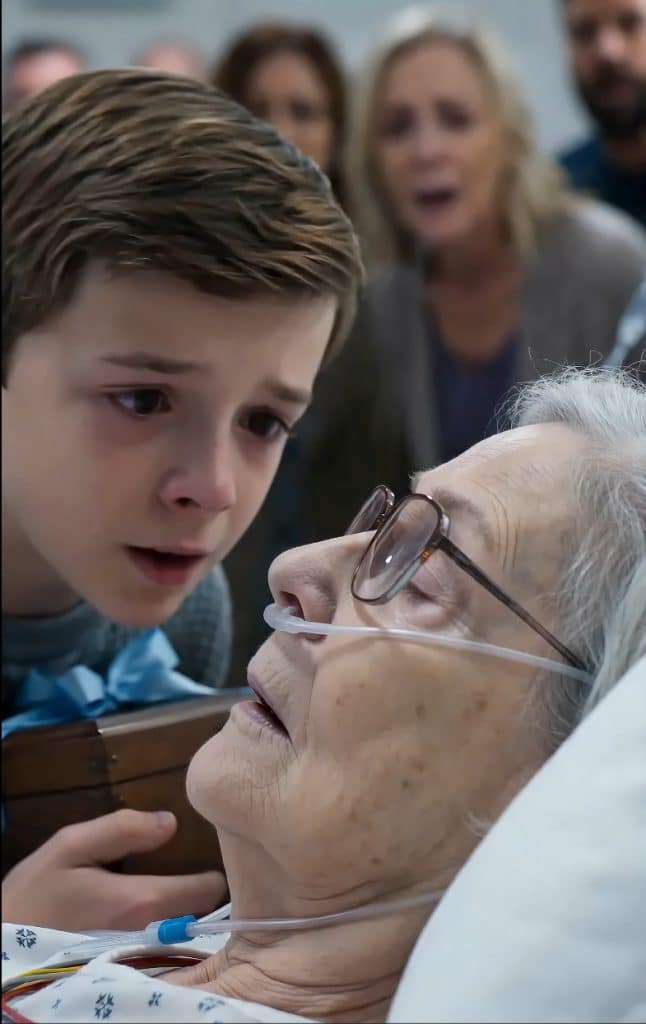
She lay under the cold hospital lights with a nasal cannula at her nose, her glasses still resting crookedly on her thin face because Richard had insisted she would want them there when she woke up. The doctors had warned the family not to expect miracles. Her body was tired. Her heart was failing. Her mind had drifted somewhere they could not reach.
And then a strange boy had walked into the room carrying a small wooden box tied with a blue ribbon.
He looked no older than ten.
He wore a gray knit sweater too big at the sleeves, the kind of sweater that looked borrowed from someone who loved him but could not afford a new one. His hair was neat, his cheeks red from crying, and both his hands were wrapped around that wooden box as if it contained the only proof in the world that he belonged there.
But Richard did not care.
“You don’t belong in here,” he snapped. “Who let him in?”
Behind him, his sister Claire covered her mouth, already shaking her head. A cousin whispered something about security. The doctor stepped closer, cautious but unsure whether to interfere.
From the corner of the room, Aunt Margaret pointed a trembling finger at the boy.
“Take him out of there!”
The boy stumbled when Richard pulled him back, but he did not fight.
He only held the box tighter.
And that was the first thing that unsettled the room.
A child in trouble usually cried harder. He begged, he panicked, he tried to explain himself all at once.
But this boy did not.
He looked at Richard with wet eyes and a sadness too old for his face.
Then he said quietly, “She’s not just your mother.”
Every sound in the room seemed to shrink.
The steady beep of the monitor. The soft hiss of oxygen. The rustle of hospital curtains. Even Richard’s breathing changed.
His grip loosened.
“What did you say?”
The boy swallowed, but his voice did not shake.
“She promised she would remember me.”
Richard stared down at him, anger burning through confusion.
Evelyn Hale had been a widow for twenty years. A respected donor, a former piano teacher, a woman whose Christmas cards were still handwritten and whose name appeared on plaques in the hospital lobby. She was not the kind of woman who had strangers appearing at her deathbed.
Especially not children.
Especially not children carrying boxes tied with ribbon.
Richard turned toward the doctor, his jaw tight. “I want him removed.”
But before anyone moved, the boy looked past Richard toward the bed.
Not at the machines.
Not at the tubes.
At Evelyn’s face.
And for the first time since he had entered the room, fear broke through his calm.
“Please,” he whispered. “I came before it was too late.”
Richard should have thrown him out then.
Instead, he took one step back.
And that single step would tear open a secret the Hale family had spent eleven years pretending did not exist.
Act II
No one in the room knew the boy’s name.
Not at first.
He had arrived alone, slipping past the nurses’ station during the shift change while the family argued quietly near the elevators about funeral homes and whether Evelyn would want lilies or white roses. A volunteer had assumed he belonged to the family. A nurse had seen the wooden box and thought he was delivering something from the chapel.
By the time anyone realized he was a stranger, he was already beside Evelyn’s bed.
Richard had caught him leaning close, his lips near the old woman’s ear.
That was when rage took over.
Richard had spent his entire life being Evelyn Hale’s son in public and her shield in private. He managed her accounts, attended charity dinners in her place when she grew too tired, answered calls from distant relatives who only remembered her money when they needed some. He had protected her from greedy friends, dishonest caregivers, and half the people now gathered in the room wearing grief like a costume.
So when he saw the boy so close to her, whispering, his mind did not ask why.
It only asked how fast he could stop him.
But the boy did not look like a thief.
He looked like a child who had already lost too much.
The wooden box was small, polished by age, with tiny scratches along the lid. The blue ribbon around it had faded almost gray at the edges. It was tied carefully, not beautifully, as if done by hands that had tried their best.
Richard noticed that and hated himself for noticing.
“What’s your name?” the doctor asked gently.
The boy glanced at Richard before answering.
“Noah.”
“Noah what?”
“Noah Bennett.”
A strange movement passed through the room.
Not shock, exactly.
Something colder.
Claire turned sharply toward Margaret. Margaret looked away too quickly. Richard saw it. He had known his aunt long enough to recognize guilt disguised as discomfort.
“Bennett?” Richard repeated.
Noah nodded.
“My mom’s name was Anna Bennett.”
Was.
The word landed softly, but it changed the air.
The boy looked down at the wooden box.
“She died last month.”
Claire drew in a breath. Margaret closed her eyes. Richard felt a pressure rise behind his ribs, not because he understood, but because suddenly everyone else seemed closer to understanding than he was.
“Who was she?” Richard demanded.
Noah’s fingers tightened around the ribbon.
“She worked at your mother’s house.”
Richard almost laughed, but there was no humor in him.
“My mother had dozens of people come through that house over the years. Nurses. cleaners. drivers. piano students. That doesn’t give you the right to walk into her ICU room.”
Noah looked at Evelyn again.
“My mom wasn’t just staff.”
Margaret’s voice sliced through the silence.
“That’s enough.”
Everyone turned.
She stood stiffly near the foot of the bed, pearls at her throat, eyes bright with panic. Margaret had always been the family historian, the one who remembered birthdays, marriages, scandals, and which relatives were not to be invited to which weddings. She also had a talent for ending conversations before they became dangerous.
But this time, the conversation had already found the wound.
Noah lifted the wooden box a little.
“My mom said Mrs. Hale gave this to her. She said if anything happened, I had to bring it back.”
Richard stared at the box.
Something about it tugged at him.
He had seen it before.
Not recently. Not even as an adult. But somewhere in the old house, in a room that smelled like cedar polish and rose soap. His mother’s music room, maybe. The cabinet under the baby grand piano.
A blue ribbon.
A small box.
A memory he could not place.
Claire stepped toward Noah. Her voice softened despite herself.
“What’s inside?”
Noah did not answer immediately.
He looked at Richard, then at the woman in the bed, as though permission belonged to the person who could no longer give it.
“My birth bracelet,” he said. “A photo. And a letter.”
Richard’s anger returned because anger was easier than fear.
“A letter from whom?”
Noah looked up.
“From her.”
He meant Evelyn.
The monitor beeped steadily.
No one moved.
Richard reached for the box. Noah pulled it back instinctively, pressing it to his chest.
“No,” the boy said.
Richard’s face hardened.
“No?”
“She told my mom not to let anyone open it until I was old enough to come myself.”
Margaret stepped forward then, too quickly.
“Richard, this is absurd. Your mother was confused for years. You know how she became after the stroke. People take advantage of elderly women every day.”
Noah’s eyes flashed, but not with anger.
With hurt.
“My mom never took anything.”
Margaret ignored him.
“She probably gave that woman some trinket and the woman built a fantasy around it. This child should not be here. Evelyn needs peace.”
At the name Evelyn, the boy turned toward the bed.
The change in him was immediate. His shoulders lowered. His lips parted like he had heard someone calling from far away.
“She used to sing to me,” he said.
Richard went still.
Noah began humming softly.
It was barely a tune at first, just a fragile thread of sound under the machines. But Claire recognized it. Her hand flew to her mouth.
It was not a famous lullaby.
It was something Evelyn had written herself after Richard’s father died. A melody she played only at home, usually when grief made words impossible. Richard had not heard it since he was a teenager.
Noah hummed the second line perfectly.
The doctor looked from the boy to the family.
Richard’s voice fell to a whisper.
“Where did you learn that?”
Noah blinked through tears.
“She sang it when she visited us.”
Richard felt the floor tilt beneath him.
Because his mother had not visited anyone named Bennett.
At least, that was what he had been told.
And then Noah untied the blue ribbon.
Act III
The lid opened with a soft wooden click.
Inside, on a folded square of cream-colored cloth, lay a hospital bracelet no larger than a strip of paper, yellowed with age. Beside it was a photograph, creased down the middle, and beneath that an envelope with Evelyn’s handwriting across the front.
Richard knew his mother’s handwriting instantly.
It had a graceful slant, elegant but firm, with loops that looked almost musical. He had seen it on birthday cards, recipe notes, tuition checks, sympathy letters, and the final shaky signatures she had made after her first stroke.
The envelope read:
For Noah, when he comes home.
Claire began to cry before anyone opened it.
Richard could not move.
Noah unfolded the photograph and held it out.
It showed Evelyn eleven years younger, standing in the garden behind the Hale house. She was smiling in a way Richard had not seen in years, both arms wrapped around a young woman with tired eyes and a newborn wrapped in a blue blanket.
Anna Bennett.
Noah’s mother.
On the back, written in Evelyn’s hand, were four words.
My grandson. My promise.
Richard’s face changed as if someone had struck him without touching him.
“No,” he said.
It was not denial for the room.
It was denial for himself.
Claire turned to Margaret, trembling. “What is this?”
Margaret’s expression hardened, but there was fear beneath it.
“A lie.”
Noah shook his head. “It’s not.”
Richard looked at the bracelet.
The name printed there was faint, but readable.
Baby Boy Hale.
The room seemed to inhale at once.
Richard reached for the bed rail because suddenly his legs did not feel steady. “That’s impossible.”
Noah’s voice broke for the first time.
“My mom said my father died before I was born.”
Claire whispered, “Daniel.”
At the name, Richard closed his eyes.
Daniel Hale had been Richard’s younger brother. The charming one. The reckless one. The son who played guitar badly, laughed loudly, and made Evelyn forgive him before he even apologized. He had died in a car accident twelve years earlier, leaving behind a house full of grief and a family determined to turn memory into something clean.
But Daniel had also left things unfinished.
Bills. Apologies. Promises.
And, apparently, a child.
Richard looked at Margaret.
“You knew?”
Margaret’s mouth tightened.
“I protected this family.”
The words were so cold that even the doctor looked disturbed.
Claire stepped toward her. “Protected us from what? A baby?”
Margaret’s eyes flashed.
“From a scandal. From a woman who showed up six months after Daniel died claiming she was carrying his child. No marriage. No proof. Just tears and a story.”
Noah flinched.
Richard saw it and felt shame crawl up his throat.
Margaret continued, her voice gaining speed because she was no longer defending herself to them. She was defending herself to the ghost of the woman in the bed.
“Your mother was grieving. She was vulnerable. Anna Bennett knew that. She worked in the house. She knew Daniel. She knew what Evelyn had lost.”
Noah clutched the photograph.
“My mom loved him.”
Margaret snapped, “Your mother wanted money.”
The boy went silent.
Not because he believed her.
Because children learn early when adults have decided they do not matter.
Richard’s hands curled into fists at his sides.
“What did you do?”
Margaret looked away.
Claire whispered, “Aunt Margaret, what did you do?”
For once, the woman who always had an answer had none ready.
The doctor cleared his throat softly. “This may not be the place—”
“No,” Richard said. His voice was low now. Dangerous in a way his shouting had not been. “This is exactly the place.”
Noah reached into the box and removed the envelope.
He held it toward Evelyn first, as if giving her the chance to stop him.
But Evelyn did not move.
So he gave it to Richard.
The paper trembled in Richard’s hands as he opened it.
The letter was dated eight years earlier.
Evelyn had written it after her first minor stroke, when her memory was beginning to fail in small frightening ways. She wrote that Anna had come to her with proof. Daniel’s letters. A photograph. A private paternity test that Evelyn had paid for herself, quietly, because she had needed the truth before she could fight for the child.
The truth had been clear.
Noah was Daniel’s son.
Evelyn had wanted to bring Anna and Noah into the family. She had wanted to amend her will, create a trust, and give the boy Daniel’s watch when he was old enough to understand. But before she could tell Richard, the documents vanished from her desk.
Then Anna disappeared.
Evelyn wrote that Margaret told her Anna had taken a settlement and left the state. Margaret said Anna wanted no contact. Margaret said the boy was better off without the Hale name.
For years, Evelyn believed it.
Until one day she found Daniel’s old watch missing from the drawer and a blue ribbon in its place.
That was when she knew.
The letter ended with a sentence Richard had to read three times because the words blurred.
If I forget him, bring him to me. Make me remember what they stole.
Richard lifted his eyes slowly.
Margaret had gone pale.
And behind him, the heart monitor gave one steady beep after another, like a countdown.
Act IV
“You forged it,” Richard said.
Margaret drew herself up. “I did what had to be done.”
Claire stared at her as if seeing a stranger wearing their aunt’s face.
“You sent them away?”
“I gave Anna money,” Margaret said sharply. “Enough to start over.”
Noah’s voice was small. “My mom never got money.”
Margaret did not look at him.
That was answer enough.
Richard’s face twisted, not with rage now, but with the slow horror of understanding. “You told Mom Anna abandoned us.”
“She was obsessed,” Margaret said. “She kept writing. Kept calling. Evelyn was ill, Richard. She could barely manage her own medication some days.”
“She was well enough to write this letter.”
“She was confused.”
“She knew exactly what you did.”
Margaret’s eyes shone, but not with remorse. “And what would you have done? Brought that woman into the family? Given her Daniel’s name? Let every charity board, every newspaper, every smug old friend whisper that Daniel had left behind some illegitimate child?”
Claire recoiled.
“He is standing right here.”
For the first time, Margaret looked at Noah.
But she did not see a boy.
She saw the scandal she had buried, breathing.
Noah stepped closer to Evelyn’s bed.
Richard moved as if to stop him, then stopped himself.
His mother’s hand lay motionless on the blanket. Her face remained pale, her eyelids still, her breathing thin and delicate beneath the cannula.
Noah leaned over her, tears sliding down his cheeks.
“I came,” he whispered. “Grandma, I came.”
The word hit Richard so hard he turned away.
Grandma.
Not Mrs. Hale. Not the patient. Not the rich woman in the photograph.
Grandma.
Noah opened the wooden box again and took out one final item.
A small silver watch.
Daniel’s watch.
Richard knew it instantly. His father had given it to Daniel at graduation. Daniel had worn it every day, even when the leather strap cracked and the face scratched. After the accident, Evelyn kept it in her music room and touched it whenever she thought no one was looking.
Richard had searched for it after she moved into assisted living.
Margaret had told him Evelyn must have misplaced it.
Noah held it in both hands.
“My mom said Mrs. Hale gave it to her the last day they saw each other,” he said. “She said it was supposed to be mine, but only if Grandma remembered.”
Richard’s eyes filled despite every instinct he had spent years building against tears.
“What happened to your mother?” he asked.
Noah looked down.
“She got sick. She tried to call. She said nobody ever answered.”
Claire covered her face.
Margaret whispered, “I changed Evelyn’s number.”
Richard turned on her.
The room seemed to shrink around them.
“You cut them off.”
“I saved your mother from being manipulated.”
“You stole her grandson.”
The words came out quietly, but they broke something.
Margaret’s mouth opened, then closed.
There was nothing left to hide behind.
Noah slipped the watch into Evelyn’s weak hand.
Her fingers did not close around it.
The watch rested there, silver against paper-thin skin, and for a moment nothing happened.
The family stood frozen.
The doctor watched the monitor.
The nurse held her breath.
Richard wanted to apologize to the boy, but no apology felt big enough. How did a man apologize for a decade of birthdays missed? For Christmas mornings where a child wondered why no one came? For a grandmother dying without knowing whether her promise had survived?
Noah leaned down until his forehead nearly touched Evelyn’s pillow.
His voice became a trembling whisper.
“You promised you would remember.”
The room went still.
At first, there was only the monitor.
Beep.
Beep.
Beep.
Then Evelyn’s eyelids fluttered.
It was so faint that Richard thought grief had invented it.
But Noah saw it.
He lifted his face slowly, afraid even his breathing might make the moment disappear.
“Grandma?”
Her eyelids trembled again.
The doctor stepped forward, alert now.
Evelyn’s face did not transform. She did not wake dramatically. She did not open her eyes and speak a perfect sentence like in the movies.
She remained fragile, caught somewhere between silence and return.
But her right hand moved.
Just a little.
The hand with Daniel’s watch beneath it.
Her fingers curled weakly, trembling against the silver face.
Noah gasped.
Richard gripped the bed rail.
Claire whispered, “Mom?”
Evelyn’s eyelids flickered, and a single tear slipped from the corner of her eye into the hollow beside her glasses.
Then her hand lifted.
Only an inch.
Only enough to reach toward the boy.
But it was enough.
Noah placed his small hand in hers.
And the entire Hale family understood that Evelyn had not forgotten him.
Someone had made sure she could not find him.
Act V
The next morning, the Hale family attorney arrived with a sealed folder from Evelyn’s safe deposit box.
Richard had not known it existed.
Margaret had.
That was why she tried to leave the hospital before sunrise.
She made it as far as the elevator before Claire stopped her.
No shouting this time. No dramatic scene. Just Claire standing in front of the elevator doors with red eyes and a voice that no longer belonged to the frightened daughter Margaret had always controlled.
“You’re staying,” Claire said.
Margaret looked past her toward Richard, but Richard did not move.
Something in him had changed overnight.
He had spent years thinking grief made him strong because it made him hard. He had mistaken suspicion for loyalty. He had guarded his mother so fiercely that he never noticed the person she needed protection from had been inside the family all along.
The folder confirmed everything.
There was a paternity report. Copies of Anna’s letters. A notarized amendment Evelyn had drafted but never filed because Margaret intercepted the paperwork. There was even a statement from Evelyn, recorded with her attorney two years earlier during a brief period of clarity.
In the recording, Evelyn’s voice was thin but unmistakable.
She said Daniel had a son.
She said his name was Noah.
She said if he ever came, he was not to be treated as a stranger.
Richard listened to the recording once.
Then he asked to hear it again.
Noah sat beside the window, the wooden box on his lap, his feet not quite touching the floor. He did not look victorious. Children who have lost their mothers do not feel victory when adults finally admit the truth.
He looked tired.
Too tired for ten.
Richard crossed the room slowly and sat in the chair beside him.
For a long moment, he said nothing.
Then he lowered his head.
“I’m sorry.”
Noah looked at him.
Richard’s voice cracked.
“I grabbed you. I shouted at you. I called you a stranger in front of her.”
Noah’s eyes moved to Evelyn, still resting in the bed, her breathing fragile but steadier than before.
“You were scared,” he said.
That forgiveness, offered so simply, nearly broke Richard.
“No,” Richard whispered. “I was wrong.”
Noah looked down at the box. “My mom said rich people don’t say that much.”
Richard let out a small, painful laugh.
“Your mom was probably right.”
For the first time, Noah almost smiled.
The doctor warned them that Evelyn’s recovery was uncertain. The hand movement did not mean a miracle. It did not erase the years or undo the damage inside her body.
But something had shifted.
When Noah sat beside her and hummed the old melody, Evelyn’s fingers twitched around his. When Richard placed Daniel’s watch near her pillow, her breathing changed. When Claire told her that Noah was safe, Evelyn’s eyelids trembled again.
It was not a full return.
It was a message.
I know.
Margaret’s version of the family collapsed within forty-eight hours.
The attorney began reviewing the missing documents. Richard froze the accounts Margaret had managed. Claire found boxes in Margaret’s townhouse containing old letters from Anna, all unopened, all returned before Evelyn could see them.
One envelope had been opened.
Inside was a photograph of Noah at age five, missing his front tooth, holding a crayon drawing of a piano.
On the back, Anna had written:
He knows your song.
Richard kept that photograph.
Not because it belonged to him.
Because it reminded him what silence costs.
Three days later, Evelyn woke for twelve minutes.
Only twelve.
Her voice was weak, and most of her words were difficult to understand. The doctor asked the family not to overwhelm her. Claire cried quietly at the foot of the bed. Richard stood beside the monitor, afraid to hope for more than the room could bear.
Noah sat closest.
Evelyn’s eyes opened halfway, clouded and tired behind her glasses.
They searched the room slowly.
Then they found him.
Noah leaned forward, both hands around hers.
“Hi,” he whispered.
Evelyn’s mouth trembled.
It took all her strength to form the word.
“Noah.”
The boy covered his face and cried.
Richard turned away, one hand pressed over his mouth.
Because in that single word was everything Margaret had stolen and everything she had failed to destroy. Birthdays. Letters. Songs. A grandmother’s promise. A child’s name carried through years of absence and finally returned to the person who had been waiting somewhere beneath the silence.
Evelyn could not say much more.
But she did not need to.
Her fingers moved weakly toward the wooden box, and Noah placed it beside her. The blue ribbon lay loose now, untied at last.
Richard watched his mother look at it.
Then at him.
There was no anger in her eyes.
Only sorrow.
And instruction.
He understood.
Weeks later, after Evelyn passed quietly with Noah’s hand in hers and Daniel’s watch ticking on the bedside table, Richard stood in the old music room for the first time in years.
Dust floated in the afternoon light.
The baby grand piano sat untouched by the window.
Noah stood near the doorway, uncertain, wearing the same gray sweater, the wooden box tucked under one arm. He had no mother now, and the grandmother he had found had already become another goodbye.
But he was not alone.
Richard lifted the piano cover.
“My mother taught me this when I was a kid,” he said.
Noah looked at the keys.
“She taught my mom too.”
Richard nodded.
Then he sat down and played the first notes of Evelyn’s song.
His hands were clumsy at first. He missed one note, then another. Noah stepped closer, listening.
After a moment, the boy began to hum.
Softly.
Exactly on pitch.
Richard kept playing.
Claire joined them in the doorway, wiping her eyes. Outside, somewhere beyond the old garden, the world moved on as if nothing had happened.
But inside that room, the Hale family was becoming something different.
Not clean.
Not perfect.
Not untouched by betrayal.
But honest.
And sometimes, after a secret has poisoned a family for years, honesty feels less like peace than surgery.
It hurts.
It saves.
Richard looked at Noah and saw Daniel in the tilt of his head, Anna in the sadness of his eyes, and Evelyn in the way he held on to music as if love could be remembered through a melody.
The boy had arrived at the hospital as an intruder.
He left as the heir to a promise.
And the wooden box, once tied shut with a faded blue ribbon, stayed on the piano from that day forward.
Not as proof of scandal.
Not as evidence in a fight over money.
But as a reminder that the truth does not disappear just because powerful people lock it away.
Sometimes it waits.
Sometimes it crosses a hospital room in a gray sweater.
And sometimes it whispers one sentence softly enough to wake the person who never stopped trying to remember.