Act I
The young woman looked like she had rehearsed being brave in the car and lost the courage at the door.
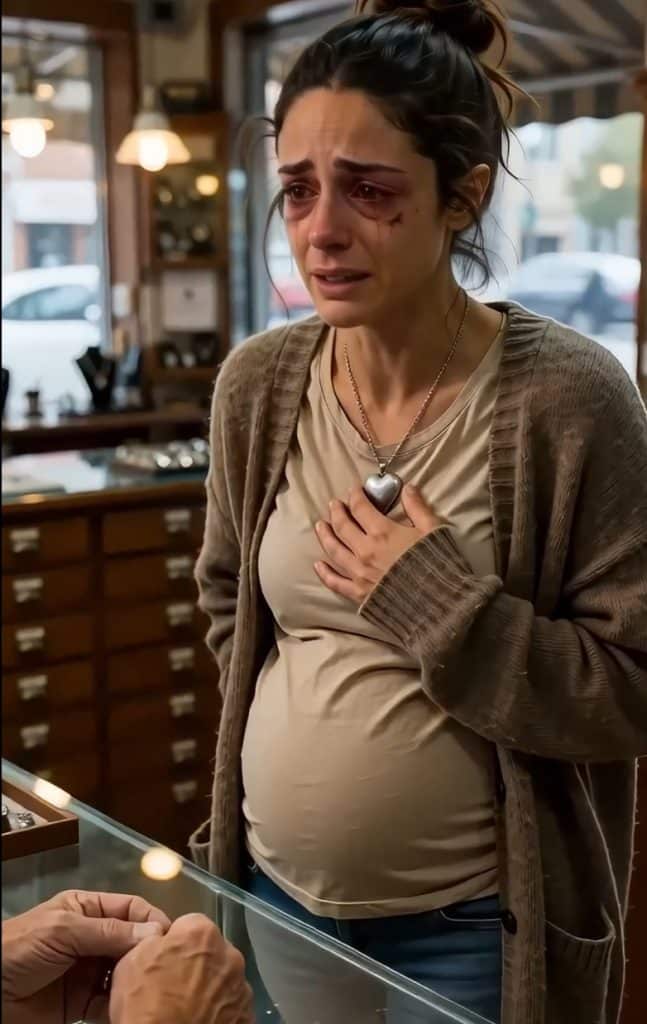
She stood in front of the glass counter with one hand resting over her pregnant belly and the other pressed against her chest, where a silver heart pendant lay against her beige shirt. Her eyes were red from crying. Her oversized brown cardigan hung from her shoulders like it belonged to someone who had not slept properly in weeks.
Across from her, the old jeweler waited.
The shop was quiet except for the soft piano music coming from a small radio near the watch cabinet and the faint sound of traffic beyond the front window. Warm light fell over trays of rings, watches, little velvet boxes, and tiny repair tools arranged with the careful patience of a man who had spent his life fixing things other people broke.
“I want to sell my pendant,” she said.
Her voice barely made it across the counter.
The jeweler did not answer right away. He was an older man with thinning grey hair, glasses low on his nose, and a wedding band worn smooth from decades of use. His name was Isaac Adler, though the gold letters on the window simply read ADLER WATCH & JEWELRY REPAIR.
He had heard that sentence many times.
People came in to sell jewelry when rent was due. When medicine cost too much. When marriages ended. When parents died. When hope narrowed down to something small enough to fit in a palm.
But this woman’s hand stayed on the necklace too long.
Isaac noticed that.
He noticed everything.
“Take your time,” he said gently.
The woman swallowed hard, reached behind her neck, and unclasped the chain. The tiny metallic click sounded much louder than it should have. She lowered the pendant into her palm and stared at it like she was saying goodbye to a living thing.
“It was a gift,” she whispered. “From my late husband.”
Isaac’s expression softened.
“I’m sorry.”
She nodded quickly, as if kindness might break her.
“He died before he knew we were having a boy.”
The words slipped out before she seemed ready for them. Her mouth trembled, and she looked down, ashamed of having given a stranger so much truth.
Isaac held out both hands.
She placed the pendant in them.
For one second, her fingers did not let go.
Then they opened.
The silver heart touched the glass counter with a delicate sound. Not dramatic. Not loud. Just a tiny clink, the sound of a last memory being offered for sale.
Isaac lifted the pendant toward the warm light.
It was simple. Worn around the edges. Brushed silver, not polished, with a tiny seam so fine most people would miss it. The chain had been repaired at least once. The clasp was cheap, replaced by someone who cared more about keeping it wearable than making it perfect.
The woman leaned forward.
“Please,” she said.
One word.
It carried rent, food, hospital bills, fear, pride, grief, and the humiliation of standing in a shop asking a stranger to put a price on love.
Isaac turned the pendant again.
Then his thumb stopped.
Near the curve of the heart, hidden beneath years of wear, was a maker’s mark so small it looked like a scratch.
A tiny star inside a circle.
Isaac’s breathing changed.
He took off his glasses, cleaned them with a cloth, and put them back on.
Then he looked again.
The woman noticed.
“Is something wrong?”
Isaac did not answer.
Because the last time he had seen that mark, he had carved it into the pendant himself.
Act II
Her name was Emily Carter.
She was twenty-eight years old, five months pregnant, and down to forty-three dollars in her checking account after paying half the electric bill. The other half sat folded in her purse beside an overdue rent notice and a hospital estimate that made her hands go cold every time she opened it.
Six months earlier, she had been married to Caleb Carter.
Caleb had not been rich. He had not been polished. He owned two good shirts, one pair of dress shoes, and a pickup truck that made a coughing sound every time it started in winter.
But he had a way of making poverty feel temporary.
He could turn instant noodles into dinner by adding eggs and laughing about it. He could fix a leaking faucet with a borrowed wrench and three videos on his phone. He could stand in the doorway of their tiny apartment after a double shift, smelling like sawdust and cold air, and still ask Emily how her day had been as if his own exhaustion did not matter.
The pendant had appeared on their first anniversary.
Emily had found it wrapped in brown paper on the kitchen table, beside a grocery-store cupcake with one candle stuck crookedly into the frosting.
“I know it’s not much,” Caleb had said.
She had opened the paper and seen the silver heart.
It was not flashy. It was not expensive-looking. But when she held it, Caleb watched her with a strange tenderness, almost fear, as if the necklace carried more than he could explain.
“It belonged to someone important,” he said.
“Who?”
He smiled, but it did not reach his eyes.
“My past life.”
That was Caleb’s way whenever she asked about his family.
He joked. He changed the subject. He kissed her forehead and told her that some doors stayed closed because there was nothing worth reopening behind them.
All Emily knew was that Caleb had grown up angry.
He told her his mother had died when he was young. He told her his father had chosen the shop over him, pride over love, silence over apology. At seventeen, Caleb walked out after a fight and never went back.
“Did he ever look for you?” Emily once asked.
Caleb had stared at the floor.
“No.”
She believed him because he believed it.
Then came the accident.
Caleb worked renovation jobs on old buildings, taking every shift because they were trying to save for a house before the baby came. Emily had not even told him she was pregnant yet. She had bought a tiny pair of blue socks and hidden them in a drawer, waiting for the right night.
The right night never came.
A support beam failed at a worksite. Caleb helped two younger workers get clear before the upper floor came down enough to trap him badly. He survived long enough to make it to the hospital, long enough for Emily to hold his hand, not long enough for her to tell him about the socks.
After the funeral, everything became paper.
Insurance forms. Death certificates. Workers’ compensation delays. Rent notices. Medical bills from the emergency room. Letters from people who wrote “our condolences” above balances they still expected her to pay.
Caleb’s employer said the investigation was ongoing.
The landlord said grief did not pause rent.
The clinic said prenatal care could not wait.
So Emily opened the small wooden box where she kept Caleb’s wedding ring, his old watch, and the pendant he had begged her never to sell.
“If something happens to me,” he had once said, touching the necklace at her throat, “keep this close.”
She had promised.
But promises made in warmth are tested in cold rooms.
That morning, she had stood in front of the mirror and whispered, “I’m sorry,” before taking off the necklace.
Now the old jeweler held the pendant as if it had burned him.
Emily’s shame turned to fear.
“Sir?” she asked. “Can you buy it or not?”
Isaac Adler looked at her.
His face had gone pale.
“Who was your husband?”
“Caleb Carter.”
The jeweler’s fingers tightened around the heart.
“Was that his birth name?”
Emily stared at him.
“I don’t know.”
Isaac closed his eyes for one second.
And when he opened them, they were wet.
Act III
Isaac reached beneath the counter and pulled out a small black cloth.
He spread it carefully over the glass, then set the pendant in the center as if placing something sacred on an altar. From a drawer, he took a thin jeweler’s blade and a magnifying lens.
Emily stiffened.
“Please don’t damage it.”
“I won’t,” Isaac said, but his voice was not steady.
He turned the pendant to the side and pressed the blade against the seam.
Emily had worn the necklace every day for three years and had never known there was a seam at all.
A tiny click followed.
The silver heart opened.
Emily covered her mouth.
Inside was not a photograph. Not a jewel. Not anything a pawnshop would have valued.
There was a sliver of folded paper, yellowed with age, protected behind the inner wall of the pendant.
Isaac removed it with tweezers. His hands shook so badly that Emily forgot her own fear for a moment and watched his face instead.
He unfolded the paper.
The writing was small, faded, and uneven.
Gabriel,
No matter how far anger takes you, this will always be proof you had a home. Come back when you can.
Dad.
Emily felt the room tilt.
Gabriel.
Not Caleb.
Gabriel.
Isaac put one hand on the counter to steady himself.
“My son’s name was Gabriel,” he whispered.
Emily could not speak.
The piano from the radio played softly on, cruelly gentle in the silence.
Isaac touched the tiny star mark on the pendant.
“I made this for him on his sixteenth birthday. His mother had just died. I didn’t know how to talk to him. I didn’t know how to help him grieve. All I knew how to do was work, so I made him this.”
His voice broke on the last word.
Emily looked at the pendant, then at him.
“Caleb said his father never looked for him.”
Isaac flinched.
“I did.”
The words came out raw.
“I looked for years. He left after a terrible fight. I said things I would give my life to take back. He took his mother’s maiden name. I hired people. I called shelters. I checked hospitals. Every time I thought I found him, he was gone.”
Emily stepped back, one hand pressing against her belly.
“No.”
Isaac looked at her stomach.
His expression changed again, this time with a grief so deep it seemed to make him older before her eyes.
“He had a wife,” he said softly. “And a child coming.”
Emily shook her head.
“He thought you hated him.”
Isaac bowed his head.
“I know.”
Those two words carried years.
Emily wanted to be angry at him. Part of her was. For Caleb. For the boy who had walked through life believing no one had searched for him. For the man who gave jokes instead of answers because the wound underneath never closed.
But the man across from her did not look like someone who had won.
He looked like someone who had been punished every day by the door he failed to open in time.
Isaac reached under the counter again, this time pulling out an old leather wallet. From inside, he removed a photograph and placed it beside the pendant.
It showed a teenage boy with dark hair, a stubborn jaw, and eyes Emily knew better than her own.
Caleb.
Younger. Harder. Hurt before life had taught him how to hide it.
Emily’s breath left her.
“That’s him.”
Isaac pressed his knuckles to his mouth.
For a moment, the repair shop vanished. There were no watches under glass, no warm lights, no wooden drawers full of spare parts. There was only an old father and a young widow standing on either side of a counter, separated by a life neither of them had known how to save.
Then Isaac looked down at the pendant again.
“You came here to sell it,” he said.
Emily nodded, crying silently now.
“I have no choice.”
Isaac closed the silver heart and pushed it gently back toward her.
“Yes,” he said. “You do.”
Act IV
Emily did not take the pendant.
Not at first.
“I need money,” she said, ashamed of how blunt it sounded. “I wouldn’t be here if I didn’t. My rent is overdue. The clinic bills are stacking up. Caleb’s company keeps saying they’re still reviewing the accident. I can’t wait for people to feel sorry for me.”
Isaac looked at her carefully.
“What company?”
“Brenner Construction.”
His face hardened.
Emily noticed the change.
“You know them?”
Isaac took a slow breath. “They’ve been trying to buy this building for five years.”
Emily stared at him.
The shop suddenly felt smaller.
“They offered Caleb extra shifts,” she said. “He said the site was rushed. He said they were cutting corners, but he needed the money.”
Isaac’s eyes moved to the old wooden cabinet behind him, then back to her.
“What was his full name on the employment papers?”
“Caleb Gabriel Carter.”
Isaac closed his eyes again, but this time not from grief.
From recognition.
“He kept it,” he whispered.
Then he moved.
The quiet old jeweler became suddenly precise. He locked the front door, flipped the sign to CLOSED, and pulled a chair around the counter for Emily.
“Sit down before you fall,” he said.
“I’m fine.”
“You are shaking.”
She sat.
Isaac went into the back room and returned with a metal file box. From it, he removed a thick envelope labeled GABRIEL ADLER TRUST.
Emily stared at the name.
“I set this up after his mother died,” Isaac said. “College money. Then housing money. Then, when I could not find him, just money waiting for a day I kept telling myself would come.”
He placed the envelope on the counter.
“If he was your husband, then you are his family. That child is his blood. Whatever is in this belongs to both of you.”
Emily shook her head quickly.
“No. I didn’t come here for that.”
“I know.”
“I came to sell a necklace.”
“No,” Isaac said gently. “You came because my son found a way to bring you home.”
That broke her.
Not loudly. Not all at once. Her face folded, and she bent forward over her belly, crying with a grief too exhausted to be graceful.
Isaac came around the counter but stopped a few feet away, giving her space.
“I’m sorry,” he said. “For every year he thought he was unwanted. For every night you had to carry this alone. For not knowing he was gone.”
Emily wiped her eyes with the sleeve of her cardigan.
“He was good,” she said. “Whatever happened before, he was good.”
“I believe you.”
“He talked to strangers like they mattered. He fixed things he didn’t have to fix. He once spent our grocery money replacing an old neighbor’s heater because she said she could still manage one more cold night.”
Isaac smiled through tears.
“That was his mother.”
Emily looked up.
“She did that too?”
“All the time.”
For the first time, the story of Caleb’s life widened.
He was no longer only a husband lost too soon, no longer only a man who had risen out of pain by sheer will. He was someone’s son. Someone’s memory. Someone’s unfinished apology.
Isaac called his attorney before Emily could argue again.
Then he called a doctor he knew through one of his oldest customers and arranged an appointment for the next morning. Then he wrote a check large enough to stop the eviction, cover the overdue bills, and make Emily stare at it as if it were dangerous.
“I can’t take this.”
“You can,” he said.
“No.”
“Emily,” Isaac said, voice trembling but firm, “I missed my chance to protect my son. Do not make me miss my chance to protect his wife and child.”
She looked at the check.
Then at the pendant.
Then at the old man who had carved a star into silver years before either of them knew how far love could travel after being lost.
Her hand went to her belly.
For the first time in months, the baby kicked.
Act V
The investigation into Brenner Construction reopened two weeks later.
It turned out Caleb had not been exaggerating when he told Emily the site was unsafe. Other workers came forward after Isaac hired an attorney. Photos appeared. Messages surfaced. A foreman admitted the company had been warned about the support structure and pushed the crew forward anyway because delays cost more than risk.
The settlement did not bring Caleb back.
Nothing could.
But it paid the medical bills. It paid the rent. It gave Emily enough to stop choosing between grief and survival.
Isaac refused to let her disappear after that.
At first, she resisted.
She had learned to distrust sudden kindness. People were often generous when tragedy was fresh and gone by the time the paperwork arrived. But Isaac did not behave like a rescuer. He behaved like a man trying, carefully and awkwardly, to become family without demanding the title.
He brought groceries and left them by the door.
He fixed Caleb’s old watch and returned it in a velvet box.
He showed Emily photographs of Gabriel as a child: missing front teeth, scraped knees, birthday cake on his shirt, his mother laughing behind him. Emily brought photographs of Caleb as a grown man: holding a paintbrush, sleeping on the couch, standing in the rain beside their battered truck with a grin too bright for the weather.
Together, they built the years between them.
Some days it hurt too much.
Some days Emily left early.
Isaac never stopped her.
The pendant stayed with him for one week.
Not because he bought it.
Because he repaired it.
He cleaned the hinge, strengthened the clasp, polished the worn edges without erasing them, and added a second hidden note behind the first.
Emily did not read it until the day her son was born.
The baby arrived during a thunderstorm, loud and stubborn, with Caleb’s dark hair and a furious cry that made Isaac laugh and cry at the same time in the hospital hallway.
Emily named him Gabriel Caleb Carter.
When Isaac held him for the first time, his hands shook more than they had with the pendant.
“Hello,” he whispered to the baby. “I’m late.”
Emily, exhausted and pale against the pillows, smiled through tears.
“But you came.”
A month later, she returned to the jewelry shop with the baby sleeping against her chest.
The same glass counter gleamed under the warm light. Watches ticked quietly beneath it. The wooden cabinet stood behind Isaac, every tiny drawer closed, every tool in its place.
But the shop felt different now.
Not heavy.
Full.
Isaac brought out the pendant and placed it in Emily’s palm.
The silver heart shone softly, still simple, still worn, but stronger now.
Emily opened the hidden compartment.
The first note remained inside.
Gabriel,
No matter how far anger takes you, this will always be proof you had a home. Come back when you can.
Dad.
Behind it was the new note, written in Isaac’s older, shakier hand.
Emily and Gabriel Caleb,
This heart came back carrying the family I thought I had lost. Keep it close, not because silver matters, but because love sometimes arrives late and still tells the truth.
Emily pressed the pendant to her lips.
Isaac looked away, pretending to adjust his glasses.
Years later, people would come into Adler Watch & Jewelry Repair and see a photograph near the register.
An old jeweler stood beside a young woman holding a little boy with dark curls. Around the woman’s neck was a silver heart pendant. Beneath the frame was a tiny engraved plate.
Not for sale.
Customers sometimes asked about it.
Isaac would smile and say, “That piece repaired me.”
He never told the whole story unless Emily was there to tell it with him.
Because it belonged to both of them.
It belonged to the young widow who walked into a shop ready to sell the last gift her husband had given her and walked out with the first piece of his past that had ever come back whole.
It belonged to the father who spent years waiting behind a counter, surrounded by clocks and watches, learning too late that time could not be repaired the way metal could.
And it belonged to Caleb, once Gabriel, who had carried his father’s love against his chest even when he no longer believed it was love.
On Gabriel Caleb’s first birthday, Emily stood in the shop after closing, watching Isaac lift the boy onto the counter beside a tray of harmless old watch bands. The child slapped both hands against the glass and laughed at his own reflection.
Isaac laughed too.
Emily touched the pendant at her throat.
For months, she had thought selling it would be the moment she lost the last piece of her husband.
Instead, keeping it had given her the rest of him.
Outside, cars passed the front window. Inside, the warm lights glowed over silver, glass, and tiny turning gears.
The heart pendant rested where it belonged.
Not in a display tray.
Not behind a price tag.
But close enough for a child’s small hand to reach, someday, when he was old enough to ask why his mother cried every time she told him how his father found his way home.