Act I
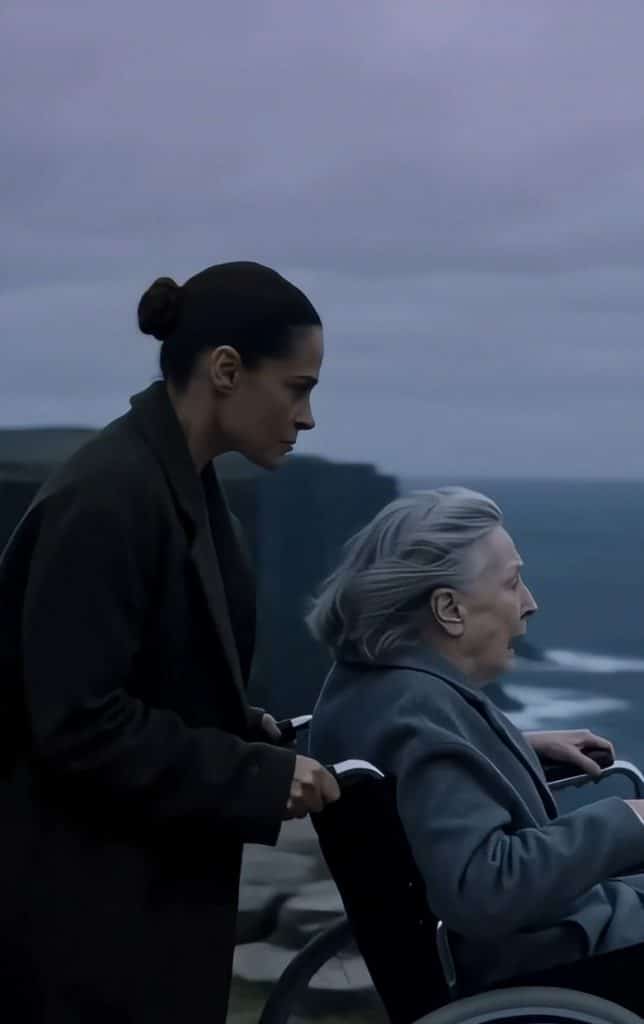
The wheelchair wheels scraped over the rocks like they were protesting.
Eleanor Whitmore gripped both armrests, her thin fingers stiff with cold and terror, while the woman behind her pushed harder through the wind. The sea below was black and furious, smashing itself against the cliff as if it knew something terrible was about to happen.
“Marissa,” Eleanor said, her voice shaking. “Stop.”
But Marissa did not stop.
Her dark hair was pulled into a tight bun. Her black coat snapped in the wind behind her, and her hands stayed locked around the wheelchair handles with a calm that frightened Eleanor more than any scream could have.
There had been no appointment. No doctor. No drive to the village, despite what Marissa had told the housekeeper.
There was only the cliff.
The same cliff Eleanor’s husband had loved. The same cliff where the Whitmore estate looked down on the sea like a judge that never forgot a crime.
“Why did you bring me here?” Eleanor whispered.
Marissa leaned down until her lips were close to Eleanor’s ear.
For the first time that afternoon, she smiled.
“Because from today,” she said softly, “that house will finally be mine alone.”
The words landed colder than the wind.
Eleanor’s mouth trembled. Not because she did not understand, but because she understood too well. The missing papers. The changed locks. The way Marissa had dismissed staff one by one. The strange bitterness in her voice whenever anyone called Greyhaven House Eleanor’s home.
“Please,” Eleanor breathed. “You don’t have to do this.”
Marissa straightened.
“Oh, I do.”
The front wheels reached the broken edge of stone.
A few pebbles tumbled down into the dark air below.
Eleanor tried to turn, tried to catch Marissa’s sleeve, tried to say the name of the one person who might still save her. But the wind tore the breath out of her.
Then Marissa shoved.
For one suspended second, the wheelchair tilted forward.
The cliff vanished beneath Eleanor.
And then there was only the sound of the sea.
Marissa stood alone at the edge, chest rising and falling for the first time. Her face remained still, but her hands shook.
It was done.
Greyhaven was hers.
The estate. The land. The accounts. The name she had married into and poisoned herself trying to own.
Then light exploded across the rocks behind her.
Headlights.
A car engine cut through the wind. Tires crunched over gravel. A dark silver Range Rover rolled to a stop on the cliff road, its beams pinning Marissa in place like a criminal on a stage.
She turned slowly.
And when she saw who stepped out of the car, the color drained from her face.
Because the man holding Eleanor’s sealed letter was the one Marissa had buried first.
Act II
Daniel Whitmore was supposed to be dead.
Not officially, not in the eyes of the law, but in every way that mattered to Marissa. Three months earlier, he had disappeared after a sailing accident off the northern coast. His body had never been found, but the police had called the search hopeless after ten days.
Marissa had cried at the memorial in a black dress that made half the county pity her.
She had stood beside Eleanor in the church, one hand on the old woman’s shoulder, while reporters whispered about the tragic young widow of the Whitmore heir. She had accepted every condolence, every casserole, every sympathetic touch.
But Eleanor had not cried.
Not because she did not love her son.
Because she knew Daniel.
He was careful. Too careful to sail alone into a storm that had been forecast for three days. Too careful to leave his mother without one final call. Too careful to vanish two weeks after telling her he had found “something ugly” in Marissa’s accounts.
That was when Eleanor began to watch.
From her wheelchair, people thought she noticed nothing. They spoke around her, above her, sometimes directly through her, as if age had made her part of the furniture.
It had not.
Eleanor noticed Marissa burning documents in the garden furnace at dawn.
She noticed the way Marissa flinched whenever Daniel’s study was mentioned.
She noticed that the housekeeper, Mrs. Bell, had been dismissed after asking why Daniel’s signature appeared on a property transfer dated two days after his disappearance.
And she noticed the lawyer’s letter.
It had arrived in a plain envelope from Boston, addressed to Eleanor personally. Marissa had almost thrown it away with the other mail, but Eleanor saw the stamp before she did.
That night, Eleanor locked herself in Daniel’s study.
Her hands were slow, but her mind was not.
The letter was from Daniel’s private attorney. It said that Daniel had amended his will one week before his disappearance. Not only that, he had placed Greyhaven House into a protective trust.
If anything happened to him under suspicious circumstances, the house would not pass to Marissa.
It would remain with Eleanor until the investigation was complete.
And after Eleanor, it would pass to someone Marissa had never been meant to know existed.
A child.
Daniel’s daughter.
Not Marissa’s.
Eleanor had read that line three times before the room seemed to move around her.
Daniel had been married once before, briefly, when he was young and reckless and living in New York under a different version of himself. The marriage had ended quietly. The daughter had been kept from the Whitmore family by a bitter custody agreement and Daniel’s own shame.
Her name was Clara.
She was twenty-one.
And two weeks before Daniel vanished, he had found her.
That discovery changed everything.
Marissa had married Daniel for permanence. For a name older than most banks. For portraits in gilded frames, dinner parties under chandeliers, and the private satisfaction of proving every person who had ever looked down on her wrong.
But Daniel had begun to pull away.
He had stopped signing documents without reading them. He had reopened old accounts. He had asked Marissa why money was moving through shell companies with names she claimed not to recognize.
Then he found Clara.
After that, Marissa’s future began collapsing in silence.
Greyhaven was no longer guaranteed. The money was no longer simple. The role of grieving widow would not be enough if Daniel had left behind another heir.
So Marissa had done what she always did when something stood between her and the life she believed she deserved.
She removed the obstacle.
First Daniel.
Then Eleanor.
And finally, if needed, the girl.
But Eleanor had made one final decision before Marissa pushed her toward the cliff.
She had sent a message Daniel had told her to send only if she was in danger.
It contained three words.
“She knows everything.”
Act III
The man stepping out of the Range Rover was not a ghost.
He was Daniel Whitmore, thinner than before, his left hand wrapped in a brace, his face pale from weeks of hiding and recovery. But he was alive.
Marissa staggered back from the cliff edge.
“No,” she whispered.
Daniel did not answer. He stood in the headlights with rain on his coat and Eleanor’s sealed letter in his hand. Beside him, a young woman stepped out of the passenger seat.
Clara.
She had Daniel’s eyes.
That was what struck Marissa first, even through the panic. The same clear gray eyes that watched too closely. The same steady face that did not break under pressure.
Behind them, another vehicle rolled up without headlights. Two detectives stepped out.
Marissa looked at Daniel, then at Clara, then at the detectives, and understood too late that this was not a rescue arriving by chance.
It was a trap closing.
Daniel had survived because his boat had not sunk where everyone thought it had. He had been found by a fishing crew miles down the coast, barely conscious, carrying a waterproof pouch tied inside his jacket.
Inside the pouch were copies of bank transfers, forged signatures, and a photograph of Marissa meeting with a man who had no reason to be near Daniel’s boat the night before it went missing.
Daniel had not returned home immediately because he no longer knew who he could trust.
So he went to the one person Marissa had not accounted for.
Clara.
At first, Clara had wanted nothing to do with him. Daniel had missed birthdays, graduations, hospital visits, and every ordinary day that mattered more than any grand apology. He arrived in her life with bandaged ribs, a family scandal, and a story that sounded too dramatic to be real.
But then he showed her the letters.
The ones he had written and never sent because her mother had returned them unopened. The savings account he had opened in her name when she was six. The photograph of her as a toddler tucked into his wallet, worn soft at the corners.
Clara did not forgive him that night.
But she listened.
And when Eleanor’s message came through, Clara was the one who drove.
They reached Greyhaven too late to stop Marissa from taking Eleanor out of the house. Mrs. Bell, the fired housekeeper, had seen the wheelchair being loaded into the back of Marissa’s car and called Daniel immediately.
The road to the cliff was narrow and wet.
The Range Rover climbed it fast.
Fast enough to arrive in time to see Marissa standing alone where Eleanor should have been.
Not fast enough to stop the push.
Daniel’s eyes moved from Marissa to the empty cliff edge.
For the first time, his control cracked.
“Where is my mother?”
Marissa opened her mouth, but no sound came.
The wind rushed between them.
One detective moved forward. “Marissa Whitmore, step away from the edge.”
She laughed once, sharp and broken.
“You don’t understand,” she said. “She was old. She was confused. She rolled too close. I tried to help her.”
Clara looked past her at the stone ground.
Wheel tracks marked the path clearly, cutting through the damp dirt in a straight line from the car to the drop. There were no signs of struggle in another direction. No attempt to turn away.
Just one set of determined tracks.
And behind them, Marissa’s footprints.
Daniel held up the letter.
“She wrote down everything,” he said.
Marissa’s eyes snapped to the envelope.
Daniel broke the seal with shaking fingers.
Inside was a handwritten statement, every line careful and deliberate, written by a woman who knew she might not live to speak again.
Eleanor had recorded Marissa’s threats. She had documented the forged signatures. She had named the accounts. She had identified the man who tampered with Daniel’s boat.
And at the very bottom, in the same elegant hand that had signed half the charitable foundations in the county, she had written one final sentence.
If I die suddenly, do not let Marissa stand in my house as a widow. Let her stand in court as herself.
Marissa’s face hardened.
For one second, the old coldness returned.
Then came the sound from below.
Not a cry.
Not a scream.
A signal.
Three sharp flashes of light blinked from a lower ledge hidden by the cliff’s curve.
Daniel turned toward the edge.
Clara gasped.
Marissa froze completely.
Because Eleanor Whitmore was not gone.
Act IV
The cliff had a secret.
Everyone in the Whitmore family knew the old stories about the smugglers’ path beneath Greyhaven, but few remembered the details. During Prohibition, men had used a narrow shelf below the main cliff to move crates from hidden boats into the estate tunnels.
Eleanor remembered.
As a girl, she had followed her father down there once, terrified and thrilled, while he warned her never to tell outsiders how the cliff folded inward just beneath the eastern point.
Marissa had chosen the wrong edge.
She believed she was pushing Eleanor into empty air.
But Eleanor, seeing the path as they approached, had done the only thing left to her. She had angled her weight, braced herself, and prayed the old shelf still held.
The wheelchair was gone.
Eleanor was not.
She lay on the lower ledge, shaken, bruised by the fall but alive, one hand gripping the emergency beacon Daniel had hidden beneath her coat weeks earlier.
The rescue team arrived minutes later.
Those minutes ruined Marissa more completely than any confession could have.
She had to stand there while ropes were secured. She had to watch Daniel call down to his mother with a voice that broke on every word. She had to see Clara kneel near the edge, tears running silently down her face for a grandmother she had not known that morning and could not bear to lose by nightfall.
And she had to hear Eleanor answer.
“I’m here.”
Two words.
Small. Hoarse. Unsteady.
But alive.
Daniel covered his mouth with one hand.
Clara closed her eyes.
Even one of the detectives looked away.
Marissa sank onto a rock as if her legs had forgotten how to hold her. The wind tore loose strands from her perfect bun and whipped them across her face.
For the first time, she looked ordinary.
Not elegant. Not untouchable. Not the grieving widow of Greyhaven.
Just a woman caught beside the crime she thought the sea would swallow.
When Eleanor was lifted safely back onto the cliff, wrapped in a rescue blanket, Daniel went to her first. He did not speak. He only took her hand and pressed it to his forehead like he was a boy again.
Eleanor looked past him.
At Clara.
The young woman stood a few steps away, uncertain, shivering in the salt wind. She had come to save a stranger connected to a father she barely trusted.
Eleanor reached out.
Clara moved toward her slowly.
“My granddaughter,” Eleanor whispered.
Clara’s face crumpled.
No one had ever said it that way before. Not as a secret. Not as a legal complication. Not as an old mistake returning to disturb an inheritance.
As belonging.
Marissa saw it happen.
That was the moment she understood the house was truly lost.
Not because of the trust. Not because of the detectives. Not even because Eleanor had survived.
Because Greyhaven had found a future without her.
The next morning, every newspaper in the county carried the story.
They did not print the worst details. They did not need to.
Widow Arrested After Alleged Cliffside Attack on Mother-in-Law.
Prominent Whitmore Heir Found Alive.
Hidden Daughter Named in Estate Trust.
By noon, Marissa’s friends had stopped answering their phones.
By evening, the charities removed her name from their boards.
By the end of the week, the man who had tampered with Daniel’s boat accepted a deal and told the investigators everything.
Marissa had paid him through three companies and one false invoice. She had promised him enough money to disappear. Instead, he gave them dates, bank records, and the burner phone she had used to plan the accident.
But the worst evidence came from Marissa herself.
Eleanor’s coat had contained a small recorder.
And on it was Marissa’s whisper.
Because from today, that house will finally be mine alone.
In court, the sentence sounded smaller than it had on the cliff.
Smaller, but uglier.
Marissa sat at the defense table in a navy suit, her face carefully composed. She did not look at Eleanor. She did not look at Daniel.
But when Clara entered the courtroom, Marissa’s mask slipped.
Just for a second.
There was hatred in her eyes.
Not regret.
Not grief.
Hatred.
And that was when Clara stopped being afraid of her.
Act V
The trial lasted eleven days.
Eleanor testified on the seventh.
She was wheeled into the courtroom wearing a pale gray coat, her hair neatly pinned, her hands folded under a blanket. People expected her to look fragile.
She did not.
She looked tired, yes. Hurt, yes. But there was a steadiness in her that made the room quiet before she even spoke.
The prosecutor asked her what happened on the cliff.
Eleanor told the truth.
Not dramatically. Not bitterly. Just clearly.
She described the drive. The wind. The wheels on stone. The moment she heard Marissa say the house would be hers. She did not embellish. She did not need to.
Marissa’s attorney tried to suggest confusion. Age. Stress. A misunderstanding.
Eleanor turned her head slowly toward him.
“I have forgotten many things in my life,” she said. “Where I set my reading glasses. Whether I watered the orchids. The name of a neighbor’s new dog.”
A faint ripple moved through the courtroom.
Then Eleanor’s eyes sharpened.
“But I did not forget the woman who pushed me toward the sea.”
The room went still.
Marissa looked down.
Daniel testified next. Then the detective. Then the financial analyst who laid out the forged transfers like stones in a path leading straight back to Marissa.
But the testimony that changed the air in the courtroom came from Clara.
She stood in front of the jury with both hands clasped tightly together.
She did not talk about money. Or the estate. Or what she might inherit.
She talked about arriving at the cliff and seeing her father’s face in the headlights. She talked about hearing Eleanor’s signal from below. She talked about realizing that a family could be broken for years and still reach for each other at the edge of disaster.
Then she looked at Marissa.
“You thought Greyhaven was just a house,” Clara said. “That was your mistake.”
Marissa did not move.
“You thought if you took enough names off the doors, there would be no one left to come home.”
The jury took less than four hours.
Guilty.
Marissa did not cry when the verdict was read.
But she turned once toward the gallery, toward the place where she had expected to see envy, fear, or pity.
Instead, she saw Eleanor holding Clara’s hand.
That broke her.
Not loudly. Not in a way that gave anyone satisfaction. Her face simply folded inward, as if the life she had built out of lies had finally become too heavy to hold.
Months later, Greyhaven House opened its doors again.
Not for parties.
For something better.
Eleanor converted the west wing into a foundation for elderly people who had been isolated, manipulated, or financially abused by relatives and caretakers. Daniel donated the first year’s funding. Clara chose the name.
The Bell Room.
After Mrs. Bell, the housekeeper who had made one phone call when everyone else had been taught to stay silent.
On the morning of the opening, the sky over the sea was bright for the first time in weeks. Sunlight touched the cliff grass. The waves below still crashed against the rocks, but they no longer sounded like a threat.
Eleanor sat near the terrace doors with a wool blanket across her knees.
Daniel stood beside her, thinner than before but alive, one hand resting on the back of her chair.
Clara arrived late, carrying coffee in one hand and a folder of foundation papers in the other. She had started coming to Greyhaven every weekend. At first, she called Eleanor “Mrs. Whitmore.” Then “Eleanor.”
That morning, as she bent to kiss the old woman’s cheek, she said, “Grandma.”
Eleanor closed her eyes.
One word can rebuild a room.
Later, Daniel walked alone to the cliff path.
Not to the edge where Marissa had pushed his mother, but to the safer overlook farther west, where the grass grew thick and the old stone wall still stood. Clara joined him there after a while.
For a long moment, neither of them spoke.
“I should have found you sooner,” Daniel said.
Clara watched the sea.
“Yes,” she said.
He nodded, accepting it.
Then she looked at him.
“But you’re here now.”
It was not forgiveness. Not fully.
But it was a door.
Behind them, Greyhaven’s windows caught the afternoon light. The house looked less like a fortress now and more like what it had always tried to be beneath the pride, grief, and secrets.
A place that could hold people.
A place that could remember.
A place that could survive what others tried to bury.
Far away, in a prison cell with no view of the ocean, Marissa received a letter from the court confirming the final loss of every claim she had made against the Whitmore estate.
No house.
No fortune.
No name worth hiding behind.
Only the echo of the sentence she had whispered into the wind, the one she thought would die with an old woman at the bottom of a cliff.
But the sea had not kept her secret.
The house had not become hers.
And Eleanor Whitmore, the woman Marissa had mistaken for helpless, lived long enough to watch the truth come home.