Act I
The glass shattered before anyone understood why.
One moment, Julian Whitmore was lifting a crystal wine glass toward his lips beneath the ballroom chandelier. The next, a young waitress in a black uniform lunged from the side and struck it from his hand.
Red wine exploded across the marble floor.
Crystal fragments scattered under polished shoes.
The music seemed to die in midair.
Every head turned.
Julian froze with his hand still raised, staring down at the broken glass. Around him, guests in tuxedos and evening gowns pulled back, champagne flutes clutched to their chests, their faces turning from polite boredom to scandalized shock.
Then Vivienne Cross stepped forward.
She was impossible to miss in that room: long blonde hair, silk pink gown, diamond earrings, and a small gray clutch pressed against her side. She had spent the evening glowing beside Julian like she belonged there, smiling for donors, touching his arm, laughing just loudly enough for cameras to catch.
Now her face twisted.
She rushed at the waitress and slapped her so hard the sound cracked through the ballroom.
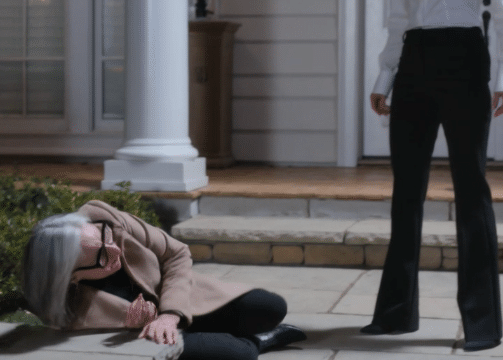
The waitress stumbled and fell to the marble, one hand catching herself near the broken glass. A gasp moved through the crowd.
“What the hell are you doing?” Vivienne shouted.
The waitress lifted one hand to her cheek.
Her name tag had come loose. Her white apron was crooked. Her short dark hair had fallen across one eye. But when she looked up at Julian, her face was not confused.
It was terrified.
Not for herself.
For him.
“Your drink is poisoned,” she said.
The room went still.
Julian’s eyes narrowed.
He was a man who had built an empire by distrusting panic. He did not believe rumors. He did not reward theatrics. He did not let strangers interrupt a gala in front of investors, judges, senators, and half the city’s old money.
“Is this some kind of joke?” he demanded. “How do you know that?”
Vivienne seized his arm.
“Julian, don’t listen to her. She’s dangerous.” Her voice rose toward the watching crowd. “Security, get her out!”
A guard in a dark suit began moving forward.
The waitress pushed herself up from the floor, still holding her cheek.
“No,” she said, louder now.
Vivienne’s fingers tightened around the gray clutch.
The waitress pointed directly at it.
“The poison vial is in her purse.”
A second gasp rippled through the ballroom.
Julian turned slowly toward Vivienne.
For the first time all evening, the woman in pink looked afraid.
And everyone saw it.
Act II
An hour earlier, the Whitmore Foundation Gala had been flawless.
That was how Vivienne liked things.
Flawless.
The marble floors gleamed. The chandelier threw thousands of tiny lights over the ballroom. The orchestra played with tasteful restraint. Servers moved between guests carrying silver trays, their black uniforms blending into the background as if the wealthy had invented a class of people meant to disappear while holding champagne.
Vivienne had checked every detail.
The flowers. The seating chart. The press wall. The order of speeches. The placement of Julian’s glass.
Especially that.
She had become part of Julian Whitmore’s life six months earlier, though she had been circling it long before then. She first appeared at a charity auction in a pink satin dress and a voice warm enough to melt suspicion. She knew which board members had vanity projects, which donors hated being ignored, which journalists could be fed a quote and made to feel chosen.
Julian noticed competence.
He noticed beauty too, but competence lasted longer.
Vivienne became useful.
Then familiar.
Then indispensable.
By winter, people were calling her his future wife.
She never corrected them.
Julian was fifty-two, widowed, powerful, and tired in ways no one saw. His first wife, Claire, had died five years earlier, leaving behind a foundation Julian funded but never emotionally touched. Claire had believed in shelters, public clinics, school libraries, and second chances. Julian believed in results, measurable returns, and avoiding personal grief by burying it under expansion plans.
Vivienne knew that weakness.
She stepped into the empty space with perfect timing.
She told him Claire would want him to live again.
She told him the foundation needed a stronger public face.
She told him loyalty was beautiful, but loneliness was not a shrine.
Slowly, Julian let her stand closer.
Too close.
The waitress, Mara Ellis, had no reason to care about any of that.
At least, that was what everyone assumed.
To the guests, she was just another staff member refilling glasses and collecting plates. A young woman with short dark hair, steady hands, and a name no one planned to remember.
But Mara remembered Julian.
He did not remember her.
Ten years earlier, her mother had worked as a private nurse for Claire Whitmore during the final year of Claire’s illness. Mara had been sixteen then, sitting in hospital corridors with homework on her lap while her mother whispered comfort to a dying woman.
Claire had been kind to Mara.
Not grandly.
Not for show.
Quietly.
She asked about school. She sent Mara home with books. She once told her, “People with money love pretending they built the whole staircase alone. Don’t believe them.”
After Claire died, Mara’s mother was dismissed with a check and a thank-you note written by an assistant.
Then she got sick herself.
Medical bills ate through everything.
Mara learned that charity could fill a ballroom and still miss the people standing just outside its doors.
So when she took a catering shift at the Whitmore gala, she expected nothing.
She wanted the paycheck.
That was all.
Then she saw Vivienne in the service corridor.
The woman in pink was standing alone near the champagne station, half-hidden behind a pillar, her gray clutch open in one hand. Mara was carrying a tray of folded napkins when she noticed the way Vivienne glanced over both shoulders before slipping something small from the purse.
A tiny glass vial.
Mara stopped.
Vivienne turned slightly, blocking the view with her body. Her hand moved over Julian’s glass, the one placed on the side table near the podium for his toast.
The motion was quick.
Practiced.
Then the vial disappeared back into the clutch.
Mara’s breath caught.
For a second, she told herself she had misunderstood.
Maybe perfume. Medicine. Something harmless.
Then Vivienne looked up.
Their eyes met.
Only for half a second.
But Mara knew.
Vivienne had seen that she had seen.
After that, there was no time to find a manager. No time to explain to security. No time to convince a room full of powerful people that the smiling woman in the pink gown had done something monstrous.
Julian was already reaching for the glass.
So Mara ran.
And shattered the evening before the poison could do worse.
Act III
Vivienne recovered quickly.
That was what frightened Mara most.
An innocent person would have been confused. Offended. Shaken by the accusation but eager for proof.
Vivienne became strategic.
She lifted her chin, widened her eyes, and pressed closer to Julian like a frightened woman seeking protection.
“This is insane,” she said. “Julian, look at her. She’s unstable.”
The guard stopped beside Mara.
“Miss, you need to stand up.”
Mara did not move her finger from the clutch.
“Search it.”
Vivienne laughed sharply. “Absolutely not.”
Julian looked at her.
It was a small look.
But she felt it.
Her expression softened. “Darling, this is humiliating. Are you really going to let a waitress accuse me in front of everyone?”
Mara forced herself upright.
Her cheek burned from the slap. Her knees trembled. The ballroom seemed too bright, too full of eyes. She could feel the guests deciding what kind of story this was.
Crazy waitress attacks society woman.
Disgruntled staff member causes scene.
Poor girl wants attention.
Vivienne understood that too. She was counting on it.
Mara looked straight at Julian.
“She put something in your glass near the podium. I saw her.”
Vivienne’s voice snapped. “You liar.”
Mara turned toward the security guard. “Check the side table camera.”
That changed the room.
Vivienne’s mouth closed.
Julian saw it.
He had missed many things in his life, but he had not made billions by missing fear when it flashed in front of him.
“Camera?” he asked.
Mara nodded. “There’s one above the service entrance. It faces the podium table.”
The event manager, a thin man with a headset and panic already forming on his forehead, stepped forward.
“Mr. Whitmore, we do have surveillance for insurance purposes.”
Vivienne’s hand tightened so hard around the clutch that the clasp clicked.
Julian heard it.
So did Mara.
“Open the purse,” Julian said.
Vivienne stared at him. “You cannot be serious.”
“I am.”
“This girl assaulted me.”
“She knocked a glass from my hand,” Julian said. “You struck her.”
The crowd murmured.
Vivienne’s mask cracked again.
Just enough.
“Julian,” she whispered, “after everything I’ve done for you?”
He did not answer.
The security guard held out his hand.
“Ma’am. The clutch.”
She took one step back.
The guard moved with her.
Vivienne’s eyes scanned the ballroom. For allies. For exits. For anyone willing to rescue her from a truth that had finally become inconvenient.
No one moved.
Not even the guests who had admired her all evening.
Wealth was loyal to reputation first.
Julian reached for the clutch himself.
Vivienne jerked away.
“Don’t touch me.”
Mara’s voice cut through the tension.
“She’ll try to drop it.”
Julian looked down.
Vivienne’s hand had shifted beneath the fold of her gown, the clutch tilted toward the floor.
The guard grabbed her wrist.
The clutch fell open.
A tiny glass vial rolled across the marble and stopped beside a shard of Julian’s broken wine glass.
The room erupted.
Vivienne went pale.
Mara closed her eyes.
She had been right.
And somehow, being right made her shake harder.
Act IV
Police arrived within ten minutes.
In a ballroom like that, ten minutes was an eternity.
No one danced. No one drank. No one dared leave, though several tried to drift toward the doors until security quietly sealed the exits.
Julian stood near the shattered glass, silent and rigid.
Vivienne sat in a chair with a guard on either side, her pink gown pooled around her like spilled paint. She no longer looked elegant. She looked furious.
Mara sat in another chair with ice wrapped in a cloth against her cheek.
No one had apologized yet.
Not Julian.
Not the guard.
Not the guests who had stared at her like she was the danger.
Then the surveillance footage was pulled.
The ballroom screen, meant for donor videos and foundation speeches, showed Vivienne in the service corridor. No sound. No glamour. Just the overhead angle of a woman in a pink gown opening her clutch, removing the vial, and moving toward Julian’s glass.
A collective breath passed through the room.
The video continued.
Mara entered the frame carrying napkins.
Stopped.
Saw.
Vivienne turned.
Then the footage skipped to the ballroom view moments later: Julian lifting the glass, Mara lunging, crystal shattering across the marble.
There was no question anymore.
Only consequence.
Julian turned to Vivienne.
“Why?”
She laughed once, bitter and low.
“Why do men like you always ask that after ignoring every answer?”
The detective standing near her paused.
Julian said nothing.
Vivienne’s eyes flashed.
“You were going to announce the revised foundation board tonight. You were going to give Claire’s voting shares to that ridiculous public trust.”
Julian’s face tightened.
Only a handful of people knew that.
The gala was not only a fundraiser. It was supposed to be the night Julian restored control of Claire’s foundation to independent trustees, undoing months of pressure from donors and private firms that wanted access to its property holdings.
Vivienne had advised against it.
Strongly.
She claimed the trust would weaken him.
In truth, it would weaken her.
“You read my private documents,” Julian said.
“I saved you from making a sentimental mistake.”
“You tried to kill me.”
Vivienne’s expression hardened.
“I tried to stop you from giving away everything I earned.”
A stunned silence followed.
Julian stared at her.
“You earned?”
“I rebuilt your life,” she snapped. “I stood beside you. I made you presentable again. I made people forget the grieving widower act. And what was I supposed to get? A ring and a foundation locked away from me forever?”
Mara watched Julian absorb the truth.
Not only the crime.
The insult beneath it.
Vivienne had never loved him.
She had studied him.
Julian looked suddenly older.
The detective gave a quiet instruction, and Vivienne was escorted from the ballroom. As she passed Mara, she leaned close enough to whisper.
“You have no idea what you interrupted.”
Mara looked up.
“Yes,” she said. “I do.”
Vivienne’s eyes narrowed.
Mara stood despite the pain in her cheek.
“You were going to let everyone think he collapsed. You were going to cry over him. You were going to inherit sympathy before anyone asked questions.”
The detective stopped walking.
Julian turned.
Mara continued, voice shaking but clear.
“And then you were going to blame the foundation vote. Stress. His heart. Anything but yourself.”
Vivienne’s face finally lost control.
For one raw second, hatred showed in it.
Then the officers led her away.
Only after the ballroom doors closed did Julian look at Mara as if seeing her for the first time.
“What is your name?” he asked.
The question landed harder than he intended.
Mara laughed softly, without humor.
“You really don’t know.”
His face changed.
She touched the melting ice against her cheek.
“My mother cared for your wife.”
Julian went still.
“Who?”
“Elena Ellis.”
The name struck him.
Not loudly.
Deeply.
He remembered then.
A nurse with tired eyes. A teenage daughter waiting in hallways with textbooks. Claire smiling whenever the girl visited because she said the child made the room feel less like an ending.
Julian whispered, “Mara.”
She nodded.
And the shame that crossed his face was not for the poison.
It was for everything he had failed to see long before that glass shattered.
Act V
The gala never resumed.
No one knew how to return to champagne after attempted murder.
Guests left in clusters, whispering beneath the chandelier, stepping carefully around the place where the broken glass had been swept but not forgotten. By midnight, the ballroom looked abandoned: wilted flowers, half-empty tables, candles burning low, a foundation banner still hanging behind the podium where Julian had been meant to speak.
Mara sat in a small side office while a medic checked her cheek.
Julian stood near the door.
For once, he looked unsure of his right to enter.
“Mara,” he said quietly.
She did not look up. “Mr. Whitmore.”
“Julian.”
That made her glance at him.
He seemed almost embarrassed by the correction.
“I owe you my life.”
“You owe me an apology first.”
The words came out before she could soften them.
His face stilled.
Then he nodded.
“You’re right.”
Mara waited.
Not because she wanted to punish him.
Because she had spent too much of her life watching powerful people skip the part where they admitted harm.
Julian stepped inside.
“I’m sorry I didn’t believe you immediately. I’m sorry my security nearly removed you. I’m sorry she struck you in my home and I stood there asking for proof while you were on the floor.”
Mara’s throat tightened.
He continued, voice lower.
“And I’m sorry about your mother.”
Her eyes sharpened.
His did not leave hers.
“Elena deserved more than a check and a note from my office after Claire died. I knew she was ill later. I heard something about medical bills. I told myself the foundation handled those things.” His mouth tightened. “That was a coward’s way of saying I didn’t want to know.”
Mara looked down at her hands.
Her anger had been easier when he was only arrogant.
Harder now that he was honest.
“My mother admired Claire,” she said. “She used to say your wife was the only rich person she ever met who knew how to listen.”
Julian closed his eyes briefly.
“That sounds like Claire.”
Mara looked toward the closed ballroom doors.
“She would have hated tonight.”
“Yes,” he said. “But she would have loved what you did.”
Mara did not answer.
Outside the office, detectives collected statements. The vial was sealed as evidence. The broken glass was bagged. Vivienne’s gray clutch was photographed under harsh white lights, stripped of glamour, reduced to proof.
By morning, news outlets had the story.
Society woman arrested at Whitmore gala.
Waitress stops suspected poisoning.
Foundation power struggle under investigation.
They called Mara a hero.
She hated that word.
Heroes sounded clean.
She had been terrified. Angry. Shaking. For one second before she knocked the glass away, she had thought of doing nothing because doing something would destroy her life.
Then she thought of her mother.
Of Claire.
Of all the quiet women who had kept powerful rooms running while powerful people forgot their names.
So she moved.
The investigation widened quickly.
Vivienne had not acted alone in ambition, though she had acted alone in the final violence. Emails revealed outside pressure from private investors eager to gain influence over the Whitmore Foundation’s real estate holdings. Vivienne had promised access after marriage. When Julian prepared to transfer authority to the public trust, she panicked.
The foundation board meeting went forward two weeks later.
This time, not in a ballroom.
In a modest conference room at a community clinic Claire had funded years before.
Julian signed the trust documents in front of attorneys, trustees, clinic workers, and two reporters.
Then he asked Mara to stay.
She almost refused.
But curiosity, and maybe unfinished grief, kept her in the room.
Julian placed a folder on the table.
“This is not repayment,” he said. “I don’t want to insult you by pretending a gift balances anything.”
Mara opened it.
Inside was a proposal.
The Elena Ellis Nursing Scholarship.
Full tuition support for students from working-class families entering nursing and patient care programs. Funded permanently. Administered independently. Named with Mara’s approval only.
Mara stared at it until the words blurred.
“You remembered her name.”
Julian’s voice softened.
“You made sure I could never forget it again.”
Mara pressed one hand over her mouth.
For years, she had carried her mother’s memory like something fragile and private, certain it would disappear if she stopped protecting it. Now it was there in ink, in policy, in money redirected toward people like the woman who had once stood beside Claire Whitmore’s bed.
Mara looked up.
“My mother would say yes.”
Julian nodded.
“What would you say?”
Mara thought about the ballroom. The slap. The crowd ready to condemn her. The vial rolling across marble. Vivienne’s face when power finally turned its head away from her.
Then she thought about her mother’s hands adjusting a patient’s blanket.
“I say make it bigger,” Mara said. “Include caregivers too. Not just nurses. Home health aides. Hospice workers. The people everyone forgets until they need them.”
For the first time since the gala, Julian smiled.
“Done.”
Months later, the ballroom reopened for another foundation event.
Mara did not work it.
She attended.
Not in uniform.
Not carrying a tray.
She wore a simple black dress and stood beneath the chandelier while the first Elena Ellis scholars were announced. Most were young. Some were older. One had three children. Another had spent years caring for her grandfather and wanted to become a hospice nurse.
Julian spoke briefly.
No grand performance.
No polished myth.
He told the room that institutions often praised generosity while ignoring the people who practiced it quietly every day. He said the foundation had been corrected by someone brave enough to act when everyone else hesitated.
Then he invited Mara to the podium.
She did not want to go.
But she did.
The room stood.
This time, the applause did not feel like spectacle.
It felt like witness.
Mara looked across the ballroom, at the marble floor where the glass had shattered months before. No stain remained. No shards. No sign of the moment that had split one life from another.
But she remembered.
A raised glass.
A woman in pink.
A room full of people waiting to be told what to believe.
And one terrible second when the truth depended on a waitress no one had bothered to notice.
Mara leaned toward the microphone.
“My mother used to say the most dangerous thing in any room is not hate,” she said. “It’s the moment decent people pause and wait for someone else to act.”
The ballroom fell silent.
She took a breath.
“I almost paused.”
Julian lowered his eyes.
Mara looked toward the scholarship recipients.
“I’m grateful I didn’t.”
The applause came slowly, then fully.
And somewhere in the weight of it, beneath the chandelier and above the marble where broken glass had once scattered, the room changed.
Not because wealth had become kinder overnight.
Because the woman who had been slapped to the floor had stood back up, pointed at the purse, and forced every powerful person present to look where the truth was hiding.