Act I
The father smiled until the front door closed.
Before that, he had been perfect.
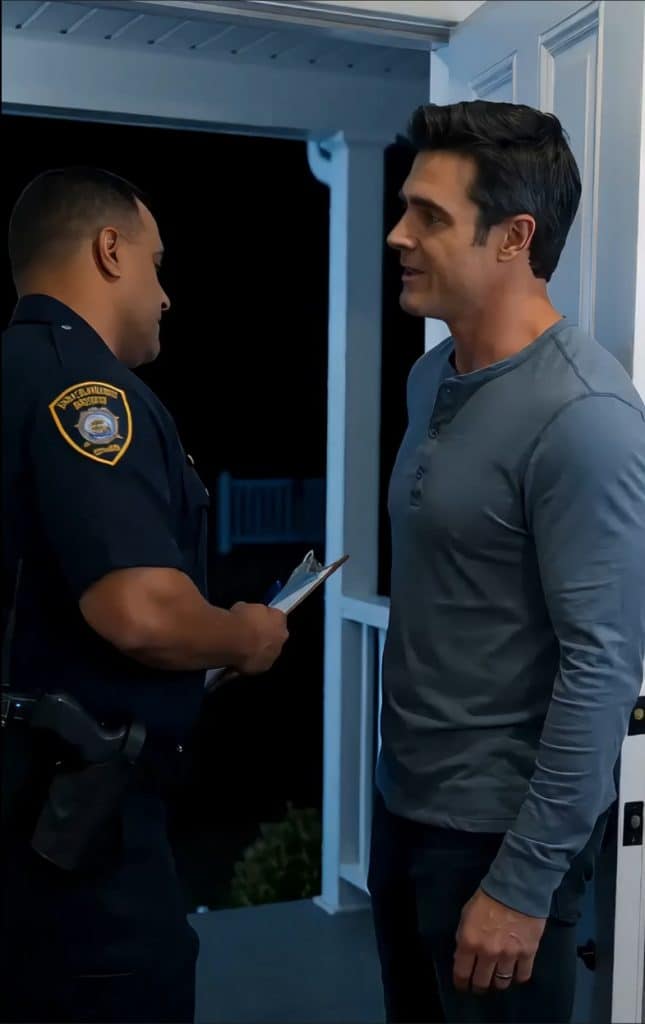
Calm voice. Open posture. One hand resting casually on the doorframe while the police officer stood on the porch with a clipboard and a pen.
“It’s really nothing to worry about, Officer,” Nathan Reed said. “She fell at the playground. Kids bruise. You know how it is.”
Officer Miles Carter glanced past him into the living room.
On the beige sofa sat Nathan’s daughter, Ava.
She was eight years old, wearing a light blue shirt and sitting so still she barely looked real. Her long brown hair fell over one shoulder. A dark bruise shadowed the skin beneath her left eye, and her hands were folded tightly in her lap.
Too tightly.
Carter’s eyes lingered on her.
“Ava,” he said gently, “you okay?”
The girl opened her mouth.
Nathan turned his head just slightly.
Not enough for the officer to call it a threat.
Enough for Ava to see it.
She nodded once.
Carter looked back at Nathan.
Nathan gave a tired little laugh, the kind of laugh responsible parents use when explaining difficult children.
“She’s embarrassed,” he said. “A neighbor made the call after she cried outside. I appreciate you checking, but we’re fine.”
From deeper inside the house, a man in an olive-green shirt watched in silence.
His name was Luke Bennett. He leaned near the hallway, hands in his pockets, face tight with worry. He had said nothing since the officer arrived.
Carter noticed him too.
“Sir, you live here?”
Luke’s jaw tightened.
“I’m family.”
Nathan smiled wider.
“My wife’s brother. He worries too much.”
Luke did not deny it.
The officer wrote something on the clipboard.
“All right,” Carter said. “I’ll make sure to note that.”
Nathan extended his hand.
“Thank you, Officer.”
They shook.
Ava’s fingers began tapping against the sofa armrest.
Fast.
Soft.
Again and again.
Three taps. Pause. Three taps. Pause.
Carter’s hand paused on the door.
For one strange second, his eyes shifted toward the sound.
Then Nathan stepped slightly into his line of sight.
“Have a good night.”
The officer hesitated, then stepped onto the porch.
The door closed.
The lock clicked.
Ava stopped tapping.
The polite smile fell from Nathan’s face like a mask dropped onto the floor.
He turned slowly toward the living room.
The house seemed to shrink around them. The polished dark hardwood. The white walls. The clean doorframes. The family photos arranged neatly on the console table.
Everything looked normal.
That was what made it terrifying.
Nathan walked toward the sofa.
Ava curled inward, tears filling her eyes without sound.
Luke moved away from the hallway wall.
“Nathan,” he said quietly. “Don’t.”
Nathan did not look at him.
His face had gone red, his jaw locked tight.
“You embarrassed me,” he said to Ava.
She shook her head.
Her breath came in tiny, trembling pieces.
Nathan raised his right hand.
Ava flinched before anything happened.
Then a hard knock struck the front door.
Once.
Twice.
Three times.
Nathan froze.
From the porch, Officer Carter’s voice cut through the wood.
“Mr. Reed. Open the door.”
Nathan’s eyes widened.
Because the officer had heard something after all.
Act II
Ava had learned the tapping from her mother.
Not as a game.
As a promise.
When Emily Reed was still alive, she used to sit beside Ava on the sofa during thunderstorms and teach her little patterns with her fingers.
Three taps means I need help.
Two taps means I’m scared.
One long press means stay with me.
Ava had been five then, too young to understand why her mother watched doorways so carefully. She only knew that Emily’s voice changed when Nathan came home late. Softer. Smaller. Like she was folding herself into a shape that would not be noticed.
Luke Bennett noticed.
He noticed because Emily was his sister, and because she had once been loud. Funny. Impossible to ignore. The kind of woman who sang in grocery aisles and argued with GPS directions as if the machine had personally insulted her.
Marriage changed her slowly.
Not all at once.
Nathan was charming in public. Successful. Fit. Friendly with neighbors. He remembered birthdays and shoveled driveways after storms. He knew exactly how to be useful where people could see.
Inside the house, the air belonged to him.
His moods controlled dinner. His silence controlled mornings. His approval became something Emily and Ava learned to chase and fear.
Emily tried to leave once.
Luke knew because she called him from a gas station outside town, whispering while Ava slept in the back seat.
“I have to do it right,” she said. “If I do it wrong, he’ll take her.”
Two weeks later, Emily died in a car crash on a wet road.
The official story was simple.
Tragic weather. Poor visibility. A curve taken too fast.
Luke accepted it at first because grief makes people obedient. Then he found Emily’s old notebook hidden behind a loose panel in his garage, left there during one of her visits.
It contained dates.
Descriptions.
A lawyer’s number.
And one line Luke could not stop rereading.
If anything happens to me, watch Ava. He’ll make everyone believe him.
After Emily died, Nathan became even better at performing.
The grieving husband.
The single father.
The man doing his best.
Ava became quieter.
At first, Luke visited often. Then Nathan began making excuses. Ava was tired. Ava had homework. Ava was sick. Ava was at a friend’s house. Ava needed routine.
Luke kept pushing.
That night, he had come over uninvited after Ava’s school nurse called him from a private number. The nurse had not accused Nathan directly. She only said Ava had arrived with a bruise and a rehearsed explanation.
“She asked if her uncle still lived nearby,” the nurse said. “I thought you should know.”
Luke drove straight there.
Nathan answered the door with calm annoyance.
Ava was on the sofa.
The bruise was visible immediately.
Luke called the police from the bathroom while pretending to wash his hands.
But when Officer Carter arrived, Nathan controlled the room so smoothly that Luke felt the same helpless rage he had felt during Emily’s marriage.
Ava would not speak.
Nathan would not slip.
And Carter, procedural and polite, seemed ready to leave.
Then came the tapping.
Three taps.
Pause.
Three taps.
The same pattern Emily had taught her daughter.
Luke heard it.
Carter heard it too.
But Nathan thought it was just fear.
He did not know that Ava’s mother had left behind a language small enough to hide inside silence.
And now, outside the locked door, the officer was beginning to understand that the little girl had been speaking the only way she could.
Act III
Nathan did not open the door right away.
He stood in the middle of the living room, hand still half-raised, eyes fixed toward the entryway.
Ava shook on the sofa.
Luke took one step toward her.
Nathan turned sharply.
“Stay where you are.”
Luke stopped, but only because Ava was between them and panic could make Nathan unpredictable.
The knock came again.
“Mr. Reed,” Officer Carter said, firmer now. “Open the door.”
Nathan inhaled through his nose.
Then the mask returned.
Not fully.
But enough.
He lowered his hand, smoothed the front of his grey-blue shirt, and walked back to the entryway.
“Everything okay, Officer?” he called.
“Open the door.”
Nathan unlocked it.
Carter stood on the porch, but he was no longer alone.
Another patrol car had pulled up behind his cruiser. A female officer stood near the steps with one hand resting calmly near her radio. Red and blue light moved across the porch railing and the white trim of the house.
Nathan’s expression flickered.
“What is this?”
Carter looked past him.
“Step away from the doorway.”
“There’s no reason—”
“Step away.”
This time, there was no politeness to hide behind.
Nathan stepped back.
Carter entered the house again, eyes moving immediately to Ava. She had pulled her knees close now, trying to disappear into the sofa.
The officer’s face changed.
Not dramatically.
But enough for Luke to see the regret.
Carter crouched several feet away from the sofa, careful not to crowd her.
“Ava,” he said gently, “were you tapping because you needed help?”
Nathan laughed sharply.
“She’s nervous. She does that.”
Carter did not look at him.
“Ava,” he repeated, softer. “Three taps. Was that for help?”
Ava’s lower lip trembled.
She looked at her father.
Then at Luke.
Luke nodded once.
Her voice came out barely louder than air.
“Mommy taught me.”
The room went still.
Nathan’s face drained.
Officer Carter slowly stood.
Nathan snapped, “She’s confused. She’s a child.”
Luke’s voice cut through the room.
“She’s a child you were about to hurt the second he left.”
Nathan spun toward him.
“You don’t know anything.”
Luke reached into his pocket and lifted his phone.
“I know enough to record after the door locked.”
Nathan froze.
The second officer entered fully now.
Carter turned toward her.
“Call child services. We need a supervisor and medical evaluation.”
Nathan’s voice rose.
“This is my house. That is my daughter.”
Carter faced him.
“And right now, my job is to make sure she is safe from you.”
Ava began to cry then.
Not loudly.
Not dramatically.
Just a small sound breaking loose from a place that had held too much.
Luke moved toward her.
This time, Nathan tried to stop him.
The officers stepped between them before he could cross the room.
The power in the house changed hands so quickly Nathan looked almost confused by it.
For years, his voice had been enough.
Now, finally, it was not.
Act IV
Nathan’s version of the story collapsed one detail at a time.
First, the bruise.
Then the tapping.
Then Luke’s recording, which did not show harm happening but captured enough: the lock click, Nathan’s footsteps, Ava’s terrified breathing, Nathan’s words, and Luke’s warning before the officer knocked again.
Then came the notebook.
Luke drove home with an officer behind him and retrieved Emily’s hidden journal from his garage. It was sealed in a plastic storage box, wrapped in one of her old scarves. He had kept it because he did not know what else to do with grief that also looked like evidence.
Now he knew.
Carter read only a few pages before his expression turned heavy.
He looked at Luke.
“You should have brought this sooner.”
Luke swallowed.
“I thought I needed proof no one could dismiss.”
Carter looked toward the house, where Ava sat wrapped in a blanket beside the female officer.
“Sometimes waiting for perfect proof leaves a child alone too long.”
The words were not cruel.
That made them harder.
Luke nodded.
“I know.”
Inside, Ava was examined by paramedics and spoken to by a child welfare specialist who arrived in a soft sweater and did not ask too many questions at once.
Nathan sat at the dining table under supervision, no longer shouting.
That silence was not peace.
It was calculation.
Carter recognized that now and hated that he had almost missed it.
He had been trained to observe houses like this. He had seen controlling partners, frightened children, family members who lied smoothly and neighbors who second-guessed themselves. But training did not erase the danger of wanting a call to resolve neatly.
A calm father.
A quiet child.
A plausible explanation.
A report to finish.
He had almost walked away.
If Ava had not tapped, if Luke had not recorded, if Carter had not paused on the porch with the sound echoing in his mind, the locked door would have held the truth inside.
He stood in the hallway and looked at Ava’s tiny hand resting on the blanket.
Three taps.
Such a small thing.
Such a desperate thing.
When the child welfare specialist asked Ava if she felt safe staying in the house that night, Ava did not answer with words.
She reached for Luke.
That was answer enough.
Nathan’s composure cracked only when he realized Ava would leave.
“You can’t take her,” he said. “She’s all I have left.”
Luke turned toward him, eyes wet but steady.
“She is not something you have.”
Nathan stared.
Luke stepped closer, but the officer held up a hand to keep distance.
Luke stopped and spoke from where he stood.
“Emily was not something you had either.”
For the first time all night, Nathan had no reply.
Ava left the house wrapped in a blanket, her hand tucked inside Luke’s. The porch light shone on her face as she stepped into the night air.
She paused at the threshold.
Carter thought she might look back at her father.
She did not.
She looked at the door.
The locked door.
The barrier that had almost sealed her inside.
Then she looked at Officer Carter.
“Did you hear me?” she whispered.
His throat tightened.
“Yes,” he said. “I heard you.”
Ava looked down.
“I didn’t think anyone would.”
That sentence stayed with every adult on that porch long after the door closed behind them.
Act V
Ava spent the first night at Luke’s house in the guest room that used to belong to Emily.
Luke had changed the bedding before, but he had never been able to change the feeling of it. His sister’s old books still sat on the shelf. A blue ceramic lamp stood beside the bed. The curtains had tiny yellow flowers on them, chosen by Emily years earlier because she said mornings needed encouragement.
Ava stood in the doorway for a long time.
“This was Mommy’s?”
Luke nodded.
“When she visited, yes.”
Ava touched the edge of the blanket.
“Can I sleep with the light on?”
“You can sleep with every light in the house on.”
She almost smiled.
That night, Luke sat in the hallway outside her room because she asked him not to close the door all the way. Every time the house creaked, she woke. Every time a car passed, her breath changed.
At two in the morning, he heard it.
Tap tap tap.
Pause.
Tap tap tap.
He opened the door slowly.
Ava sat upright in bed, crying silently.
Luke knelt in the doorway.
“I’m here.”
She looked ashamed.
“I forgot I’m not there.”
He pressed one hand to the floor, not coming closer without permission.
“That might happen for a while.”
“Is that bad?”
“No,” he said. “That’s your body remembering before the rest of you catches up.”
She thought about that.
Then she moved one hand and patted the bed beside her.
Luke sat at the edge until she fell asleep.
The next weeks were full of appointments, interviews, court orders, and careful routines. Ava did not have to return to Nathan’s house. Temporary custody went to Luke while the investigation continued. The school counselor helped create a safety plan. The nurse who had called Luke cried when she saw Ava walk back into school holding his hand.
Officer Carter visited once, in plain clothes, after asking permission.
He brought a small card.
On it, he had written three dots, then a space, then three dots again.
Underneath:
I will listen the first time.
Ava studied it for a long while.
Then she placed it in the drawer beside her bed.
“Were you scared?” she asked him.
Carter answered honestly.
“Yes.”
“But you’re police.”
“That doesn’t mean I never get scared. It means I still have to do the right thing.”
Ava nodded.
“My mom was scared too.”
Luke looked away.
Carter’s voice softened.
“She was also very smart. She gave you a way to ask for help.”
Ava touched her fingers together.
“I thought tapping was too quiet.”
Carter shook his head.
“Not if someone is listening.”
Months passed.
The house where Ava had lived became evidence, then property, then just a place on a street she no longer had to enter. Nathan’s case moved forward. Emily’s notebook mattered. Luke’s recording mattered. Ava’s words mattered most, but only when she was ready to give them.
No one rushed her.
That was the first kindness that felt strange to her.
Being allowed to take time.
Spring came slowly.
Ava started laughing again, though sometimes she stopped herself afterward, as if joy might get her in trouble. Luke learned not to comment when it happened. He only kept making pancakes badly on Saturdays until she laughed again at the shapes.
One Saturday, she told him one looked like a shoe.
He said it was supposed to be a horse.
She laughed so hard she had to sit down.
Luke turned away toward the stove, pretending to rescue another pancake, because he did not want her to see him cry.
At school, Ava’s teacher began a quiet classroom lesson about safe adults and asking for help. She did not mention Ava. She did not need to. The whole class learned simple signals: a note, a trusted person, a call, a phrase, a tap.
Officer Carter helped design the training for other officers too.
Not because he wanted praise.
Because he remembered standing on that porch, one step from leaving, while a child tried to speak without words.
At the end of the school year, Ava brought home a drawing.
It showed a house with a porch light. A little girl stood outside holding hands with a man in an olive-green shirt. Behind them was a police car. In the sky, Ava had drawn three small stars, then three more.
Luke looked at the picture for a long time.
“Are those stars?”
Ava shook her head.
“They’re taps.”
He swallowed.
“What do they mean?”
She leaned against him, light as a bird.
“They mean someone came back.”
Luke framed the drawing and hung it in the hallway.
Not as a reminder of danger.
As proof of what changed.
Years later, Ava would still remember the locked door. The sound of her father’s footsteps on hardwood. The way fear made her body small before she could tell it not to.
But she would remember the knock too.
The officer returning.
Her uncle standing between her and the man who had controlled the room for too long.
The moment she realized her mother’s quiet code had survived her.
And on difficult nights, when memories pressed too close, Ava would tap three times against her blanket.
Not because she was trapped anymore.
Because each tap reminded her of the truth she had fought so hard to believe.
Someone heard.
Someone came back.
And the door opened.