Act I
Thomas Reeves came home early because of a broken machine at the factory.
That was the official reason.
The real reason, though he could not admit it yet, was the message.
It had been waiting on his phone when his shift supervisor told everyone to leave before noon. Three seconds of silence. A soft rustle. Then his mother’s voice, so faint he had played it six times in the parking lot.
“Tommy…”
Nothing else.
Just his childhood nickname.
Then the line went dead.
By the time he reached the house, his hands were still shaking on the steering wheel.
The front door was unlocked.
That was the first thing wrong.
His wife, Marissa, always locked the door. She complained about delivery boys, neighbors, teenagers walking too slowly past the driveway. She locked the door even when Thomas was outside taking out trash.
Inside, the house was too quiet.
No television in the den. No kettle humming in the kitchen. No soft music from his mother’s room like usual.
Then he heard Marissa’s voice.
Not loud at first.
Sharp.
Low.
Cruel in a way that made Thomas stop before he reached the hallway.
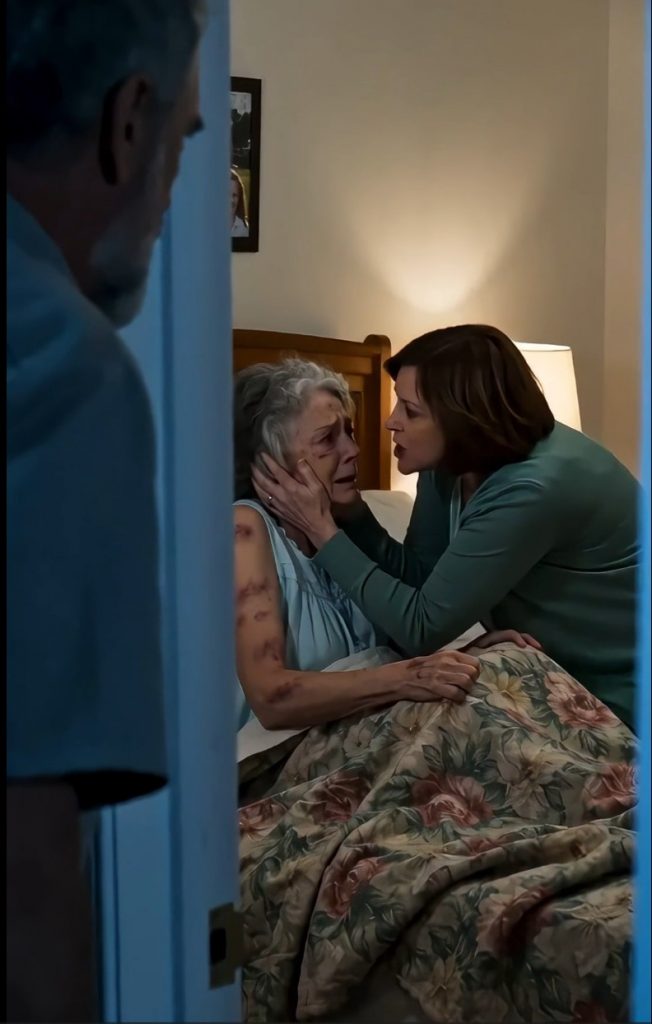
His mother’s bedroom door was slightly open. A narrow strip of warm light spilled onto the floor. Thomas stood in the dim hall, one hand hovering near the doorframe.
Through the gap, he saw his wife kneeling on the bed.
And he saw her hands on his mother’s face.
Margaret Reeves sat propped against the pillows in her light blue nightgown, the floral blanket pulled around her waist. Her gray curls were flattened from sleep. Her thin shoulders trembled. Her eyes were wet and wide with fear.
Marissa leaned close to her.
“Still hoping?” she hissed. “No one is coming.”
Thomas stopped breathing.
For a second, his brain rejected what he was seeing.
This was his wife. The woman who arranged church flowers. The woman who smiled at neighbors. The woman who told him his mother was “getting difficult” and “confused” and “ungrateful.”
This was his mother. The woman who raised him alone after his father died. The woman who worked double shifts at the diner to keep him in school shoes. The woman who moved into his house only after he begged her not to stay alone after her fall.
And now she sat in her own son’s home like a prisoner.
Marissa pulled her hands away and pointed at Margaret.
“Your punishment starts again,” she snapped. “Like every day.”
Margaret shrank back against the pillow.
Thomas’s fingers closed around the doorframe.
He almost pushed the door open.
Almost.
Then his mother spoke.
“Please,” she whispered. “Not today.”
The words broke him.
Not because they were frightened.
Because they were practiced.
Thomas understood, with a horror that hollowed him out from the inside, that he had not walked in on the first time.
He had walked in on a routine.
And his wife still had no idea he was standing outside the door.
Act II
When Margaret first moved in, Thomas thought he was saving her.
The old house on Birch Street had become too much after her fall. The stairs were steep, the bathroom was narrow, and the winter ice made every errand dangerous. Margaret resisted leaving because the house still held pieces of her life: her husband’s tool bench, the kitchen wallpaper she had chosen in 1978, the little pencil marks on the pantry door where Thomas’s height had been measured year by year.
But Thomas insisted.
“You took care of me,” he told her. “Now it’s my turn.”
Margaret cried when he said that.
Marissa did not.
She smiled politely and said, “Of course your mother should be with us.”
At first, she played the part perfectly.
She bought new bedding. She arranged framed family photos on the dresser. She told people at church that Margaret was “settling in beautifully.” She spoke softly whenever Thomas was nearby and brought his mother tea in a floral cup that looked cheerful enough to hide resentment.
Thomas wanted to believe it.
He was tired.
That was the excuse he would later hate most.
He worked long shifts repairing industrial equipment. He left before sunrise and came home with grease under his nails, back aching, mind dull from noise. Marissa handled the house. Marissa handled the appointments. Marissa handled the medications, the meals, the phone calls.
At least, that was what she told him.
Slowly, his mother changed.
She stopped joining them for dinner.
Marissa said Margaret’s stomach was sensitive.
She stopped calling her old friends.
Marissa said too many calls confused her.
She stopped wearing the blue cardigan Thomas bought her for Christmas.
Marissa said Margaret had spilled soup on it and refused to let anyone wash it.
Every time Thomas asked his mother if she was all right, Margaret smiled too quickly.
“I’m fine, Tommy.”
He believed the smile because he needed to.
Because doubt would have required action.
Because admitting something was wrong meant admitting he had left his mother alone with the wrong person.
Marissa became the translator of Margaret’s life.
“She had another episode today.”
“She accused me of hiding things.”
“She gets angry when you’re gone, then acts sweet when you come home.”
“She needs stricter routines.”
That last phrase became common.
Stricter routines.
Thomas heard it and thought of schedules, meals, medicine, sleep.
He did not think of fear.
He did not think of punishment.
He did not think of his mother lying awake in a bedroom filled with family photos, waiting for the sound of his truck in the driveway like a child waiting for rescue.
A month before the day he came home early, Thomas found a bruise on Margaret’s wrist.
It was faint, partly hidden beneath her sleeve.
He asked what happened.
Margaret looked at Marissa before answering.
“I bumped the dresser.”
Marissa laughed softly. “Your mother is always bumping things.”
Thomas remembered feeling uneasy.
Then Marissa touched his arm and said, “Honey, you can’t panic over every mark. She’s fragile.”
Fragile.
That word had done so much damage.
It made Margaret’s fear look like weakness. It made Marissa’s control look like care. It made Thomas ignore the way his mother flinched when a cabinet closed too loudly.
Then came the phone message.
Three seconds.
One word.
Tommy.
Now he stood outside the bedroom door, listening to the truth he had been too tired, too trusting, and too ashamed to see.
But the worst part had not been said yet.
Act III
Marissa moved around the bedroom like she owned the air in it.
Thomas watched through the narrow crack, hidden in the hall shadow.
His mother’s tissue box sat on the side table. The lamp glowed warmly over the wooden headboard. Framed photos lined the dresser: Thomas at graduation, Thomas with his late father, Margaret holding him as a baby in a yellow kitchen long gone.
A room full of love had become a room full of threats.
Marissa grabbed a folder from the dresser.
Thomas recognized it immediately.
The green folder.
Marissa had told him it contained insurance forms and medical paperwork that needed updating. She had been asking him for weeks to convince Margaret to sign.
“She’s being stubborn,” Marissa said. “You know how older people get about documents.”
Now Marissa opened the folder and pulled out several pages.
“You’re signing today,” she said.
Margaret shook her head weakly. “I told you. I don’t understand those papers.”
“You don’t need to understand them.”
“I want Tommy to read them.”
Marissa laughed.
The sound made Thomas’s stomach turn.
“Tommy reads what I hand him,” she said. “Tommy believes what I tell him. You think he’s going to choose you over his wife?”
Margaret’s eyes filled.
“He’s my son.”
“And I’m the one who lives with him.” Marissa leaned closer. “I’m the one who hears him complain that this is too much. I’m the one who knows he’s tired.”
Thomas felt the hallway tilt.
He had complained.
Not about his mother.
About bills. Work. pressure. Sleep. Fear that he was failing everyone.
Marissa had taken those private exhausted words and sharpened them into weapons.
Margaret looked down at the blanket.
“He wouldn’t say that.”
“He doesn’t have to,” Marissa said. “I see it.”
She shoved the papers onto the bed.
“Sign the power of attorney transfer. Sign the property release. Then maybe we can finally get you into a facility where people are paid to tolerate you.”
Thomas’s hand tightened on the doorframe so hard the wood creaked.
Marissa did not hear it.
Margaret did.
Her eyes flicked toward the door.
For one second, she saw him.
Thomas knew she did.
Her face changed.
Not much. Not enough for Marissa to notice.
But enough.
Hope flashed in her eyes, then fear. She understood instantly that he was there. She also understood he had heard.
Thomas lifted one finger to his lips.
Not to silence her suffering.
To tell her he would not waste the moment.
Marissa still believed she was alone. And for the first time, Thomas understood that if he burst in too soon, she would deny everything. She would cry. She would say Margaret was confused. She would call it a misunderstanding.
She had been building that defense for months.
So Thomas stayed hidden.
His heart was pounding so hard he could barely hear.
Marissa picked up a pen.
“Sign.”
Margaret’s voice shook. “No.”
Marissa went still.
The silence that followed was terrifying.
“What did you say?”
Margaret looked toward the door again.
This time, she did not look away.
“I said no.”
It was barely a whisper.
But to Thomas, it sounded like thunder.
Marissa’s face hardened.
And Thomas finally stepped into the room.
Act IV
Marissa turned so fast the pen fell from her hand.
Thomas stood in the doorway, gray work shirt wrinkled, beard still damp from the rain outside, face pale with fury and grief.
For a moment, no one moved.
Marissa recovered first.
She always did.
“Thomas,” she said, breathless. “You scared me.”
He did not answer.
His eyes moved from the papers on the bed to his mother’s trembling hands, then to Marissa.
“What are those?”
Marissa laughed once, too brightly. “Medical forms. Your mother is having one of her episodes.”
Margaret closed her eyes.
Thomas walked to the bed and picked up the top page.
He read silently.
The room seemed to shrink around them.
It was not a medical form.
It was a transfer of authority over Margaret’s accounts. Another page authorized the sale of Margaret’s old house. Another designated Marissa as a financial agent if Thomas was “unavailable.”
His signature line was already filled in.
Forged.
Thomas looked at his wife.
Marissa’s face lost color.
“I can explain.”
“No,” Thomas said.
One word.
Low. quiet. final.
Marissa stepped off the bed, smoothing her cardigan as if dignity could be rearranged by hand.
“Your mother is confused. She’s been saying things. I didn’t want to burden you.”
Thomas turned toward Margaret.
His voice broke.
“Mom.”
Margaret looked at him like she was afraid comfort might vanish if she reached for it.
“I’m sorry,” she whispered.
That undid him more than anything else.
He sat on the edge of the bed, careful not to crowd her, and took her hand between both of his.
“No,” he said. “You don’t apologize. Not for this. Not ever.”
Marissa’s voice sharpened.
“Thomas, don’t let her manipulate you. This is exactly what I warned you about.”
He turned slowly.
The man who looked at her then was not the tired husband she had learned to manage.
He was the son of the woman in the bed.
“I heard you.”
Marissa froze.
Thomas continued, “I heard what you said. I saw your hands on her. I heard you tell her no one was coming.”
“She’s exaggerating—”
“She didn’t say anything,” Thomas cut in. “You did.”
The room went silent.
Marissa looked toward the door, toward the hall, toward escape.
Thomas stood.
“You’re going downstairs,” he said. “You’re going to sit in the kitchen. You are not going near my mother again.”
“You can’t order me around in my own house.”
Thomas looked at the framed photo on the dresser. His mother in her younger years, holding him at two years old, smiling with the kind of faith only a mother has in a child who cannot yet stand alone.
Then he looked back at Marissa.
“This is my mother’s house too,” he said. “She paid the down payment when we couldn’t. Remember? You called it a gift. I should have called it what it was.”
Marissa’s jaw tightened.
“What?”
“Trust.”
He took out his phone.
Marissa’s eyes flicked to it.
“Who are you calling?”
“Help.”
That single word cracked through her confidence.
A doctor arrived first, then Thomas’s sister Lydia, who had been kept away for months by Marissa’s claim that Margaret “became agitated with visitors.” Later came a social worker and two officers who spoke gently to Margaret and separately to Thomas.
Marissa cried in the kitchen.
She cried beautifully.
She said stress had broken her. She said Margaret provoked her. She said Thomas had no idea what caregiving was like because he got to leave the house. She said she had sacrificed everything.
Thomas listened from the doorway.
Once, those tears might have confused him.
Now he heard only performance.
Upstairs, Margaret sat wrapped in a robe while Lydia brushed her hair with slow, careful strokes. The doctor spoke softly. Margaret answered in fragments at first, then more clearly as Marissa’s voice faded down the hall.
Yes, it had happened before.
Yes, she had been afraid.
Yes, the papers were forced on her.
Yes, she had tried to call Thomas.
Thomas stood outside the room listening, tears running silently into his beard.
He had wanted one truth.
Instead, he found months of it.
And every piece pointed back to the same terrible fact: his mother had been suffering inside his home while he called it care.
Act V
Marissa left that night.
Not with shouting.
Not with a dramatic storm of broken picture frames and slammed doors.
She left with a suitcase, a police escort, and a face emptied of the certainty she had worn for years.
At the bottom of the stairs, she turned toward Thomas one last time.
“You’re throwing away your marriage for a woman who won’t even remember this in a year.”
Thomas looked at his mother’s bedroom door.
Then back at his wife.
“She remembered enough to be afraid of you.”
Marissa opened her mouth.
No words came.
For once, silence belonged to her.
The door closed behind her.
Only then did Thomas sit on the bottom stair and cover his face.
Lydia found him there minutes later.
She did not comfort him gently.
She sat beside him and said, “You should have called me sooner.”
“I know.”
“You should have believed something was wrong.”
“I know.”
“You can hate yourself later,” she said. “Right now, Mom needs you useful.”
That was Lydia. Sharp where love needed structure.
Thomas nodded.
So he became useful.
He changed the locks before midnight. He moved a chair beside Margaret’s bed and slept there badly, waking every time she shifted. He called an attorney the next morning. He contacted the bank. He reviewed every document Marissa had touched.
The forged papers did not hold.
The old house was safe.
Margaret’s accounts were frozen and reviewed.
More importantly, Margaret was believed.
That mattered more than Thomas expected.
For the first week, she apologized constantly.
For needing help.
For being frightened.
For not telling him sooner.
For “causing trouble.”
Every apology hurt him in a different place.
Finally, on the eighth day, Thomas knelt beside her chair in the living room.
“Mom,” he said, “when I was six and broke Mrs. Keller’s window, did you apologize to me?”
Margaret blinked. “What?”
“You marched me across the street and made me tell the truth.”
A faint smile touched her mouth. “You cried the whole way.”
“I did.”
“You were always dramatic.”
Thomas laughed once, then wiped his eyes.
“You taught me that the person who does wrong carries the shame. Not the person who got hurt.”
Margaret’s smile faded.
He took her hand.
“So let me carry mine. And let her carry hers. But don’t you dare carry it for us.”
Margaret looked at him for a long time.
Then she nodded.
It was small.
It was enough.
Healing did not come quickly.
Some mornings Margaret still woke afraid when footsteps moved too fast in the hallway. Some evenings Thomas found her folding and refolding the same blanket, trying to settle nerves that had learned vigilance. Lydia visited often. A caregiver came during Thomas’s shifts, chosen by Margaret this time, not for her.
The bedroom changed too.
The green folder was gone.
The family photos stayed.
Thomas added one more beside the lamp: a new picture taken on the back porch in autumn. Margaret sat in her blue cardigan with a quilt around her knees. Thomas stood behind her chair. Lydia leaned in from one side, laughing because Margaret had just scolded them both for making a fuss.
Margaret looked fragile in the photo.
But not trapped.
That distinction became everything.
Months later, the house no longer felt like a place holding its breath.
The kitchen smelled like cinnamon again. Margaret took her tea by the window. Thomas came home from work and went to her room first, not out of fear, but because she liked to tell him neighborhood gossip in great detail.
One evening, as rain moved softly against the windows, Margaret called him by his childhood name.
“Tommy?”
He looked up immediately.
For a second, the old terror returned.
Then he saw her smile.
“Will you bring me the photo album?”
His chest eased.
“Of course.”
He brought it to her, and they sat together beneath the warm lamp, turning pages slowly.
There was Thomas as a baby.
Thomas missing two front teeth.
Thomas on his wedding day, a photograph he paused over only briefly before turning the page.
Then there was Margaret, young and strong, standing outside the old Birch Street house with a paintbrush in her hand and sunlight in her hair.
“I was something once,” she said softly.
Thomas looked at her.
“You still are.”
She patted his hand.
This time, she believed him.
Later that night, Thomas passed the bedroom door and stopped.
It was open now.
Not cracked.
Not hiding anything.
Open.
Light from the hallway spilled gently across the floral blanket, the wooden headboard, the framed photos, the tissue box, the ordinary little things that had witnessed fear and now witnessed peace.
Thomas stood there a long time.
He thought about the day he came home early. The message. The hallway. His hand on the doorframe. His mother whispering, “Please, not today.”
He would live with the guilt of that moment forever.
But guilt, Lydia had told him, was useless unless it taught your hands what to do next.
So he checked the lock.
Turned off the kitchen light.
Left the hall lamp glowing.
And when Margaret slept safely behind an open door, Thomas finally understood what his mother had been waiting for all those months.
Not a hero.
Not revenge.
Just someone to come home in time, listen at the door, and believe her before the world taught her to stop hoping.