Act I
The little girl was walking where no child should have been.
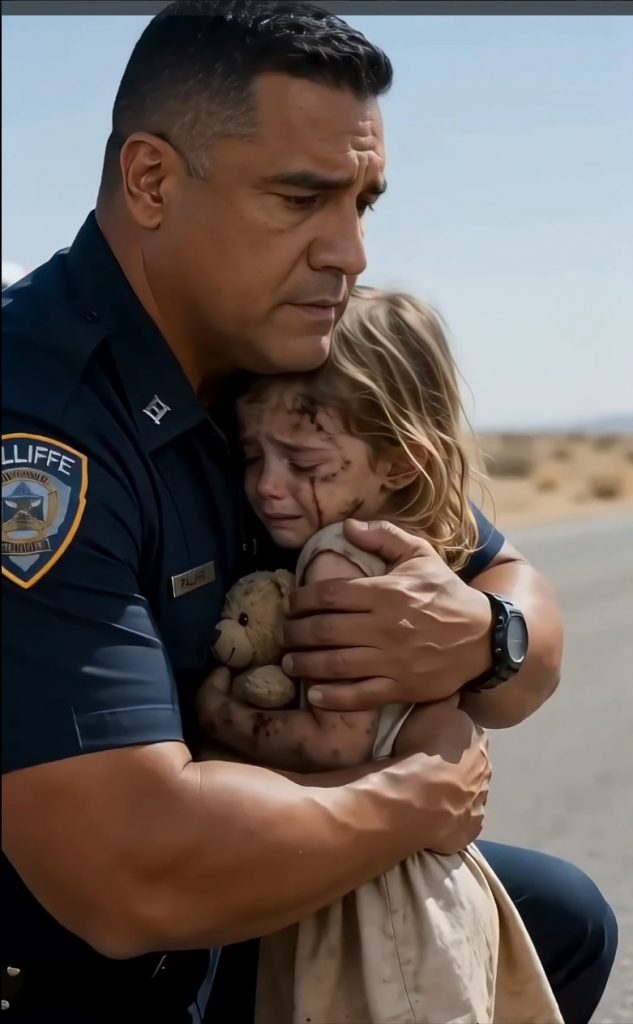
She moved along the shoulder of the desert highway with slow, uneven steps, her bare feet gray with dust, her tan dress smeared with dirt and soot. In her arms, she clutched a worn teddy bear so tightly its faded ear was pressed against her cheek.
There were no houses nearby.
No gas station.
No parent calling from the road.
Only flat, empty land, dry brush, a fence line in the distance, and faint smoke rising somewhere beneath the pale sky.
Officer Daniel Palliffe saw her from half a mile away.
At first, his mind refused to understand what his eyes were seeing. A child. Alone. Barefoot. Walking beside a highway where eighteen-wheelers could come roaring through with no warning.
He slowed the patrol car.
The tires hummed against the asphalt, then crunched softly as he pulled onto the shoulder. Unit 9790 settled beside the road, engine ticking, radio murmuring low static.
The girl stopped walking.
She turned toward him.
Her face was so dirty that her tears had carved clean tracks down both cheeks. Blonde hair stuck to her forehead. Her eyes were wide, hollow, and too tired for a child that small.
Daniel opened his door carefully.
He did not rush.
He had learned long ago that frightened children did not always run toward help. Sometimes help looked too much like another stranger.
He stepped onto the asphalt and lowered both hands where she could see them.
“Hey, sweetheart,” he said softly.
The girl hugged the teddy bear tighter.
Daniel walked closer, slowly, then crouched several feet away so he was not towering over her.
“Where are your parents?”
The question broke something in her.
Her mouth trembled. A small sound came out, not a word, barely a breath. Then she began to sob.
Daniel’s chest tightened.
He saw the soot on her arms. The scratches on her knees. The way she leaned slightly to one side, as if every step hurt. Whatever had happened, she had been walking for a while.
“Okay,” he whispered. “Okay, you don’t have to tell me yet.”
The girl stared at his badge.
Then at his face.
Then, with the last strength she seemed to have, she took one stumbling step toward him.
Daniel opened his arms.
She fell into them.
He held her carefully, one hand against her back, the other shielding her from the open road. Her sobs sank into his uniform. The teddy bear pressed between them like the only piece of her world she had managed to save.
“You’re safe now,” he said, though he had no idea if that was true yet.
Far behind them, the smoke on the horizon thickened.
And the little girl finally whispered one word.
“Mommy.”
Act II
Three months earlier, a woman named Rebecca Hart stopped sleeping.
Not fully.
Not in any way that counted.
She would drift off on the couch with the television still on, then jolt awake at every passing car, every branch scraping the window, every imagined sound from the hallway where her daughter’s bedroom remained untouched.
The room still had glow-in-the-dark stars on the ceiling.
A pink sweater hung over the chair.
On the pillow sat an empty space where a teddy bear used to sleep.
Sophie Hart had disappeared on a Thursday afternoon.
She was four years old.
Small for her age. Blonde. Shy with strangers. Brave with bugs. Obsessed with pancakes and the moon. She carried a gray teddy bear named Button everywhere because her father had given it to her before everything fell apart.
Rebecca had spent months hating that bear.
Then she spent months missing it.
Sophie’s father, Evan Rowe, had not been allowed unsupervised visits after Rebecca filed for custody protections. He was charming in public and frightening in private, the kind of man who could make neighbors believe Rebecca was dramatic and make Rebecca believe she was going crazy.
The court process had been slow.
Evan had been faster.
He took Sophie from preschool pickup using a forged emergency contact note and vanished before Rebecca even knew her daughter was gone.
For three months, the search tore through the state.
Police alerts. Flyers. Interviews. Sightings that led nowhere. Calls from strangers who wanted attention. A grainy gas station image that might have been Evan. A motel clerk who remembered a little girl with a teddy bear but could not remember which direction the car went.
Rebecca lived inside each false hope until it collapsed.
Then, two weeks before Daniel Palliffe found the girl on the highway, authorities located Evan’s burned-out vehicle near a desert access road.
There were no clear answers.
Only fire damage. Scattered belongings. Tire tracks leading toward an old service route. No confirmed sign of Sophie.
Some people began saying the thing Rebecca refused to hear.
Maybe the search was no longer a rescue.
Maybe it had become a recovery.
Rebecca would not accept it.
She kept Sophie’s room ready. She washed the sheets every Sunday. She bought the cereal Sophie liked even though no one ate it. She kept a lamp on in the hallway because Sophie had always hated waking up in the dark.
Her sister told her gently, “You can’t live like she’s coming home tomorrow.”
Rebecca answered, “Then I won’t live at all.”
On the night before the highway rescue, Rebecca sat in the dim living room with a blanket around her shoulders. The television flickered blue across her face. A local news anchor spoke about weather, traffic, city council, ordinary life moving forward with insulting ease.
Rebecca barely listened.
Beside her, on the coffee table, lay a missing child flyer so worn at the corners it had begun to soften like cloth.
SOPHIE HART
AGE 4
LAST SEEN WEARING A TAN DRESS
MAY BE WITH GRAY TEDDY BEAR
Rebecca had touched the printed photo so many times that Sophie’s face was fading under her thumb.
Then she heard a name on the television.
Not Sophie’s.
Not yet.
A highway patrol unit.
A found child.
A little girl discovered alone near Desert Route 19.
Rebecca leaned forward.
The remote slipped from her lap.
On the screen, a blurred image appeared from a patrol dash camera. A small blonde girl in a dirty tan dress. Soot on her face. A teddy bear clutched to her chest.
Rebecca’s breath stopped.
The room tilted.
Then the news cut to a closer still image from the ambulance bay.
The teddy bear’s ear was torn in a crescent shape.
Rebecca knew that tear.
She had sewn it twice.
Her hands flew to her mouth.
“Oh my God!”
And for the first time in three months, Rebecca Hart screamed because hope hurt worse than grief.
Act III
Inside the ambulance, Sophie would not let go of Officer Palliffe’s sleeve.
The paramedic tried to check her pulse, her temperature, the small scrape on her ankle. Sophie allowed it only if Daniel kept one hand where she could see it. Every time the ambulance bounced over the road, she flinched and pulled the teddy bear closer.
Daniel sat beside the stretcher, one shoulder braced against the wall.
“You’re doing great,” he said quietly.
Sophie stared at the flashing red lights reflecting against the metal cabinets.
Her lips moved.
Daniel leaned closer. “What was that?”
“Button,” she whispered.
He looked at the bear.
“Is that his name?”
She nodded.
The paramedic smiled gently. “Button’s pretty tough.”
Sophie looked at the woman, then down at the bear. “He doesn’t like smoke.”
Daniel and the paramedic exchanged a glance.
Smoke.
He kept his voice calm.
“Were you near a fire, Sophie?”
At the sound of her name, her eyes lifted sharply.
Daniel had not known it yet. Not officially.
But she had reacted before he could pretend otherwise.
“Sophie,” he repeated softly. “Is that your name?”
Her little chin trembled.
“Daddy said it wasn’t anymore.”
The ambulance seemed to shrink around that sentence.
Daniel felt a cold anger move through him, but he kept it out of his face.
“What did he call you?”
Sophie looked toward the back doors as if afraid someone might be listening.
“Sadie.”
The paramedic turned away for one second, composing herself.
Daniel nodded slowly. “Okay. But you know your real name.”
Sophie pressed her cheek to Button’s head.
“Mommy knows.”
“Yes,” Daniel said. “I bet she does.”
Sophie’s eyes filled again.
“She looked for me?”
The question was too small for the pain inside it.
Daniel had answered calls where adults lied, stole, ran, hurt, and blamed. He had stood in rooms where people screamed at each other over things they could never take back. But nothing had ever struck him quite like that child asking whether her mother had looked for her.
He swallowed.
“Every day,” he said.
He did not know the details yet.
But he knew mothers.
And he knew missing posters.
And he knew no child got this far into the desert with a teddy bear unless someone somewhere had been begging the world to bring her home.
Sophie closed her eyes.
For a moment, Daniel thought she had fallen asleep.
Then she whispered, “I walked away when he was sleeping.”
Daniel’s body went still.
“Who?”
She did not answer.
The paramedic wrote something down.
Daniel continued gently. “Was there a fire?”
Sophie nodded without opening her eyes.
“House?”
“No. Little house.”
“A trailer?”
Another nod.
“He said Mommy forgot me,” she whispered. “But Button said no.”
Daniel looked at the filthy bear.
“Button was right.”
Sophie’s fingers tightened around it.
The ambulance siren wailed through the desert. Outside, patrol units were already heading toward the smoke plume, toward whatever trailer or camp or hiding place Sophie had escaped from.
But inside the ambulance, Daniel understood the first job was not solving the crime.
It was keeping one little girl from disappearing into fear again.
So he sat with her through every mile.
He let her grip his sleeve.
And when she finally fell asleep against his side, Button still trapped beneath her arm, Daniel looked out the small ambulance window at the empty road behind them and made himself a promise.
No one was taking her back into hiding.
Act IV
Rebecca reached the hospital before the official call did.
She broke three traffic rules getting there and could not remember parking. She ran through the emergency entrance with her sister behind her, both of them breathless, both of them crying before anyone confirmed anything.
A nurse stepped into her path.
Rebecca shoved the missing flyer forward with both hands.
“Please,” she said. “Please, I saw the news. Is it her? Is it Sophie?”
The nurse’s face changed.
Not with confirmation.
With recognition of a pain too large to delay carelessly.
“Wait here,” she said.
Rebecca shook her head. “No. No, I can’t wait. I’ve waited three months.”
A police officer came down the hall.
Dark blue uniform. Badge. Nameplate reading PALLIFFE.
Rebecca knew before he spoke.
He had the face of a man carrying something fragile.
“Mrs. Hart?”
Her knees almost failed.
“My daughter,” she said. “Is she alive?”
Daniel’s voice softened.
“Yes.”
Rebecca made a sound that did not belong in a hospital hallway. It was relief and agony at once, a cry pulled from a place deeper than breath.
Her sister caught her by the shoulders.
Daniel stepped closer. “She’s being treated. She’s dehydrated, exhausted, and frightened, but she’s stable.”
Rebecca covered her mouth.
Stable.
Alive.
Found.
Words she had imagined so many times they no longer felt real.
“Can I see her?”
Daniel hesitated.
That hesitation nearly destroyed her.
“She’s been through a severe trauma,” he said carefully. “We need to move gently. She may be confused. She may need time.”
“I’m her mother.”
“I know.”
“No,” Rebecca said, tears spilling now. “You don’t. You don’t know what it is to leave a hallway light on for ninety-one nights because your child might come home scared.”
Daniel was quiet.
Because she was right.
He did not know that exact pain.
But he knew what he had seen on the highway. He knew Sophie’s question in the ambulance.
She looked for me?
He stepped aside.
“She asked if you looked for her,” he said.
Rebecca’s face crumpled.
Daniel continued, “I told her every day.”
Rebecca nodded, unable to speak.
A doctor opened the door behind him.
“You can come in,” she said softly. “Slowly. Keep your voice calm.”
Rebecca walked into the room like it was holy ground.
Sophie sat on the hospital bed in a clean gown, a blanket around her shoulders, hair damp from being gently washed. Button lay in her lap. She looked smaller than Rebecca remembered and older than any four-year-old should.
For one suspended second, mother and daughter stared at each other.
Sophie blinked.
“Mommy?”
Rebecca’s hands went to her mouth.
“Yes, baby.”
Sophie’s lower lip trembled.
“You looked for me?”
Rebecca crossed the room and stopped just short of the bed, afraid to move too fast, afraid to frighten the child she wanted to pull into her bones and never release.
“Every day,” she whispered. “Every minute.”
Sophie reached first.
Rebecca caught her.
The hug was careful for only half a second.
Then Sophie collapsed into her mother’s arms, and Rebecca held her with a soundless sob that shook both of them.
Daniel stood in the doorway and looked away.
Some moments did not need witnesses.
But this one had deserved them.
Because the world had taken a child into the desert, changed her name, covered her in soot, and tried to make her believe she had been forgotten.
And now the truth had arms around her.
Act V
Evan Rowe was found before midnight.
Alive.
Disoriented from smoke inhalation, hiding near an abandoned service road with a bag of cash, false papers, and a child’s jacket that did not belong to him anymore.
He told officers three different stories.
That Sophie had wandered away.
That Rebecca had abandoned her.
That he was trying to protect his daughter from a mother who had turned everyone against him.
None of it survived the evidence.
The trailer fire had started after a portable heater tipped over. In the panic, Evan fled. Sophie, coughing and terrified, crawled out through the back and hid until the smoke thinned. She took Button, found the road, and started walking the direction she believed led home.
She had no map.
No shoes.
No water.
Only a teddy bear and a memory of her mother saying, “If you’re ever lost, find a grown-up in uniform.”
So she walked until Officer Palliffe found her.
The court cases lasted months.
Rebecca hated that part. The hearings. The statements. The questions that made her repeat the worst days of her life while strangers took notes. The legal system moved with its usual cold patience, but this time Rebecca did not feel alone inside it.
Daniel testified.
The paramedics testified.
The preschool director testified about the forged pickup note.
Sophie did not have to face the courtroom. Rebecca made sure of that. So did the prosecutor. So did Daniel, who told anyone who needed reminding that a rescued child was not a piece of evidence to be passed around.
Sophie healed in uneven ways.
Some days she was almost herself. She asked for pancakes. She drew suns with smiling faces. She made Button sit beside her at breakfast and gave him the first pretend bite.
Other days, she hid in the closet when a truck backfired. She cried if Rebecca took too long in the shower. She woke at night asking if her name was still Sophie.
Every time, Rebecca answered the same way.
“You are Sophie Hart. You are my daughter. I looked for you every day. You are home.”
Eventually, Sophie began answering with her.
“I am home.”
Officer Palliffe visited once after she was released from the hospital.
He arrived in uniform but left his hat in the car, as if he did not want the badge to be the first thing she saw. Sophie watched him from behind Rebecca’s leg.
Daniel crouched.
“Hi, Sophie.”
She studied him.
Then she held out Button.
Daniel looked surprised. “For me?”
“For saying Mommy looked.”
His eyes softened.
He accepted the bear with both hands, held it solemnly for three seconds, then handed it back.
“That was an easy thing to say,” he told her. “Because it was true.”
Sophie nodded as if that made perfect sense.
Before he left, Rebecca walked him to the porch.
For a moment, neither of them spoke.
The neighborhood was quiet. Normal. A sprinkler clicked in the distance. Somewhere, a dog barked. The hallway light glowed behind them through the front window.
Rebecca folded her arms tightly.
“I don’t know how to thank someone for finding my child on the side of the road.”
Daniel looked toward his patrol car.
“I almost kept driving,” he said.
Rebecca stared at him.
He turned back quickly. “Not really. I mean, for a second, my brain tried to make it something else. A bag. A sign. Anything but a little girl alone out there. Then she moved.”
Rebecca’s eyes filled.
Daniel’s voice grew quieter.
“I think about that second a lot.”
“So do I,” Rebecca said.
Because life had balanced on that second.
On one officer noticing what did not belong.
On one child remembering enough to keep walking.
On one mother refusing to let grief teach her surrender.
Years later, Sophie would remember the desert in pieces.
Heat. smoke. gravel under her feet. Button’s damp ear against her face. A police car stopping. A man kneeling instead of grabbing. A voice asking where her parents were, then not getting angry when she could not answer.
She would remember the ambulance lights.
She would remember her mother’s arms.
Rebecca remembered everything.
The television glow. The blurry news image. The scream that tore out of her before certainty arrived. The hospital doorway. Sophie’s question.
You looked for me?
That question became the center of Rebecca’s life for a while.
Not because it hurt.
Because she wanted Sophie to grow up with the answer rooted so deeply in her that no one could ever lie it out of her again.
Every night, Rebecca turned on the hallway light.
Not because Sophie needed it forever.
Because Rebecca did.
It glowed softly across the floor, past the framed missing flyer she could not bring herself to throw away, past the shelf where Button sat when Sophie was at school, past the front door that no longer felt like the edge of a nightmare.
One evening, Sophie came downstairs in her pajamas and found Rebecca looking at the old flyer.
“Mommy?”
Rebecca turned. “Yes, baby?”
Sophie tilted her head.
“You don’t need that anymore.”
Rebecca looked down at the paper.
Sophie’s missing photo stared back at her from another life.
Slowly, Rebecca folded it.
Not to erase it.
To put it away.
“You’re right,” she said.
Sophie climbed into her lap, all warm weight and sleepy breath, and Rebecca held her as tightly as she dared.
Outside, the street was dark.
Inside, the hallway light stayed on.
The desert had been vast. The highway had been empty. The world had come terrifyingly close to losing a child who had already lost too much.
But Sophie kept walking.
Officer Palliffe stopped.
And somewhere in a dim living room, a mother saw a dirty little face on the television screen and recognized the miracle everyone else was only beginning to name.