Act I
The second slap never landed.
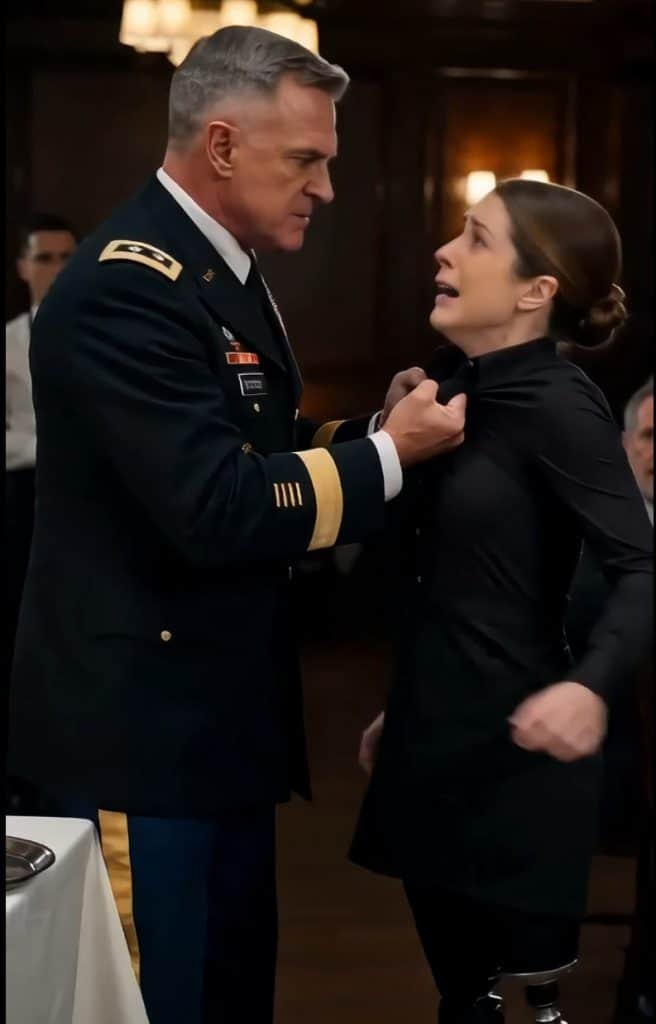
General Marcus Boterit’s hand was already raised, palm open, shoulder drawn back, his polished medals trembling against a uniform now soaked with ice water. With his other fist, he still had the waitress by the collar.
All around them, the restaurant had gone silent.
A moment earlier, the dining room had been all soft candlelight and quiet luxury. Mahogany walls. White tablecloths. Crystal glasses. Low conversation. The kind of place where people lowered their voices because money had taught them to.
Then a little boy in a tuxedo vest came running between tables.
He slammed into the waitress just as she passed with a tray of ice water.
She had tried to save it. Everyone close enough saw that. Her body twisted, her hands tightened, and her prosthetic left leg shifted hard against the polished floor as she fought for balance.
But the tray tipped.
Glasses fell.
Water splashed across General Boterit’s chest, his lapel, his medals, his ribbons, the rows of color he wore like armor.
The waitress froze.
“I’m sorry, sir,” she gasped. “I’m so sorry.”
Her name was Clara Hayes.
She stood in a black button-up shirt and apron, brown hair pinned into a bun, one hand hovering uselessly near the ruined table. Her face had gone pale. Beneath the apron, her robotic prosthetic leg was visible from the knee down, the metal joint catching the warm restaurant light.
The general looked down at his wet uniform.
Then he looked at her.
“Do you have any idea what this uniform is worth?” he shouted.
Clara tried to explain.
The boy had run into her. It was an accident. She would clean everything. She would pay if she had to.
But the general did not want an explanation.
He wanted a target.
His hand struck her face so sharply that the sound seemed to break the room in two.
A woman gasped. A waiter stopped mid-step. The little boy who had caused the accident hid behind his father’s chair, eyes wide and terrified.
Clara stumbled, catching herself with difficulty.
Before she could step back, Boterit grabbed her by the collar and yanked her close.
His voice dropped into a cruel whisper, but the nearest tables still heard it.
“People like you shouldn’t be working in a place like this.”
Clara’s eyes filled.
Not from the pain.
From the recognition.
She had heard that tone before. In hospitals. In interviews. In rooms where people looked at her leg before they looked at her face.
Boterit lifted his hand again.
This time, several patrons half-rose from their chairs.
But nobody moved fast enough.
Then a chair scraped at Table Seven.
An elderly man stood slowly, placing his napkin beside his plate with almost ceremonial calm.
He wore a dark suit, not a uniform. His hair was white. His posture was stiff with age, but his voice cut through the restaurant with a force that made even the general freeze.
“Remove your hand from Captain Hayes.”
Clara stopped breathing.
Boterit turned.
“Who the hell are you?”
The old man’s eyes did not move from the general’s fist twisted in Clara’s collar.
“Someone who knows exactly what that woman’s uniform used to be worth.”
Act II
Clara Hayes had not planned to become a waitress.
She had planned to serve twenty years.
That was the sentence she used when people asked too many questions about the leg.
I was military.
That was usually enough. Most people did not want the full story. They wanted a simple explanation that let them feel respectful without becoming uncomfortable.
So Clara gave them the short version.
Army medic. Injury overseas. Medical discharge. Came home. Started over.
The long version had more ghosts in it.
Before the restaurant, before the prosthetic, before she learned which floor surfaces were dangerous when wet, Clara had been Captain Clara Hayes, combat medic, the person soldiers called for when the world turned loud.
She had been steady under pressure. Too steady, some said. She could wrap a wound, calm a panicked nineteen-year-old, and call coordinates over radio static while dust filled her mouth and fear clawed at her ribs.
Her unit trusted her because she never looked away.
Not from pain.
Not from panic.
Not from anyone who needed her.
Then came the convoy outside Al-Mazrah Ridge.
A supply route. A stalled vehicle. A civilian bus caught in the wrong place at the wrong time. The report later used clean phrases like hostile engagement and secondary blast, but Clara remembered the heat, the screaming metal, and the little girl in a yellow dress trapped near the roadside.
Command said hold position.
Clara moved anyway.
She dragged two soldiers behind cover. Then a third. Then she went back for the child.
That was when the second blast took her leg.
She remembered waking in a field hospital with her left side burning and a young private crying beside her bed because she had pulled him out before everything went white.
She remembered the medal ceremony months later, though not clearly. Too many lights. Too many hands. Too many people calling her brave when she felt hollowed out.
She remembered Major General Boterit standing on the stage.
He had not been her direct commander then, but his name was on the operation. His signature was on the report that reduced the chaos to paragraphs. His speech praised sacrifice, honor, resilience.
He had shaken her hand for cameras.
He had not remembered her face.
That did not surprise her.
Men like Boterit remembered symbols better than people.
After discharge, Clara learned that returning home was not the same as coming back.
The Army sent paperwork. Doctors sent appointments. The world sent sympathy that expired quickly. People wanted her to be inspiring, but not inconvenient. Strong, but not visibly struggling. Grateful, but not angry.
She applied for medical administration jobs and was told she might not be a “good fit” for fast-paced environments. She applied for hospital roles and watched interviewers glance under the table. She applied for anything that let her stand, move, work, be useful.
The restaurant hired her because the owner’s sister was a veteran and because Clara could carry six plates without shaking.
She took pride in it.
Not because serving water in a dining room resembled saving lives in combat.
Because dignity is not measured by the job people imagine for you.
It is measured by whether you still show up.
Every night, Clara tied her apron, checked the alignment of her prosthetic, and entered the dining room with the same discipline she once carried into field hospitals.
Most patrons were kind.
Some stared.
A few complained quietly that a woman with a prosthetic looked “uncomfortable” in a luxury setting.
Clara learned to hear everything and keep walking.
But she had never been struck.
Not there.
Not under chandeliers.
Not by a man wearing the same institution that had once pinned a medal to her chest.
And now, as General Boterit held her by the collar in front of the room, the old man at Table Seven stepped into the aisle.
His name was Colonel Thomas Avery.
Retired.
And he had been there the day Clara lost her leg.
Act III
Boterit released Clara’s collar, but only because every face in the restaurant had turned toward him.
He straightened his soaked jacket.
“Captain?” he said with a dismissive laugh. “This woman is a waitress.”
Colonel Avery walked forward slowly.
“She is both.”
The general’s jaw tightened.
Clara’s hand rose to her collar, but she did not speak. Her cheek stung. Her leg trembled from the awkward shift of balance, but she locked her knees and stayed upright.
Avery stopped beside her.
“Are you all right, Captain?”
The title nearly undid her.
Not because she needed rank.
Because someone had seen her whole.
Clara nodded once.
“I’m okay, sir.”
“No,” Avery said softly. “You are not. But you are standing.”
The general scoffed.
“This is absurd. She ruined my uniform.”
The little boy’s father stood suddenly.
“My son ran into her.”
Every head turned.
The man looked ashamed, one hand resting on the boy’s shoulder.
“It was his fault. He got away from me. She was walking carefully. She tried to stop the tray from falling.”
The boy began to cry.
“I’m sorry,” he whispered.
Clara turned toward him immediately.
Her voice was gentle.
“It’s okay. You didn’t mean to.”
Boterit looked furious that compassion had entered a scene he wanted ruled by humiliation.
Avery’s eyes hardened.
“You heard that, General? A child understands accountability faster than you do.”
A murmur moved through the dining room.
Boterit pointed a finger at him.
“You watch your tone.”
Avery smiled without warmth.
“I watched my tone for thirty-one years. I’m retired now.”
Someone near the bar let out a startled breath that was almost a laugh.
Then the restaurant manager hurried over, pale and panicked.
“General Boterit, Colonel Avery, please, perhaps we can move this conversation—”
“No,” Avery said.
The single word stopped him.
“This happened in public. It will be addressed in public.”
Clara closed her eyes briefly.
She hated this. Hated every stare, every whisper, every phone camera now half-hidden near table edges. She had spent years trying not to be a spectacle.
But Avery was not making her one.
Boterit had already done that.
Avery was changing what the room saw.
He turned to the nearest waiter.
“Call the police.”
The manager swallowed.
“Colonel, maybe that’s not necessary—”
“A decorated officer just assaulted a disabled veteran in front of witnesses,” Avery said. “It is necessary.”
The words struck the room like a gavel.
Disabled veteran.
Clara saw Boterit’s face change.
Not with remorse.
With calculation.
“Veteran?” he said carefully.
Avery looked almost disgusted.
“Yes. Captain Clara Hayes. Army medical corps. Silver Star. Soldier’s Medal. Purple Heart. She lost her leg pulling men out of an attack that happened under your operational command.”
Boterit stared at Clara.
For the first time, recognition flickered in his eyes.
Not personal recognition.
Institutional recognition.
A file. A ceremony. A photograph beside a flag.
Clara watched him search his memory and felt colder with every second.
He did not remember her pain.
He remembered the publicity.
Avery reached into his jacket and pulled out his phone. He opened a photo and held it up.
The screen showed Clara years earlier in dress uniform, standing on a stage with a cane, her face pale but composed. Beside her stood Boterit, smiling for the cameras as he pinned a medal to her chest.
The room went utterly silent.
A waiter whispered, “Oh my God.”
The general looked from the photo to Clara’s face.
And the uniform he had been screaming about suddenly seemed far less important than the one she had earned and no longer wore.
Act IV
Boterit tried to recover the room.
Men like him always do.
“This is being twisted,” he said. “I reacted to an incident. I was disrespected.”
Clara finally spoke.
Her voice was quiet, but it carried.
“You were wet.”
The simplicity of it stripped the drama from his defense.
A few diners looked down, not hiding their disgust.
Boterit’s face flushed.
Clara continued, “You were wet because a child ran into me. I apologized anyway. You hit me.”
The general’s nostrils flared.
Avery stepped slightly closer, but Clara lifted one hand.
Not to stop him.
To stand for herself.
She looked at Boterit, and the years between the battlefield and restaurant collapsed into one narrow line.
“You shook my hand once,” she said. “You called me a credit to the uniform.”
Boterit said nothing.
“You said the Army never forgets its wounded.”
The silence after that was brutal.
Clara’s voice did not break, but it sharpened.
“Then you forgot the moment I was serving your table.”
A woman near the window began to cry silently.
The running boy’s father pulled his son closer.
The manager stood frozen, understanding too late that this was no longer a customer complaint. It was a moral exposure.
Boterit looked around the room and saw not admiration, not fear, not deference.
Witnesses.
He lowered his voice.
“Captain Hayes, I regret that this became emotional.”
Clara almost smiled.
Emotional.
As if her cheek had reddened because of feelings. As if his hand had risen because the air had misunderstood him.
“No,” she said. “You regret that people saw.”
The restaurant doors opened behind them.
Two police officers entered with a hotel security manager, followed by a woman in a dark suit who had been dining near the back. She approached with her phone in hand and an expression of controlled fury.
“General Boterit,” she said, “I’m Dana Whitaker, Deputy Inspector General, Department of Defense.”
Boterit stiffened.
Avery looked at her, then gave the smallest nod.
Whitaker had been at Table Twelve, quietly hosting a retirement dinner for a civilian analyst. She had seen the spill. The slap. The collar. The raised hand.
And she had recorded enough.
Boterit’s voice changed instantly.
“Deputy Inspector General, this is a private misunderstanding.”
“No,” Whitaker said. “It is an assault witnessed by civilians and a potential conduct violation by a senior officer in uniform.”
His face drained.
She turned to Clara.
“Ma’am, do you want to make a statement?”
Clara hesitated.
Every instinct trained into her told her to minimize, to manage, to survive the room without causing more damage. Women like her learned early that being hurt was often treated as less disruptive than saying so.
Then she looked at the little boy.
He was still crying, convinced he had started the whole thing.
Clara bent slightly, careful with her leg.
“What’s your name?”
“Oliver,” he whispered.
“Oliver, accidents happen. What happened after was not your fault.”
He nodded through tears.
Clara straightened and looked at the officers.
“Yes,” she said. “I want to make a statement.”
Boterit’s mouth tightened.
A police officer moved beside him.
“Sir, please step over here.”
For the first time that night, the general obeyed an order.
As he passed Clara, his eyes flicked once toward her prosthetic leg.
No disdain now.
Fear.
Not of her body.
Of what he had revealed about his own.
Act V
The restaurant did not return to normal after that.
Some places cannot pretend once the truth has stood in the middle of the room.
The manager offered Clara the rest of the night off with full pay. She accepted because her leg had begun to ache and because her hands would not stop shaking. In the staff hallway, she sat on a crate beside stacked linen bags and finally touched her cheek.
A young busboy brought her ice wrapped in a cloth.
He looked about seventeen and terrified of saying the wrong thing.
“My brother’s in the Marines,” he said.
Clara took the cloth gently.
“Then tell him to keep extra socks.”
He blinked.
Then laughed awkwardly, relieved.
Avery found her ten minutes later.
He did not enter the hallway until she nodded permission.
“You didn’t have to do that,” she said.
“Yes,” he replied. “I did.”
She looked at him.
The old colonel leaned on the wall across from her, suddenly less commanding and more tired.
“I should have found you sooner,” he said.
Clara frowned.
“Sir?”
“After you were discharged. I checked once. They told me you were managing. That word covers a lot of neglect.”
Clara looked down.
“I was managing.”
“I know.” His voice softened. “That’s what worries me.”
She let out a breath that almost became a laugh.
For years, she had been praised for resilience by people who never asked what resilience cost.
Avery understood that.
He took a small card from his wallet.
“I work with a veterans’ legal and employment foundation now. Not charity. Advocacy. If you want help pursuing the assault complaint, workplace accommodation, benefits review, anything, call me.”
Clara accepted the card.
“Thank you.”
“And Captain?”
She looked up.
“You were not diminished by that apron.”
Her eyes burned.
“I know.”
But hearing it still mattered.
By morning, the story had left the restaurant.
Not because Clara wanted fame.
Because too many people had filmed the truth.
The headline appeared first on local news, then national outlets: SENIOR OFFICER UNDER REVIEW AFTER ASSAULTING DISABLED VETERAN SERVER.
The Army issued a careful statement. The Department of Defense opened a review. General Boterit was placed on administrative leave pending investigation. Old clips of him praising wounded service members circulated beside footage of him raising his hand against one.
People argued online, as people always do.
Some defended him.
Most did not.
But the part that mattered to Clara was quieter.
Messages came from other disabled workers. Other veterans. Other women who had been told to accept humiliation because the person humiliating them had money, rank, or status.
You stood there, one wrote. I needed to see that.
Clara read that message three times.
One week later, she returned to the restaurant.
The staff lined up before opening, pretending they had not arranged themselves. The chef polished the same spoon for five minutes. The hostess cried before Clara even clocked in.
The manager had placed a new policy on the staff board.
Zero tolerance for customer abuse. Immediate removal. Police involvement when needed. Full management support for employees.
It should have existed before.
But Clara knew better than most that justice often arrives late and still has work to do.
Table Seven had been left empty that evening.
On it sat a small folded card.
Captain Hayes,
Dinner is on me whenever you’re ready to let an old colonel order dessert badly.
—Avery
Clara smiled.
Then Oliver arrived.
He came with his father, holding a small envelope in both hands. He wore regular clothes this time, not the tuxedo vest, and he looked much smaller without the chaos around him.
Clara knelt carefully so they were eye level.
Oliver held out the envelope.
“I made you a card.”
Inside was a drawing of a woman with one silver robot leg standing taller than a man with too many medals. Beside her was a tray of water glasses, all perfectly balanced.
At the top, in uneven letters, he had written:
I’M SORRY. YOU ARE BRAVE.
Clara pressed the card to her chest.
“Thank you, Oliver.”
His father cleared his throat.
“We also wanted to apologize properly. I should’ve stopped him from running.”
Clara nodded.
“Kids run. Adults are supposed to know better.”
The father understood.
“Yes, ma’am.”
Months later, Clara stood in a different room under different lights.
Not a restaurant.
A veterans’ employment conference.
She had been invited to speak after the video changed more than she expected. She had resisted at first. She was not interested in becoming a symbol. Symbols were heavy, and she had carried enough.
But Avery told her, “You don’t have to represent everyone. Just tell the truth.”
So she did.
She stood at the podium in a dark suit, her prosthetic leg visible because she had stopped choosing clothes around other people’s discomfort.
She spoke about work.
About dignity.
About how uniforms do not create honor by themselves, and how medals mean nothing if the person wearing them forgets the humanity they are supposed to defend.
She did not say Boterit’s name.
She did not need to.
At the end, she said, “I used to think coming home meant finding a place where I would no longer have to prove I belonged. I was wrong. Sometimes coming home means building that place for the next person.”
The room stood for her.
Clara did not cry until later, alone in the hallway, when she saw Oliver’s drawing tucked inside her folder beside Avery’s card.
That night, she returned to the restaurant for one final shift.
Not because she had to.
Because she wanted to leave on her own feet.
The dining room looked the same. Mahogany walls. White cloths. Candlelight. Glassware shining in neat rows.
But Clara was different.
She walked between the tables with steady steps, tray balanced in one hand, her prosthetic moving with a soft mechanical rhythm beneath her apron.
A man at a corner table glanced down at her leg.
Then looked away quickly.
Clara kept walking.
At Table Seven, Colonel Avery sat waiting with two menus.
He rose when she approached.
“Captain,” he said.
She smiled.
“Colonel.”
He looked at the tray in her hand.
“Still better balance than half my platoon ever had.”
This time, Clara laughed.
The sound was light, real, and hers.
Across the room, Oliver’s card had been framed discreetly near the staff station. Not as decoration. As a reminder.
The world might still mistake cruelty for power.
It might still confuse rank with character.
It might still look at a woman’s prosthetic before seeing the life she fought to stand in.
But in that restaurant, on that night, the lesson was written plainly enough for anyone to read.
A uniform could be soaked.
Medals could tarnish.
Power could collapse in public.
And the woman they tried to make small could still walk forward, tray steady, head high, with every eye in the room finally understanding who had deserved respect from the beginning.