Act I
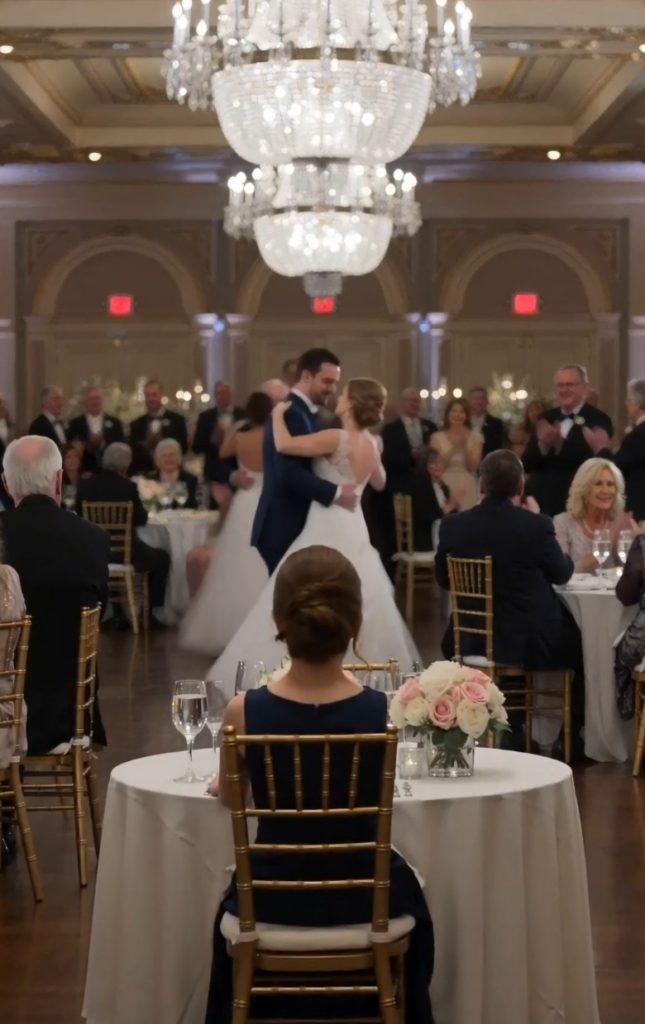
The ballroom was clapping for love while Clara Wynn tried not to cry.
She sat alone at table twelve, beneath the glow of a chandelier that made every glass, every fork, every diamond in the room shine brighter than it needed to. The newlyweds were dancing in the center of the polished floor, the bride’s white gown turning softly with every step, the groom’s hand resting at her waist as guests smiled and applauded around them.
It should have been beautiful.
To everyone else, it was.
But Clara kept her eyes on the white tablecloth in front of her, on the folded napkin, on the untouched champagne glass, on the empty space where her right arm should have been.
Her navy dress was simple, elegant, and chosen carefully after three hours of standing in front of a mirror trying to convince herself not to stay home.
She had known people would stare.
She had not known they would whisper loudly enough for her to hear.
At the next table, a woman in a beige silk dress leaned toward a man with silver hair and a crystal glass in his hand.
“How did she even dare to come?” the woman whispered. “This is awful.”
Clara’s fingers tightened around the tablecloth.
She did not look up.
Across the room, the bride laughed as the groom spun her once beneath the chandelier. The guests clapped harder. Someone tapped a spoon against a glass. Camera flashes popped like tiny lightning strikes.
Then the silver-haired man spoke.
“Look at her,” he murmured, turning just enough to make sure Clara knew exactly who he meant. “She’s so full of herself.”
A woman beside him smiled into her wine.
The sound that followed was worse than the words.
Laughter.
Light, polished, careful laughter from people who knew how to cut without raising their voices.
Clara felt heat rush into her face.
Her left hand closed into a fist, bunching the white linen beneath her fingers. She could feel her nails pressing into her palm. She focused on that small pain because it was easier than letting the larger one take her apart.
She had survived hospital rooms.
She had survived months of learning how to button a shirt with one hand, how to tie her hair, how to balance a plate, how to endure strangers looking at her body before they looked at her face.
But this room was different.
This room had known her before.
And that made the cruelty intimate.
A tear gathered in her eye. She held it there as long as she could, refusing to give them the satisfaction of seeing it fall.
Then the laughter swelled again behind her.
Clara lowered her head.
The tear slipped down her cheek.
At that exact moment, the groom looked over his bride’s shoulder and saw her.
His smile disappeared.
And before anyone understood why, Julian Mercer let go of his bride’s hand and walked straight off the dance floor.
Act II
Clara had not planned to attend the wedding.
The invitation arrived six weeks earlier in a thick ivory envelope, her name written in careful gold script as if elegance could erase history.
Miss Clara Wynn
With joy, the families of Mercer and Bellamy request your presence…
She had stared at it for a long time in her apartment kitchen, one hand resting on the counter, the kettle screaming behind her until the whole room filled with steam.
The Mercer family did not request her presence.
They had spent five years making it clear they preferred her absence.
Once, Clara had been everywhere in their world.
She had grown up next door to Julian Mercer in a town where old money lived behind iron gates and taught its children how to smile without showing need. Julian had been the heir, the golden son, the boy with private tutors, tennis lessons, and a mother who corrected his posture by touching two fingers to his spine.
Clara had been the scholarship girl whose mother cleaned rooms at the Mercer estate.
That should have been the end of the story.
It wasn’t.
Julian found her reading under the stone gazebo when they were twelve. She expected him to tell her to leave. Instead, he sat beside her and asked what happened at the end of the book.
She told him to read it himself.
He did.
That was how their friendship began.
By sixteen, they were inseparable. By twenty, they were the secret everyone pretended not to see. By twenty-four, Julian was telling her he would rather lose the Mercer name than live the life his parents had planned for him.
Clara believed him.
That was her first mistake.
Not because Julian did not love her.
He did.
But love and courage are not the same thing.
The Mercer family had built an empire of hotels, private clubs, and quiet influence. They did not scream when they disapproved. They froze people out. They closed accounts. They ruined reputations with raised eyebrows and dinner invitations that never came again.
Julian’s mother, Victoria Mercer, looked at Clara like she was a stain on silk.
“You are very sweet,” she once told her. “But sweet things spoil quickly.”
Clara never told Julian.
She was too proud.
Then came the accident.
It happened on a rain-slick road outside the city, late at night, after a charity gala where Julian had publicly introduced Clara as “someone very important to me.” Not his girlfriend. Not the woman he loved. Not yet.
Someone very important.
Still, it had been enough to make Victoria’s face go white.
On the drive home, Julian argued with his father over the phone. Clara remembered his hand tightening on the steering wheel, his voice shaking with anger as he said, “I’m done letting you decide who gets to stand beside me.”
Then headlights appeared too fast around the bend.
After that, memory became broken glass.
Sound. Rain. Metal. Clara calling Julian’s name. Julian unconscious beside her. The smell of smoke from the engine. Her own body pinned in a way she did not understand until much later.
She got him out.
That was all anyone needed to know.
She got him out before the car was fully swallowed by smoke, dragging him through the mud with a strength she never found again afterward.
Then the world went dark.
When she woke in the hospital, Julian was alive.
Her right arm was gone.
Victoria Mercer arrived in pearls and a cream coat.
She did not thank Clara.
She closed the hospital room door and said, “You will not use this to trap him.”
Clara had been too drugged, too broken, too stunned by the strange lightness on one side of her body to answer.
Victoria placed a check on the bedside table.
“Recover somewhere else,” she said.
Julian never came.
At least, that was what Clara believed.
For five years, she built a life around that absence.
Then the wedding invitation arrived.
And tucked behind it, in a different envelope, was a handwritten note from the bride.
Please come. Julian needs you there more than he knows.
Clara almost threw it away.
Instead, she bought the navy dress.
She told herself she was not going for Julian.
She was going for the girl in the hospital bed who had deserved to be seen.
But when she walked into the ballroom and every whisper turned toward her, Clara wondered if survival had made her brave or simply foolish.
Then Julian reached her table.
And the whole room began to turn.
Act III
“Clara.”
Julian said her name like it hurt.
The guests nearest them went quiet first. Then the silence spread outward, table by table, until even the music seemed to realize something had gone wrong.
Clara looked up slowly.
Julian Mercer stood beside her chair in his black wedding suit, pale beneath the chandelier light. He looked older than she remembered. Still handsome, still polished, still carrying the expensive posture of a man raised to be watched.
But his eyes were not polished.
They were devastated.
Behind him, his bride stood alone on the dance floor, one hand holding the skirt of her gown, her face unreadable.
“Why are you sitting here?” Julian asked.
Clara almost laughed.
It came out as a breath.
“It’s my assigned table.”
“No,” he said quietly. “I mean why are you alone?”
The woman in beige shifted uncomfortably.
The silver-haired man looked down at his drink.
Clara’s fingers loosened from the tablecloth. She could still feel the wrinkle she had made in the linen, small proof of how hard she had been holding herself together.
“I’m fine,” she said.
Julian’s jaw tightened.
He knew that sentence.
Clara had used it when her mother died. When his parents insulted her. When she walked through rooms that welcomed him and measured her. When she was terrified but would rather break privately than beg publicly.
“You’re not,” he said.
A murmur moved through the ballroom.
Victoria Mercer rose from the head table.
“Julian,” she called, smiling too sharply. “This is not the time.”
Julian did not turn.
The bride did.
Her name was Amelia Bellamy, daughter of an old political family, the kind of woman newspapers called graceful before she had done anything at all. Clara had expected to hate her. It would have been easier.
But Amelia’s eyes were full of something too clear to be cruelty.
She stepped forward.
“Actually,” Amelia said, “it is exactly the time.”
Victoria’s smile vanished.
Julian turned to his bride.
“What did you do?”
Amelia reached into the hidden pocket of her wedding gown and removed a folded bundle of papers.
“I found the letters.”
The room changed.
Not loudly.
It tightened.
Victoria’s hand gripped the back of her chair.
Clara looked at the papers.
Her heart began to pound.
“What letters?” she asked.
Julian’s face had gone still.
Amelia walked to Clara, careful with her dress, and placed the papers on the table in front of her.
“They were in Julian’s father’s office,” she said softly. “Locked in a file marked settlement.”
Clara stared at the top page.
Her own name was written there.
Not typed.
Written.
In Julian’s handwriting.
Clara, please let me see you. They won’t tell me where you are. I don’t care what my mother said. I don’t care what the doctors said. I am coming. Please hold on.
The ballroom blurred.
Clara touched the page with shaking fingers.
There were more.
Dozens.
Some still sealed.
Some returned.
Some never mailed.
Julian looked like a man watching his own life be pulled from beneath the floorboards.
“I wrote every week,” he said. “For almost a year. My mother told me you refused to see me.”
Clara could not speak.
Victoria’s voice cut in, low and cold.
“She needed peace. You were recovering. Both of you were.”
Amelia turned on her.
“No. You buried her.”
A gasp moved through the guests.
Victoria lifted her chin.
“I protected my son.”
“You erased the woman who saved him,” Amelia said.
Julian reached for one of the letters, but Clara pulled it closer to herself.
Not out of anger.
Out of instinct.
The paper trembled beneath her hand.
For five years, she had believed he chose silence.
For five years, grief had worn his face.
Now that grief had another name.
Victoria.
Act IV
The first person to clap was the woman in beige.
It was not real applause.
It was nervous, ugly, misplaced, as if she thought the scene could be turned into a joke if someone made enough noise.
“Well,” she said with a brittle laugh, “this is quite dramatic for a wedding.”
No one joined her.
Clara looked at the woman.
For the first time all night, she did not look down.
The woman’s smile faltered.
Julian turned slowly toward the tables.
“Who said something to her?”
No one answered.
His voice grew colder.
“Who?”
The silver-haired man cleared his throat. “Julian, emotions are high. People were only surprised. One doesn’t expect—”
“One doesn’t expect what?” Julian asked.
The man stopped.
Julian stepped closer.
“One doesn’t expect the woman who pulled me out of a burning car to attend my wedding? One doesn’t expect her to sit in the same room as people who owe her my life? One doesn’t expect her to have the courage to show her face after this family paid lawyers to make sure she disappeared?”
His words struck the room one by one.
Clara closed her eyes.
She had imagined this moment before.
Not exactly this, not in a ballroom, not with a bride standing beside her in white. But she had imagined someone finally saying it aloud. Not because it would fix anything. It wouldn’t.
But because silence had been its own kind of prison.
Victoria came around the head table now, her diamonds flashing at her throat.
“Enough,” she said. “You are humiliating your wife.”
Amelia laughed once.
It was not happy.
“My wife?” she repeated softly, looking at Julian. “I signed the marriage certificate an hour ago, Victoria. Do not use me as your shield.”
Then she turned to the room.
“I invited Clara.”
Another wave of whispers.
Clara stared at her.
Amelia’s voice trembled only slightly.
“I thought I was marrying a man whose past had ended tragically. That was the story your family gave me. That Clara left after the accident. That she took money. That she wanted distance. That Julian was heartbroken but needed to move on.”
Julian looked at Clara with pain so raw she had to look away.
Amelia lifted the letters.
“Then I found these. And the hospital visitor logs. And the nondisclosure agreement Clara never signed. And the check she never cashed.”
Victoria’s face hardened.
“You went through private family documents.”
“I went through lies,” Amelia said.
The ballroom was silent now.
Even the servers stood frozen near the walls.
Amelia faced Clara fully.
“I am sorry,” she said. “For inviting you into a room that was not ready to honor you. For thinking the truth only needed to be revealed, not protected.”
Clara’s mouth trembled.
“You don’t have to apologize for them.”
“No,” Amelia said. “But I have to apologize for me. I was going to let this wedding happen quietly and confront it later. I thought I was being strategic.”
She looked at Julian.
“I was being cowardly.”
Julian shook his head, but Amelia raised a hand.
Then she reached up and removed her veil.
The gesture was so simple that it took the room a second to understand its meaning.
This was not a bride adjusting her outfit.
This was a woman laying down a role.
“Julian,” Amelia said, voice breaking now, “I can’t begin a marriage inside a lie that hurt someone else this deeply. Not even if the lie was handed to us before we knew its shape.”
Victoria stepped forward sharply.
“Do not be ridiculous.”
Amelia did not look at her.
Julian’s eyes filled, but he did not argue.
Maybe some part of him had known the wedding was never truly about love. It was about repair. Image. Family pressure disguised as healing.
Clara stood.
The movement was small, but it drew every eye.
Her navy dress fell cleanly around her. Her left hand rested by her side. Her right side, the part so many people had stared at with pity or disgust, remained visible beneath the chandelier’s light.
She looked first at Amelia.
Then at Julian.
Then at the room that had laughed at her.
“I did not come here to ruin a wedding,” she said.
Her voice was quiet.
That made everyone lean in.
“I came because I was tired of being treated like the evidence of something shameful.”
No one moved.
Clara swallowed.
“I lost my arm. I did not lose my name. I did not lose my memory. I did not lose the right to sit at a table in a room full of people who know exactly what happened and still chose to whisper.”
The woman in beige lowered her eyes.
Clara’s gaze moved to Victoria.
“And I did not disappear because I wanted money.”
She lifted the first letter.
“I disappeared because you made sure everyone believed I had.”
For the first time that night, Victoria Mercer had no answer.
Act V
The music never started again.
No one knew whether to sit, leave, apologize, or pretend they had not enjoyed the cruelty when it belonged to someone else. The chandelier still glittered. The roses still opened softly in their crystal vases. Champagne still fizzed in untouched glasses.
But the wedding had become something else.
Not a celebration.
A reckoning.
Julian removed his wedding ring first.
Not dramatically. Not angrily.
He slipped it from his finger and held it in his palm, looking at Amelia with a grief that contained no blame.
“I’m sorry,” he said.
Amelia nodded, tears in her eyes.
“So am I.”
There are heartbreaks that come from betrayal.
And there are heartbreaks that come from waking up too late inside someone else’s design.
This was the second kind.
Amelia stepped toward Clara and offered her the stack of letters.
Clara hesitated before taking them.
They were heavier than paper should have been.
Five years of unanswered grief. Five years of rage misdirected. Five years of believing she had been easy to abandon.
Julian stood in front of her, close enough now that she could see the tiny scar near his eyebrow from the accident.
“I came to the hospital,” he said. “The first night I could walk. They told me you had transferred. Then my mother said you didn’t want me there. I should have looked harder.”
Clara’s throat tightened.
“Yes,” she said.
He flinched, but he nodded.
She was not cruel about it.
That made it worse.
“You should have,” she said again.
Tears slipped down his face.
“I loved you.”
Clara looked at him for a long moment.
The ballroom held its breath.
“I know,” she said. “But love that can be managed by other people still has growing up to do.”
Julian closed his eyes.
Clara looked down at the letters.
“I loved you too,” she said.
The words did not open a door.
They closed one gently.
Victoria turned as if to leave, but Amelia’s father blocked her path. He had said nothing until then, a tall man with silver cufflinks and a politician’s careful face. Now even he looked disgusted.
“I think,” he said, “there will be legal conversations after tonight.”
Victoria’s eyes flashed.
“You have no idea what you are interfering with.”
Clara stepped forward.
“She saved nothing,” Clara said. “She protected a family image by destroying people inside it.”
Then she looked around the ballroom.
“I don’t want revenge.”
That surprised them.
Some seemed disappointed.
People who enjoy public cruelty often enjoy public punishment too, as long as it is not aimed at them.
Clara held the letters against her chest.
“I want the truth corrected. Publicly. I want the accident report released in full. I want the hospital records restored. I want every story your family told about me taken back by the same mouths that spread it.”
Victoria’s lips pressed together.
Julian looked at his mother.
“And she’ll get it,” he said.
By morning, the Mercer wedding was everywhere.
Not because of the flowers.
Not because of the gown.
Because the bride walked out of her own reception after exposing the groom’s family. Because the woman mocked at table twelve turned out to be the reason the groom was alive. Because half the guest list had to pretend they had not been caught smiling at someone else’s pain.
For once, money could not purchase silence fast enough.
Victoria Mercer released a statement two days later.
It was cold, legal, and empty.
Clara refused to accept it.
So Julian released his own.
He named her.
He told the truth.
He said Clara Wynn saved his life after the accident. He said his family isolated her, misrepresented her, and concealed his attempts to contact her. He said no apology could undo the harm, but silence would no longer be part of it.
The check Victoria left in the hospital room, still uncashed after five years, became evidence in the lawsuit that followed.
Clara did not attend every hearing.
She did not need to.
Healing, she discovered, was not the same thing as watching guilty people sweat.
Sometimes healing was quieter.
It was waking up in her apartment and reading one of the letters slowly, not as proof of abandonment, but as proof that the story she had been given was incomplete.
It was wearing sleeveless dresses without rehearsing explanations in the mirror.
It was entering rooms without shrinking first.
Three months later, Clara received another envelope.
This one was not ivory.
It was plain white, with her name written by hand.
Inside was a note from Amelia.
No gold script. No family crest. No performance.
Just words.
I should have stopped the music sooner. I’m trying to become the kind of woman who does.
Clara read it twice.
Then she smiled.
Not because everything was forgiven.
Because someone had understood the cost of silence.
A year later, Clara stood in a different ballroom.
Not as a guest hidden near the edge.
As the keynote speaker at a gala for trauma survivors and adaptive rehabilitation programs, held in a hotel the Mercer family no longer owned. She wore a deep blue dress, darker than the one from the wedding, with her hair swept back and her head held high.
At table twelve, by her request, sat nurses from the hospital wing where she had learned how to live again.
Amelia was there too.
Julian was not.
Some chapters do not need to reopen just because the truth has.
When Clara stepped to the microphone, the room quieted.
Crystal glasses stilled. Conversations faded. Hundreds of faces turned toward her.
For a heartbeat, she remembered the other ballroom.
The whispers.
The laughter.
The white tablecloth crushed beneath her fist.
Then she looked down at her left hand resting calmly on the podium.
No trembling.
No hiding.
She began.
“People often ask what I lost,” Clara said. “They rarely ask what I carried.”
A silence settled, deep and respectful.
She looked across the room, not afraid of being seen anymore.
“I carried a man out of a wreck. I carried grief that did not belong only to me. I carried lies other people told because they were too afraid to look at the truth. And for a while, I carried shame that was never mine.”
Her voice strengthened.
“But I am done carrying that.”
No one laughed.
No one whispered.
When the applause came, it rose slowly at first, then all at once, filling the room until the chandelier above her seemed to tremble.
Clara closed her eyes for one brief second.
This time, the sound did not humiliate her.
It lifted her.
And somewhere in the thunder of that applause, the woman who had once cried silently at a wedding table finally heard what she should have heard years before.
Not pity.
Not permission.
Honor.