Act I
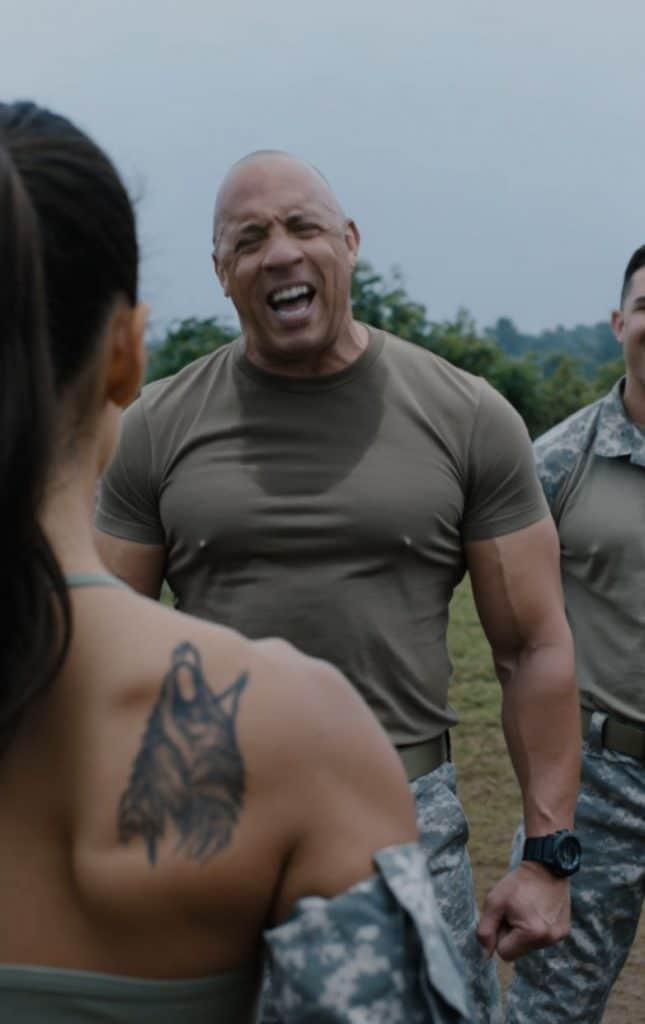
The field was quiet until Sgt. Miller started laughing.
Cadet Elena Torres stood at attention on the trampled grass, her boots planted in the dirt, her eyes fixed straight ahead. Six male soldiers stood in formation in front of her, hands clasped behind their backs, faces arranged into the hard blankness men used when they wanted cruelty to look like discipline.
Behind her, Miller stepped close.
Too close.
He was bald, broad, and built like a man who believed muscle was the same thing as authority. His olive tactical shirt stretched across his chest. His black watch flashed as he reached for Elena’s collar.
Then he yanked it down.
The fabric pulled hard across her shoulder, exposing the tattoo on her left shoulder blade.
A wolf.
Its head lifted toward a full moon.
The ink was dark, detailed, and old enough to have faded slightly around the edges. It did not look decorative. It looked earned.
Miller laughed louder.
“Well, look at that,” he called. “Our little wolf.”
The line of soldiers broke into chuckles.
Elena did not move.
Not when the cold air touched her exposed skin. Not when Miller’s fingers released the collar with a snap. Not when one of the soldiers muttered, “How cute.”
Miller circled around to face her.
He stopped inches from her, chest puffed out, jaw tight with challenge.
“You really think you can keep up with the rest of us?”
Elena’s expression did not change.
That irritated him more than any answer could have.
He leaned closer, searching her face for fear and finding none.
“Go on,” he snarled. “Say something. Or is silence your best skill?”
The squad laughed then.
All six of them, still locked in parade rest, heads tilted back, voices sharp and cruel against the gray sky.
“Hahaha! Yeah, look at her!”
Elena stood like stone.
But her eyes changed.
They lifted slowly to Miller’s, wide and unblinking, carrying a cold intensity that made his laughter die in his throat.
For half a second, the field seemed to stop.
Miller blinked first.
And somewhere beyond the tree line, in the command vehicle parked behind the mess hall, a recorder captured every word.
Act II
Elena had been silent for eleven days.
That was what the squad knew.
She arrived at Fort Hawthorne with no stories, no friends, and no visible interest in being liked. Late twenties. Long dark ponytail. Standard greens worn clean, boots polished, answers clipped to the minimum required by regulation.
Yes, Sergeant.
No, Sergeant.
Understood, Sergeant.
The men called her Ice behind her back.
Miller called her princess when officers were not around.
To the recruits, Fort Hawthorne was supposed to be the last proving ground before assignment to a specialized security battalion. The instructors called it pressure training. The brochures called it elite preparation. The men who washed out called it something else entirely.
A machine.
It did not train people.
It ground them down until they either hardened into the shape Miller wanted or disappeared from the roster.
For years, nobody challenged him.
Miller had friends in the right places, awards framed in the hallway, and a reputation for producing “resilient” soldiers. Command liked numbers. Completion rates. Fitness scores. Men who did not complain.
They did not ask why the medical clinic was full on Mondays.
They did not ask why certain recruits requested transfers without explanation.
They did not ask why the few women assigned there either quit, transferred, or learned to become invisible.
Elena had come because of a file.
Not a rumor.
Not a grudge.
A file.
Her younger cousin, Private Sofia Ramirez, had washed out of Fort Hawthorne six months earlier after only three weeks. The official report said anxiety, failure to adapt, voluntary withdrawal.
Elena knew Sofia.
The girl who climbed trees at ten, ran half marathons at nineteen, and once pulled a stranger from a flooded underpass did not quit because someone shouted at her.
When Elena visited her after the discharge, Sofia could barely speak about the field. She remembered laughter more than pain. Men standing in formation while one instructor stripped her confidence piece by piece. Her tattoo mocked. Her body judged. Her silence used against her.
Miller’s name was in every memory.
Elena did not storm the base.
She did not write an angry letter that would vanish into a polite office.
She went to the Inspector General.
And when the investigation stalled because no one would testify, she made a decision.
Elena Torres was not a cadet.
She was Captain Elena Torres, military police special investigations, temporarily assigned undercover to Fort Hawthorne.
The tattoo Miller exposed was not rebellion.
It was a memorial.
Years earlier, Elena had been part of a rescue unit nicknamed the Night Wolves. They operated in disaster zones and conflict areas, pulling civilians, soldiers, and children from places most people only saw later in reports. After their final mission together, the surviving members got the same tattoo: a wolf facing the moon.
Not because it looked fierce.
Because wolves call to one another in the dark.
Elena had watched better people than Miller stay brave under pressure he could not imagine.
So when he mocked the tattoo, when the squad laughed, when he tried to shrink her in front of men who wanted permission to despise her, Elena did not answer.
She listened.
She remembered.
And she let the recorder inside her collar catch every word.
Act III
Miller mistook silence for submission.
That was his first mistake.
His second was thinking the men behind him were loyal.
They were not loyal.
They were afraid.
There is a difference, and Elena had spent her career learning to recognize it.
After the field drill, Miller dismissed the squad and ordered Elena to stay behind. The soldiers marched away in formation, but not all of them laughed this time. One looked back. A tall private named Jensen. His face was pale, jaw clenched, eyes restless with the look of someone carrying a truth that had gotten too heavy.
Miller saw it too.
“Eyes forward!” he barked.
Jensen snapped his head front.
Elena noticed.
Miller turned back to her.
“You think staring makes you strong?”
“No, Sergeant.”
Her voice was calm.
The sound of it annoyed him.
“So you can speak.”
“Yes, Sergeant.”
“Then maybe next time you’ll use that mouth to answer when I ask you a question.”
Elena held his gaze.
“What was the question, Sergeant?”
His face darkened.
The challenge was too subtle to punish openly and too clear to ignore.
He stepped closer.
“You’re not going to last here.”
Elena said nothing.
Miller smiled.
“You women always come in with something to prove. Tattoos. Attitude. Little tragic backstories. Then the field teaches you where you belong.”
Elena’s expression remained blank.
But inside, the words settled into place.
Pattern.
Bias.
Abuse disguised as tradition.
Retaliation dressed as training.
He was giving her the report himself.
That night, Elena sat alone in the barracks and wrote every detail in a small notebook no one ever saw. Time. Location. Witnesses. Exact words. Body contact. Squad reaction.
At 2300, someone slipped a folded paper under her door.
She waited ten seconds before picking it up.
No name.
Just one sentence.
He did the same thing to Sofia.
Elena stared at the note for a long time.
Then another paper slid under.
This one had names.
Six of them.
Recruits who had washed out.
Recruits whose files said unstable, unfit, insubordinate, poor resilience.
At the bottom was a final line.
Jensen has video.
Elena did not sleep that night.
By dawn, the investigation was no longer about one humiliation in a field.
It was about a system that had taught frightened soldiers to call silence discipline.
The next day, Miller scheduled what he called a correction drill.
Everyone knew what it meant.
Elena would be singled out. Exhausted. Mocked. Pushed until she reacted. Then her reaction would become the evidence against her.
At 0600, the squad assembled on the field.
Cold mist hung low over the grass.
Miller stood in front of them with a whistle around his neck and cruelty already shining in his eyes.
“Cadet Torres,” he called. “Front.”
Elena stepped forward.
He looked at the tattoo barely visible under her collar and smiled.
“Let’s see if the wolf can run.”
Act IV
The course was brutal by design.
Weighted carry. Low crawl. wall climb. hill sprint. Dummy drag. Balance beam over mud. Final mile with full pack.
Miller had used it for years as a humiliation tool. He knew which recruits were tired, injured, or afraid. He knew how to make failure look personal.
Elena listened while he explained the rules.
Then she asked one question.
“Will the time be recorded, Sergeant?”
Miller grinned.
“Oh, it’ll be recorded.”
He looked toward the squad.
“Everyone will see.”
That was his third mistake.
He thought he had given himself an audience.
He had given Elena witnesses.
The whistle blew.
She moved.
Not fast at first.
Controlled.
Efficient.
She lifted the weight cleanly, crossed the first marker, dropped into the low crawl without hesitation. Mud streaked her uniform. Grass stuck to her cheek. Miller shouted from the side, voice sharp with insults that grew less creative as she kept moving.
The squad’s laughter faded by the wall climb.
By the hill sprint, no one was laughing.
By the dummy drag, Jensen’s mouth had fallen open.
Elena pulled the weighted training dummy across the mud with steady, brutal focus, every muscle working, breath controlled, eyes locked ahead.
Miller’s expression shifted.
The smugness drained first.
Then irritation.
Then disbelief.
She reached the final mile with the pack on her shoulders and began to run.
Not sprint.
Run.
Like someone who had learned long ago that pain was not a command to stop.
By the time she crossed the final marker, the field was silent.
Jensen checked the stopwatch in his hand.
His face went pale.
Miller snatched it from him.
“What?”
Jensen swallowed.
“She broke the course record, Sergeant.”
The words moved through the squad like wind through dry leaves.
Miller stared at the time.
Then at Elena.
She stood in front of him, mud on her uniform, breath heavy but controlled, eyes as steady as they had been when he pulled down her collar.
For one long moment, all he could do was look at her.
Then applause began.
Not from the squad.
From behind them.
Miller turned.
Three vehicles had pulled up near the edge of the field. The base commander stepped out first, followed by an Inspector General officer, two military police investigators, and a woman in civilian clothes with a folder pressed against her chest.
Sofia Ramirez.
Miller’s face changed completely.
Elena did not turn around right away.
She watched his eyes find Sofia.
Watched the old confidence crack.
Watched the man who had built his power on fear discover that fear had started giving statements.
The commander walked to the center of the field.
“Sgt. Miller,” he said, voice cold, “stand down.”
Miller forced a laugh.
“Sir, this is a training exercise.”
“No,” the commander replied. “It’s evidence.”
The Inspector General officer lifted a tablet.
“We have audio from yesterday’s incident. Video from multiple prior sessions. Statements from former recruits. Medical discrepancies. Retaliatory remarks. Altered performance reports.”
Miller looked at Elena.
Understanding arrived slowly.
“You,” he whispered.
Elena finally spoke, not like a cadet now, but like the officer she had always been.
“Captain Elena Torres, Special Investigations.”
The squad went rigid.
Jensen’s eyes widened.
Miller stared at her like the ground had disappeared beneath him.
Elena stepped closer.
“You asked if silence was my best skill.”
Her voice stayed calm.
“It wasn’t silence. It was collection.”
Act V
Miller was relieved on the field.
No ceremony.
No dramatic speech.
Just the clean, quiet removal of authority from a man who had mistaken it for ownership.
An investigator took his whistle. Another collected his training logs. The commander ordered the squad dismissed, but no one moved until Elena stepped aside.
That mattered.
For the first time since she arrived, they were not looking at her like an outsider.
They were looking at her like someone had opened a door they had all been too scared to touch.
Sofia walked onto the field slowly.
She had not worn a uniform in six months. Her hands trembled around the folder. But her head was high.
Elena met her halfway.
For a moment, neither woman spoke.
Then Sofia looked at the mud on Elena’s sleeve and gave a broken little laugh.
“You always hated running.”
Elena smiled faintly.
“I still do.”
Sofia’s eyes filled.
“He said no one would believe me.”
Elena’s face softened.
“I believed you.”
That was when Sofia cried.
Not loudly. Not helplessly.
Just enough for the field to understand that the investigation was not about one instructor losing control. It was about every recruit who had walked away believing their pain had no witness.
The inquiry spread quickly.
Records were reviewed. Old medical reports reopened. Training videos recovered from personal phones and cloud backups. Men who had laughed in formation learned that group cruelty did not disappear because everyone participated.
Some were disciplined.
Some testified.
Some apologized too late.
Jensen gave the video he had kept for months and admitted he had been afraid.
Elena did not absolve him.
She did not condemn him either.
“Fear explains silence,” she told him. “It does not make it honorable.”
He nodded.
That sentence stayed with him.
Fort Hawthorne changed slowly, painfully, and not because the army suddenly became pure after one investigation. Institutions do not transform because one bad man is removed. They change when the systems that protected him are dragged into daylight and forced to answer for every excuse.
The course remained.
Elena insisted on that.
Pressure was not the enemy.
Humiliation was.
Difficulty was not abuse.
Discipline was not cruelty.
A new policy went up outside the training field:
Standards test ability. Abuse tests only what people can survive.
Months later, Elena returned to Fort Hawthorne as a guest instructor.
The sky was gray again. The grass had grown back in patches over the old mud. A new class of recruits stood in formation, men and women together, eyes forward, nervous in the way all recruits should be nervous before a hard day.
Elena wore her uniform properly now.
No disguise.
No hidden recorder.
Her collar covered the tattoo, but everyone knew it was there.
The new training officer introduced her as Captain Torres, special investigations, decorated rescue officer, advisor on ethical command standards.
Elena hated long introductions.
She stepped forward and looked down the line.
“I’m not here to make training easy,” she said. “Easy training gets people hurt when things become real.”
The recruits listened.
“I am here to make one thing clear. No one earns strength by humiliating someone who cannot answer back. No leader proves courage by performing cruelty for a crowd. If you see it, you stop it. If you can’t stop it, you report it. If you stay silent because it is comfortable, then you are not disciplined. You are useful to the wrong person.”
The field was silent.
Not afraid.
Listening.
After the session, a young woman approached Elena near the equipment shed.
“Captain?”
Elena turned.
The recruit hesitated.
“I saw your tattoo in an article.”
Elena waited.
“What does it mean?”
Elena could have given the simple answer.
Unit symbol. Memorial mark. Old story.
Instead, she looked toward the tree line, where fog gathered beneath the branches like smoke that had forgotten how to rise.
“It means you call back when someone is lost in the dark,” she said.
The recruit nodded slowly, as if she understood more than the words.
Years later, soldiers would still tell the story.
About the day Sgt. Miller pulled down a woman’s collar to mock the wolf on her shoulder.
About the squad laughing.
About the field going silent.
About the moment the “cadet” revealed she was a captain and the humiliation became evidence.
But Elena remembered something else most clearly.
Miller’s face when he realized she had never been afraid of his volume.
Only careful with her timing.
He had wanted her to speak so he could punish the sound.
So she let him speak instead.
And in the end, his own voice became the thing that brought him down.
That was the lesson the recruits rarely forgot.
Powerful people often fear anger.
But they should fear patience more.
Especially from someone who has learned to stand still, listen closely, and wait until the truth has gathered enough witnesses to howl.