Act I
Sarah was already on her knees when Mr. Grant stepped out of the white pickup truck.
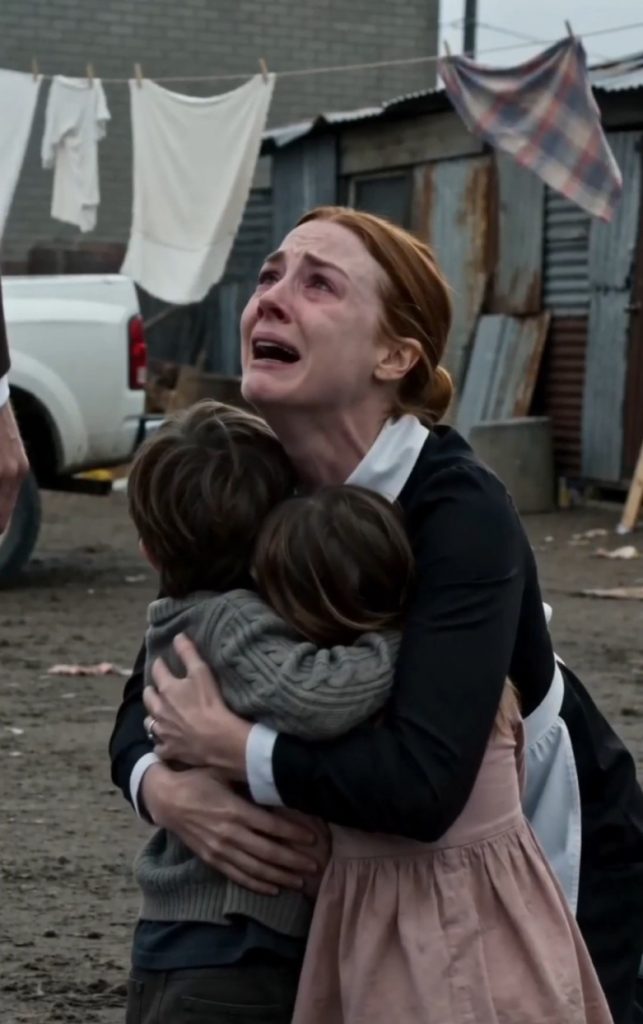
The dirt beneath her apron was damp from the morning mist, turning the hem of her black maid’s uniform a dull brown. Behind her, laundry swung from a sagging rope between two metal shacks, white sheets twisting in the gray wind like surrender flags.
Her son clung to one side of her body.
Her daughter clung to the other.
“I’m here!” Sarah cried, as if being present could undo everything. As if arriving breathless, barefoot at the edge of the shantytown, with two frightened children wrapped around her, could stop the man in the brown suit from destroying what little she had left.
Mr. Grant did not answer.
He stood above her, polished shoes planted on cracked earth, his black tie motionless against his white shirt. Everything about him looked clean, pressed, controlled.
Everything about Sarah looked broken.
“Please don’t fire me,” she begged. Her voice cracked so hard the words barely came out whole. “I can explain. I just needed the job.”
The boy, no older than six, buried his face against her shoulder. His cheeks were streaked with dirt and tears. The little girl in the dusty pink dress had stopped crying completely, which somehow made it worse. She stared at Mr. Grant with the frozen stillness of a child who had already learned adults could take things away.
The shacks behind them seemed to lean inward, listening.
Mr. Grant had come here angry.
He had come because his housekeeper had placed a file on his desk that morning and said, with the satisfied calm of someone delivering justice, “Sir, the new maid lied on her application.”
Sarah Miles, age thirty-two.
No dependents listed.
No prior connection to the Grant family.
No outstanding debts.
All lies, according to Mrs. Beale.
And then came the final accusation: Sarah had been stealing from the pantry, taking envelopes from the study, and using false references to gain access to the Grant estate.
So Mr. Grant had done what Grant men always did. He made a decision before he had the whole story.
He drove himself to the address in the file. Not because he needed to. Because he wanted Sarah to look him in the eye when he fired her.
But now she was looking at him.
And there were children in her arms.
“Mom,” the boy sobbed.
Sarah pulled him closer. “It’s okay, Noah. I’m here.”
Mr. Grant’s expression shifted for the first time.
Not much. Just a crack in the stone.
The boy turned his wet face toward him and pointed with a trembling hand.
“Mom,” he whispered, “is he bad?”
The words landed harder than any accusation could have.
For three seconds, no one moved.
Not Sarah. Not the children. Not Mr. Grant.
Only the clothesline behind them kept swaying, slow and helpless in the wind.
Then Mr. Grant looked down at the boy’s face properly.
At the shape of his eyes.
At the stubborn line of his chin.
At the small silver airplane pin fastened crookedly to his sweater.
The color drained from Mr. Grant’s face.
His jaw tightened, but not with anger anymore. Something older moved through him. Something buried. Something he had spent years refusing to touch.
When he finally spoke, his voice was low.
“Why didn’t you tell me?”
Sarah stared up at him as if those six words had opened a locked room inside her chest.
Because the truth was not just that Sarah needed the job.
The truth was that Mr. Grant had been standing over his own blood.
And he had no idea what his family had done.
Act II
Six months earlier, Sarah had entered the Grant estate through the servants’ door with her hair pinned tight and her wedding ring turned inward against her palm.
The mansion sat on a hill above the city, all white stone, black iron gates, and windows tall enough to reflect the sky. It was the kind of house people slowed down to look at, even when they hated themselves for admiring it.
Sarah had looked once.
Then she lowered her head and walked in.
The agency supervisor had told her not to speak unless spoken to. The Grant family valued discretion. No gossip, no personal stories, no mistakes.
Sarah could do all three.
She had been surviving on silence for years.
At the estate, she cleaned guest rooms no one slept in. She polished silver that had belonged to dead men. She dusted framed portraits of people whose names she already knew but pretended not to recognize.
Especially one portrait.
It hung in a side hallway near the library, half-hidden behind a tall arrangement of white lilies. Two brothers stood shoulder to shoulder in the photograph. The older one was stiff, severe, already wearing responsibility like a suit. The younger one smiled as if rules were things meant to be negotiated.
The nameplate beneath it read:
Elliot and Daniel Grant, 2009.
Sarah never looked at it for more than a second.
Daniel had been her husband.
Not legally, according to the Grant family lawyers.
Not publicly, according to the newspapers.
Not respectfully, according to the people who whispered that he had ruined himself over a girl from nowhere.
But Sarah still wore the ring he had bought from a pawn shop two weeks before their courthouse wedding. It was thin silver, scratched on one side, engraved inside with letters so small she had to press it close to her eye to read them.
D + S. Until the lights come back.
Daniel used to say that whenever things got hard.
When the power was cut off in their first apartment.
When Sarah was pregnant and scared.
When his father froze his bank accounts.
Until the lights come back.
Then Daniel died on a rainy highway outside Baltimore, in a crash that left Sarah with two children, one box of his things, and a warning from a Grant attorney.
Stay away from the family.
Do not contact Mr. Elliot Grant.
Do not attempt to claim inheritance.
Do not create scandal.
Sarah had been twenty-six, grieving, and too exhausted to fight men who used letterhead like a weapon.
So she disappeared.
She moved from one cheap rental to another until even those became too expensive. She took cleaning jobs, night shifts, laundry work, anything that paid in cash. She learned which grocery stores threw out bread after closing. She learned how to smile at her children while counting coins behind her back.
Then came the fever.
Her daughter, Lily, had always been small, but that winter she became frighteningly quiet. The clinic said treatment would cost more than Sarah made in three months. The landlord gave her seven days to pay back rent or leave.
That was when the agency called.
A maid had quit at the Grant estate.
The pay was steady. The hours were long. The background check was shallow if the applicant came recommended.
Sarah almost said no.
Then Lily coughed in her sleep, tiny shoulders shaking under a donated blanket, and Sarah said yes.
She used her maiden name. She listed no children because the agency rejected live-in staff with dependents. She gave an old address because the shantytown changed names depending on which city department wanted to deny it existed.
Every lie felt like a stone in her stomach.
But every paycheck bought medicine.
At the Grant estate, Mr. Elliot Grant rarely noticed her.
He was a man of clipped words and colder rooms. He ran a charitable foundation, sat on hospital boards, donated to housing initiatives, and never once saw the woman scrubbing his floors until someone told him she had broken a rule.
Sarah did not hate him at first.
That was the cruelest part.
Sometimes, when he passed through the hall at night, she saw Daniel in him. Not the smile. Elliot almost never smiled. But the same gray eyes. The same way his hand tightened around a cup when he was thinking.
Once, she had heard him in the library, speaking to no one.
“Daniel would have known what to do.”
Sarah had frozen outside the door with a stack of folded towels in her arms.
For one wild second, she almost knocked.
She almost said, “He left you children.”
But fear won.
Fear always had good reasons.
Then one evening, Sarah found something behind the loose panel under the library desk.
It was an envelope.
Old. Yellowed. Sealed with Daniel’s name written across the front in Elliot’s handwriting.
Not Mr. Grant’s handwriting now. Younger handwriting. More rushed. More human.
Sarah should have left it.
Instead, with shaking hands, she opened it.
Inside was a letter Elliot had written to Daniel ten years earlier.
Not angry.
Not cruel.
Begging.
It said their father had lied. It said Elliot had never wanted Daniel cut off. It said if Daniel came home, they could fix it. It said Sarah was welcome if Daniel loved her.
At the bottom, one sentence had been underlined.
You are my brother before you are his disappointment.
Sarah sat on the library floor and cried without making a sound.
Because Daniel had died believing Elliot hated him.
And Elliot had spent years believing Daniel had chosen never to answer.
That letter should have changed everything.
Instead, it put Sarah in danger.
Because someone had hidden it.
And someone saw her find it.
Act III
Mrs. Beale had been housekeeper at the Grant estate for twenty-two years, which meant she knew where every key was kept and where every secret was buried.
She had a soft voice, clean gray hair, and the habit of calling cruelty “standards.”
The morning after Sarah found the letter, Mrs. Beale appeared in the laundry room and watched her fold sheets.
“You were in the library late last night,” she said.
Sarah kept her eyes on the linen. “I was dusting.”
“The study desk does not need dusting inside its panels.”
The sheet slipped in Sarah’s hands.
Mrs. Beale smiled.
It was not a large smile. It did not need to be.
By noon, the missing pantry items were reported.
By evening, an envelope from Mr. Grant’s desk was said to be gone.
By the next morning, Sarah’s employment file sat open in front of Elliot Grant, every desperate omission marked in red.
“She is not who she says she is,” Mrs. Beale told him.
Elliot stood by the window of his office, looking down at the gardens. “Then who is she?”
“A thief, most likely. A liar, certainly. And someone with children she concealed from this household.”
At that, Elliot turned.
“Children?”
Mrs. Beale gave a small sigh, as though motherhood itself were an inconvenience. “Two, according to the driver who followed her last week.”
Elliot’s face hardened. “You had her followed?”
“I protected this house.”
No one in the room said the obvious: Mrs. Beale had never protected the house. She had protected the version of the house that kept her powerful.
The Grant family had trusted her with everything after Elliot’s mother died. She managed staff, sorted correspondence, screened visitors, and quietly made sure certain letters never reached certain hands.
Including Daniel’s.
Including Sarah’s hospital bills when, years later, she wrote once in desperation and begged only for a chance to speak.
Elliot never saw that letter.
Mrs. Beale did.
She recognized Sarah the first day she entered the estate, though Sarah’s face had thinned and grief had changed the way she carried herself. Daniel’s widow, reduced to service. Daniel’s children, hidden somewhere beyond the city’s respectable map.
To Mrs. Beale, Sarah was not a woman in need.
She was a threat.
Because the old Mr. Grant had left instructions before he died. Private instructions. The kind that sat in sealed files with lawyers until someone had the courage to open them.
Daniel’s children, if proven legitimate, were entitled to a portion of the family trust.
Not enough to ruin Elliot.
Enough to expose everyone who had lied.
Mrs. Beale had spent years helping the old man erase Sarah. She had forwarded attorney letters. Buried family messages. Told Elliot his brother wanted nothing from him. Told Daniel, through intermediaries, that Elliot had agreed he should be cut off.
She did it because the old Mr. Grant rewarded loyalty.
And because Mrs. Beale believed people like Sarah should remain exactly where society placed them.
Below stairs.
Below notice.
Below mercy.
So when Sarah found Elliot’s hidden letter, Mrs. Beale moved quickly.
She planted suspicion.
She turned poverty into evidence.
She made Sarah’s children sound like a scheme.
And Elliot, ashamed of how easily betrayal seemed to repeat itself in his family, believed the wrong person.
That was why he drove to the shantytown.
That was why Sarah ran from the bus stop when she saw his truck near the row of shacks.
That was why she fell to her knees before he could speak, because she thought the last door had closed.
But Elliot was no longer looking at her like an employer.
He was staring at Noah’s silver airplane pin.
Daniel had owned one exactly like it.
Their mother had given the brothers matching pins as boys, after their first flight to London. Elliot lost his. Daniel kept his pinned inside his jacket for years. He used to joke it was proof he could still escape if dinners became unbearable.
Elliot took one step forward.
Sarah flinched.
He stopped immediately.
“Where did he get that?” he asked.
Sarah’s hand went to Noah’s sweater. “His father.”
“What was his father’s name?”
Her lips trembled.
For years she had protected the name like a candle in wind. She had whispered it to her children at bedtime, but never outside. Never near people who could take it and twist it.
“Daniel,” she said.
Elliot closed his eyes.
The shantytown seemed to fall away.
The rusted roofs. The wet dirt. The watching neighbors behind broken windows.
All of it vanished beneath the weight of a name he had not heard spoken with love in seven years.
He opened his eyes again, and this time Sarah saw something terrible in them.
Not anger.
Recognition.
“Daniel Grant?” he asked.
Noah looked up sharply.
“My daddy was Daniel Grant,” the boy said, small voice shaking. “Mom says he was brave.”
Elliot bent slightly, as if the sentence had struck him in the chest.
Sarah pulled Noah closer, afraid of what came next.
But Elliot did not reach for the boy.
He reached into his coat pocket and took out his phone.
His fingers were unsteady.
“Mrs. Beale,” he said when the call connected, his eyes still fixed on Sarah. “Bring me the old family trust files. Daniel’s sealed correspondence. All of it.”
A pause.
His voice changed.
“And if anything is missing, call your attorney before I call mine.”
For the first time since Sarah had known him, Elliot Grant sounded like a man who had discovered the monster was not outside his house.
It had been answering the door for years.
Act IV
The next twenty-four hours tore open the Grant family piece by piece.
Elliot brought Sarah and the children to a small guest cottage behind the estate, not the main house. Sarah refused the mansion. She refused the marble floors, the staring portraits, the pity of staff who had ignored her when she wore an apron.
“I’m not bringing my children through the servants’ entrance again,” she said.
Elliot accepted that without argument.
He sent a doctor for Lily. He had groceries delivered. He gave Sarah space, which was the first kindness she believed.
Then he went into the library and began reading the dead.
The first file came from the family attorney, who sounded nervous the moment Elliot demanded records. The second came from a locked cabinet Mrs. Beale claimed not to have a key for. The third was found by the youngest footman behind a false drawer in the linen office.
By midnight, Elliot knew enough to hate himself.
Daniel had written to him six times.
Sarah had written twice after Daniel’s death.
None of the letters reached him.
The old Mr. Grant had commissioned a private report on Sarah, full of humiliating details about her childhood, her mother’s debts, the apartment she shared with Daniel, even the clinic where she gave birth to Noah. At the bottom of one page, Elliot’s father had written in blue ink:
She will leave when hunger teaches her place.
Elliot read that sentence three times.
Then he folded the paper and placed it in the evidence stack.
Mrs. Beale denied everything at first.
She stood in the library the next morning in her black dress, hands folded, chin lifted.
“I served this family faithfully,” she said.
“No,” Elliot replied. “You served my father’s cruelty and called it loyalty.”
Her face tightened.
Sarah stood near the doorway with Noah behind her and Lily in her arms. She had not wanted to attend. Elliot had asked, but not ordered. The difference mattered.
Mrs. Beale looked at Sarah once, and the old contempt surfaced.
“This woman lied her way into your home.”
Sarah’s cheeks burned.
Elliot turned slowly.
“So did you.”
The room went still.
He opened a folder and placed three documents on the desk.
A copied letter from Daniel.
A returned envelope Sarah had never seen.
A signed statement from the former Grant attorney’s assistant, who admitted that Mrs. Beale had personally collected correspondence meant for Elliot and marked it “handled.”
Mrs. Beale’s mask cracked.
Only slightly.
But Sarah saw it.
For years, the world had told her women like Mrs. Beale were respectable and women like Sarah were suspicious. Yet there they were, in a room filled with expensive books, and the truth had dirt under its nails while the lie wore pearls.
“You don’t understand what I prevented,” Mrs. Beale said. Her voice had lost its softness. “Your father built this name. Daniel disgraced it.”
“My brother fell in love,” Elliot said.
“He married beneath him.”
Elliot’s eyes sharpened. “He married better than us.”
Sarah looked down fast, but not before tears slipped over her lashes.
Mrs. Beale laughed once, bitter and small. “And now what? You hand the estate to her? You let those children inherit because she crawled back at the right time?”
Noah stepped out from behind Sarah.
He was trembling, but he stepped out anyway.
“My mom didn’t crawl,” he said.
Every adult in the room looked at him.
His small hands were balled at his sides. The airplane pin glinted on his sweater.
“She works,” he said. “She works when it’s dark. She works when Lily’s sick. She works when she cries and thinks we don’t hear. She didn’t crawl.”
Sarah covered her mouth.
Elliot looked at the boy and saw Daniel so clearly it almost hurt to breathe.
Then he looked back at Mrs. Beale.
“You’re dismissed,” he said.
Her expression froze.
“And by dismissed,” he continued, “I mean removed from this property pending legal action. You will not contact my staff, Sarah, or the children. You will not touch another file. You will not step through these doors again.”
Mrs. Beale stared at him as though he had betrayed the natural order of the world.
But the natural order had already broken.
It broke when Sarah knelt in the dirt.
It broke when a little boy asked if Elliot was bad.
It broke when Elliot realized the answer might have been yes if he did nothing next.
Two security officers escorted Mrs. Beale down the hall she had ruled for decades. Staff gathered silently near doorways, watching the woman who had terrified them leave with her lips pressed white.
At the front entrance, she turned once.
“You’ll regret letting them in,” she said.
Elliot did not raise his voice.
“No,” he answered. “I regret keeping them out.”
But justice on paper was easy.
The harder thing was waiting in the cottage, wearing Sarah’s wedding ring, and wondering whether forgiveness could ever enter a room where trust had been starved for years.
Act V
Elliot did not ask Sarah to forgive him.
That surprised her more than the lawyers, the trust documents, or the sudden appearance of people who now addressed her as Mrs. Grant with careful respect.
He apologized once, plainly, without decoration.
“I believed the first story that made me comfortable,” he said. “That was my failure.”
Sarah stood on the cottage porch, arms crossed against the evening cold. Noah and Lily were inside eating soup at a real table, under a roof that did not leak.
“You looked at me like I was dirt,” she said.
Elliot accepted the blow because it was true.
“I did.”
“You came to take my job.”
“Yes.”
“My children were scared of you.”
His throat moved.
“I know.”
The honesty made it harder to stay angry. Sarah almost wished he had defended himself. It would have given her something solid to push against.
Instead, he stood there in his expensive coat, looking like a man who had finally understood that regret was useless unless it changed what happened next.
The legal process took months.
Daniel and Sarah’s marriage certificate was verified. Noah and Lily were recognized as Grant heirs. The portion of the trust that had been withheld was restored, with interest Elliot insisted on paying personally, though Sarah’s lawyer told him he did not have to.
Sarah kept the lawyer.
She had learned the hard way that kindness and contracts should never be confused.
The shantytown did not disappear overnight. Places like that rarely do. But Elliot funded repairs without putting his name on a plaque. Medical bills were paid quietly. Several families were moved into safe housing through channels that did not require them to perform gratitude for wealthy donors.
Sarah noticed.
She did not praise him.
That, too, Elliot accepted.
The first time Noah visited the main house, he refused to go past the front steps.
“Is this where the bad lady lived?” he asked.
Sarah knelt beside him. “She worked here.”
“Are there more bad people?”
Elliot, standing a few feet away, answered before Sarah had to.
“Probably,” he said gently. “But we’re going to be more careful now.”
Noah studied him with Daniel’s gray eyes.
“Are you bad?”
The question was quieter this time.
Not accusing.
Testing.
Elliot crouched, careful to stay at the boy’s level.
“I was wrong,” he said. “I’m trying not to be.”
Noah considered that.
Then he took Sarah’s hand and walked inside.
It was not forgiveness.
It was a beginning.
Months later, on what would have been Daniel’s thirty-sixth birthday, Sarah received a box from Elliot. Inside was the original letter he had written to Daniel all those years ago, the one hidden behind the library panel.
There was also a second envelope.
Sarah opened it at the kitchen table while Noah drew airplanes and Lily lined up crackers in careful rows.
The letter was short.
Sarah,
I don’t know if Daniel ever told you this, but when we were boys, he used to say I was brave because I never cried. He was wrong. He was always the brave one. He loved without permission.
I cannot give him back to you. I cannot give your children the years this family stole. But I can make sure no one ever again treats them like a secret.
The house on the hill is not mine alone anymore. It belongs to Daniel’s children too. Whether you choose to live here, sell your share, burn every portrait, or never step inside again, that choice is yours.
For once, a Grant choice belongs to you.
Sarah read the letter twice.
Then she removed her wedding ring and looked at the tiny engraving inside.
Until the lights come back.
For years, she had thought that meant rescue. Some impossible morning when Daniel would walk through the door, smiling, apologizing for being late, ready to fix what death had shattered.
But now she understood it differently.
Sometimes the lights came back slowly.
A doctor saying Lily was getting stronger.
A lawyer saying the truth was on record.
A little boy sleeping without flinching at truck headlights.
A man born into power learning, painfully and late, how to kneel without being forced.
One spring afternoon, Elliot invited Sarah and the children to a dedication ceremony at a new family shelter downtown. Sarah almost refused. She disliked ceremonies. She disliked cameras more.
Then Elliot told her the name.
The Daniel Grant House.
Not the Grant Foundation Center.
Not the Elliot Grant Community Initiative.
Daniel.
Sarah stood in the back of the crowd while Elliot gave a speech that lasted less than three minutes. He did not make himself the hero. He did not mention redemption. He simply said his brother had believed a person’s worth was never measured by the door they entered through.
Then he stepped aside.
Noah tugged Sarah’s sleeve.
“Mom,” he whispered, pointing at the bronze plaque near the entrance.
Under Daniel’s name were smaller words.
For Sarah, Noah, and Lily — who should never have had to beg to be seen.
Sarah pressed one hand to her mouth.
The crowd blurred.
Lily slipped her tiny hand into Elliot’s. He looked down, startled, then held it as carefully as if she had handed him something breakable and sacred.
Noah looked at him for a long moment.
Then he reached into his pocket and pulled out the silver airplane pin.
“My dad’s,” he said.
Elliot nodded. “I know.”
Noah pinned it clumsily to Elliot’s suit jacket.
“You can borrow it,” the boy said. “But you have to bring it back.”
Elliot’s eyes filled, but he smiled.
“I will.”
Sarah watched them from the doorway of a building meant for people who had once been invisible. For the first time in years, she did not feel like she was standing outside a world that had locked her out.
She was not healed.
Not completely.
Some wounds do not vanish because papers are signed or names are restored.
But when Noah took her hand and Lily laughed at something Elliot said, Sarah felt the old sentence rise in her memory, softer now, less like a promise from a ghost and more like a truth arriving late.
Until the lights come back.
And this time, they did.