Act I
The girl did not belong in that room.
Everything around her glittered.
Crystal chandeliers poured warm gold over the banquet hall. White linen tablecloths fell in perfect folds. Silver knives rested beside gold-rimmed plates. Women in evening gowns lifted champagne glasses as if the whole world had been polished just for them.
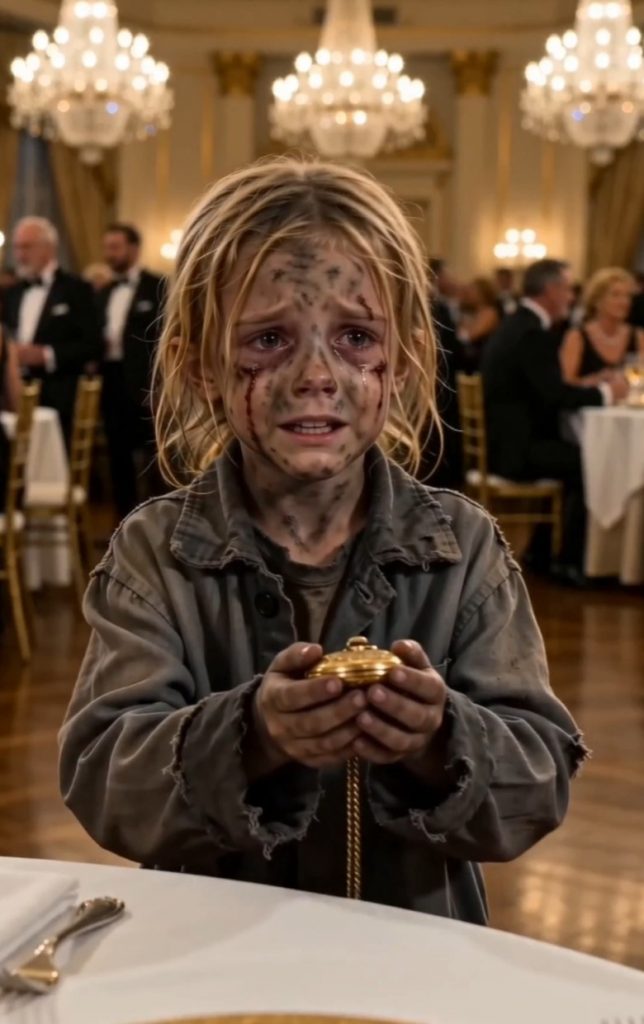
Then the little girl stepped between the tables barefoot and filthy, carrying a gold pocket watch in both trembling hands.
She was no more than seven.
Her blonde hair was matted against her soot-streaked cheeks. Tear tracks cut pale lines through the dirt on her face. She wore an oversized grey work shirt that hung from her small body like something stolen from a laundry line.
People noticed her too late.
A waiter stopped mid-step. A woman in pearls frowned. A man in a tuxedo whispered something irritated under his breath, as if a starving child were a stain on the carpet.
But the girl ignored all of them.
Her eyes were fixed on one woman.
The Lady in Gold.
Evelyn Ashford sat near the front of the hall in a rose-gold sequined gown that caught every chandelier flame. Her blonde hair fell in perfect Hollywood waves. A diamond pendant rested at her throat like a frozen tear.
To the guests, she was the face of the Ashford Foundation.
Elegant. Untouchable. Tragic in a beautiful way.
To the girl, she was simply the woman her mother had described.
Find the lady in gold.
The girl stopped beside Evelyn’s table and held out the watch.
“I think this is yours,” she whispered.
Evelyn looked down.
For one second, the entire room disappeared.
The watch was yellow gold, round and heavy, its lid engraved with vines and tiny flowers. A delicate chain spilled between the girl’s dirty fingers. Evelyn knew every curve of it.
She had buried that watch in her memory because remembering it hurt too much.
Her hand hovered near her plate.
“Where did you get this?” she breathed.
The girl’s lips trembled.
“My mommy kept it.”
Evelyn took the watch as if it might burn her. Her manicured thumb found the latch. The lid opened with a tiny click.
Inside was a black-and-white photograph.
A younger Evelyn smiled from the circular frame, her hair loose, her face softer, wearing a white nightgown. In her arms was a newborn wrapped in a thick blanket.
Evelyn stopped breathing.
The photo had been taken eight years ago in a private hospital room before the world told her the baby had died.
“No,” she whispered.
Then the whisper tore into a sob.
“No. No! Who gave this to you?”
The girl’s chin quivered. Tears ran through the soot on her cheeks.
“My mommy,” she said. “She said… find the lady in gold.”
Evelyn gripped the edge of the table as the guests around her finally began to stare.
“What is your mother’s name?”
The girl looked at her with an ancient sorrow no child should carry.
“Before she died,” she whispered, “she told me to tell you…”
Evelyn leaned forward, shaking.
The girl’s voice broke.
“Your mommy.”
The watch slipped from Evelyn’s hand and struck the plate like a bell.
And somewhere behind her, a man stood up too fast.
Act II
Evelyn Ashford had spent eight years learning how to smile with a dead heart.
She had become very good at it.
She smiled at donors. She smiled at photographers. She smiled at charity boards and hospital directors and wealthy men who called her brave because they preferred polished grief to honest pain.
The Ashford Foundation had been born from tragedy, or so the newspapers said.
Eight years earlier, Evelyn had been twenty-four, unmarried, and pregnant in a family where appearances mattered more than truth. Her father was already dead. Her mother, Margaret Ashford, ruled their world from behind silk curtains and closed doors.
Margaret did not shout.
She did not have to.
She could ruin a person with a quiet phone call, a cancelled invitation, a locked bank account.
When Evelyn told her she was keeping the baby, Margaret’s face went calm in the way skies go calm before storms.
“You are confused,” she said.
Evelyn was not confused.
The baby’s father, Daniel Reyes, had been a young architect hired to restore one of the Ashford properties. He was kind, brilliant, and entirely unacceptable to Margaret. When Evelyn refused to end the relationship, Daniel was offered a job across the country and threatened with a lawsuit if he ever contacted her again.
Evelyn did not find out until months later.
By then, she was alone in a private maternity suite with Margaret standing beside the bed, telling doctors what Evelyn could and could not know.
The delivery was difficult.
Evelyn remembered pain, bright lights, a nurse with gentle eyes, and the sound of a baby crying.
A girl.
She saw her only once.
Someone placed the newborn in her arms. Evelyn touched the baby’s cheek and laughed through tears because she had never known a person could be so small and still change the entire universe.
Margaret stood at the foot of the bed.
A photographer came in. Evelyn thought it was strange, but she was too exhausted to argue.
The flash went off.
Then everything blurred.
Medication. Sleep. A voice saying there were complications. Another voice saying the baby was gone.
When Evelyn woke, her arms were empty.
Margaret sat beside her, dry-eyed.
“I’m sorry,” she said. “She didn’t survive.”
There was no funeral Evelyn could remember clearly. No body she was allowed to hold. No grave that felt real. Only a white marble marker in the Ashford family cemetery with the name Margaret had chosen.
Infant Daughter Ashford.
Evelyn begged for answers until people began calling it hysteria.
Margaret called it grief.
Then she built a foundation in the baby’s memory and placed Evelyn in front of cameras until her sorrow became useful.
For years, Evelyn carried the gold pocket watch everywhere. It had belonged to her father, and she had hidden the baby’s photograph inside it. On the first anniversary of the birth, the watch vanished.
Margaret told her she must have misplaced it.
Evelyn searched the entire mansion.
She never found it.
Six months later, Margaret Ashford died of a sudden stroke, leaving Evelyn the foundation, the house, the wealth, and a grief with no door.
Evelyn believed the truth had died with her.
Now a little girl stood in a banquet hall saying Margaret had kept the watch.
And called herself Mommy.
Evelyn rose from her chair so quickly the diamond pendant swung against her chest.
“What is your name?” she asked.
The girl stared at the watch.
“Clara.”
Evelyn’s knees weakened.
That was the name she had whispered to her newborn before they took her away.
Not the name on the grave.
Not the name in the papers.
The secret name.
The one no one knew except Evelyn and the baby.
The man who had stood behind her moved closer.
His name was Richard Vale, chairman of the foundation board. Silver-haired, handsome, controlled. He had been Margaret’s attorney for twenty years before becoming Evelyn’s advisor. He was the kind of man who spoke gently while closing every exit.
“Evelyn,” he said, placing a hand near her shoulder. “Step away from the child.”
She turned on him.
“Why?”
Richard’s expression did not change, but his eyes moved to the watch.
Only for half a second.
It was enough.
Clara saw it too.
She took one frightened step back.
Richard smiled at the guests.
“This poor child is clearly confused. Security should help her before this becomes cruel.”
Evelyn heard the words beneath the words.
Before she says more.
Before the room understands.
Before the lie breaks open.
Clara reached into the oversized shirt and pulled out a folded strip of fabric.
It was white once.
Now it was grey with age and smoke.
A hospital bracelet.
Evelyn’s hands shook as she took it.
Baby Girl Ashford.
Date of birth.
Time of birth.
And beneath that, written in faded ink, one word.
Clara.
The banquet hall tilted.
Evelyn looked at Richard.
He was no longer smiling.
Act III
The first security guard reached the table, but Evelyn stepped between him and Clara.
“Touch her,” she said, “and I will own your badge by morning.”
The guard froze.
No one in the hall had ever heard Evelyn Ashford speak like that.
Not the soft widow of a dead child. Not the golden woman on charity posters. This was someone else entirely. Someone whose grief had just been handed back to her alive, dirty, terrified, and shaking beneath chandeliers.
Richard lowered his voice.
“Evelyn, you are emotional. That bracelet proves nothing.”
Clara flinched at his tone.
Evelyn noticed.
She crouched in front of the child, ignoring the floor, the gown, the gasps of rich women who had never knelt for anyone.
“Clara,” she said carefully, “the woman who raised you… what did she call herself?”
Clara swallowed.
“Mommy Margaret.”
A sound escaped Evelyn that was not quite a sob.
Margaret.
Her own mother had taken her baby, hidden her, raised her somewhere out of sight, and let Evelyn mourn an empty grave.
“Where did you live?” Evelyn asked.
Clara looked around the room as if expecting someone to punish her for answering.
“In the service house. Behind the old orchard.”
Evelyn closed her eyes.
The Ashford estate had a caretaker’s cottage beyond the orchard, boarded up after Margaret’s death. Evelyn had never gone inside. Richard told her it was unsafe, full of mold, scheduled for demolition.
Richard.
Always Richard.
Clara’s voice dropped.
“She said I couldn’t go to the big house. She said the lady there was sick and would hate me if she saw me.”
Evelyn covered her mouth.
“No.”
“She had pictures of you,” Clara whispered. “A lot of them. She watched you on TV.”
“What happened to her?”
Clara’s face crumpled.
“She got sick. She kept saying she had to tell the truth before Mr. Richard came.”
The room turned colder.
Evelyn slowly stood.
Richard’s jaw tightened.
“Children invent things under stress.”
Clara shook her head hard.
“He came to the cottage. He yelled. He said she should have destroyed the watch. He said if anyone found me, everything would belong to me.”
A ripple moved through the banquet hall.
Everything.
Not love. Not family. Not truth.
Inheritance.
Evelyn turned to Richard with the watch clenched in her fist.
“What did my mother do?”
Richard’s face remained smooth, but the skin beneath his eyes had gone pale.
“Margaret made difficult decisions to protect you.”
“Protect me from my daughter?”
“To protect the Ashford name.”
The words left his mouth before he could dress them properly.
Several guests heard.
Phones began rising quietly around the room.
Richard noticed and changed tactics.
“Evelyn, listen to me. Your mother was unstable near the end. She became attached to a child from one of the staff families. She filled the girl’s head with fantasies. This is sad, but it is not scandal.”
Clara’s breathing quickened.
Evelyn knelt again and held out her hand.
Clara hesitated.
Then she placed her small soot-streaked fingers in Evelyn’s palm.
The contact shattered something in both of them.
Evelyn had expected proof to feel legal. Cold. Official.
Instead, it felt like a pulse.
Clara whispered, “She told me your song.”
Evelyn went still.
“What song?”
Clara hummed four soft notes.
The lullaby Evelyn had made up in the hospital, half-delirious, with her newborn against her chest.
No one else had been close enough to hear it.
Except the baby.
Evelyn pulled Clara into her arms.
The girl was stiff at first, unused to being held without fear. Then she collapsed against Evelyn’s sequined gown and sobbed so hard her whole body shook.
The room blurred.
Evelyn pressed her lips to Clara’s dirty hair.
“My baby,” she whispered.
Richard stepped backward.
Maddox, the head of security, moved to follow him, but Richard lifted one hand.
“I would be careful,” Richard said. “A public scene will damage the foundation permanently.”
Evelyn looked up over Clara’s shoulder.
For the first time in her life, she understood exactly how her mother had ruled people.
Not with power.
With shame.
The fear of what others would think.
Evelyn stood, still holding Clara.
“Then let it be damaged.”
Richard’s eyes sharpened.
“You don’t mean that.”
“I mean every word.”
Then Clara tugged gently at Evelyn’s necklace.
“There’s more,” she whispered.
Evelyn looked down.
Clara reached into the pocket of the work shirt and removed a tiny brass key.
“Mommy Margaret said it opens the box under the floor.”
Act IV
No one ate after that.
The gala dissolved into a storm of whispers, ringing phones, and staff members pretending not to listen while hearing every word. Richard tried twice to pull Evelyn aside. Both times, she refused.
She did not let go of Clara.
Not once.
Within thirty minutes, Evelyn, Clara, two security guards, and a foundation trustee named Helen Brooks were in a car headed toward the Ashford estate. Richard insisted on coming.
Evelyn told him no.
He came anyway, following in his own black sedan.
That was how she knew there was something in the cottage worth fearing.
The old service road behind the orchard was overgrown. Branches scraped the car windows. The sun had fully set, and the estate lights glowed far away through the trees like another world.
Clara grew smaller in the seat beside Evelyn.
“I’m sorry I got dirty,” she whispered.
Evelyn turned to her, stunned by the apology.
“Clara, no.”
“She said ladies don’t like dirty children.”
Evelyn’s heart twisted.
“Then she was wrong.”
Clara studied her face.
“Are you mad at me?”
The question nearly broke her.
Evelyn gathered Clara’s hands between hers.
“I have been looking for you in every room of my life without knowing it,” she said. “I could never be mad at you for finding me.”
The caretaker’s cottage appeared beyond the trees.
It was smaller than Evelyn remembered from childhood. Peeling white paint. One broken shutter. A porch sagging at one corner. Smoke stains marked the side wall near the kitchen window.
Clara stared at them.
“The fire started after she died,” she whispered. “I think someone came looking.”
Evelyn’s stomach tightened.
Inside, the cottage smelled of dust, old wood, and smoke. There were signs of a life hidden in plain sight. A child’s cup. A narrow bed. Stacks of newspapers with Evelyn’s face on the front. A cracked television. A shelf of canned soup. A blue ribbon tied around a photograph frame.
The photograph showed Margaret Ashford holding a baby.
Clara.
Evelyn could barely look at it.
Not because Margaret looked cruel.
Because she looked tender.
That was the worst part.
Margaret had stolen Evelyn’s child and still loved the child enough to keep her. The crime was not made softer by affection. It was made more monstrous.
Clara led them to the bedroom.
Under a loose floorboard beneath the bed, the brass key opened a metal box.
Inside were documents wrapped in oilcloth.
Hospital records.
A signed confession in Margaret’s handwriting.
A birth certificate that had never been filed.
Letters addressed to Evelyn but never delivered.
And a sealed envelope marked with Richard Vale’s name.
Helen Brooks took one look at the papers and said, “We need police.”
Richard arrived before they could call.
He appeared in the doorway, breathing hard, his polished gala shoes muddy from the orchard path.
“Step away from that box,” he said.
Evelyn stood slowly.
Clara hid behind her.
Helen held the documents against her chest.
Richard’s mask was gone now. Without chandeliers, donors, and photographers, he looked less like a gentleman and more like a cornered man.
“You have no idea what you are about to destroy,” he said.
Evelyn’s voice was cold.
“My mother already destroyed enough.”
“She saved you,” Richard snapped. “You were a foolish girl ready to hand the Ashford fortune to a contractor’s baby.”
“My baby.”
“A legal inconvenience,” he said, and then seemed to realize he had spoken too honestly.
Helen stared at him.
Evelyn did not move.
Richard pointed toward Clara.
“That child’s existence changes control of trusts, shares, voting rights, the foundation charter. Margaret understood that. She understood legacy.”
Evelyn’s eyes filled, but her voice stayed steady.
“No. She understood possession.”
Richard took a step inside.
One of the guards blocked him.
Richard laughed bitterly.
“You think this ends with a hug? Your mother bribed doctors. Nurses signed false statements. I arranged the records. Half the board knew something was irregular and chose not to ask. If you open this, you open all of it.”
Evelyn looked at the little girl gripping the back of her gown.
“Good.”
Richard’s face hardened.
Then Clara spoke.
“She recorded you.”
The room froze.
Richard looked at her.
Clara pointed to the metal box.
“Mommy Margaret said bad men always believe paper can disappear. So she used the little black machine.”
Helen dug beneath the documents and found a small voice recorder wrapped in a handkerchief.
Richard lunged.
The guard caught him before he reached it.
Helen pressed play.
Margaret’s frail voice filled the cottage.
“I took the child. God forgive me, I took her. Richard said Evelyn would recover faster if there was nothing left to hold. He said the trust would remain clean. He said no one needed to know. But Clara asks why the lady in gold cries on television, and I can no longer bear what I have done.”
A second voice cut in.
Richard’s.
“You will bear it, Margaret. Or I will make sure Evelyn remembers you as a madwoman and the child as a stray you kept out of guilt.”
Evelyn closed her eyes.
The last wall fell.
Outside, police lights flashed through the orchard trees.
Helen had already made the call.
Act V
By morning, the gala was no longer a charity event.
It was a headline.
The Lady in Gold.
The Lost Ashford Child.
The Watch That Exposed an Eight-Year Lie.
Evelyn did not read the articles.
She sat in a hospital room beside Clara’s bed while doctors treated dehydration, exhaustion, and years of neglect that no family fortune could excuse. Clara slept curled on her side with one hand wrapped around the gold pocket watch.
Every few minutes, Evelyn checked to make sure she was still there.
Helen handled the police. The foundation board suspended Richard before noon. By evening, two retired hospital administrators and one former Ashford family employee had agreed to speak with investigators.
Fear, it turned out, had kept many people quiet.
But fear weakens when the first person tells the truth.
Richard was arrested three days later.
He wore a dark suit and said nothing as reporters shouted questions. His silence looked dignified on camera, but Evelyn knew better now. It was not dignity.
It was strategy.
Margaret Ashford could not be arrested. She was already in the ground beneath a marble angel in the family cemetery. But her confession was read aloud in court months later, and for the first time, Evelyn heard the whole story.
Margaret had ordered the baby taken after delivery.
A nurse had been paid.
A doctor had signed a false report.
Richard had altered trust documents to keep Clara’s existence from triggering inheritance clauses Evelyn’s father had written years before.
The infant grave held no child.
Only sealed hospital linens and a lie.
When Evelyn heard that, she did not cry.
She had cried enough.
Instead, she reached for Clara’s hand.
Clara was cleaner now, healthier, her blonde hair cut gently at the ends but still wild when she ran. She wore a soft blue sweater Evelyn had bought her, though she still slept sometimes in the oversized grey shirt because it was the last thing Margaret had given her.
Grief is not simple for children.
Clara missed the woman who had lied to her.
Evelyn let her.
Love and harm can live in the same memory, and forcing a child to choose only deepens the wound.
At night, Clara asked hard questions.
“Did she love me?”
Evelyn would sit beside her bed and answer honestly.
“Yes.”
“Then why did she hurt you?”
“Because love without truth can become selfish.”
“Do you hate her?”
Sometimes Evelyn wanted to say yes.
Sometimes she did.
But Clara’s eyes were too young to carry adult hatred.
So Evelyn said, “I hate what she did. I am still learning what to do with the rest.”
That answer seemed to satisfy Clara more than any lie.
The Ashford Foundation changed after the scandal.
Evelyn resigned the old board and rebuilt it from the ground up. The first program she funded was not a gala, not a wing with her name on it, not a polished campaign for magazines.
It was a legal aid fund for mothers and children trapped behind family power, sealed records, and quiet threats.
No chandeliers.
No photographers.
Just help.
One year after Clara walked into the banquet hall, Evelyn returned to that same room.
This time, there were no gold plates.
No diamond donors pretending generosity was the same as justice.
The hall had been opened to families served by the foundation. Children ran between tables covered in simple white cloths. Volunteers carried trays of food. A small band played near the windows.
Evelyn wore a plain cream dress.
Clara wore gold shoes she had chosen herself.
“They’re not too much?” she asked.
Evelyn smiled.
“They are exactly enough.”
Near the entrance, a display case held the pocket watch.
Not as decoration.
As testimony.
Inside the open lid was the photograph: Evelyn in the hospital, young and glowing, holding the baby she had been told was dead.
Beside it sat a small card.
Clara Ashford was never lost.
She was hidden.
There is a difference.
Clara stood in front of the case for a long time.
Then she slipped her hand into Evelyn’s.
“Do you wish I came sooner?”
Evelyn looked down at her daughter.
Every answer hurt.
Yes, because she wanted back every birthday, every first word, every fever, every bedtime story stolen from them.
No, because Clara had been a child surviving the only way she knew how.
So Evelyn chose the truth.
“I wish they had never taken you,” she said. “But you came when you could. And that was enough to bring you home.”
Clara leaned into her side.
Across the room, guests began to quiet as Helen stepped to the microphone. She started to introduce Evelyn, but Evelyn gently stopped her.
Not tonight.
Instead, she brought Clara forward.
The room softened at the sight of them together.
Evelyn took the microphone and looked out over the crowd.
“A year ago,” she said, “my daughter entered this hall carrying a watch. People saw a dirty child interrupting a beautiful evening.”
Her voice trembled, then steadied.
“They were wrong. She was not interrupting anything. She was ending a lie.”
Clara squeezed her hand.
Evelyn continued.
“For years, I thought grief was the worst thing that could happen to a mother. I was wrong. The worst thing is being taught to doubt the love you know you felt.”
She looked down at Clara.
“But truth has a sound. Sometimes it is loud. Sometimes it is a courtroom door closing. Sometimes it is a child whispering a name no one wanted spoken.”
The hall remained silent.
Not the cruel silence from the year before.
A listening silence.
Evelyn handed the microphone to Clara, who stared at it in alarm.
“I don’t know what to say,” Clara whispered.
Evelyn crouched beside her.
“Say only what is true.”
Clara looked at the crowd.
Then at the watch.
Then at Evelyn.
“My mommy told me to find the lady in gold,” she said softly. “I did.”
A few people cried.
Evelyn did too.
But this time, the tears did not ruin anything.
They belonged.
Later, after the hall emptied and the chandeliers dimmed, Evelyn and Clara stood alone beneath the golden light. The pocket watch rested between them in its glass case, no longer a weapon, no longer a secret.
Clara pressed her palm to the glass.
“Can we take it home someday?”
Evelyn nodded.
“When you’re ready.”
Clara thought about that.
Then she reached up and touched Evelyn’s diamond pendant, the same one she had worn the night they met.
“You’re still the lady in gold,” she said.
Evelyn smiled through tears.
“No,” she whispered. “Not anymore.”
Clara tilted her head.
“Then who are you?”
Evelyn gathered her daughter into her arms and held her beneath the chandeliers that had once witnessed her breaking.
This time, they witnessed something else.
“I’m your mother,” she said.
And for the first time, the word did not sound like grief.
It sounded like home.