Act I
The janitor did not raise his voice.
That was what made the lecture hall go quiet for half a second before the laughter came.
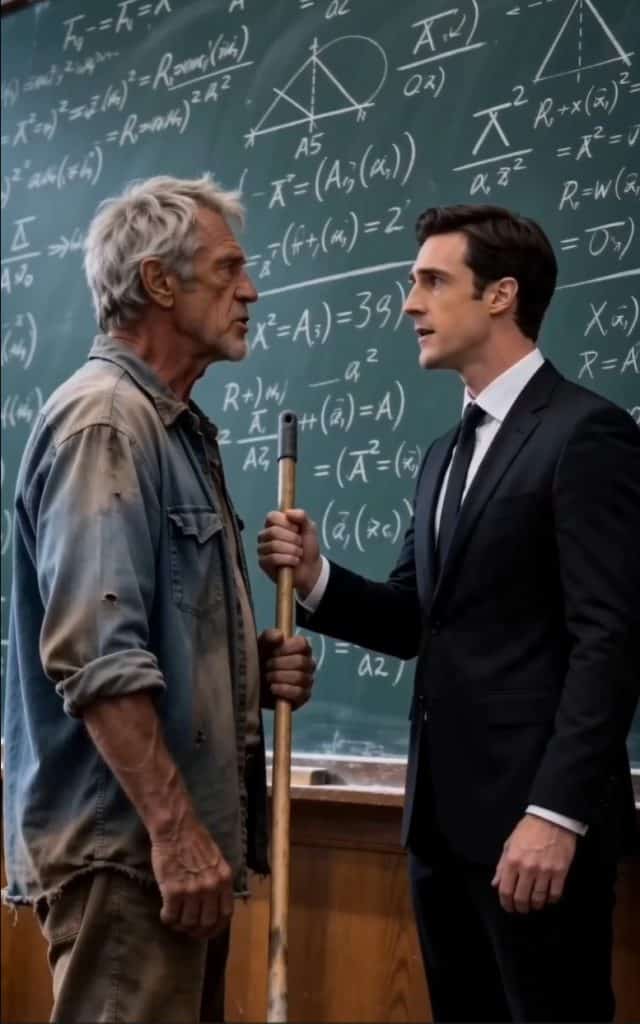
He stood at the front of the room with both hands wrapped around the handle of his industrial broom, his faded denim shirt dusted white at the cuffs, his khaki pants stained from a morning spent cleaning spilled coffee out of the engineering building stairwell.
Behind him, a wall-to-wall chalkboard was covered in equations so dense they looked less like mathematics and more like a foreign weather system.
At the center of it all stood Professor Julian Voss.
Black suit. Perfect tie. Perfect hair. Perfect smile.
He had spent the last forty minutes writing across the board while twenty students watched him like he was carving fire out of stone. The lecture was supposed to be a preview of the university’s most prestigious physics symposium, where Voss would present his final derivation of the Calder-Lyons Field Problem, a theoretical model that had embarrassed researchers for almost thirty years.
Grants were attached to it.
Reputations were attached to it.
A future chairmanship was attached to it.
Then the janitor looked at the board and said, “The answer is wrong.”
Professor Voss turned slowly.
For a moment, he seemed more amused than offended. His hand was still gripping the top of the janitor’s broom, because he had stopped the man from sweeping too close to the chalk dust near the podium.
Then Voss released it.
He threw both hands outward and laughed.
“You clean floors.”
The students erupted.
It rolled through the hall in one bright, cruel wave. Some leaned back in their chairs. A boy in a varsity jacket slapped the desk. A girl near the aisle covered her mouth, but her shoulders shook anyway.
The janitor lowered his eyes.
Only for a second.
But everyone saw it.
That tiny dip of the head, that flicker of pain crossing his weathered face, made the laughter worse. The students were not laughing at the equation anymore. They were laughing at the wrong person daring to speak in the wrong room.
Professor Voss smiled as if he had restored order.
“This is a graduate seminar,” he said. “Not a maintenance meeting.”
The janitor looked up.
His eyes were gray, tired, and steady.
“Then fix it,” he said.
Voss blinked.
The janitor nodded toward the board. “May I?”
The professor’s smirk returned. He stepped aside with a theatrical sweep of his hand.
“Go ahead,” he said. “Enlighten us.”
A few students laughed again, but softer this time.
The janitor set the broom against the wall.
He took a piece of chalk from the tray.
Then his hand began to move.
At first, the class waited for the mistake.
They expected him to freeze after one line, to write some nonsense symbol, to expose himself as exactly what Voss had implied he was: a man who belonged near the trash bins, not beside a world-class proof.
But the chalk did not hesitate.
It struck the board with clean, rapid confidence.
The janitor crossed out a term near the center of the derivation. Then another. Then he moved backward through the professor’s logic like a man walking through a house he had built himself, pointing out every cracked beam hidden behind expensive paint.
The laughter died.
Students leaned forward.
Someone whispered, “No way.”
The janitor did not look back. His hand blurred across the board, building a new path through the error. He shifted a boundary condition, rewrote an energy term, corrected a sign buried three lines above where anyone had been looking.
Voss’s face changed.
The color drained slowly, not all at once. His smile stayed for a few seconds too long, like a mask refusing to fall. Then his jaw tightened. Then his eyes widened.
The janitor finished with one final strike of chalk.
He circled the corrected answer.
The room was silent now.
Professor Voss stared at the board like it had betrayed him.
The janitor turned, calm and dust-covered, with chalk on his fingertips.
Voss whispered, “He solved it.”
Then, softer, with fear rising under every word, he asked, “Who are you?”
The janitor looked at him for a long moment.
Then he said the name that made the professor step back.
Act II
“Elias Ward,” the janitor said.
No one laughed this time.
The name moved through the lecture hall strangely. Most of the students did not know it. A few did. Their faces shifted from confusion to disbelief as they searched memory and old journal references and half-heard rumors from professors who spoke carefully after wine at faculty dinners.
Elias Ward had been a legend once.
Not a famous kind of legend. Not the kind who appeared on magazine covers or gave polished interviews with bright lights in his eyes. He had been the other kind. The dangerous kind.
The kind brilliant people mentioned when they wanted to sound humble.
In the 1990s, Elias Ward had published three papers before the age of thirty that changed how researchers approached nonlinear field stability. Then he vanished from academic life after a scandal no one understood completely but everyone repeated confidently.
Data manipulation.
Grant fraud.
A laboratory fire that destroyed original notebooks.
A disciplinary hearing behind closed doors.
By the time the official statement came out, Elias Ward was no longer Dr. Ward. He was a cautionary tale.
Professor Julian Voss knew the name better than anyone.
His father, Malcolm Voss, had chaired the review committee that ended Ward’s career.
Julian had grown up hearing the story at dinner parties. His father told it with a glass of bourbon in one hand and moral disgust in his voice.
“Genius without discipline becomes rot,” Malcolm Voss used to say. “Ward had talent, but he lacked character.”
Julian had built part of his own career on that warning.
He spoke often about academic integrity. About rigor. About how brilliance meant nothing without institutional trust.
And now the ruined man from his father’s favorite story was standing in front of him, holding chalk like a weapon.
“That’s impossible,” Voss said.
Ward looked down at his work shirt, then back at the professor.
“Apparently not.”
The class remained frozen.
Even the students who did not recognize the name could feel the air changing. The professor was no longer in command of the room. The janitor was no longer invisible.
Voss forced a laugh, but it came out thin.
“Elias Ward is not a janitor.”
Ward gave him a tired smile. “You’d be surprised what a man becomes after the right people finish with him.”
That landed harder than anger would have.
A student in the front row, Maya Ellison, opened her laptop and began searching. She found the old article within seconds.
BRILLIANT PHYSICIST REMOVED AFTER MISCONDUCT FINDINGS.
The photo showed a much younger Ward being led out of a university building by two administrators. His face in the picture was pale, shocked, and furious in a way that looked almost grief-stricken.
Maya looked from the article to the man at the board.
The eyes were the same.
Professor Voss saw the laptop screen and snapped, “Close that.”
Maya did not close it.
That was the first real crack.
Ward turned back to the chalkboard.
“You made the same mistake your father made,” he said.
Voss stiffened.
“My father has nothing to do with this.”
Ward tapped the board with the chalk.
“This derivation is built from my 1994 notes.”
The room went colder.
Voss stepped forward. “Careful.”
“No,” Ward said. “I was careful for thirty years.”
For the first time, his voice hardened.
He pointed to the upper left corner of the board, where Voss had written the opening assumption that anchored the entire proof.
“That notation isn’t standard. It was mine. I used it in private notebooks because I was trying to keep separate two terms everyone else kept collapsing into one. Your father had copies after the investigation. He said they were contaminated evidence.”
Voss’s face tightened.
Ward moved down the board.
“This substitution here? Mine too. Not published. Never peer-reviewed. Never presented.”
The students began to murmur.
The professor lifted his voice. “This is absurd. You walk in here with a broom and expect us to believe some fantasy about stolen work?”
Ward looked at him.
“No,” he said. “I expected you to finish the theft correctly.”
The room went still.
Even Voss had no answer for that.
Ward turned and circled the corrected answer again.
“You didn’t understand the last step,” he said quietly. “That’s why you got it wrong.”
And in the back row, where no one had noticed her before, an elderly woman in a navy coat stood up.
Professor Voss saw her and went pale for an entirely different reason.
Act III
Her name was Dr. Helen Strauss.
Thirty years earlier, she had been the youngest member of the review committee that condemned Elias Ward.
Now she walked slowly down the lecture hall steps with one hand gripping the railing and the other holding a brown leather folder against her chest.
No one spoke as she approached the front.
Voss’s voice turned sharp. “Dr. Strauss, this is a closed seminar.”
She did not even look at him.
She looked at Ward.
For the first time since entering the classroom, his steady expression faltered.
“Helen,” he said.
She stopped a few feet away from him.
Age had bent her slightly, but shame had done more damage than time. It was visible in the way she could not quite meet his eyes.
“I heard you had taken work here,” she said.
Ward glanced at his broom. “I needed health insurance.”
That small sentence seemed to hurt her.
Maya, still in the front row, watched the exchange with her hand over her mouth.
Dr. Strauss opened the folder.
Inside were photocopies, old hearing transcripts, and a stack of pages marked with faded red stamps.
“I should have done this years ago,” she said.
Voss moved toward her. “Whatever you think you’re doing, this is not the place.”
Dr. Strauss finally turned to him.
“No, Julian. This is exactly the place.”
The professor stopped.
She faced the class.
“In 1996, I signed a misconduct finding against Dr. Elias Ward. I was told the evidence was conclusive. I was told his notebooks were inconsistent with lab records. I was told he had fabricated a data set to support a theoretical claim he could not prove.”
Her voice trembled, but she did not stop.
“Years later, after Malcolm Voss retired, I found an archival box mislabeled under a grant account. It contained Ward’s original notebooks.”
Voss’s expression flattened.
Ward did not move.
Dr. Strauss placed one page on the desk at the front of the hall.
“The supposedly fabricated data was copied from an experiment run six months after Dr. Ward was suspended. It could not have been his.”
The students stared.
Voss gave a short laugh. “That proves nothing.”
“It proves the timeline was altered,” she said.
Then she placed another page beside it.
“And this proves why.”
Ward’s eyes dropped to the page.
For a moment, the lecture hall disappeared from his face.
It was not anger.
It was recognition.
The page showed the same phoenix-like structure of equations Ward had just corrected on the board. The handwriting was his. The date was 1994.
At the bottom was a note.
If boundary term holds, Voss model collapses.
Maya read it aloud before she could stop herself.
The words hit the room with a strange force.
Ward turned slowly toward Julian Voss.
“Your father wasn’t protecting integrity,” he said. “He was protecting his own work.”
Dr. Strauss closed her eyes briefly.
“Malcolm Voss had built his career on a field model that Dr. Ward’s research would have overturned. If Ward published, the Voss model would not just be challenged. It would be obsolete.”
Voss’s voice dropped. “You don’t have proof my father did anything.”
Dr. Strauss looked exhausted.
“I have his letter.”
She removed one final sheet from the folder.
This one was not a photocopy. It was yellowed, creased, and preserved in a plastic sleeve.
Ward stared at it.
He knew the signature before she read the words.
Malcolm Voss had written to a private donor two weeks before the misconduct hearing.
Ward is brilliant, but reckless. Once removed, the university will regain control of the direction of the field. His unpublished materials should remain sealed until they can be responsibly evaluated.
Dr. Strauss lowered the page.
“In the margin,” she said quietly, “he wrote, ‘Julian may need these one day.’”
The professor said nothing.
The students turned toward him.
For forty minutes, Julian Voss had stood before them as the future of theoretical physics. For years, he had been called a once-in-a-generation mind. His suits, his lectures, his contempt for anyone beneath him had all rested on one assumption.
That the world would never open the old box.
Ward looked at him, not with triumph, but with something worse.
Pity.
“You knew,” Ward said.
Voss’s jaw twitched.
That was the answer.
Dr. Strauss looked down. “I came today because I was told Julian was presenting a solution to the Calder-Lyons problem using language I had only ever seen in one place.”
Ward laughed once, softly, without humor.
“My notebooks.”
“Yes,” she said.
The room was so quiet the old training clock near the back wall seemed loud.
Ward picked up the chalk again.
His hand was not shaking anymore.
“Then let’s finish the record.”
And beneath the corrected answer, he wrote one final line that exposed the entire lie.
Act IV
Elias Ward did not write his name first.
He wrote the original date.
October 11, 1994.
Then, beneath it, he wrote the title of the unfinished proof exactly as it had appeared in his private notebook.
Boundary Stabilization in Nonlinear Calder-Lyons Fields.
Finally, he wrote:
E. Ward.
The chalk paused.
Then he added:
Completed publicly today.
The students stared at those words as if they were watching a tombstone being changed back into a birth certificate.
Professor Voss moved fast.
He grabbed an eraser from the tray.
Before he could touch the board, Ward caught his wrist.
Not violently. Not dramatically. Just firmly enough to stop him.
The janitor’s calloused hand closed around the professor’s expensive cuff.
“No,” Ward said.
For the first time all day, Voss looked genuinely afraid.
Not of being hurt.
Of being seen.
Maya stood up.
Then another student.
Then another.
Within seconds, half the lecture hall had phones raised. Screens glowed across the room, capturing the board, Dr. Strauss’s folder, Voss’s face, Ward’s hand holding the chalk.
Voss looked at them with pure disbelief.
“You are recording confidential academic material,” he snapped.
Maya’s voice shook, but she spoke clearly.
“You humiliated a man in front of us because you thought his job made him stupid.”
The professor turned on her.
“You have no idea what you are talking about.”
“No,” she said. “But he does.”
She pointed at Ward.
That simple gesture changed the room.
A few minutes earlier, the students had pointed at him to mock him.
Now they pointed to him as the only authority left standing.
The doors at the top of the lecture hall opened.
Dean Margaret Halloway entered with two faculty members behind her. Someone had called her. Or perhaps Dr. Strauss had arranged more than anyone realized.
The dean took in the scene in one sweeping glance: the corrected proof, the students recording, the professor frozen near the board, the janitor in dusty clothes standing over equations that could alter a field.
“Professor Voss,” she said carefully, “step away from the board.”
Voss straightened.
“Dean Halloway, this is a coordinated attack.”
Ward almost smiled.
The dean looked at Dr. Strauss. “Is it?”
Dr. Strauss handed her the folder.
“No,” she said. “It is a delayed confession.”
The words broke something open.
Not loudly. Not with shouting or drama. Just a quiet institutional fracture, the kind that starts in one room and spreads through every polished hallway.
The dean read the first page.
Then the second.
Her face changed with each line.
Voss began speaking quickly, too quickly. He talked about context, about inherited materials, about incomplete records, about academic lineage, about how all great work builds on prior insight. Every sentence sounded polished enough to have been rehearsed for a scandal he had always feared might come.
Ward listened.
Then he looked at the students.
“I want you to remember this,” he said.
The room turned to him.
“Not because of me. Because every institution will teach you to respect titles. Some titles are earned. Some are inherited. Some are stolen and worn so long they start to look natural.”
Voss’s face burned.
Ward nodded toward the broom leaning against the wall.
“And some people without titles know exactly what they are looking at.”
Dean Halloway closed the folder.
“Professor Voss,” she said, “you are relieved of this seminar pending investigation.”
Voss stared at her.
“You can’t do that.”
“I just did.”
For a second, he looked like he might argue. Then he saw the phones. The faces. The board. The proof he could not explain because he had never truly understood the final step.
He walked out without his notes.
No one followed him.
The door closed behind him with a heavy wooden thud.
Ward turned back toward the chalkboard, and only then did the strength seem to leave his shoulders. Thirty years of silence had been standing upright inside him. Now that it had somewhere to go, he looked suddenly older.
Dean Halloway approached him softly.
“Dr. Ward,” she said.
He looked down at his stained clothes.
“I haven’t been called that in a long time.”
“You should have been.”
His jaw tightened.
The apology was too small.
They both knew it.
Then Maya stepped down from the front row, holding her notebook in both hands.
“Dr. Ward,” she said, voice careful, “can you explain the correction?”
Ward looked at her.
Then at the rest of the students.
They were waiting now, not to laugh, not to judge, but to learn.
For the first time all day, his eyes softened.
He picked up the chalk.
“Yes,” he said. “But this time, we start from the beginning.”
Act V
The video spread before sunset.
By morning, the university could not contain it.
The clip of Professor Voss saying “You clean floors” played beside the image of Elias Ward correcting the proof that Voss had claimed as his own. News anchors called it stunning. Alumni called it disgraceful. Former colleagues called it complicated, which usually meant they were trying to remember what they had known and when they had decided not to know it.
But students remembered it more simply.
A man had been mocked.
Then he had told the truth in chalk.
Within a week, Julian Voss was suspended.
Within a month, Malcolm Voss’s old committee records were reopened. Dr. Strauss testified publicly. Other retired faculty came forward, some with guilt, some with excuses, a few with both. The university issued a formal apology that used careful language and avoided the word destroyed until public pressure made careful language impossible.
Elias Ward read the apology in the break room beside the janitorial supply closet.
He was drinking vending machine coffee out of a paper cup when Dean Halloway found him.
“We would like to offer reinstatement,” she said.
Ward looked at her over the rim of the cup.
“To what?”
“Your academic title. Research privileges. A visiting chair, to begin with.”
He let out a quiet breath.
For thirty years, he had imagined some version of this moment. In the early years, he imagined it with rage. Then with speeches. Then with the kind of victory that made every person who doubted him lower their eyes in shame.
But life had a way of making justice arrive late and dressed in paperwork.
He looked past the dean to the mop sink, the stacked buckets, the shelf where his name was written on a time card.
“I spent half my life wanting that door reopened,” he said.
“And now?”
Ward folded the apology letter and placed it on the table.
“Now I know a door is not the same thing as a home.”
The dean did not know what to say to that.
So he helped her.
“I’ll teach one seminar,” he said. “No chair. No ceremony. No portrait in a hallway. One seminar. Open enrollment.”
“On what subject?”
Ward smiled faintly.
“Errors.”
The class filled in eleven minutes.
Students from physics came first. Then mathematics. Then philosophy, engineering, history, even art. Some wanted to witness a legend. Some wanted to be near a scandal. A few wanted to understand the proof.
Ward knew the difference.
On the first day, he entered the same lecture hall wearing a clean denim shirt and the same worn khaki trousers. His broom was gone, but he carried a piece of chalk in his shirt pocket.
The board was empty.
Maya sat in the front row.
So did three students who had laughed at him that day. They looked nervous when he walked in.
Ward noticed.
He did not punish them.
That would have been easy.
Instead, he wrote one sentence on the board.
The first error is assuming you are above making one.
Then he turned around.
“This course is not about being right,” he said. “Being right is pleasant. Sometimes useful. Often temporary. This course is about what you do when being wrong threatens the person you think you are.”
No one moved.
Ward looked at the students who had laughed.
“You will all fail at this at some point,” he said. “The question is whether you become cruel when you are afraid.”
Maya wrote that down.
In the back row, Dean Halloway stood quietly near the door. Beside her was Dr. Strauss, hands folded over her cane, eyes wet but steady.
Ward began with the same equation that had exposed Voss.
This time, he did not rush.
He built every line carefully, stopping to explain not only the mathematics but the temptation inside it. The temptation to hide a weak step. To borrow brilliance and call it influence. To confuse confidence with proof. To treat someone’s appearance as evidence against their mind.
Halfway through the lecture, a student raised his hand.
“Dr. Ward?”
Ward looked up.
The boy swallowed. He was the same varsity-jacket student who had slapped the desk laughing.
“I’m sorry,” he said.
The room went still.
Ward studied him.
The apology was awkward. Public. Too late to be clean, but not too late to matter.
Ward nodded once.
“Then learn better,” he said.
The student lowered his eyes and wrote that down too.
Outside the university, Julian Voss disappeared from public view. There were hearings, statements, legal arguments, and headlines that grew smaller each week. His career did not end in one dramatic collapse. It ended in the slow humiliation of being asked to explain work he had never truly owned.
Malcolm Voss died before he could answer for all of it.
That angered some people.
Not Ward.
He had learned that some men spend their whole lives building monuments to themselves because they are terrified of being measured by the truth. Death did not rescue Malcolm Voss from judgment. It simply meant he would never have the relief of confession.
The university offered to rename a research fellowship after Elias Ward.
He refused.
Then Maya suggested something else.
A fund for maintenance workers, dining staff, security guards, and clerks who wanted to take classes at the university.
Ward said yes before she finished the sentence.
They called it the Open Door Fellowship.
On the day it was announced, Ward stood at the back of the auditorium while administrators praised resilience in expensive suits. He listened politely. He did not believe half of what they said, but he believed in the people sitting in the last rows wearing uniforms, name tags, work boots, and the guarded expressions of those used to being unseen.
After the ceremony, an older custodian approached him.
She held the pamphlet in both hands.
“You really think people like us can take these classes?” she asked.
Ward looked at her.
“No,” he said. “I think classes like these should have been built for people like us from the start.”
She smiled then, small and stunned.
Later that evening, Ward returned alone to the lecture hall.
The room was empty. The lights were dim. The chalkboard had been washed clean, but if he stood close enough, he could still see faint ghost lines from the day everything changed.
For thirty years, he had believed his life had been reduced to what others took from him.
His title.
His work.
His name.
But standing there in the quiet, he understood something he had not expected.
They had stolen the room from him.
They had not stolen his mind.
Ward took the piece of chalk from his pocket and wrote one final equation in the corner of the board. Not the famous proof. Not the correction that went viral. Just a small boundary condition he had once discovered as a young man, back when he believed the world rewarded truth simply because it was true.
Then he paused.
Beneath it, he wrote:
Still here.
The chalk clicked softly against the tray.
For a moment, Elias Ward stood in the silence, no applause, no laughter, no professor sneering beside him.
Just a man in a lecture hall.
A man who had cleaned floors under the feet of people who thought they were above him.
A man who had waited thirty years for a door to open.
And when it finally did, he did not walk through as a ghost.
He walked through as the answer they had tried to erase.