Act I
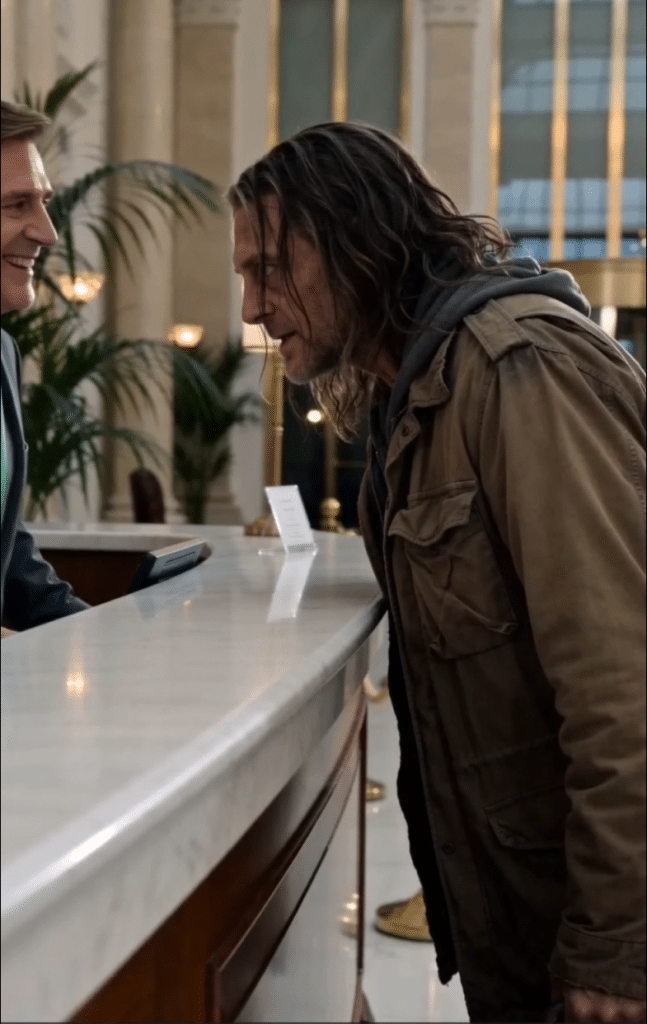
The man crossed the marble lobby like he didn’t belong there.
Everyone noticed.
His brown jacket was dirty. His camouflage trousers were stained. His hair fell in tangled strands around a rugged, weathered face. In one hand, he carried a heavy vintage suitcase that looked older than half the furniture in the room.
The receptionists exchanged looks before he even reached the desk.
One of them smirked.
The senior manager appeared behind them in a charcoal suit so perfect it looked untouched by real life. His green silk tie gleamed beneath the chandelier light as he looked the stranger up and down.
The man placed his suitcase beside the counter.
“I’d like to book a room for tonight,” he said quietly.
For one second, nobody spoke.
Then the manager laughed.
Loudly.
Cruelly.
The kind of laugh meant to invite witnesses.
The receptionists joined him, covering their mouths as if that made their mockery polite.
The stranger stood still.
The manager pointed toward the glass doors.
“Get out before we have security throw you out ourselves!”
The stranger’s expression did not change.
He only looked at the manager for a long, silent moment.
Then he picked up his suitcase and turned away.
The staff laughed behind him as he walked toward the exit.
But halfway across the lobby, something shifted.
His shoulders straightened.
His face hardened.
The humility vanished.
He reached into the inside pocket of his filthy jacket, pulled out a sleek black phone, and made a call.
When the line connected, his voice was cold.
“It’s me.”
And that was the moment the hotel stopped belonging to the people laughing inside it.
Act II
His name was Samuel Rourke.
Not that anyone at the desk knew it.
To them, he was dirt on polished marble. A problem before he ever spoke. A man whose clothes told them everything they thought they needed to know.
But thirty years earlier, Samuel had entered that same building through the service door.
Back then, the hotel was smaller, warmer, and nearly bankrupt.
He had been seventeen, sleeping in train stations and washing dishes for cash. The old owner, Margaret Bellamy, found him behind the kitchen one winter morning and gave him work instead of calling the police.
She taught him two things.
A hotel was not built from chandeliers.
And a guest was not measured by the shine of his shoes.
Samuel never forgot.
He rose from kitchen porter to night clerk, from clerk to operations manager, from manager to silent investor. By the time Margaret died, he had already become the man quietly saving failing hotels across Europe and America.
But he hated public attention.
So he bought properties through shell companies, visited them unannounced, and tested them the only way he trusted.
Not with champagne receptions.
With humility.
A good hotel revealed itself when someone powerless walked in.
And this one had failed before he even reached the counter.
Outside the glass doors, Samuel stood beneath the portico as the cold city air moved through his tangled hair.
His assistant answered on the second ring.
“Sir?”
Samuel looked back through the glass at the manager still laughing with the receptionists.
“Begin the review,” he said.
There was a pause.
“All departments?”
Samuel’s jaw tightened.
“Ownership level.”
The line went quiet.
Then his assistant understood.
“I’ll notify legal.”
Samuel ended the call.
The suitcase in his hand felt heavier now, but not because of its weight.
Because inside it were Margaret Bellamy’s old service manuals, guest letters, and the original deed to the hotel.
He had come back to honor her legacy.
Instead, he had found people spitting on it.
And he was done being invisible.
Act III
Inside the lobby, the manager’s laughter faded only when the phones began ringing.
First the front desk.
Then the office behind it.
Then his personal mobile.
He answered with irritation still on his face.
“Yes?”
His expression changed almost immediately.
The receptionists watched his spine stiffen.
“What do you mean the owner is here?”
Silence.
Then color drained from his face.
“No, that’s impossible. I know every board member.”
He listened.
His eyes flicked toward the glass doors.
Samuel was still standing outside.
Still holding the suitcase.
Still watching.
The manager’s mouth opened slightly.
For the first time all afternoon, he looked afraid.
A black car pulled up to the entrance minutes later. Then another. Men and women in dark suits stepped out carrying briefcases and tablets.
They didn’t look at the chandeliers.
They didn’t admire the marble.
They walked straight to Samuel.
One woman handed him a folder.
“Mr. Rourke,” she said, “legal is ready.”
The manager heard the name.
Rourke.
His knees nearly weakened.
Everyone in luxury hospitality knew that name. Most had never seen the face attached to it, but they knew the power.
Samuel Rourke didn’t just own hotels.
He ended careers in rooms people thought were private.
Samuel walked back into the lobby.
This time, nobody laughed.
The receptionists stood frozen behind the desk.
The manager rushed forward, smiling too hard.
“Mr. Rourke, sir, there’s been a misunderstanding.”
Samuel stopped in front of him.
“No,” he said. “There has not.”
The lobby went silent.
Samuel’s eyes moved from the manager to the receptionists.
“You understood exactly what you were doing.”
The manager swallowed.
“Sir, we have standards.”
Samuel’s voice dropped colder.
“So did Margaret Bellamy.”
That name struck the lobby like a bell.
The hotel’s founder.
The woman whose portrait hung above the grand staircase.
Samuel turned toward it.
“She once gave a hungry boy a job when he looked worse than I do today.”
Then he looked back at the manager.
“You would have thrown him out.”
Act IV
The review lasted forty-seven minutes.
That was all it took.
Security footage.
Guest complaints.
Staff reports buried in deleted folders.
Discrimination claims quietly paid off.
Former employees bullied into resigning.
A pattern emerged so quickly that even the manager stopped trying to defend himself.
The receptionists cried.
Not from remorse at first.
From fear.
Samuel watched without softness.
He had sympathy for mistakes.
Not for cruelty practiced as policy.
The manager stood near the desk, sweating through his expensive suit.
“I’ve given this hotel five years,” he said weakly.
Samuel nodded.
“And in five years, you forgot the first rule of hospitality.”
The manager looked up.
Samuel pointed toward the entrance.
“You open the door.”
No one spoke.
Then Samuel signed one document.
The manager’s access badge was disabled before he reached the elevator.
His office was locked.
His company email erased.
And when security escorted him across the same marble floor where he had humiliated Samuel, guests watched quietly from velvet ropes and lounge chairs.
No applause.
No shouting.
Just the unbearable silence of a man losing power in the exact place he had abused it.
At the doors, the manager turned back.
“Sir, please. I have a family.”
Samuel’s face did not change.
“So did many people you threw away.”
The doors opened.
The manager stepped out.
And for the first time, he understood what it felt like to be unwanted at the entrance.
Act V
By evening, the hotel lobby looked the same.
Same chandeliers.
Same marble.
Same gold stanchions.
But something essential had changed.
The reception desk was quiet now, not with arrogance, but with shame.
Samuel opened his old suitcase on the counter.
Inside were Margaret Bellamy’s handwritten notes.
One page had been framed long ago by time and wear.
Every person who enters is already carrying something. Our duty is not to judge the luggage.
Samuel had it copied and placed behind the front desk by morning.
The receptionists who remained were retrained.
Some left.
Others stayed and learned.
A new general manager was promoted from housekeeping, a woman who had worked there twelve years and knew every forgotten corner of the building better than any executive ever had.
Weeks later, a tired man in paint-stained clothes entered the lobby asking if there were any rooms left.
The young receptionist looked at him, then at the framed note behind the desk.
She smiled.
“Of course, sir. Welcome.”
Across the lobby, Samuel sat in a quiet chair with a cup of coffee, watching.
No one recognized him.
That was fine.
He had never needed them to.
He only needed the hotel to remember what luxury was supposed to mean.
Not gold.
Not marble.
Not polished shoes.
But dignity given before anyone proved they deserved it.