Act I
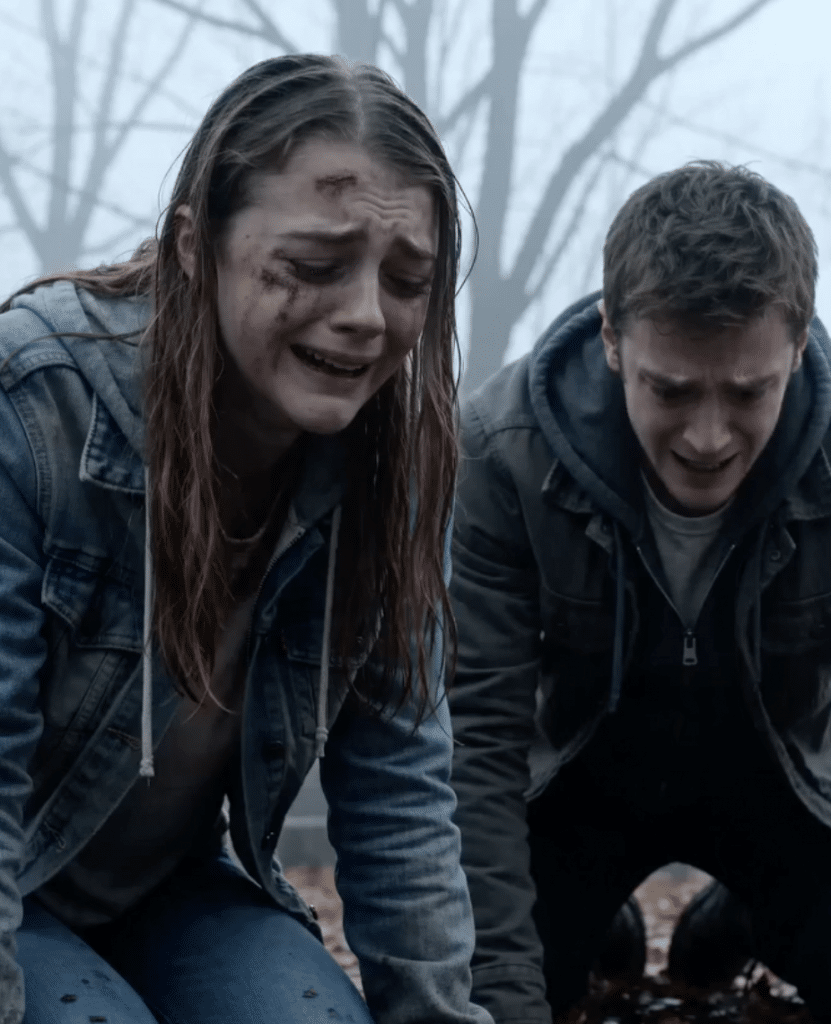
The mother was kneeling in the wet leaves when the child screamed.
Not cried.
Screamed.
“No! They’re cold!”
The sound cut through the fog so sharply that every bird in the old cemetery seemed to vanish at once.
Emma Vale had both hands pressed into the damp earth in front of the small double grave. Rain had soaked through her gray cardigan. Dark makeup streaked down her cheeks. Her husband, Daniel, knelt beside her with his head lowered, one hand gripping the edge of the headstone as if the stone itself was the only thing keeping him from falling apart.
On the grave were two names.
Oliver Vale.
Owen Vale.
Beloved sons.
Five years old.
Above the names, behind a small oval of glass, was a photograph of the twins smiling in matching blue sweaters.
They had been missing for twelve days before the police told Emma and Daniel to prepare themselves. Two days later, the search ended at the river. A wrecked van. Burned documents. A medical examiner’s report sealed so quickly no one questioned it until grief had already swallowed the room.
The boys were gone.
That was what everyone said.
That was what the grave said.
Then the barefoot girl appeared beside the headstone.
She looked no older than seven. Her brown hair hung in tangled strands around her face. Her oversized beige tunic was stained with dirt and torn at the hem. She had no coat, no shoes, and no reason to be standing in a cemetery wrapped in autumn fog.
She pointed at the twins’ photograph with a trembling finger.
“No,” she said again, softer now, but somehow worse. “They’re cold.”
Daniel’s head snapped up.
Emma stopped breathing.
For one impossible second, neither parent moved. The world seemed to narrow to the girl’s bare feet in the leaves, the photograph on the stone, and the thin blue string tied around her wrist.
Daniel pushed himself up on his knees.
“What did you say?”
The girl flinched at his voice, but she did not run.
She pointed harder at the picture.
“They stay with me.”
Emma’s mouth opened, but no sound came out.
“Who?” she whispered.
The girl looked at her with eyes too old for her face.
“Both.”
Daniel lunged toward her, not with anger, but with the terror of a man hearing the dead knock from the other side of a locked door.
“Where?”
He caught her wrist.
The girl cried out, and Emma grabbed Daniel’s arm.
“Daniel, stop!”
He let go instantly, horror flooding his face.
The girl clutched her wrist against her chest. The blue string trembled there, bright against the gray cemetery air.
Then she said the words that made Emma’s grief split open.
“At the orphanage.”
The fog moved between the headstones.
The twins’ photograph stared from the grave.
And for the first time since the funeral began, Emma looked at the stone and wondered who, exactly, they had buried.
Act II
The girl’s name was Lily.
At least, that was what she said after Emma wrapped her own cardigan around the child’s shoulders and knelt in front of her in the wet leaves.
Lily did not trust Daniel.
Not at first.
She kept looking at his hands, especially the one that had grabbed her wrist, and each time she did, shame crossed his face so plainly that Emma could barely stand to see it.
“I’m sorry,” he said again.
Lily studied him.
“You yelled like Mr. Granger.”
Daniel went still.
Emma heard the name and felt something cold settle at the base of her spine.
“Who is Mr. Granger?”
Lily’s eyes shifted toward the cemetery gate.
“The man who says children should be quiet when grown-ups are fixing things.”
Daniel looked at Emma.
Neither of them spoke, but they both understood.
This was not a lost child wandering through fog.
This was a child who had escaped something.
Emma softened her voice.
“Lily, you said the boys stay with you. Do you know their names?”
The girl nodded.
“Ollie and O.”
Daniel covered his mouth.
Emma’s whole body went rigid.
Only family called Owen “O.” Only Oliver called him that first, back when they were toddlers and Owen’s full name seemed too heavy for his twin brother’s tongue.
No police report had mentioned the nickname.
No newspaper article had printed it.
Emma reached for the headstone, suddenly dizzy.
“Where did you hear that?”
“They told me.”
“When?”
Lily looked down at her bare feet.
“At St. Bartholomew’s.”
Daniel’s face changed.
St. Bartholomew’s Home for Children sat forty miles north of the cemetery, hidden behind old brick walls on land donated by one of the county’s oldest families. Everyone knew the place by reputation. A respectable institution. Quiet. Religious. Underfunded, maybe, but beloved by donors who liked seeing their names printed on brass plaques.
Emma had volunteered there once, years ago.
Before the boys were born.
Before motherhood rearranged every bone in her life.
She remembered long halls. Quiet children. A director with a polished smile who had called the place “a bridge between abandonment and grace.”
His name had been Martin Granger.
Daniel rose too quickly.
“We’re going there.”
Emma caught his sleeve.
“No. We call the police.”
Daniel’s laugh came out broken.
“The police closed our sons’ case in forty-eight hours after they found that van.”
“And if we rush in there wrong, we may lose whatever chance we have.”
Lily watched them argue with the stillness of a child who knew adults could turn fear into noise.
Then she reached into the pocket of the cardigan Emma had wrapped around her and pulled out something small.
A button.
No.
A piece of blue yarn, tied in a loop.
Emma stared at it.
Her hands began to shake.
The twins had worn blue yarn bracelets the day they disappeared. Emma had tied them herself that morning because the boys had been fighting over identical toy cars and she had joked that she needed a way to tell her own children apart.
Oliver wore blue on the left wrist.
Owen wore blue on the right.
The police returned only one bracelet.
They said the other had likely been lost in the river.
Lily placed the loop in Emma’s palm.
“Ollie said to give you this if I found the crying lady.”
Emma made a sound so small it barely reached the air.
Daniel looked at the yarn, then at the grave, then at Lily.
“Where is he?”
Lily’s lips trembled.
“In the cold room.”
Emma’s face drained of color.
Daniel turned toward the gate.
This time, Emma did not stop him.
Because somewhere beyond the fog, beyond the official reports and sealed papers and condolences spoken by people who went home to living children, one impossible truth had begun breathing.
Their sons had not been lost.
They had been taken.
Act III
They did not go to St. Bartholomew’s alone.
Emma called the one person who had never believed the case felt right.
Detective Mara Sutton had been removed from the twins’ investigation after accusing her own department of accepting the medical examiner’s report too quickly. She was told grief made parents see conspiracies. She was told children disappear, accidents happen, and not every tragedy has a villain.
Mara had looked Emma in the eye at the station and said, “Something is wrong, but I can’t prove it yet.”
Now Emma called her from the cemetery with Lily wrapped in her cardigan and Daniel pacing between graves like a man trying not to break apart.
Mara arrived in twenty minutes.
She came in an unmarked car, no lights, no siren, and crouched in front of Lily without crowding her.
“Hi, Lily. I’m Mara.”
Lily stared at her badge.
“Are you the kind that takes kids back?”
Mara’s expression tightened.
“No.”
“Promise?”
Mara did not answer quickly. That was why Lily listened.
“I promise I will not hand you to anyone until I know you’re safe.”
Lily nodded once.
Then she told them what she knew.
St. Bartholomew’s had two buildings.
The front building was for tours. Clean beds. Painted walls. Classrooms with donated books. Children chosen carefully to smile when sponsors visited.
The back building was called the Annex.
That was where children went when paperwork was “unfinished.”
The cold room was in the basement.
Not a freezer. Not anything Lily fully understood. Just a windowless storage room near the old laundry where the heating pipes failed and children were sent when they caused trouble.
Ollie and O had been there for two nights.
Emma turned away and pressed both hands over her mouth.
Daniel looked like he might stop breathing.
Mara kept her voice even.
“Lily, how did you get out?”
The girl touched the blue string on her wrist.
“Ollie made me go.”
“He made you?”
“He said moms always come when kids get lost. He said if I found his mom, she would come for both of them.”
Daniel lowered his head.
The boy who had been declared dead had sent a barefoot child through autumn woods because he still believed his mother could reach him.
That nearly destroyed Emma.
Mara asked, “Why did you go to the cemetery?”
Lily pointed at the grave.
“Mr. Granger took them there once.”
Emma froze.
“What?”
“He told them this was where bad children ended up when they told stories.”
Daniel’s hands curled into fists.
Mara stood.
“That’s enough.”
She walked a few steps away and made three calls. State police. Child protective services. A judge she trusted because she owed him nothing. She did not give the local department time to interfere.
Within an hour, they had an emergency welfare order.
Within ninety minutes, they were driving toward St. Bartholomew’s under a sky turning black.
Lily slept in the back seat with Emma’s cardigan around her. Emma sat beside her, staring at the blue yarn in her palm. Daniel sat in the passenger seat, silent except for one sentence he repeated under his breath as if it were prayer and warning both.
“Hold on, boys.”
At the top of the long hill, St. Bartholomew’s appeared through the trees.
The front building glowed warmly.
Yellow windows. A stone cross. A banner tied across the entrance announcing the annual donor dinner that evening.
Cars lined the gravel drive.
Men in suits. Women in pearls. Laughter behind glass.
Emma stared at the bright windows, sick with recognition.
This was how cruelty survived.
Not in shadows only.
Sometimes it dressed itself in charity and invited witnesses to dinner.
Mara parked beyond the main gate and turned around.
“Emma, Daniel, listen to me. We do this by the order. We go in clean.”
Daniel’s jaw tightened.
“My sons are in there.”
“And we get them out by making sure no one can hide what happened after we leave.”
Emma looked at the building.
Then Lily woke suddenly and whispered, “Don’t use the front door.”
Mara turned.
“Why?”
Lily pointed toward the trees.
“Ollie said the front door is for people who believe lies.”
No one spoke.
Then Lily lifted her wrist and showed them the blue string.
“He said his mom would know the back way.”
Emma’s heart slammed once.
Years ago, when she volunteered here, she had used a side entrance near the old chapel garden. Staff called it the laundry passage. Donors never saw it.
She looked at Daniel.
“I know where it is.”
And under the cover of fog, they walked toward the door St. Bartholomew’s had never expected a grieving mother to remember.
Act IV
The laundry passage smelled like damp stone and old soap.
Mara led the way with two state officers behind her. Emma followed close enough to hear her own heartbeat. Daniel carried Lily because the girl’s bare feet were cut and cold, and because after the third time he apologized, she had finally let him.
The corridor opened into the basement.
At first, there was nothing.
No voices.
No crying.
Only pipes ticking overhead and the distant hum of music from the donor dinner upstairs.
Then Emma heard it.
A cough.
Small.
Familiar.
Her knees nearly gave out.
Daniel heard it too.
“Ollie?” he called, before Mara could stop him.
Silence.
Then from behind a gray metal door came a voice so thin it seemed to travel from another world.
“Dad?”
Daniel dropped Lily gently into Mara’s arms and ran to the door.
It was locked.
He pulled at the handle with both hands, but it did not move.
“Owen!” Emma cried. “Oliver!”
Another voice answered, breaking on a sob.
“Mommy?”
Emma struck the door with her palm.
“I’m here. I’m here, baby. I’m right here.”
Mara snapped at one officer, “Open it.”
The officer used a bolt cutter from his kit. The lock hit the floor with a sound that traveled through the whole corridor.
Daniel yanked the door open.
The room beyond was narrow and dim, lined with old shelves and folded blankets that smelled of dust. Two boys sat huddled together on a thin mattress, wrapped in a single gray coat.
For one second, no one moved.
Because grief had made Emma imagine this moment a thousand times, but imagination had never dared give it warmth.
Oliver was thinner. Owen’s hair was longer. Both boys looked pale and frightened and painfully alive.
Then they ran.
Emma fell to her knees as they crashed into her arms.
Daniel dropped beside them and gathered all three of them against his chest, saying their names over and over until the names became the only truth left in the world.
Oliver clutched Emma’s hair.
“I told O you’d come.”
Emma held his face between her hands.
“I came. I came.”
Owen looked at Daniel.
“We didn’t go in the river.”
Daniel broke.
He pulled the boy close and pressed his face into his son’s hair, shaking silently.
Mara turned away for half a second.
Even state officers have to choose where to look when a family returns from the dead.
Lily stood near the doorway, watching.
Oliver saw her first.
“Lily!”
She smiled then, a tiny exhausted smile, and Owen reached out one hand.
“She saved us,” he said.
Emma looked at the barefoot girl.
Lily looked suddenly embarrassed, as if bravery were something she had been caught wearing without permission.
Before Emma could speak, footsteps pounded at the far end of the hall.
Martin Granger appeared with two staff members and a woman in an evening gown whose diamond necklace glittered beneath the basement lights.
“What is the meaning of this?” Granger demanded.
Mara stepped in front of the family.
“Emergency welfare inspection. Step back.”
Granger’s polished expression flickered when he saw Lily.
“You,” he said.
Daniel rose slowly.
The air changed.
Mara put a hand out before he could move.
“No,” she said quietly. “Do not give him anything he can use.”
Daniel stopped.
Barely.
Granger recovered fast.
“These children are wards under temporary protection. The parents are unstable. There are legal issues you don’t understand.”
Emma stood with one arm around each son.
“My children have graves.”
The woman in the evening gown looked sharply at Granger.
“What does she mean, graves?”
Granger ignored her.
Mara lifted a folder.
“The court order gives us immediate access to all resident records, medical transfers, intake documents, and basement facilities.”
His smile disappeared.
“You have no authority over private charitable operations.”
A voice spoke from behind him.
“She does tonight.”
Everyone turned.
An older man in a black judicial robe stood at the foot of the stairs, flanked by two more officers. Judge Halden had left his dinner, driven through fog, and walked into the basement of St. Bartholomew’s with mud on his shoes.
Granger went pale.
The judge looked at the twins, then at Lily, then at Emma and Daniel.
His face hardened.
“Seal the building.”
The donor dinner upstairs ended in chaos.
Guests who had arrived to write checks found state officers carrying boxes of records through the foyer. Children from the Annex were brought into the front hall wrapped in blankets, not for display, not for pity, but for protection. Some donors cried. Some denied knowing anything. Some called attorneys before they called their consciences.
Mara found the first file in Granger’s private office.
Oliver and Owen Vale.
Listed not as deceased.
Listed as “unclaimed minors pending private placement.”
Attached was a forged medical summary, a false death confirmation, and a payment schedule.
Emma read only the first page before she had to sit down.
Daniel read further.
His face went white.
The twins had not been taken by accident.
Their disappearance had been arranged.
The river. The van. The sealed report. The grave.
All of it.
At the bottom of the file was a name Emma recognized from the funeral arrangements.
A family liaison who had stood beside her at the cemetery, handed her tissues, and told her the pain would soften one day.
Patricia Vale.
Daniel’s aunt.
The woman who had always said Emma was too emotional to raise boys properly.
The woman who controlled half the family trust until the twins turned eighteen.
And suddenly, the grave in the cemetery was no longer just a lie.
It was a receipt.
Act V
Patricia Vale was arrested in her kitchen at dawn.
She wore a silk robe and asked whether the officers knew who her family was.
They did.
That was why they had come with state warrants, financial subpoenas, and enough evidence from St. Bartholomew’s to make her name sound smaller each time she repeated it.
She had never believed Daniel should have married Emma. She had never forgiven him for taking control of the family business away from the older generation. But the twins were the real problem.
Oliver and Owen were named in Daniel’s father’s trust.
At eighteen, they would inherit voting power Patricia had spent years using as if it belonged to her.
So she created a tragedy.
A van near the river. A sealed report. A charitable home willing to hide children until a private placement could move them out of state. A funeral to bury the questions before anyone could ask them.
What she did not plan for was Lily.
Lily, who had watched everything.
Lily, who knew the boys were not ghosts.
Lily, who ran barefoot through cold woods because Oliver told her his mother would come.
The trial lasted six weeks.
Emma attended every day.
Daniel did too, though he struggled most when evidence appeared in clean folders and professional language. Words like transfer, placement, misidentification, and asset protection sat on the page as if they were not covering the theft of two living children.
The twins did not testify in open court.
Emma and Daniel refused to let their sons become a spectacle.
But Lily did.
Not alone. Not unprotected. She spoke from a private room with a child advocate beside her and a stuffed rabbit Owen had given her resting on the table.
When asked why she went to the cemetery, Lily answered simply.
“Because moms look for their kids there when bad people make them think they’re gone.”
The courtroom fell silent.
Even the judge had to lower his eyes.
Granger’s charity collapsed first. Its board claimed ignorance. Its donors claimed deception. Its records claimed otherwise.
Patricia lasted longer.
People like Patricia do. They know how to wear pearls to court, how to speak softly, how to call cruelty concern and greed stewardship.
But paperwork has a memory.
So do children.
And by the end, her version of events lay in pieces beside the truth.
She lost the trust.
Then the family name.
Then her freedom.
But Emma discovered that justice and healing were not the same thing.
Justice had verdicts.
Healing had nightmares.
Oliver woke screaming the first month. Owen refused to sleep unless his brother’s hand touched his. Lily hid food in drawers and apologized every time someone opened a door too quickly.
The house became gentle by necessity.
Night-lights in the hallway.
Soup at odd hours.
Shoes by the door for Lily, who still sometimes forgot she was allowed to wear them.
Emma learned not to say, “You’re safe now,” as if safety could be declared.
Instead, she said, “I’m here.”
Again and again.
Until the words began to build something solid.
Lily was supposed to stay temporarily.
That was the first plan.
A kind foster placement. A careful transition. A fresh start away from the Vale family’s grief.
But one rainy evening, Emma found all three children asleep on the living room rug. Oliver and Owen were curled on either side of Lily, the blue yarn bracelet lying between them like a tiny flag no one wanted to surrender.
Daniel stood beside Emma in the doorway.
“She’s theirs,” he said quietly.
Emma nodded.
“And ours, if she wants.”
Lily wanted.
She did not say it in a grand way.
She said it three weeks later at breakfast, while Daniel burned toast and the twins argued over cereal.
“Can I stay after my room is painted?”
Emma looked up.
Daniel went still.
Oliver said, “Obviously.”
Owen added, “You’re the reason Mom found us.”
Lily stared into her bowl.
“That doesn’t mean people keep you.”
Emma crossed the kitchen and knelt beside her chair.
“In this house,” she said, “it does.”
Lily did not cry then.
She only nodded.
But that night, Emma found the girl standing in the hallway, touching the wall outside her newly painted room as if making sure it would not disappear.
A year after the cemetery, the family returned to the grave.
The old double headstone was still there, but the names had been removed. Not destroyed. Replaced.
Emma had asked for something different.
No dates.
No false death.
Just one line carved beneath the twins’ photograph.
Here lies the lie that failed.
Oliver thought it sounded dramatic.
Owen liked that it made Patricia angry.
Lily stood barefoot in the leaves until Daniel quietly placed her shoes beside her, not forcing, just offering. After a moment, she slipped them on.
Emma watched the three children gather around the stone.
The boys were warmer now. Taller. Still healing in ways no one could see at first glance. Lily’s hair was brushed and tied with a blue ribbon, but the old string remained around her wrist.
Daniel stood beside Emma and took her hand.
The fog was thinner that day.
The trees still looked skeletal, but sunlight pressed through the gray in pale, determined beams.
Oliver touched the photograph on the stone.
“We’re not there,” he said.
“No,” Emma answered. “You’re not.”
Owen looked at Lily.
“You told them we were cold.”
Lily shrugged.
“You were.”
Oliver smiled.
“Now we’re not.”
For a while, no one spoke.
Then Lily removed the blue string from her wrist.
Emma felt a small pinch of panic before she understood.
Lily tied it around the iron fence beside the grave. It fluttered there, bright against the black metal.
Daniel crouched beside her.
“You sure?”
Lily nodded.
“I don’t need it to remember.”
Emma’s eyes filled.
“What do you need?”
Lily turned toward the path where the car waited, where Oliver and Owen were already kicking leaves at each other like ordinary boys on an ordinary autumn day.
“Dinner,” she said.
Daniel laughed first.
Then Emma.
Then Lily, surprised by her own laughter, joined them.
It was small at first, then real.
The sound moved through the cemetery, soft but alive, passing over wet leaves and old stones and the grave that had once tried to convince a mother that love had nowhere left to go.
Emma looked back only once before they left.
The false grave remained behind them.
The children walked ahead.
And as the fog opened around the cemetery gate, Emma understood that some miracles do not arrive glowing or clean.
Sometimes they come barefoot, frightened, and covered in dirt.
Sometimes they point at the place where the world told you to surrender and say, No.
They are cold.
They are waiting.
Come find them.