Act I
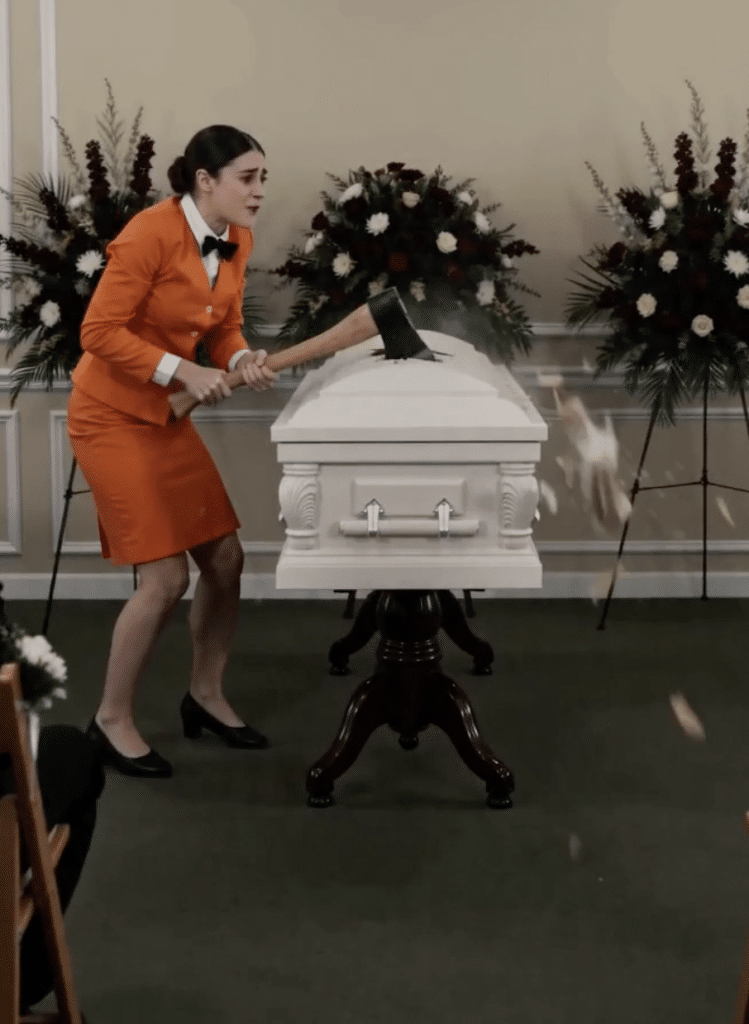
The first swing split the white casket open.
Wood cracked across the funeral parlor like lightning.
A floral wreath toppled from its stand. Mourners screamed. Someone dropped a prayer card. The bright room, with its beige walls and polished molding, turned suddenly wild as splinters scattered across the dark wooden casket stand.
Sofia Rivera lifted the axe again.
Her orange uniform was wrinkled, her white apron stained with dust, and her dark hair had come loose from the neat bun she had pinned that morning. Tears streaked her face, but her hands did not let go.
“Stop the funeral!” she cried. “She’s not dead!”
The second swing struck the lid.
This time, the room erupted.
“Have you lost your mind?!” shouted the gray-haired man in the black suit.
Richard Vale stood near the front row, one hand raised as if he could stop the whole nightmare through authority alone. His face was twisted with outrage, but beneath it was something sharper.
Fear.
Around him, mourners in black recoiled. A woman clutched her pearls. A man backed into a flower stand. A minister froze beside the guest book, his mouth half-open, no blessing prepared for this.
Sofia swung again.
The axe sank deep.
“No, no, no,” she whispered, her voice breaking. “Don’t do this to me. I heard her.”
Richard stepped toward her. “Put that down!”
Sofia pulled the axe free and stood over the damaged casket, breathing hard. She looked younger than anyone had noticed before. Not a criminal. Not a madwoman.
Terrified.
“I heard her crying,” she said.
A murmur moved through the viewing room.
At the front, Eleanor Vale slowly rose from her chair.
She was dressed in a black lace dress, her short gray hair carefully set, a pearl necklace trembling against her throat. Until that moment, she had looked like a woman trapped inside grief too heavy to lift.
Now she looked awake.
“Sofia,” Eleanor whispered.
The young worker turned toward her.
“I washed her hair this morning,” Sofia said. “Her hands were warm.”
Richard’s face hardened. “Enough.”
But Eleanor was already moving.
“Eleanor,” Richard warned.
She ignored him.
Step by careful step, she approached the casket. Sofia lowered the axe, her whole body shaking as Eleanor touched the broken edge of the lid.
The room held its breath.
Then Eleanor leaned her ear toward the splintered opening.
For one terrible second, there was nothing.
Only the hum of the lights.
Only the faint rustle of flowers.
Only the sound of people realizing they were standing in a room where certainty had begun to rot.
Then came a soft sound.
Not a voice.
Not quite.
A faint, desperate scraping from inside the casket.
Eleanor went completely still.
Her eyes widened.
“My God,” she whispered.
Richard stopped moving.
Every face turned toward the casket.
And from inside the darkness, something scratched again.
Act II
Sofia Rivera was supposed to be invisible.
That was what the funeral director told her on her first day at Hart & Vale Memorial Rooms. Not in those exact words, of course. People like him used softer language.
Move quietly.
Do not interrupt families.
Do not make yourself part of the service.
Sofia understood. She had spent her life understanding rooms where her presence was needed but not welcomed.
Her mother had cleaned houses on the east side of the city, including the Vale estate, where white roses grew along iron gates and guests arrived in cars that never had dirt on the tires. Sofia grew up waiting in laundry rooms, back kitchens, and staff corridors while wealthy families celebrated milestones in rooms she was told not to enter.
The only person in the Vale house who spoke to her like a child instead of furniture was Charlotte Vale.
Charlotte was Eleanor’s daughter.
Richard’s stepdaughter.
The woman in the casket.
When Sofia was nine, Charlotte found her reading a torn library book in the servants’ pantry and asked what story it was. Sofia hid the cover, afraid she would be scolded for sitting. But Charlotte only sat beside her on the floor in a silk dress and listened while Sofia explained the plot.
After that, Charlotte brought books every month.
Years passed. Sofia’s mother grew sick. The Vale estate changed staff. Richard took tighter control after Eleanor’s health began to fail, and Charlotte left for law school. Sofia thought the connection had ended.
Then, three months before the funeral, Charlotte walked into the funeral parlor where Sofia worked.
She was older now. Thirty-six. Elegant in a quiet way. Her dark hair pinned back. Her eyes tired but kind.
“Sofia Rivera?” she asked.
Sofia almost dropped the urn catalogue she was carrying.
Charlotte smiled. “You used to read under the kitchen table.”
It should have been a warm reunion.
It was not.
Charlotte was there to plan a funeral.
Not hers.
Her mother’s, she said. Eleanor’s health was failing, and Richard insisted arrangements be made in advance. But after the paperwork was signed, Charlotte asked Sofia to walk with her into the side hall.
Her voice dropped.
“If anything happens suddenly,” Charlotte said, “and my stepfather is the one giving instructions, pay attention.”
Sofia frowned. “What do you mean?”
Charlotte looked back toward the office, where Richard’s lawyer was laughing with the funeral director.
“I mean, my family has a long history of making inconvenient women disappear politely.”
The sentence chilled Sofia.
Charlotte did not explain everything then. Only enough.
She had found irregularities in the Vale Foundation, a charity created by her late father to fund housing for widows and children. Money had been redirected. Properties had been transferred. Signatures had been forged after her father’s death.
Every trail led back to Richard.
Charlotte planned to confront the board.
Then she was found unresponsive in her bedroom.
Richard said it was a sudden medical tragedy. The family physician signed quickly. The casket was closed quickly. The service was scheduled quickly.
Too quickly.
Sofia was assigned to prepare the viewing room.
That morning, when she helped wash Charlotte’s hair, she noticed the warmth in her hands.
Not imagination.
Not grief.
Warmth.
She told the funeral director.
He told her she was emotional.
She told Richard.
He stared at her with cold eyes and said, “You are here to clean, Miss Rivera. Not diagnose.”
Then, an hour before the service, Sofia passed the viewing room alone.
She heard it.
A sound from the casket.
Soft.
Muffled.
Human.
She ran for help. The funeral director refused to open the lid without family authorization. Richard ordered her removed from the room. Eleanor was kept in a private sitting area, sedated by grief and carefully surrounded by relatives who repeated what Richard had told them.
Charlotte is gone.
It is done.
Let her rest.
But Sofia could still hear the sound.
So she did the only thing left.
She ran to the maintenance closet, grabbed the wood-splitting axe, and became visible in the most unforgivable way possible.
She ruined the funeral.
And in doing so, she saved the woman it was meant to bury.
Act III
“Open it,” Eleanor said.
Richard turned on her. “You are in shock.”
Eleanor’s hands trembled against the broken casket lid, but her voice sharpened.
“I said open it.”
The funeral director hesitated near the doorway, pale and sweating. “Mrs. Vale, there are procedures—”
“My daughter is inside that box,” Eleanor said. “Open it now.”
No one argued after that.
Two men from the funeral home rushed forward. Sofia stepped back, still clutching the axe like she had forgotten how to put it down. The mourners watched in horrified silence as the damaged lid was lifted away.
Eleanor made a sound that seemed to tear through every person in the room.
Charlotte Vale lay inside the casket, pale and barely moving.
But moving.
Her fingers twitched against the white lining.
Her eyes fluttered.
Sofia dropped the axe.
It struck the floor with a heavy thud.
“Call an ambulance!” someone shouted.
The room exploded into motion. A woman sobbed. A man stumbled backward into a row of chairs. The minister began praying under his breath, no longer for the dead but for mercy from the living.
Richard did not move.
He stared at Charlotte the way a man stares at a locked door that has opened by itself.
Eleanor reached for her daughter’s hand.
Warm.
Weak.
Alive.
“Charlotte,” she whispered. “Baby, I’m here.”
Charlotte’s lips moved.
No sound came at first.
Then one word.
“Sofia.”
Sofia froze.
Eleanor looked over her shoulder. “Come here.”
Sofia stumbled forward, tears spilling freely now.
Charlotte’s eyes opened just enough to find her.
“The lilies,” Charlotte breathed.
Sofia frowned through panic. “What?”
Charlotte’s fingers moved weakly toward the floral wreath beside the casket.
“The white lilies.”
Richard stepped forward suddenly.
“I think that is enough. She needs medical attention, not confusion.”
Sofia looked at him.
Then at the wreath.
The white lilies stood nearest the head of the casket, wrapped in a satin ribbon that read Beloved Daughter. Sofia had arranged them herself that morning. They were heavier than the others. She remembered thinking that.
She reached into the flowers.
Richard lunged.
Eleanor saw him move.
“Stop him!”
For the first time all afternoon, the mourners did not hesitate.
Two men caught Richard by the arms before he reached Sofia.
His calm shattered.
“Let go of me,” he hissed.
Sofia’s hand closed around something hidden inside the wreath.
A small black recorder.
The room went silent again.
Sirens wailed faintly in the distance.
Eleanor stared at the recorder in Sofia’s hand.
Charlotte had not only been alive.
She had expected someone to try to silence her.
Sofia pressed play.
The first voice that came through was Richard’s.
“She knows too much. If the board hears her tomorrow, the trust is gone.”
Then another voice, the family physician.
“The dosage will make it appear natural long enough. But the service must be closed. No delays.”
A gasp moved through the room.
Richard stopped struggling.
His face had gone gray.
The recording continued, calm and damning.
Richard again.
“By the time anyone asks questions, she will already be buried beside her father.”
Eleanor turned toward him slowly.
For decades, she had mistaken his control for strength.
Now she saw it clearly.
A cage with a wedding ring.
Act IV
Charlotte survived.
That was the first headline.
The second was worse.
Heiress Declared Dead Found Alive During Funeral.
By morning, the city knew Sofia’s name. By noon, they knew Richard’s. By evening, detectives had sealed the funeral parlor, searched the Vale estate, and taken possession of the family physician’s files.
Richard’s lawyers called it a misunderstanding.
Then the recorder was authenticated.
They called it a medical error.
Then investigators found altered prescriptions, forged consent forms, and emails between Richard and the physician discussing Charlotte’s “interference.”
They called it grief.
No one believed them after that.
Charlotte woke fully in a private hospital room two days later with Eleanor seated on one side of her bed and Sofia on the other. Sunlight moved across the white blanket. Machines beeped softly. Charlotte looked at the ceiling for a long time before speaking.
“I heard the service,” she whispered.
Eleanor covered her mouth.
Charlotte’s eyes filled. “I heard you crying.”
“I’m sorry,” Eleanor said. “I should have known.”
“You were told not to know.”
The words landed gently, but they were still true.
Richard had spent years controlling access to Eleanor. Her doctors. Her letters. Her finances. Her grief after her first husband’s death. He had made himself necessary, then indispensable, then unquestionable.
Charlotte had been the only one who kept pushing back.
That was why he tried to remove her.
At least, that was the simple version.
The deeper truth came from the files Charlotte had hidden before she was drugged.
Richard had stolen from the Vale Foundation for more than a decade. The missing money had not gone only to private accounts. It had gone into silencing people. Buying signatures. Paying off inspectors. Evicting families from buildings the foundation was supposed to protect, then selling those properties through shell companies.
One name appeared in the files that made Sofia stop breathing.
Marisol Rivera.
Her mother.
Years earlier, Marisol had been accused of stealing jewelry from the Vale estate and dismissed without references. Sofia remembered the humiliation, the closed doors, the way her mother carried the accusation like an illness until she died.
Charlotte had found the truth.
Marisol had not stolen anything.
She had discovered Richard’s first false transfer documents. The missing necklace had been planted to destroy her credibility.
Sofia read the page twice.
Then a third time.
Charlotte watched her from the bed, tears in her own eyes.
“I was going to tell you,” she said. “I wanted proof first.”
Sofia pressed a hand to her mouth.
For years, she had believed her mother died with shame attached to her name.
Now the shame had somewhere else to go.
Eleanor requested to see Sofia privately that evening.
The old woman stood by the hospital window, smaller without the black lace and pearls, less like a matriarch and more like a person forced to meet the truth late.
“Your mother worked in my house,” Eleanor said.
“Yes.”
“I let Richard handle it when she was accused.”
Sofia said nothing.
Eleanor turned, her eyes wet.
“I did not ask enough questions.”
No apology could restore Marisol Rivera’s life. Eleanor knew that. Sofia saw it in her face.
But some apologies matter not because they fix, but because they finally stop lying.
“My mother used to say rich people never lose things,” Sofia said quietly. “They just decide who has to pay for them.”
Eleanor closed her eyes.
“She was right.”
The trial began six months later.
Richard entered the courtroom in a black suit, the same color he had worn to the funeral where he expected Charlotte to disappear forever. He looked older now. Not weaker. Just exposed.
The prosecutor played the funeral recording.
The room listened to Richard plan a burial for a living woman.
No one needed dramatic argument after that.
Charlotte testified.
So did Sofia.
When Sofia took the stand, Richard’s lawyer tried to paint her as unstable, emotional, reckless. He asked why she chose an axe instead of waiting for proper authorization.
Sofia looked at the jury.
“Because proper authorization was killing her.”
No one forgot that sentence.
Act V
Richard Vale was convicted before winter.
The physician who helped him lost his license and later confessed to forging the certificate. The foundation board was dissolved and rebuilt under court supervision. Families who had been displaced through Richard’s schemes were contacted, compensated, and, where possible, returned to homes they should never have lost.
But the public remembered one image more than any legal detail.
A young woman in an orange uniform standing over a white casket with an axe in her hands, screaming that the funeral had to stop.
Sofia hated the image at first.
It made her look wild.
People called her fearless, which was not true. She had been terrified. Terrified of being fired. Terrified of being arrested. Terrified of being wrong. Terrified that if she waited one more minute, the sound inside the casket would stop.
Charlotte understood.
“Courage looks ugly when polite people force it to break furniture,” she said.
Sofia laughed when she heard that.
Then she cried.
Charlotte’s recovery was slow. Her body healed faster than her trust. For months, she could not sleep in dark rooms. She flinched at closed doors. She avoided flowers, especially white lilies, until Eleanor quietly had every vase in the Vale house replaced with sunflowers.
Mother and daughter returned to the estate together.
Not as before.
Never as before.
Eleanor dismissed half the staff Richard had hired to watch her. She opened accounts in her own name. She sat through foundation meetings without letting men finish her sentences. At eighty-one, she learned how to send her own emails and called it “revenge by typing.”
Charlotte took over the Vale Foundation in her father’s name and added a new legal aid program for domestic workers falsely accused by employers.
The first restored file was Marisol Rivera’s.
At the ceremony, Sofia stood beside a framed photograph of her mother. Eleanor read a public statement clearing Marisol’s name, admitting the family’s failure, and announcing a scholarship for the children of service workers.
Sofia did not forgive the Vale family that day.
That was not what the ceremony was for.
But when Eleanor stepped down from the podium, Sofia took her hand.
Just once.
Sometimes justice is not a warm embrace.
Sometimes it is a name returned to its rightful owner.
A year after the funeral, the memorial room reopened.
Not as a funeral parlor.
Charlotte bought the building, restored the front room, and turned it into a community legal clinic. The beige walls remained. The classic molding stayed. But the casket stand was gone. In its place stood a long wooden table where volunteers helped people fill out housing forms, employment complaints, and protection petitions.
Sofia returned on opening day wearing a navy dress instead of an orange uniform.
Near the front window, Charlotte had placed a small glass case.
Inside it was not the axe.
Sofia had refused that.
“I don’t want people worshiping the weapon,” she said. “I want them remembering why no one listened before I picked it up.”
So instead, the case held Marisol Rivera’s restored employment record, Charlotte’s first foundation report, and a folded white ribbon from the lily wreath.
Beneath them was a brass plaque.
When a voice is buried, listen harder.
Eleanor arrived late, leaning on Charlotte’s arm. She walked slowly to the center of the room and stood where the white casket had once rested.
For a moment, none of them spoke.
They could all hear echoes if they let themselves.
The crack of wood.
The screams.
The scratch from inside.
The impossible second when death lost its authority because one young worker refused to obey the silence.
Charlotte reached for Sofia’s hand.
“I never thanked you properly,” she said.
Sofia looked around the room.
At the new desks.
At the open doors.
At the people already waiting for help.
“You did,” she said. “You made sure the next person doesn’t need an axe.”
Later, after the guests left and the clinic quieted, Sofia found Eleanor standing by the empty wall where funeral wreaths had once been hung.
The old woman was crying silently.
Sofia almost left her alone.
Then Eleanor said, “I keep thinking about what would have happened if you had believed us.”
Sofia understood.
If she had believed the certificate.
If she had believed Richard.
If she had believed the funeral director.
If she had believed that people with money and titles must know more than a worker who felt warmth in a hand and heard a sound no one else wanted to hear.
“She would be gone,” Eleanor whispered.
Sofia looked at the doorway, where Charlotte was laughing softly with a group of young volunteers.
“No,” Sofia said. “She would have been taken. There’s a difference.”
Eleanor nodded through tears.
Outside, evening light settled over the street. Inside, the old funeral parlor no longer smelled of lilies and polished wood. It smelled faintly of coffee, printer ink, and fresh paint.
Ordinary things.
Living things.
Sofia walked to the front door and turned the sign from CLOSED to OPEN.
For a second, she saw her reflection in the glass.
Not invisible.
Not obedient.
Not the girl from the service corridors.
A woman who had heard the smallest sound in the room and trusted it more than every powerful voice telling her to stop.
Behind her, Charlotte called her name.
Sofia turned.
The room was bright now.
And no one inside it was silent.