Act I
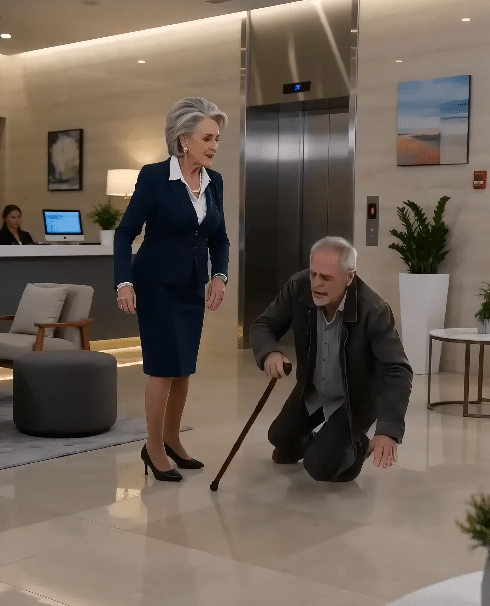
The cane hit the marble before anyone moved.
It clattered once, then spun across the polished white floor of the Beverly Hills medical center’s VIP reception wing, stopping beneath a glass partition where a nurse stood frozen with one hand over her mouth.
The old man fell a second later.
He landed hard on his side, one elbow tucked beneath him, his brown tweed blazer twisting at the shoulder. His silver hair slipped over his forehead. For a moment, he did not make a sound. He only blinked up at the recessed lights above him as if trying to understand how a place built for healing had become so cruel so quickly.
Above him stood Marjorie Vale.
She did not apologize.
She adjusted the strap of her designer tote on her arm, glanced down at him with open disgust, and exhaled like he had inconvenienced her by collapsing.
“Step aside,” she snapped. “This place is not for people like you.”
The nurse behind the circular station took one small step forward.
Marjorie turned her head just enough to stop her.
It was not a shout. It was worse.
It was the look of a woman who knew her donations, her last name, and her husband’s position on the hospital foundation board had trained people to hesitate.
The old man tried to rise. His hand searched for the cane that was no longer there.
Marjorie’s pearl necklace shifted against her beige tweed suit as she leaned closer.
“If you have no money,” she said, “don’t dirty the VIP lounge.”
The words hung in the air, bright and poisonous.
The old man’s face tightened, not with anger, but with something quieter. Humiliation. Exhaustion. A grief so practiced it almost looked like patience.
“My appointment is here,” he said softly.
Marjorie laughed.
“With whom? Housekeeping?”
A young male staff member lowered his eyes. Another nurse pressed her lips together, torn between fear and shame. Through the glass walls, a few waiting patients stared in disbelief.
The old man pushed himself up slightly, but his arm shook.
Marjorie stepped around him as if stepping around dropped luggage.
“Someone remove him.”
Then the elevator doors opened.
The sound was gentle, almost elegant, but the reaction was immediate.
Three hospital executives stepped out first, followed by a man in a white coat over a dark suit and purple silk tie. Dr. Charles Whitaker, Chief of Medicine, was known throughout the center as calm to the point of severity. He did not rush. He did not raise his voice. He did not lose composure in front of donors.
But when he saw the old man on the floor, his face changed.
“Professor,” he breathed.
Then he ran.
The executives followed, alarm spreading across their faces.
Dr. Whitaker dropped to one knee beside the elderly man, one hand supporting his shoulder, the other carefully checking his arm.
“Professor, please forgive this disrespect,” he said.
The word struck the lounge like breaking glass.
Professor.
Marjorie froze.
Her mouth opened.
The color drained from her face so quickly that even the nurses noticed.
“Professor?” she whispered.
Dr. Whitaker helped the old man stand with the care one gives to someone irreplaceable. Then he bent, retrieved the cane, and placed it back into the professor’s hand.
Only then did he turn toward Marjorie.
And in that cold, clinical silence, Marjorie Vale realized she had not shoved some poor old man out of her way.
She had shoved the person the entire hospital had been waiting to honor.
Act II
His name was Professor Elias Hartwell.
To the world, he was a retired physician-scientist, a Nobel-nominated researcher, and one of the last living pioneers of pediatric immunotherapy. To former students, he was the man who answered midnight calls, wrote recommendation letters by hand, and remembered the names of interns long after they had become department chairs.
To Dr. Charles Whitaker, he was the reason he had become a doctor at all.
Forty years earlier, Charles had been a scholarship student with two suits, one pair of polished shoes, and a permanent fear that someone would discover he did not belong in medical school. Elias Hartwell had found him asleep in the anatomy lab after a sixteen-hour study session and left a sandwich beside his textbook with a note.
Medicine does not belong to the confident. It belongs to the committed.
Charles kept that note in his desk to this day.
But the hospital did not know the full story of Elias Hartwell.
No one in that bright white VIP lounge knew why he had arrived in a modest tweed blazer instead of a tailored suit. No one knew why he still carried an old wooden cane instead of the sleek medical device the hospital had once offered him. No one knew why he disliked private entrances, donor plaques, and rooms where people were separated by net worth before they were asked where it hurt.
They only knew he had been invited.
Not as a patient.
As the guest of honor.
The Hartwell Children’s Research Wing was scheduled to be announced that afternoon at a private reception upstairs. The hospital board had prepared speeches. Photographers had been booked. Silver trays of hors d’oeuvres waited in a conference suite overlooking Beverly Hills.
Marjorie Vale had come for that reception.
She had dressed for cameras.
Her husband, Preston Vale, had spent years buying influence in philanthropic circles. Their family name appeared on museum walls, hospital gala programs, and charity invitations where generosity was measured by font size.
Marjorie enjoyed those rooms because they made kindness feel like status.
She gave where people could see it. She embraced suffering when it came with photographers. She used words like service and compassion at luncheons, then spoke to receptionists as if they were furniture.
That morning, she was already irritated.
Her driver had taken the wrong entrance. Her appointment with a cosmetic surgeon had been delayed. A nurse had asked her to wait like everyone else. Then she saw Elias standing near the VIP desk, slightly bent over his cane, wearing a cardigan under a blazer that looked older than half the doctors in the building.
To Marjorie, the conclusion was instant.
He did not belong.
That was all she needed.
The world had always rewarded her for making fast judgments. The right guest list. The right handbag. The right school. The right charity. The right people, separated from the wrong ones.
Elias Hartwell had spent his life proving that those judgments killed quietly.
They killed opportunity.
They killed dignity.
Sometimes, in hospitals, they killed patients.
Years before, he had lost his wife, Ruth, in a clinic that ignored her symptoms because she arrived without the right insurance card. He had been young then, brilliant but broke, still buried under fellowships and debt. Ruth waited six hours in a crowded room while wealthier patients were ushered ahead.
By the time someone listened, it was too late.
Elias never forgave the system.
He never fully forgave himself.
From that grief came his life’s work: medicine for children whose parents could not buy access, trials for patients without famous names, research funds that crossed borders and ignored family income.
He became respected because he was brilliant.
He became beloved because he refused to become cruel.
And now, decades later, in a hospital wing that bore the smell of money more than medicine, he had been pushed to the floor by a woman wearing diamonds at noon.
Dr. Whitaker knew all of this.
That was why his hands trembled as he adjusted the professor’s blazer.
“Are you hurt?” he asked.
Elias gave a faint smile.
“Only disappointed.”
The words were quiet.
But everyone heard them.
Marjorie swallowed.
For the first time since entering the lounge, she seemed to understand that the room was not frozen because she was powerful.
It was frozen because she was exposed.
Dr. Whitaker turned toward her.
“Mrs. Vale,” he said, each syllable controlled, “you will step back.”
Her eyes darted to the executives.
“Charles, surely this is being exaggerated.”
Elias looked at her then.
Not harshly.
That somehow made it worse.
“My dear,” he said, “when people show contempt before they know a name, they reveal what they worship.”
Marjorie’s lips parted.
She had no answer.
Because the professor had just diagnosed her more accurately than any doctor in the building could have.
Act III
The VIP lounge became painfully quiet.
No machines beeped. No phones rang. Even the staff at the nursing station seemed afraid to breathe too loudly.
Marjorie drew herself upright, trying to recover the version of herself that worked at galas.
“I had no idea who he was,” she said.
The sentence fell flat.
Dr. Whitaker stared at her.
“That is not a defense.”
“It was an accident.”
A nurse spoke before she could stop herself.
“No, ma’am.”
Every face turned.
The nurse was young, maybe twenty-six, with blue scrubs and tired eyes. Her badge read Elena Ruiz. She looked terrified the moment the words left her mouth, but she did not take them back.
Marjorie glared.
“Excuse me?”
Nurse Ruiz swallowed.
“You shoved him. He was waiting to check in. He hadn’t done anything to you.”
The male staff member beside her nodded.
“I saw it too.”
Marjorie’s face hardened.
“This is absurd. I am on the foundation’s hospitality committee.”
Dr. Whitaker’s expression sharpened.
“Not anymore.”
Her confidence flickered.
“You don’t have that authority.”
One of the executives stepped forward. “Actually, he does.”
That was the first crack.
The second came when an older woman stepped out of the elevator behind the executives. She had silver-black hair, a navy dress, and the steady posture of someone who had survived too many boardrooms to be impressed by panic.
Marjorie recognized her immediately.
Helen Armitage.
Chair of the hospital board.
Helen looked from Elias to the cane, then to Marjorie.
“What happened?”
No one answered quickly enough.
So Elias did.
“I was mistaken for someone unworthy of standing in a hallway.”
Helen’s eyes closed briefly.
When she opened them, they were cold.
Marjorie took a half step toward her.
“Helen, this is a misunderstanding. I was under pressure, and he was blocking the entrance. I simply asked him to move.”
Dr. Whitaker turned to the nurse.
“Please preserve the security footage from this corridor.”
Marjorie’s face changed.
The room saw it.
Fear, quick and unmistakable.
Because people who live by polished versions of events fear cameras most when they forget cameras are watching.
Helen looked at Marjorie’s hand, still gripping the luxury tote as if it were a shield.
“Mrs. Vale,” she said, “you insulted Dr. Hartwell?”
Marjorie blinked.
“Dr. Hartwell?”
The title landed harder than professor.
Her eyes moved to the executives, searching their faces. She began assembling the truth too late.
Elias Hartwell was not a charity case.
He was the name behind the research wing.
The private reception upstairs was not honoring the Vales.
It was honoring him.
And Marjorie, who had come prepared to pose beside him, had shoved him onto the floor.
Dr. Whitaker’s voice cut through her realization.
“Professor Hartwell trained half the leadership in this hospital. He helped develop treatments that changed pediatric care worldwide. His foundation just committed the largest research endowment this medical center has ever received, with one condition.”
He paused.
Elias looked away, almost embarrassed.
Dr. Whitaker continued.
“That no child be denied trial access because their parents lack wealth or influence.”
The staff heard it first.
Then the executives.
Then Marjorie.
The words rearranged the room.
No money? Don’t dirty the VIP lounge.
Her own sentence came back to her, uglier now that it had found its target.
Helen’s jaw tightened.
“Mrs. Vale, your husband has been lobbying for a naming opportunity in that same wing.”
Marjorie’s throat moved.
“I support children’s medicine.”
Elias looked at her gently.
“Do you support children, or do you support being photographed near them?”
A flush rose beneath her makeup.
“You don’t know me.”
“No,” Elias said. “But I know the tone of someone who believes value can be appraised from shoes, jackets, and bank accounts.”
He leaned slightly on his cane.
“I have heard that tone in hospitals before.”
For the first time, the room sensed something deeper beneath his calm. Not anger exactly. Memory.
Dr. Whitaker did too.
“Professor,” he said softly.
Elias nodded once, as if giving himself permission to continue.
“My wife died in a waiting room that looked nothing like this one,” he said. “No marble. No private elevator. No pearls. But the principle was the same. Someone decided she could wait because someone else looked more important.”
The words did not become loud.
They became unbearable.
Marjorie’s eyes dropped.
Helen’s face softened with sorrow.
Elias looked around the VIP wing, at the glass, the lights, the white marble, the quiet luxury disguised as care.
“I gave this hospital my research because I believed it wanted to become better than the world outside its doors,” he said. “But if this floor teaches staff to freeze while a human being is degraded, then marble has become more important than medicine.”
No one spoke.
Then the elevator doors opened again.
Preston Vale stepped out, smiling broadly, ready for the reception.
“Marjorie,” he said, “there you are. They’re waiting upstairs for—”
He stopped.
He saw his wife’s face.
He saw Elias Hartwell leaning on the cane.
He saw Helen Armitage standing like a judge.
And he knew, with the instinct of a man who had built his life around influence, that something very expensive had just been lost.
Act IV
Preston Vale recovered faster than his wife.
He crossed the lounge with his hand extended, smile adjusted to emergency warmth.
“Professor Hartwell,” he said. “What an honor. Preston Vale. My wife and I have admired your work for years.”
Elias did not take his hand.
Preston’s smile stiffened.
Dr. Whitaker watched in silence.
Marjorie whispered, “Preston…”
He ignored her.
“Whatever has happened here,” Preston continued, lowering his voice, “I’m sure we can resolve it privately. Hospitals are stressful places. Emotions run high.”
Elias looked at him for a long moment.
“Your wife pushed me to the floor.”
Preston’s hand dropped.
Marjorie’s eyes flashed with panic.
“It wasn’t like that.”
Nurse Ruiz spoke again, stronger this time.
“It was exactly like that.”
The young nurse’s voice changed the atmosphere. Not because she was powerful, but because truth spoken by someone with something to lose often carries more weight than speeches from people who lose nothing.
Preston turned his head slowly.
“Your name?”
Dr. Whitaker stepped between them.
“You will not intimidate my staff.”
Preston smiled thinly.
“Doctor, I’m simply asking who is making accusations against my family.”
Helen Armitage’s voice sliced through the exchange.
“The cameras are making them.”
Preston went still.
A security director arrived moments later with a tablet. He did not play the footage publicly. He did not need to. He showed it to Helen, Dr. Whitaker, and Elias first.
The scene was brief.
Mercilessly brief.
Marjorie striding through the VIP wing. Elias standing near the desk. Her shoulder driving into his with impatience and force. His cane slipping. His body turning. The fall. Her face afterward. The words.
Even without sound, contempt had a shape.
Helen handed the tablet back.
“Mrs. Vale,” she said, “you will leave this facility.”
Preston’s face hardened.
“My wife is a major donor.”
Helen held his gaze.
“Your wife is a liability.”
The sentence landed cleanly.
Marjorie’s eyes filled, not with remorse, but with outrage.
“You’re humiliating me.”
Elias sighed.
“No, Mrs. Vale. Humiliation is being thrown to the ground and told you do not belong in the place you helped build.”
The executives looked at one another.
Preston shifted tactics.
“Professor, let me be direct. The Vale family was prepared to make a significant contribution to your research wing. Surely we shouldn’t let one unpleasant moment jeopardize care for children.”
There it was.
The old bargain.
Money in exchange for silence.
A room full of educated people recognized it, but Elias looked the least surprised.
He had spent a lifetime watching wealth dress coercion in the language of generosity.
He straightened as much as his body allowed.
“Mr. Vale,” he said, “my foundation’s endowment is sufficient without your contribution.”
Preston’s smile disappeared.
“And if the board disagrees?”
Helen answered before Elias could.
“The board does not.”
Then she turned to Dr. Whitaker.
“Cancel the Vale naming proposal. Effective immediately.”
Marjorie gasped.
Preston’s face darkened.
“You are making a mistake.”
Helen stepped closer.
“No. We are correcting one.”
Dr. Whitaker looked toward the nursing station.
“Nurse Ruiz.”
Elena stiffened.
“Yes, Doctor?”
“Thank you for speaking.”
Her eyes shone with sudden emotion.
Marjorie stared at her in disbelief, as if a nurse being thanked in the VIP wing violated some natural order.
Elias noticed.
He began walking slowly toward Elena, his cane tapping once, twice, three times against the marble. The entire lounge watched him cross the floor he had just been shoved onto.
When he reached the desk, he extended his hand.
“Thank you,” he said.
Elena shook it carefully.
“I’m sorry we didn’t move faster.”
“You moved when it mattered,” Elias said. “Next time, move sooner.”
She nodded.
“I will.”
Dr. Whitaker heard the lesson in it. So did everyone else.
This was no longer only about Marjorie Vale.
It was about the culture that had made room for her.
The deference. The fear. The silent calculations staff made when cruelty wore money. The way a hospital could speak of compassion while teaching employees to check a donor list before defending a person on the floor.
Elias turned back to Helen.
“I would like to change the terms of the gift.”
Preston gave a bitter laugh.
“Now we negotiate?”
Elias ignored him.
Helen nodded. “Of course.”
“The wing will not be named Hartwell.”
Dr. Whitaker looked startled.
“Professor—”
Elias lifted a hand.
“I have had enough of names on walls.”
His gaze moved across the VIP lounge.
“It will be named for Ruth. And the first floor will house a patient advocacy office with independent authority. Staffed, funded, and protected from donor influence.”
Helen’s expression softened.
“Done.”
“And this lounge,” Elias added, “will no longer use the word VIP.”
The executives exchanged glances.
Elias looked at the marble beneath his feet.
“Pain is not more urgent because it arrives in diamonds.”
That sentence ended the Vales in that room.
Security approached quietly.
Marjorie did not fight. She looked too stunned to move. Preston took her arm, but she pulled it away, as if even his touch reminded her that the performance had failed.
As they were escorted toward the elevator, Marjorie looked back once.
Not at Elias.
At the nurses.
At the staff.
At the people she had expected to shrink.
None of them looked away this time.
And that was when she finally understood.
Her money had opened doors.
But it could not close the one she had just broken wide open.
Act V
The reception upstairs did not begin on time.
For twenty-three minutes, executives whispered, assistants revised programs, and caterers stood by silver trays wondering whether the event would be canceled. The photographers lowered their cameras. The donors murmured among themselves, hungry for scandal but careful not to be seen enjoying it.
Then the doors opened.
Professor Elias Hartwell entered slowly, leaning on his cane.
Dr. Whitaker walked at his side.
Behind them came Helen Armitage, the hospital executives, and Nurse Elena Ruiz, still in blue scrubs, looking as if she would rather be anywhere else.
Elias had asked for her personally.
The room rose.
Not because an announcement told them to.
Because something about the old man’s quiet entrance made remaining seated feel wrong.
He reached the podium beneath a screen that still read:
The Hartwell Children’s Research Wing.
Elias looked at it for a long moment.
Then he turned to the crowd.
“I was honored today,” he began, “in a hallway.”
The room stilled.
“Not by ceremony. Not by wealth. Not by applause. I was honored by a nurse who chose truth over comfort.”
Elena lowered her eyes.
Dr. Whitaker smiled faintly.
Elias continued.
“I was also reminded why this wing must exist. Not to flatter donors. Not to polish reputations. Not to create another beautiful floor where people learn to rank suffering by appearance.”
A ripple moved through the crowd.
Some understood immediately that something had happened downstairs.
Others simply listened.
“My wife, Ruth, believed medicine should begin with the question, ‘What do you need?’ Not, ‘Who are you?’ Not, ‘What can you pay?’ Not, ‘Will helping you impress someone important?’”
His voice thinned slightly on her name.
But he did not stop.
“For years, I allowed institutions to put my name on things because I thought names could attract money, and money could build care. Perhaps that is partly true. But names can also become mirrors. People gather around them to admire themselves.”
He turned toward the screen.
“So today, I am giving this wing its proper name.”
Behind him, the slide changed.
The Ruth Hartwell Center for Children’s Medicine and Patient Dignity.
No one spoke for a second.
Then applause rose, first soft, then overwhelming.
Elias did not bask in it. He looked almost relieved to give the honor away.
Dr. Whitaker wiped quickly beneath one eye.
Helen stepped forward and announced the new patient advocacy office, the removal of donor privileges from clinical access decisions, and a full review of VIP policies. Her voice was steady, but the room understood the message beneath it.
The hospital had been embarrassed.
And embarrassment, in the right hands, could become reform.
Downstairs, the sign outside the reception wing was removed within the month.
VIP Lounge became Patient Reception.
The marble remained.
The glass remained.
But something in the staff changed faster than the architecture.
Nurses interrupted rude donors. Receptionists called security without apology. Doctors were reminded that no gift, no board seat, no last name carried more weight than a person’s dignity.
Nurse Elena Ruiz was promoted six months later to lead the new advocacy office.
She tried to refuse at first.
Elias told her, “The best people for power are usually the ones suspicious of it.”
So she accepted.
As for Marjorie Vale, the story followed her in the way stories do among people who pretend they do not gossip. Invitations slowed. Luncheon chairs became unavailable. Her name was quietly removed from a hospital gala committee she had once controlled with a raised eyebrow.
Preston tried to repair the damage with money.
But money, for once, found no immediate door.
The Vales did not disappear from society. People that wealthy rarely do. But something about them became smaller. Less feared. More carefully watched.
And Marjorie never again entered that medical center through the front doors.
Professor Hartwell returned often.
Not for ceremonies.
For children.
He sat beside infusion chairs and asked patients about school, pets, cartoons, and whether the pudding was still terrible. He wrote notes to young doctors in the margins of their research drafts. He walked slowly, cane tapping against the floor, through hallways where staff now greeted him not with panic, but with affection.
One afternoon, nearly a year after the incident, he paused outside the former VIP reception wing.
A young father stood near the desk, holding a little girl in a yellow sweater. His clothes were wrinkled. His eyes were exhausted. He looked like a man prepared to be told no.
Elena saw him first.
She came around the desk and knelt to the child’s level.
“Hi,” she said warmly. “What do you need?”
The father’s face changed.
Just slightly.
Hope entering before relief.
Elias watched from a few feet away, one hand resting on the head of his cane.
Dr. Whitaker joined him.
“You were right,” Charles said.
Elias smiled.
“At my age, one enjoys hearing that.”
Charles laughed softly.
Then he looked toward the new sign on the wall.
The Ruth Hartwell Center.
“She would have liked this,” he said.
Elias’s smile faded into something tender.
“No,” he said. “She would have asked what took us so long.”
Together, they watched Elena lead the father and child through the glass doors.
No velvet rope.
No special list.
No question of whether they belonged.
Months earlier, a woman in pearls had looked at an old man on the floor and thought she was seeing someone beneath her.
She had been wrong.
She was seeing the conscience of the place.
And when that conscience rose, leaning on a wooden cane and carrying the memory of every patient ever made to feel small, the hospital had no choice but to rise with him.