Act I: The Boy in the Aisle
I was halfway through the vows when the ballroom doors flew open.
The sound cut through the chandeliers, the string quartet, the priest’s measured voice, and every expensive breath in the room. Three hundred guests turned at once, their faces lifting from crystal glasses and folded programs toward the white double doors at the back of the hall.
A boy came running down the aisle.
He couldn’t have been older than seven or eight. Barefoot. Dirty. Hair matted with soot and sweat. His shirt hung off him in rags, too big at the collar and torn near one shoulder, as if it had once belonged to a larger child or an adult who had run out of other things to give.
He didn’t slow for the flowers.
He didn’t hesitate under the chandeliers.
He ran straight toward me.
“What is this?” I heard myself say.
The words came out thin, almost absurdly polite, as though my mind still believed this could be explained by some servant’s mistake or a guest’s deranged relative wandering in from the grounds. Beside me, Vivienne’s bouquet dipped slightly in her hand. The priest stopped speaking. Even the quartet missed a note.
The boy stopped two steps from the altar.
His chest was heaving. His eyes were red-rimmed and bright, not with confusion but with purpose. He looked up at me once, searching my face as though he had crossed an entire world just to confirm I was real.
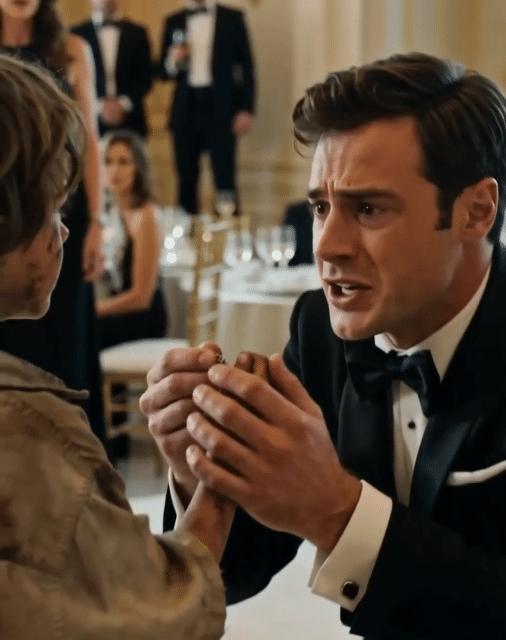
Then he held out a silver bracelet.
It dangled from his trembling fingers, small enough for a child’s wrist, worn thin at the edges, its engraved plate catching chandelier light. I took it before I understood why my hand was shaking.
The inscription was only four words.
For my son — Daniel.
The room disappeared.
I knew that bracelet.
I had commissioned it twenty-one years earlier from a jeweler in Florence who owed my father money and discretion. I had held it in my hand on the night Lucia went into labor, turning the little chain between my fingers and imagining, stupidly, that a piece of silver could somehow make me look more prepared to become a father.
But my son had died before he was ever placed in my arms.
That was what they told me.
Lucia had died too.
That was what they made me bury.
The boy looked at me while the bracelet hung cold in my hand.
“My mom kept it for me,” he said. “She gave it to me before she died.”
His voice cracked on the last word, but he kept going.
“She said you left us the day I was born.”
I didn’t hear Vivienne drop the bouquet.
I didn’t hear the first wave of whispers break loose among the guests.
I only heard myself ask the question my body already feared.
“What was your mother’s name?”
The boy swallowed once.
Then he said it.
“Lucia Moretti.”
And just like that, my wedding stopped being a wedding.
Because Lucia Moretti had been dead for twenty-one years.
At least, that was the lie my family had taught me to survive.
Act II: The Woman They Buried Before the Fire Cooled
I met Lucia when I was twenty-four and still foolish enough to mistake rebellion for courage.
She worked in the Laurent summer house on the Amalfi coast, not as a maid exactly, though that is what my mother called her when she wanted to reduce her to something decorative and replaceable. Lucia catalogued the old house library, arranged shipments, translated correspondence when my father’s partners from Naples or Marseille wanted someone quicker and cheaper than a lawyer.
She was not impressed by any of us.
That was the first thing I loved about her.
She looked at old money the way a botanist looks at fungus—interesting, somewhat ugly, and rarely worth worship. She had dark hair, patient hands, and a laugh she tried to suppress in formal rooms because once it got free, it was impossible to control. I spent a summer inventing reasons to find her in corridors, on terraces, in the overgrown garden near the old stone wall where the orange trees grew.
By October, I would have married her.
By December, she was pregnant.
By January, my mother knew.
That was when reality entered the room in place of romance. My father was negotiating a merger that would attach our family holdings to a banking dynasty in Milan. My mother was arranging my engagement to Vivienne Harrow long before she ever bothered asking whether I wanted one. Lucia, in their eyes, was not simply inconvenient. She was catastrophic.
My mother called her “the servant girl” when we were alone.
My father called her “the sort of mistake that becomes permanent if handled sentimentally.”
I told them I loved her.
My mother laughed.
It is amazing how efficiently powerful families can move once they decide a young woman’s life is an administrative problem. Lucia was dismissed from the summer house under the excuse of restructuring. Her final wages were doubled, which told me even then that the money was not generosity but hush. She disappeared into a rented room in the old quarter with one suitcase and the stubborn confidence of someone who had not yet learned what wealthy people can do when they feel mocked by your existence.
I went to her anyway.
For six months, we lived in the space between secrecy and defiance. I met her in borrowed apartments, church courtyards, restaurants too small for my family to enter without staining themselves. We whispered about names, schools, escape, trains north, a small life somewhere else. We were poor at planning, rich in certainty, and doomed in ways only hindsight makes obvious.
Then the baby came early.
Labor started at dawn during a thunderstorm in late May. The roads were half-flooded. The private clinic my mother preferred for “delicate matters” had already been arranged without my knowledge. I was on my way there when my father’s driver intercepted me outside the south gate and said my mother had collapsed.
He took me to the family estate instead.
By the time I understood it was a lie, I had lost two hours.
When I finally reached the clinic, it was burning.
Not in some cinematic explosion.
Just flames in one wing, smoke pouring from upper windows, nurses and attendants in the courtyard, rain mixing with ash in the lights. I remember shouting Lucia’s name until my throat bled. I remember a doctor with singed eyebrows and dead eyes telling me the mother was gone, the infant never stabilized, and there was nothing left to identify.
My mother held me that night.
She wore mourning before there was even a burial.
She told me some women were not built to survive labor and that God was cruelest when we were youngest. My father arranged the funeral with such efficiency it still makes me sick when I think about it. Closed casket. Family chapel. No body visible. No viewing. Just enough tragedy to be credible and not enough detail to let grief ask proper questions.
I wore black.
I buried an empty coffin.
And six months later, under pressure I pretended was duty, I agreed to marry the woman my family had selected all along.
By the time the boy stood at the altar with Lucia’s bracelet in his hand, I had spent twenty-one years building a life around that grave.
The problem was not only that Lucia might have lived.
It was that only one person in my family had the intelligence, cruelty, and reach to make me believe she died in the first place.
My mother.
And when I turned toward the front row, she was already standing.
Act III: The Pianist Who Remembered the Night Nobody Mentioned Again
Armand Delacroix had played at every Laurent wedding, funeral, and donor banquet since I was a child.
He sat at the grand piano like part of the architecture—thin, silver-haired, tuxedoed, nearly invisible until he chose not to be. Most guests forgot he was there until they wanted Chopin with their grief or Cole Porter with their money.
But Armand remembered everything.
He left the bench slowly, one hand on the lacquered edge of the piano, and looked first at me, then at the boy, then at my mother. There was no uncertainty in his face. Only horror delayed far too long.
“I knew that bracelet,” he said quietly.
The ballroom went still again.
My mother turned to him with the brittle composure of a woman who had already decided which lies to deny first. “Armand, this is not the time—”
“It is exactly the time,” he said.
That shocked the room almost as much as the boy had.
Armand was old-world polite, the sort of man who apologized to furniture if he brushed it too hard. Hearing steel in his voice felt like watching a portrait step out of its frame. He crossed the marble toward us, and when he stopped beside the boy, I saw tears standing in his eyes.
“I saw her that night,” he said.
I tightened my hand around the bracelet until the metal bit my palm.
“Who?”
“Lucia.”
My mother closed her eyes for one fraction of a second. That was all the answer I needed.
Armand swallowed hard. “Not dead. Sedated. Two orderlies carried her through the side gate after the fire started. Your mother was there. So was Father Bellori. The baby was alive. I heard him crying.”
The room broke into sound at last—gasps, whispers, one woman murmuring no, no, no as if repetition might reverse history. Vivienne stood motionless beside the altar, her face so pale it looked powdered. Whatever she thought this wedding had been, she understood now that she was no longer the center of it.
I went to the boy then, slowly, and crouched so I could see him at eye level.
“What is your name?”
“Matteo.”
It was Lucia’s father’s name.
That detail nearly undid me.
“Did she tell you where to come?”
He nodded and pulled something crumpled from the pocket of his torn shorts. Not just a note. A white envelope, damp from sweat and rain and being held too tightly by a child who knew losing it meant losing everything. My name was written across the front in Lucia’s hand.
I stared at it.
The dead do not write letters.
Not unless they were never dead to begin with.
My mother stepped forward then, finally abandoning the dignified silence that had protected her for decades.
“Daniel,” she said sharply, “do not open that here.”
That was the worst possible thing she could have said.
Because it confirmed the letter did not belong to confusion, extortion, or madness.
It belonged to truth.
I broke the seal.
Inside was one sheet of paper and a hospital bracelet cut from an infant’s wristband. The handwriting was weaker than I remembered, uneven, as though written by someone who had run out of time and strength together.
If you are reading this, they failed to erase us completely.
I felt the whole room move closer without taking a step.
Lucia wrote that the fire had been staged to destroy records, not lives—but my mother wanted both if she could get them. Father Bellori, bought with money and family loyalty, helped remove Lucia and the baby to a rural clinic under false names. Lucia was told I refused her and agreed to the removal. I was told she died. When she finally understood the lie, it was too late. She had no money, no papers, no safe route back, and a son whose existence would destroy the marriage alliance my mother was still building around me.
Lucia fled south.
She raised Matteo in small towns, under borrowed names, in the shadow of people paid to keep watch. She wrote that she had tried twice to contact me and both times the letters came back opened but never delivered. Last month, she learned she was dying. That was when she finally decided our son would have truth, whether or not I deserved it.
At the bottom of the page, under her signature, was the line that split my life cleanly in two.
Your wife-to-be knows enough to help your mother finish this if you let the ceremony continue.
I looked up from the letter.
Vivienne was staring at my mother.
Not at me.
That was when I realized the scandal in the ballroom was still not the deepest wound in the room.
Act IV: The Bride Who Knew More Than She Said
“Tell him,” I said.
I wasn’t sure whether I meant Vivienne or my mother at first.
The ballroom solved that for me. My mother stepped forward wearing the face she used for bank directors, bishops, and men foolish enough to think she feared public judgment. Controlled. Frosted. Almost calm.
“This child is the product of a deeply regrettable situation,” she said.
The words landed in the room like acid.
Matteo flinched.
I turned on her with a hatred so pure it made the chandeliers look dim.
“Regrettable?”
She lifted her chin.
“You were unstable. She was manipulative. There were larger responsibilities at stake than your infatuation with a librarian who understood exactly what your name could buy her.”
Even now, faced with the living evidence of what she had done, my mother needed to reduce Lucia to ambition. That was her reflex. If a woman could not be erased, then she must be downgraded.
Armand made a sound of disgust.
But it was Vivienne who surprised me.
“She told me the child died,” she said.
Everyone turned toward her.
Her voice was thin at first, but it strengthened as it moved. She looked younger suddenly, less like a bride and more like a daughter discovering too late what had been inherited along with the diamonds.
“She said there had been a fire and a mistress and a scandal that nearly destroyed the family. She said if anything ever surfaced, it would be extortion.”
My mother stared at her with naked fury.
“You are speaking far too freely.”
Vivienne laughed once. It wasn’t a pleasant sound.
“Oh, I think we’re well past discretion, don’t you?”
The room shifted.
Not morally.
Strategically.
Guests began recalculating where power now lived. Lawyers in good suits edged toward exits to make phone calls. One of the older board members from our foundation sat down so suddenly his chair scraped hard against the marble. My father’s portrait, hanging above the back gallery doors in military oils and inherited confidence, suddenly looked less like legacy and more like evidence.
I held Lucia’s letter in one hand and Matteo’s shoulder in the other.
“Did you help her?” I asked Vivienne.
She met my eyes.
“Only by not asking enough questions.”
There it was.
Complicity, not authorship. Easier to survive in court. Harder to survive in the mirror.
She took a breath. “Your mother told me, two weeks ago, that if any claim surfaced today, the child would be removed before the press arrived and the paternity challenged quietly in probate. She already had the injunction drafted.”
My mother did not deny it.
She didn’t need to.
In women like her, denial comes second to management. She was already turning the room over in her mind, counting allies, liabilities, bloodlines, money trails. Matteo beside me was not just a child she stole from me. He was the legitimate son of Victor Laurent, which made him my heir in a way the trustees and lawyers in that room understood instantly and viscerally.
That was the true scandal.
Not infidelity. Not hidden birth. Succession.
Matteo reached into his shirt then and pulled out one more thing on a cord around his neck: a brass key.
Lucia had mentioned it at the bottom of the letter.
The nursery vault.
Only if she refuses to confess.
I knew exactly what she meant.
The old nursery wing at the Laurent estate had been closed since the fire. My mother kept the key to the service vault where insurance inventories and personal effects from the burned rooms had supposedly been stored before disposal. I looked at the brass key in Matteo’s hand and understood that Lucia had not just preserved a letter.
She had preserved proof.
And somewhere, above the ballroom where I had almost said vows to the wrong woman under the wrong story, a locked room was waiting to finish what my mother had spent two decades trying to keep unfinished.
Act V: The Room Above the Ballroom
The nursery still smelled faintly of smoke.
Not fresh smoke. Memory smoke. Old plaster, varnished wood, and something sealed beneath years of expensive renovation no decorator had fully managed to erase. We climbed the east staircase in a silence so brittle I thought it might break under the weight of footsteps—me, Matteo, Armand, Vivienne, two family attorneys, and behind us, because she could not bear not to control the final moment, my mother.
The brass key fit the service vault behind the nursery wardrobe.
Inside were boxes.
Insurance inventories. Burn reports. One scorched stuffed rabbit I recognized from Lucia’s first pregnancy gift. And beneath the top shelf, locked in a black deed case, the clinic transfer ledger my mother should have destroyed and somehow, through arrogance or sentiment, had not.
The ledger contained everything.
The payments to Father Bellori. The orderlies’ signatures. The rural clinic admission under false names. Monthly transfers to a trust that kept Lucia and Matteo alive while ensuring they remained geographically isolated. Returned letters. Intercepted correspondence. A final notation from three months after the fire that froze me where I stood.
Daniel requested exhumation denied on family medical grounds. Encourage mourning closure.
I had begged for that exhumation.
I remembered it suddenly, vividly—the shouting, the locked study, my mother’s white face, the doctor’s statement about contamination risk. She had not just lied about Lucia’s death. She had used my grief as a wall against my own instincts.
Matteo stood beside me reading none of it and understanding all of it from my face.
“Is it true?” he asked.
I put my hand over his hair, filthy and warm and utterly real.
“Yes,” I said.
My mother began to speak then, something about necessity and survival and the ruin Lucia would have brought to all of us, but I no longer heard her as a mother. Only as a witness trying to narrate herself into lesser guilt.
Vivienne took off her engagement ring and set it gently on the ash-dark shelf.
“I won’t marry into this,” she said.
It was not a dramatic line. She almost whispered it. That made it stronger.
I turned to Matteo.
Twenty-one years of loss looked back at me through Lucia’s eyes.
“I don’t expect you to forgive me,” I said.
He frowned in that serious, searching way children do when adults say things too large for the room. “You didn’t know.”
“No,” I said. “But I should have fought harder.”
That, at least, was true.
Not for Lucia’s choices. Not for my mother’s money. Not for the machinery of old families protecting themselves. For my own surrender. For the years I let grief be arranged for me because obedience is such an easy habit in houses like ours.
Below us, the ballroom noise had changed from celebration to crisis.
Phones ringing.
Voices raised.
Orders given.
Somewhere, security trying to decide whether a wedding had become a crime scene.
I took the deed case, the ledger, Lucia’s letter, and my son’s hand.
When we walked back into the ballroom, the guests parted without being asked.
No one looked at the abandoned altar now. No one cared about the flowers, the cake, the seating cards, or the white aisle that had been laid out for a future that no longer existed. They looked at Matteo, at me, at the papers in my hand, and then, finally, at the woman who had built half her life on fire and called it duty.
I never said the wedding was over.
I didn’t need to.
Some endings announce themselves by silence.
I crossed the ballroom with my son beside me and did not look back at the arch, the priest, or the bride I had nearly wronged with a life built on a lie. Outside, the night air smelled of rain and cut roses. The press had not arrived yet. The lawyers would. The courts would. The public scandal would have its turn.
But in that moment, none of it mattered more than the small hand gripping mine with fearful certainty.
The boy who ran into my wedding barefoot and dirty had not come to ruin my life.
He had come to return it.
And when the doors closed behind us, taking us out of the ballroom and away from the family that had taught me how easily power can mistake itself for love, I realized something Lucia had understood long before I did:
They can bury a woman.
They can burn a room.
They can write death onto paper and call it mercy.
But if even one child survives carrying the truth in his hands, the lie is never really finished.