Act I
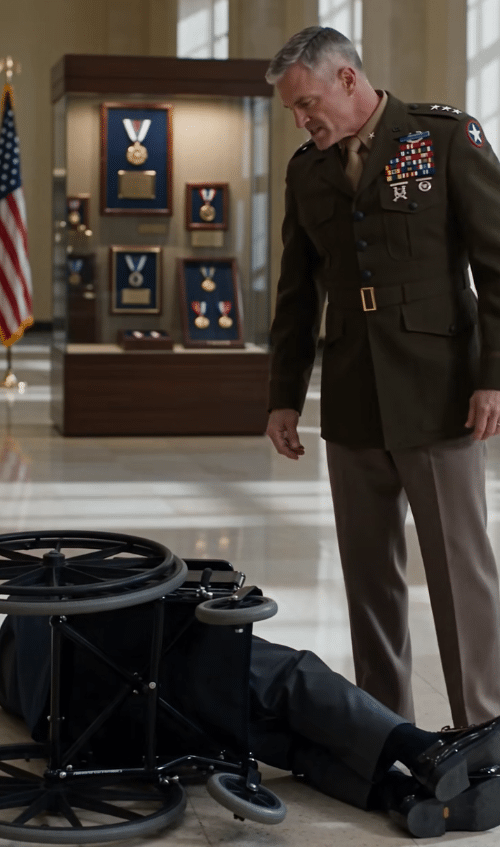
The wheelchair lay on its side beneath a display of military medals.
An elderly man in a charcoal suit was sprawled across the polished museum floor, one hand pressed against his chest. His burgundy tie had twisted sideways. A red swelling spread across his cheek, and a faint trace of blood marked the corner of his mouth.
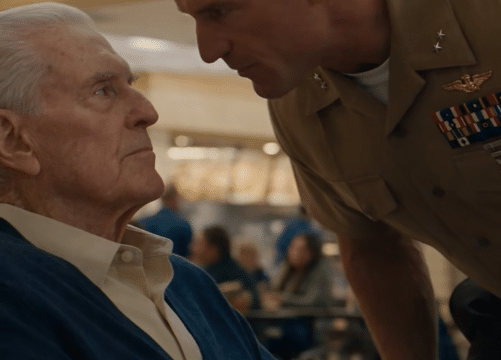
Standing over him was a uniformed Brigadier General.
The younger officer was fifty-one, with salt-and-pepper hair, an immaculate Army uniform, and a single star clearly visible on his insignia. His ribbons and service badges were arranged with the precision of a man who took pride in every symbol of his authority.
Only moments earlier, the elderly man had been moving through the Veterans Weekend exhibition in his manual wheelchair. He had stopped near a glass case displaying medals from an earlier generation when the chair brushed against the officer’s path.
The Brigadier General turned sharply.
“Can’t you control that chair?”
The older man looked toward the display. Nothing had fallen. The glass case was untouched.
“Nothing was damaged.”
It was a calm answer. A reasonable one.
But the officer seemed to hear an insult.
He stepped closer, looking down at the seated man as though the wheelchair itself were an act of disrespect. Around them, visitors moved between exhibits displaying historic uniforms, flags, and photographs of soldiers who had served long before either man entered the museum.
The officer’s expression hardened.
Then he punched the elderly man across the face.
The blow snapped his head sideways. His cheek reddened and began to swell, and the corner of his mouth split just enough to leave a faint trace of blood.
The old man struggled to straighten himself in the chair.
The officer stepped back.
Then he drove a hard kick into the man’s chest.
The impact threw him out of the wheelchair and onto the museum floor. The chair tipped sideways, its wheels spinning briefly before becoming still.
A woman near the medal display screamed. A veteran wearing a service cap took one step forward, then stopped in disbelief. Several visitors raised their phones.
The Brigadier General looked down at the injured man.
“Being disabled doesn’t excuse disrespect.”
The old man did not plead.
Even as he struggled to breathe through the pain, he lifted his eyes and met the officer’s gaze.
There was no fear in them.
Only a cold, unmistakable dignity.
The Brigadier General mistook that expression for defiance.
He had no idea whose dignity he had just tried to destroy.
And he had even less idea who was about to walk through the museum doors.
Act II
The elderly man’s name was Richard Hale.
He was seventy-six years old, silver-haired, sharply dressed, and confined to a wheelchair after an injury that had changed the course of his later life. His charcoal suit was tailored but understated. His white shirt was crisp, his burgundy tie neatly knotted, and his polished shoes rested on the wheelchair’s footplates.
He did not look like someone seeking attention.
That was intentional.
Richard had spent most of his adult life in a world where attention followed him whether he wanted it or not. He had attended briefings where a single sentence could change the direction of an operation. He had stood before rooms filled with senior officers and government officials. He had carried responsibilities that most people would never see and fewer still would understand.
He had once worn four stars.
Richard Hale was a retired Four-Star General.
His career had taken him through decades of military service, difficult decisions, and moments when the lives of thousands depended on the judgment of a handful of people. His name had appeared in official records and military publications, but retirement had gradually separated him from the public image attached to his former position.
He preferred it that way.
The museum had been one of his favorite places to visit. He enjoyed the historical displays, especially the cases containing medals and personal effects donated by families of fallen service members.
He never looked at those objects as decorations.
To him, each medal represented a person. Someone who had gone home, or someone who had not. Someone whose family had waited for a letter, a phone call, or a knock at the door.
He had come that afternoon to attend a Veterans Weekend exhibition and quietly revisit a section dedicated to an earlier generation of military leaders.
The Brigadier General had seen none of that.
He had seen a wheelchair blocking his path.
And when the older man refused to apologize for something that had caused no damage, the officer had decided that his rank gave him the right to demand submission.
The distinction mattered.
Richard had spent his career teaching that authority was supposed to protect people, not humiliate them. A senior officer was not entitled to obedience because of the shine on his shoes or the insignia on his collar.
He was entrusted with responsibility because other people depended on his judgment.
The man who had attacked him seemed to believe the opposite.
Now Richard lay on the museum floor, breathing carefully, with his overturned wheelchair beside him.
A visitor knelt several feet away, afraid to move him without assistance. Another person hurried toward the front desk.
The Brigadier General adjusted his uniform.
He glanced at the phones recording him and seemed irritated rather than concerned.
He still believed he controlled the situation.
But the museum was about to become a very different place.
Act III
The first person to understand the seriousness of the incident was an older veteran standing near the flag exhibit.
He had watched the entire assault.
He had seen the elderly man answer calmly. He had seen the officer strike him, then kick him out of his wheelchair. And he had heard the remark that followed.
The veteran’s face tightened.
He knew what a uniform was supposed to represent. He also knew that the officer standing in front of him had just brought disgrace into a place built to honor service.
Nobody spoke.
The museum staff began moving toward Richard, but the Brigadier General remained close to the fallen wheelchair. His single star was visible beneath the overhead lights.
He looked around at the visitors.
There were too many witnesses now.
Too many phones.
Too many people who had seen exactly what happened.
Still, he seemed convinced that his position would protect him from the consequences. He had spent years being addressed with respect, and perhaps he had begun to confuse respect with immunity.
Then the museum’s main doors opened.
The sound drew every eye toward the entrance.
A senior Four-Star General entered with six decorated officers.
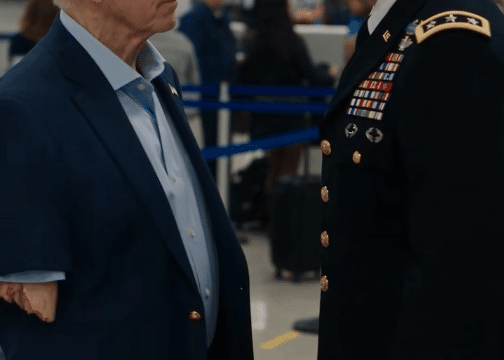
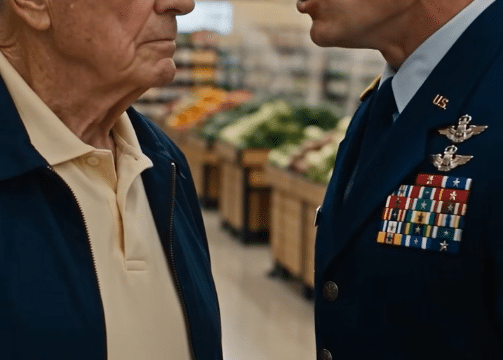
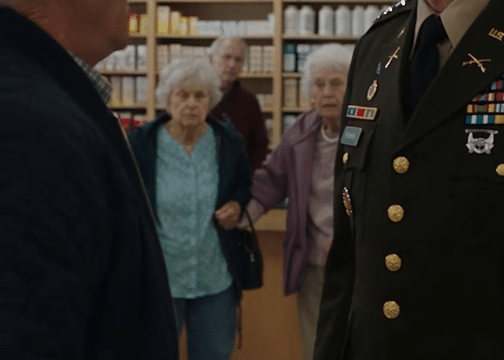
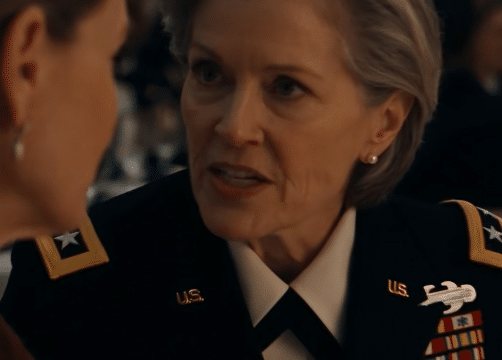
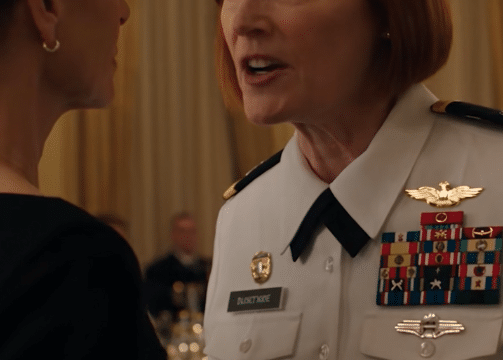
The camera never revealed the senior officer’s face. It showed only the decorated shoulders, the four-star insignia, the dense ribbon and medal rack, formal trousers, and polished boots moving across the museum floor.
The six officers followed in disciplined formation.
They did not stop to admire the exhibits. They did not pause to speak with the staff.
Their attention was fixed on the scene ahead.
The senior general looked first at Richard on the floor.
Then at the overturned wheelchair.
The Brigadier General turned toward the entrance. His expression shifted from irritation to confusion as he recognized the rank approaching him.
He straightened automatically.
For years, he had understood the military hierarchy as a ladder. He knew what a brigadier general represented, and he knew what stood above that rank.
Four stars.
The highest level of general officer authority.
But the arrival was not simply another senior officer entering a museum.
There was something in the urgency of the entourage that made the situation feel different. The six decorated officers moved with purpose, and none appeared interested in the Brigadier General’s presence.
They passed him.
Every one of them.
The senior general continued toward Richard.
The Brigadier General slowly turned, watching the entourage gather around the man he had just thrown to the floor.
His expression changed again.
This time, it was not confusion.
It was the first sign of fear.
Act IV
The senior general stopped beside Richard.
The six officers formed a quiet presence behind them. Their decorations and polished uniforms stood in sharp contrast to the overturned wheelchair and the elderly man lying on the floor.
The senior general’s face remained hidden.
No one needed to see it.
The four stars were enough to establish the authority in the room.
The Brigadier General stood stiffly, his own single star still visible. A moment earlier, he had treated his rank as permission to intimidate a disabled man.
Now that same insignia seemed to expose the distance between what he believed himself to be and what he had actually done.
The senior general looked at Richard.
Then at the wheelchair.
Then at the crowd of witnesses.
When the question came, it was direct.
“Who put him on that floor?”
Nobody answered immediately.
The museum seemed to hold its breath.
A woman near the display case lowered her phone slightly. The veteran in the service cap stared at the Brigadier General. One of the museum employees stood with a hand over her mouth.
The officer’s jaw tightened.
He looked at the senior general’s decorations, then at the six officers behind them. His posture became less rigid, almost as if his body had begun to understand the danger before his mind could accept it.
He could not claim that he had merely helped the elderly man.
The witnesses had seen the punch.
They had seen the kick.
They had seen the wheelchair overturn.
And the cameras had captured it all.
The senior general did not need to make an accusation. The question had already placed the responsibility exactly where it belonged.
Richard remained conscious on the floor.
His cheek was swollen. His breathing was painful, and one hand stayed close to his chest. Yet he did not reach toward the senior general or ask anyone to announce his identity.
He simply held the same steady gaze he had given the Brigadier General before the assault.
The younger officer looked at him again.
Something about the older man’s face now seemed familiar. Not because of the suit or the wheelchair, but because of the way the senior officers had moved toward him without hesitation.
The Brigadier General’s eyes widened.
He looked back at the four stars.
Then at Richard.
The pieces began to fall into place.
His mouth opened, but the words came out broken.
“Four-star…? Him?”
It was not really a question.
It was the sound of a man realizing that the person he had treated as insignificant had once stood at the very top of the institution he represented.
And that realization was only the beginning.
Act V
The museum remained silent.
The senior general did not reveal their face. The six officers stayed close, their presence unmistakable, while the visitors watched the Brigadier General struggle to process what he had just learned.
Richard Hale had once been a Four-Star General.
He had commanded at the highest levels of the Army, carried the weight of enormous decisions, and spent decades serving alongside men and women whose sacrifices were represented in the cases surrounding them.
He had not come to the museum to be recognized.
He had not worn a uniform or displayed his former rank. He had arrived in a charcoal suit, using a wheelchair, intending to spend a quiet afternoon among the history he had helped shape.
The Brigadier General had looked at him and seen only a disability.
He had mistaken the wheelchair for weakness and the old man’s calmness for disrespect. He had believed that a person who could not stand up quickly could be pushed around without consequence.
But Richard’s worth had never depended on whether he could walk.
It had never depended on the number of stars on his shoulders, either.
The senior general’s arrival did not give him dignity. It exposed the dignity he had possessed all along.
That was the part the Brigadier General seemed unable to understand.
He had expected the elderly man to apologize. He had expected him to lower his eyes. He had expected the uniform to settle the argument before anyone could question him.
Instead, the entire museum had watched him assault a disabled veteran in a place dedicated to honoring people who had served.
The medal cases stood behind him, filled with reminders of courage, sacrifice, and responsibility.
He had worn the uniform.
But he had failed to understand what it meant.
Richard remained on the floor, still in pain, but his eyes never left the officer who had attacked him. The senior general stood beside him, protective and controlled.
There was no need for a speech.
There was no need to announce Richard’s former command.
The question had already done what the Brigadier General’s rank could not undo.
It had made everyone look at the person on the floor—and see the man the officer had refused to recognize.
The museum had been built to preserve the memory of service.
That afternoon, it witnessed something else: a reminder that rank can be displayed on a uniform, but honor has to be carried by the person wearing it.
And the Brigadier General, standing beneath the medals of generations who had served before him, finally understood how badly he had failed.
Tighten the repetitive middle sectionsMake the officer’s consequences explicit