Act I
The wine splashed across her face before anyone could stop it.
A crystal glass shattered against the ballroom floor, sending fragments scattering beneath the elegantly dressed guests. A woman in a deep burgundy gown stood motionless, wine dripping from her dark-brown hair and staining the fabric across her shoulders.
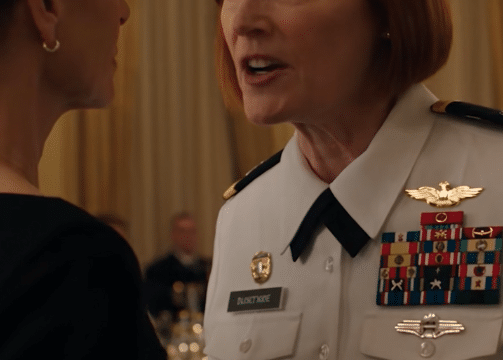
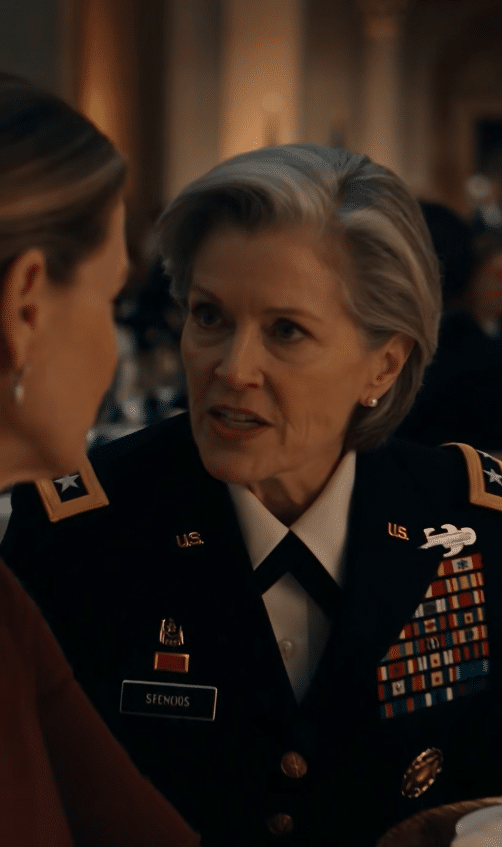
Standing in front of her was a fifty-six-year-old female major general with short silver hair, a decorated dress uniform, and an expression filled with contempt.
“Do you have any idea who I am?”
The question echoed through the nearby tables.
The woman in burgundy slowly lifted her eyes.
She wore simple diamond earrings, carried a small black clutch, and had the quiet composure of someone who had nothing to prove.
“Yes. That’s why this is disappointing.”
For a moment, the major general looked stunned.
She wasn’t accustomed to being answered that way, especially by someone who wasn’t wearing a uniform.
Her expression hardened.
“Never speak to a general like that.”
Then she threw the remaining wine across the woman’s face.
Before anyone could intervene, she slapped her hard across one cheek. The woman’s head turned with the impact, leaving her cheek red and swollen, with a faint trace of blood at the corner of her mouth.
The major general grabbed her by the hair.
With a violent pull, she dragged her off balance and threw her onto the polished ballroom floor.
A collective gasp swept through the room.
Several guests stood abruptly. One officer reached toward the scene, but stopped when the woman on the floor raised her head.
She was conscious.
Hurt, humiliated, and covered in wine.
But she wasn’t begging.
She looked directly at the woman who had attacked her, her expression cold and controlled.
The major general stood over her, seemingly proud of what she had done.
She believed she had just reminded an ordinary guest that military rank demanded respect.
What she didn’t realize was that the woman she had thrown onto the floor was the highest-ranking honored guest at the entire event.
And the announcement that would expose her mistake was only moments away.
Act II
The Military Foundation Awards Night was one of the most prestigious events on the annual military calendar.
The celebration was being held inside a museum ballroom beneath a suspended historic aircraft. Enormous chandeliers illuminated the polished floors, while a live orchestra performed beside the stage.
Senior military leaders, influential donors, decorated veterans, and distinguished guests occupied the formal round tables.
The event had been organized to recognize service, leadership, and the people whose contributions had strengthened the military over generations.
For Major General Eleanor Whitmore, the evening was another opportunity to demonstrate her importance.
At fifty-six, she had accumulated an impressive collection of medals and professional distinctions. Her silver hair was always perfectly styled, her uniform immaculate, and her expectations of everyone around her unusually demanding.
She believed strongly in hierarchy.
But somewhere along the way, her respect for the chain of command had turned into something much uglier.
She expected people to recognize her immediately.
She expected them to move aside when she approached.
And she considered disagreement from anyone outside her immediate circle an insult.
Officers who worked with her knew that even a small mistake could become a public confrontation.
Tonight, however, she had encountered someone who didn’t seem impressed by her reputation.
The woman in burgundy was Alexandra Reid.
At fifty, Alexandra had spent decades serving in positions where decisions carried consequences far beyond a single room.
Her career had been marked by difficult command assignments, strategic responsibilities, and the respect of officers who understood what genuine leadership required.
She had not come to the awards night to impress donors or display her authority.
She had come because the foundation was recognizing her contributions as its highest-ranking honored guest.
The organizers had prepared a special ceremonial welcome.
Her arrival had been coordinated with senior leadership, and the master of ceremonies was waiting for the appropriate moment to introduce her.
Alexandra had deliberately chosen an elegant evening gown rather than a military uniform.
She wanted to attend the event as a guest, not as someone who needed every person in the ballroom to know her rank.
That decision had created an unfortunate misunderstanding.
Eleanor had seen a woman without insignia and assumed she was unimportant.
She had mistaken quiet confidence for weakness.
And now, beneath a historic aircraft surrounded by people who understood military leadership, she had committed an act that could not be dismissed as a minor disagreement.
But Eleanor still didn’t know the full extent of her mistake.
Act III
Alexandra slowly pushed herself up from the floor.
Her burgundy gown was stained with wine, and one side of her hair had become disheveled. The swelling on her cheek was becoming more noticeable.
She reached into her clutch, took a napkin, and carefully wiped the faint trace of blood from the corner of her mouth.
Her hands remained steady.
Across the room, Eleanor adjusted the decorated sash on her uniform.
She looked around, apparently expecting someone to support her behavior.
Instead, she found dozens of uncomfortable faces.
A retired general near the front table had risen from his chair.
A senior officer standing beside the orchestra was watching Alexandra with growing concern.
Several donors had stopped talking entirely.
Nobody was laughing.
Nobody was congratulating Eleanor.
The major general interpreted the silence as hesitation rather than disapproval.
She believed the guests were simply afraid to get involved.
Then the master of ceremonies stepped onto the stage.
The orchestra fell silent.
A microphone was adjusted, and the host looked toward the audience.
“Ladies and gentlemen, please rise.”
Chairs moved backward as guests stood.
“Form two lines along the center aisle for tonight’s highest-ranking honored guest.”
The instruction immediately changed the atmosphere.
Officers began arranging themselves into two lines, leaving a clear passage through the center of the ballroom.
Eleanor straightened her shoulders.
She assumed another senior official was about to enter.
Perhaps someone whose arrival would attract even more attention than hers.
She glanced toward the stage with a confident expression.
Then the master of ceremonies announced the name.
“Please welcome General Alexandra Reid.”
For a moment, Eleanor didn’t understand.
The name traveled through the ballroom.
Several senior officers immediately stood straighter.
A distinguished veteran near the front recognized Alexandra and turned toward her with unmistakable respect.
Then the realization reached Eleanor.
Her eyes moved toward the woman in the burgundy dress.
The woman she had poured wine over.
The woman she had slapped.
The woman she had grabbed by the hair and thrown onto the floor.
Eleanor’s expression changed completely.
Because General Alexandra Reid wasn’t simply another senior officer.
She was a four-star general.
And she was the highest-ranking honored guest of the evening.
Act IV
Alexandra rose to her full height.
She carefully wiped the remaining wine from her face, adjusted the front of her burgundy gown, and straightened her posture.
Her cheek was still swollen.
The faint mark at the corner of her mouth remained visible.
But she carried herself with the same calm authority she had displayed before the assault.
The ballroom responded immediately.
Senior officers instinctively straightened their uniforms.
Some stood almost rigidly as Alexandra approached the ceremonial aisle.
Others watched her with expressions of concern, particularly after noticing the condition of her face.
The woman who had been lying on the floor only moments earlier was now the person everyone had risen to honor.
Eleanor stood frozen.
Her eyes widened as she began understanding the implications.
She had attacked a four-star general.
Not in a private room.
Not during some isolated misunderstanding.
But in front of senior military leadership, distinguished guests, donors, and foundation representatives.
The entire incident had unfolded beneath the suspended aircraft, in the middle of an event dedicated to honoring military service.
And there were witnesses everywhere.
Eleanor’s posture began to change.
Her shoulders lowered.
The confidence that had made her appear so imposing moments earlier was disappearing.
She glanced toward the officers standing near the aisle, hoping to find some indication that the situation might somehow be manageable.
But their expressions offered no comfort.
One senior commander looked directly at her, his face completely serious.
Another continued watching Alexandra.
Nobody appeared willing to pretend that the assault had not happened.
Alexandra took her first step toward the center aisle.
The officers parted slightly, creating a clear path.
She didn’t turn toward Eleanor.
She didn’t demand an apology.
She didn’t threaten anyone.
She simply continued walking.
That quiet response made the contrast even more powerful.
Eleanor had used her rank to intimidate someone she believed was beneath her.
Alexandra carried four stars without needing to use them to intimidate anyone.
And now the entire ballroom could see the difference.
Act V
Eleanor’s face had gone pale.
She stared at Alexandra as the general approached the ceremonial aisle.
The realization seemed almost impossible for her to accept.
Four stars.
The highest-ranking honored guest.
The woman she had just assaulted.
Eleanor’s eyes moved toward the wine-stained burgundy gown and then toward Alexandra’s injured cheek.
She seemed to remember every second of the confrontation.
The glass breaking.
The slap.
The hair grab.
The fall.
There was no way to erase those moments.
The guests had seen everything.
And now they knew exactly who had been standing on the receiving end of her behavior.
Alexandra entered the center aisle.
The senior officers on either side stood respectfully as she passed.
Her expression remained composed, even though the pain on her face was impossible to hide.
She had not needed to reveal her identity herself.
The announcement had done it.
Eleanor opened her mouth.
For the first time that evening, the woman who had demanded that everyone recognize her rank seemed unable to find a single commanding word.
She stared at Alexandra, her confidence completely shattered.
Then she whispered:
“Four-star Reid…? No way…”
Her voice sounded almost unrecognizable.
The ballroom remained silent.
Beneath the historic aircraft, surrounded by the people who had gathered to celebrate military service, Eleanor was forced to confront the consequences of her own behavior.
She had believed that respect belonged to whoever wore the most impressive uniform.
But Alexandra had demonstrated something far more important.
A person’s dignity should never depend on their position, their clothing, or the number of stars attached to their shoulders.
And sometimes, the most powerful lesson about military leadership comes from the person who refuses to use rank as a weapon.
Eleanor had demanded respect because she was a general. Alexandra had earned it long before anyone announced her name.
Tighten the repetitive middle sectionsAdd Alexandra’s immediate legal response