Act I
“Put it back on her shoulder.”
Captain Derek Walsh’s voice cut through the storm.
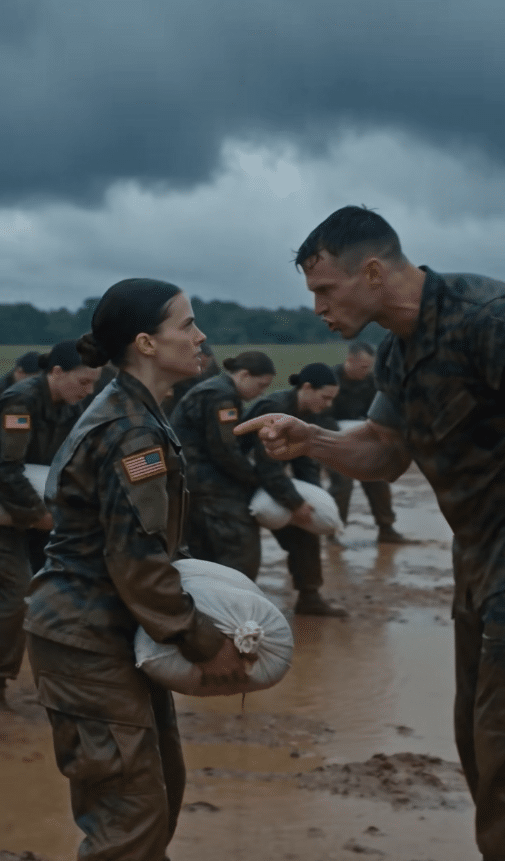
A young female officer stood knee-deep in muddy water, rain running down her face and soaking through her OCP uniform. Her black hair was pulled into a tight low bun, and her boots were buried in the flooded training lane.
At twenty-five, First Lieutenant Emily Carter had already learned that leadership sometimes meant standing between someone vulnerable and someone more powerful.
That was exactly what she was doing now.
A trainee several feet away was struggling to remain upright. The young woman had injured her shoulder during the march, and the heavy sandbag she had been carrying had become too much for her.
Emily had taken the bag from her.
Captain Walsh didn’t approve.
“She’s already injured,” Emily replied.
Her tone was controlled, but there was no hesitation in her voice.
Walsh stared at her as rain ran down the collar of his uniform.
He was thirty-one, athletic, and fiercely protective of his reputation as one of the toughest training officers on the installation. He believed exhaustion revealed character. He believed discomfort built discipline. And he had little patience for anyone who questioned his methods.
To him, Emily’s decision was an act of defiance.
He stepped forward and ripped the sandbag from her hands.
It landed in the mud with a heavy splash, sending dirty water across her uniform.
Then he struck her hard across the cheek.
Her head turned with the impact.
Before she could regain her balance, he drove a kick into her stomach.
Emily folded forward, lost her breath, and fell into the flooded lane.
Around them, the other trainees froze.
Rain hammered the ground.
Walsh looked down at her.
“Daddy can’t save you on my course.”
He said it with a cruel smile.
He thought he had humiliated an inexperienced young officer who had forgotten her place.
But Emily wasn’t looking at him with fear.
She was trying to catch her breath, her cheek reddened and swelling, a faint trace of blood at the corner of her mouth.
Even from the mud, her eyes remained fixed on the injured trainee.
And Walsh had just made a mistake that would follow him far beyond that training field.
Because someone had witnessed what he had done.
Someone who knew exactly who Emily was.
And that person was already on the way.
Act II
Emily Carter had never wanted special treatment.
That was one reason she had kept her family background private throughout her military career.
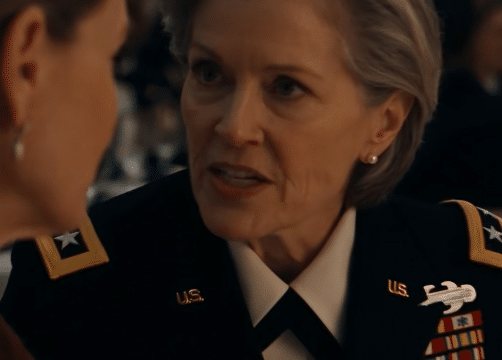
Her father was a Lieutenant General, one of the senior officers in the United States military. His career had involved major commands, difficult assignments, and responsibilities that most people would never fully understand.
But at home, he was simply Dad.
He had taught Emily to take responsibility for her decisions, respect the people serving beside her, and never use a family name as a shortcut to success.
When she decided to join the Army, he had supported her.
He had also made one thing clear.
She would have to earn her own reputation.
Emily took that seriously.
She attended the same training, completed the same evaluations, and accepted the same hardships as everyone else. She rarely discussed her father, even when people asked about her family.
Some might have considered that unnecessary.
Emily considered it freedom.
She wanted colleagues to judge her by her judgment, her discipline, and the way she treated the people under her authority.
That morning’s endurance march was supposed to test a group of trainees under difficult field conditions.
Heavy rain had flooded sections of the course. Sandbags had become heavier with water, and the muddy ground made every step more demanding.
Emily had noticed one trainee struggling well before the confrontation.
The young soldier had been favoring one shoulder and losing balance whenever the ground dipped beneath her boots.
Emily knew the difference between ordinary fatigue and a potential injury.
She had quietly taken the sandbag and instructed the trainee to step aside for assessment.
Captain Walsh saw it as an opportunity to make an example of her.
He had developed a reputation for demanding unquestioning obedience. Officers who challenged him often found themselves assigned extra duties or criticized in front of their units.
Some trainees feared him.
Others had learned to keep their heads down.
Emily knew that discipline mattered.
But she also knew that discipline without judgment could become dangerous.
And when she refused to put the sandbag back on an injured soldier’s shoulder, Walsh decided that her refusal would not go unanswered.
He had no idea that the young lieutenant had spent years preparing for precisely this kind of responsibility.
He only saw someone refusing to obey.
And that blindness was about to cost him everything he thought he understood about command.
Act III
Emily lay in the mud for a moment, struggling to draw a full breath.
The rain struck her face.
Her cheek was already swelling, and her stomach tightened painfully after the kick.
The trainees stood motionless.
Nobody wanted to become Walsh’s next target.
But Emily wasn’t thinking about her own humiliation.
She looked toward the injured trainee.
The young soldier was still standing near the edge of the flooded lane, visibly frightened.
Emily slowly pushed herself upright.
Her breathing was guarded, and one hand rested briefly against her stomach. She wiped the faint trace of blood from the corner of her mouth.
Then she looked at the trainee again.
That small gesture said more about her character than anything she could have said aloud.
Walsh watched her.
He expected anger.
He expected tears.
He expected her to challenge him so he could accuse her of insubordination.
Instead, she remained silent.
That irritated him even more.
He had built his authority around the belief that everyone eventually submitted.
He had mistaken Emily’s restraint for weakness.
What he didn’t understand was that she had spent her entire career learning when to speak, when to act, and when to let someone else’s conduct become impossible to deny.
Several trainees had witnessed the assault.
An instructor near the course entrance had seen the kick.
A medic was already moving toward the injured soldier, who was now being guided away from the flooded lane.
The incident was no longer a disagreement over training standards.
It was an assault carried out by an officer against another officer in front of witnesses.
Walsh seemed unconcerned.
He adjusted his soaked uniform and looked toward the rest of the formation as though expecting them to resume the march.
Then an unfamiliar engine sound interrupted the rain.
A dark command vehicle had stopped beyond the training lane.
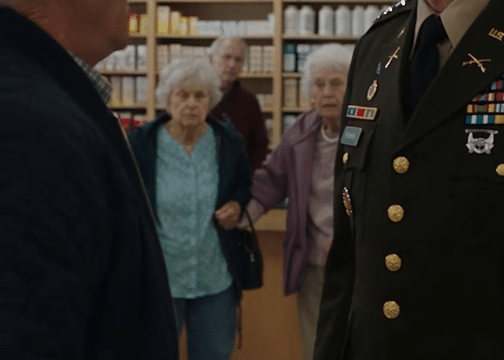
The driver remained near the vehicle as a senior figure stepped out into the storm.
The trainees began turning their heads.
Walsh frowned.
He recognized the unmistakable presence of senior command, but he couldn’t understand why such an officer would appear at an endurance course without warning.
The figure walked toward the flooded lane.
Emily saw him.
For the first time since the assault, her expression softened.
Walsh noticed.
And suddenly, the confidence he had worn so comfortably began to slip.
Act IV
The senior officer crossed the muddy ground without hesitation.
Rain ran over his uniform as he approached the training lane.
The trainees straightened.
The instructors fell silent.
Even Walsh seemed to remember that he was standing in front of someone whose authority extended far beyond his own command.
The officer stopped several feet from him.
His eyes moved briefly toward Emily.
He saw the swelling on her cheek.
He saw the mud covering her uniform.
He saw the way she was protecting her stomach as she tried to stand upright.
Then he looked at Walsh.
His expression was controlled, but there was no mistaking the anger beneath it.
“Captain… get away from my daughter.”
The words landed harder than the storm.
For a moment, nobody moved.
Emily said nothing.
She did not rush toward the officer or attempt to explain herself.
The senior figure remained beside her, his attention fixed on the captain.
Walsh stared.
His mind seemed to struggle with what he had just heard.
My daughter.
He looked at Emily.
Then back at the Lieutenant General.
The connection became painfully clear.
The young officer he had slapped and kicked into the mud was the daughter of a Lieutenant General.
Not a distant relative.
Not someone with a vague connection to military leadership.
His daughter.
The same family connection Walsh had mocked only moments earlier.
He remembered his own words.
“Daddy can’t save you on my course.”
Now the person he had used to threaten Emily was standing directly in front of him.
And the man who had arrived was not there to negotiate.
Walsh’s posture changed.
His shoulders lowered.
His jaw tightened.
The trainees watched in complete silence.
For the first time, they were seeing something they had rarely witnessed on that course.
Captain Walsh had run out of confidence.
But the Lieutenant General did not need to shout.
He did not need to threaten.
He had seen the injuries, the witnesses, and the condition of the training lane.
The facts were already beginning to speak for themselves.
Emily remained beside him, soaked and muddy, but composed.
She had not asked her father to protect her from ordinary training.
She had not used his rank to avoid hardship.
She had simply refused to let an injured soldier be pushed beyond a safe limit.
And now Walsh was discovering the difference between a demanding officer and an abusive one.
Act V
The rain continued falling over the flooded course.
The Lieutenant General stood beside his daughter.
Walsh looked from the senior officer to Emily, trying to reconcile the scene with the authority he had believed he possessed only minutes earlier.
His face had lost its color.
He had thought Emily was an easy target.
A young lieutenant without powerful connections.
Someone who could be embarrassed in front of the formation and forced back into obedience.
But he had misjudged her completely.
Emily had not needed to reveal her father’s identity to defend her decision.
She had acted because another soldier was injured.
She had accepted the consequences of speaking up.
And even after being assaulted, she had kept her attention on the people who depended on her.
That was leadership.
Walsh had confused fear with respect.
He had mistaken obedience for trust.
And in trying to prove that he controlled the course, he had shown everyone exactly why he should not be trusted with that responsibility.
The trainees stood in the rain, watching the confrontation.
Some looked toward Emily with concern.
Others looked at Walsh with a mixture of disbelief and anger.
The injured trainee was being escorted toward medical evaluation.
The sandbag remained abandoned in the mud.
It was a small, ordinary object, but it had become the center of an incident that could no longer be dismissed as a training disagreement.
The Lieutenant General remained beside Emily.
He did not speak over her.
He did not turn the moment into a display of family privilege.
Instead, he allowed the witnesses and the evidence to establish what had happened.
A formal investigation would follow.
The assault, the unsafe training practices, and the captain’s conduct toward his subordinates would all have to be examined. Any disciplinary action would depend on the findings, not on the identity of the victim’s father.
But Walsh understood something before the investigation even began.
His career would never look the same.
He had spent months teaching trainees that strength meant enduring pain without complaint.
Yet the young lieutenant he had attacked had demonstrated something far more difficult.
She had protected someone weaker than herself, even when doing so made her the target.
And when the senior officer finally stepped beside her, she did not look triumphant.
She looked relieved that the injured soldier was safe.
Walsh’s lips parted.
He stared at Emily as the meaning of the revelation finally settled in.
“Your… daughter?”
For the first time, the captain had no command left to give.
And the rain kept falling over the course where his authority had finally collapsed.