Act I
“Teach her how to sit in public.”
The words came from a man in an expensive sport coat, his voice sharp enough to silence several tables on the restaurant patio.
A seventy-year-old grandfather sat beside his young granddaughter. His short silver hair was neatly combed, and his charcoal jacket looked modest compared with the expensive clothes worn by the military families around them.
The little girl had accidentally bumped her chair while trying to reach something on the table. A glass had nearly tipped over, attracting the attention of the man sitting nearby.
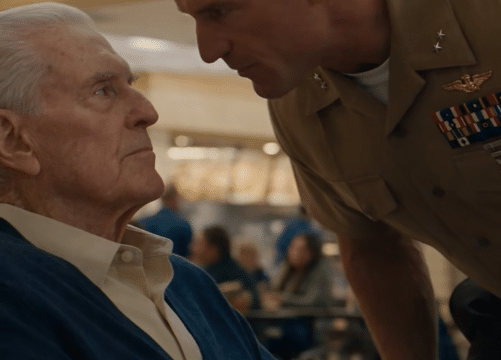
He was Major General Richard Lawson, a fifty-three-year-old officer accustomed to being treated like the most important person in any room.
The grandfather looked at him calmly.
“She apologized.”
It should have ended there.
The child had already apologized, and the grandfather had gently corrected her.
But Lawson wasn’t interested in an apology.
He believed that his family’s reputation deserved special treatment, and he particularly disliked anyone who appeared unwilling to acknowledge his authority.
He picked up his glass of iced tea.
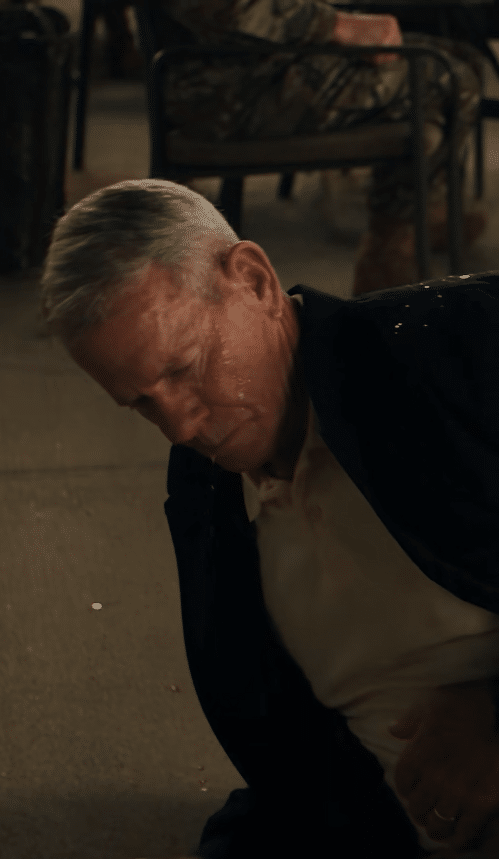
Then he threw its contents directly into the old man’s face.
The cup hit the patio floor.
Before anyone could react, Lawson drove a powerful punch into the grandfather’s cheek.
His head snapped sideways.
Then the officer delivered a hard kick to his stomach, forcing him to fold forward and fall beside his chair.
The little girl screamed.
A woman at the next table covered her mouth. Several military families stood frozen, watching an active-duty general attack an elderly man in front of a child.
The grandfather slowly raised his head.
His cheek was swelling, and a faint trace of blood appeared at the corner of his mouth.
Lawson looked down at him.
“You don’t embarrass a general’s family and walk away.”
He seemed proud of himself.
He believed the old man had finally learned his place.
But Lawson had no idea who was sitting in front of him.
And the man he had just attacked was about to make one phone call that would turn an ordinary evening into the worst night of his military career.
Act II
His name was Robert Whitmore.
He was seventy years old, retired, and generally uninterested in the complicated politics of military life.
But there was a time when Robert had worn a uniform himself.
He had served for decades, eventually retiring as a full General.
His career had taken him through difficult assignments, demanding command responsibilities, and years of decisions that affected thousands of people.
He had learned that authority was not something to display.
It was something to carry responsibly.
After retirement, Robert had deliberately stepped away from military attention.
He spent his time with his family, enjoyed quiet evenings, and occasionally took his granddaughter, Sophie, out for dinner.
Sophie was eight years old.
She adored her grandfather.
To her, he wasn’t a decorated military veteran or an important former commander. He was the man who told funny stories, helped her with homework, and always ordered an extra dessert.
That evening, Robert had taken her to a popular restaurant patio near the military base.
The place was filled with families, officers, and civilians enjoying dinner beneath the outdoor heaters.
It should have been a pleasant evening.
But Richard Lawson had arrived with his own family.
Lawson was a Major General who enjoyed the privileges of his position. He was particularly sensitive about how people treated his family.
He expected restaurant staff to recognize him.
He expected other officers to make room for him.
And he expected ordinary civilians to understand that he was someone they should never challenge.
When Sophie accidentally disturbed his table, he saw an opportunity to assert himself.
Robert had calmly explained that she had already apologized.
That simple response infuriated Lawson.
He interpreted it as disrespect.
What made the situation even more complicated was that Robert had never introduced himself.
He hadn’t mentioned his military career.
He hadn’t displayed any medals or photographs.
He had simply wanted to enjoy dinner with his granddaughter.
Now, sitting beside his fallen chair, Robert looked at Sophie.
The little girl was frightened.
He knew she would remember this moment for a long time.
And he refused to let her believe that cruelty was something people had to accept simply because the person committing it wore a uniform.
He slowly reached into his jacket.
His phone was still there.
And he knew exactly whom to call.
Act III
Robert carefully steadied himself beside the chair.
His stomach hurt, and his cheek throbbed, but he remained conscious and composed.
Sophie moved toward him.
“Grandpa…”
He gently raised one hand, reassuring her that he was still there.
Then he wiped the faint trace of blood from the corner of his mouth.
Lawson watched with an expression of irritation.
He seemed to expect the old man to apologize for causing a scene.
Instead, Robert unlocked his phone.
He made a call.
His voice was quiet.
“South patio. Five minutes.”
Then he ended it.
Lawson stared at him.
For a second, he seemed uncertain about what the call meant.
Then he laughed.
“Call your lawyer.”
He turned toward the surrounding tables as though inviting everyone to recognize his authority.
But the reaction was not what he expected.
Nobody laughed.
Several guests were staring at him in disbelief.
A retired military officer at a nearby table had witnessed the entire incident. He looked at Robert, then at Lawson, with an expression that suggested he understood the seriousness of what had just happened.
One restaurant employee had already contacted security.
Another guest quietly began documenting the scene.
Robert said nothing more.
He simply helped Sophie move beside him and waited.
Lawson adjusted his sport coat.
He still believed the elderly man was bluffing.
He had no idea that Robert’s phone call had gone to someone who would recognize those three words immediately.
Because Robert had not called a lawyer.
He had contacted someone who was already nearby.
Someone who held the highest military rank in the country.
Someone who happened to be his son.
Outside the restaurant, a valet suddenly looked toward the road.
A pair of headlights appeared.
Then another.
And within moments, the sound of several powerful engines filled the parking area.
Lawson turned toward the railing.
His expression changed.
A command motorcade was approaching.
Act IV
The first black SUV stopped outside the patio.
Then a second vehicle pulled in behind it.
The valet stepped aside as military personnel began exiting.
The restaurant’s conversations faded.
A moment later, a senior military figure stepped out of the lead vehicle.
The camera revealed only his uniform.
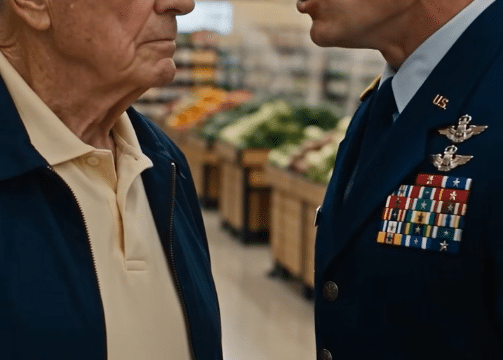
Four stars covered his shoulders.
Decorations filled his chest.
His polished boots touched the pavement as he moved toward the restaurant entrance.
His face remained hidden.
The personnel accompanying him maintained a disciplined formation.
Lawson recognized the significance immediately.
He was a Major General himself.
He knew exactly what four stars represented.
But he couldn’t understand why someone of that rank would arrive at a restaurant patio without prior announcement.
Then he noticed where the senior figure was heading.
Not toward the restaurant manager.
Not toward the other officers.
Toward Robert.
The old man was already standing beside Sophie.
His charcoal jacket was soaked with iced tea, and his cheek was swollen.
But his expression remained steady.
Lawson looked at him.
Then back at the approaching figure.
Something began to trouble him.
He had seen the senior general’s photograph before.
At military conferences.
In official command publications.
During major ceremonies.
The name was familiar.
Very familiar.
Then he remembered a detail that made his stomach tighten.
The Four-Star General had occasionally been photographed with his family.
There was an older man who appeared beside him at certain private ceremonies.
A man whose face bore a striking resemblance to the grandfather now standing on the patio.
Lawson looked again.
The realization was becoming impossible to ignore.
The approaching general wasn’t there because of a routine military matter.
He was coming for Robert.
And the man Lawson had just kicked to the ground might be the father of the most powerful military officer he would ever encounter.
Act V
The senior general walked through the patio entrance.
His aides followed at a respectful distance.
The surrounding officers straightened immediately.
Robert stood beside his granddaughter, waiting.
He didn’t wave.
He didn’t make a scene.
He simply looked toward the approaching figure.
Lawson’s confidence had completely disappeared.
His eyes moved from the four-star insignia to Robert’s face.
Then toward Sophie.
The little girl was no longer crying.
She seemed relieved.
The general continued toward them.
And suddenly Lawson understood the family connection.
Robert Whitmore was not merely a retired officer.
He was the father of the Four-Star General now approaching him.
The grandfather he had attacked was the senior commander’s father.
The child he had frightened was the commander’s granddaughter.
Lawson’s mouth fell slightly open.
He had spent the evening insisting that nobody should embarrass a general’s family.
Now he was discovering that he had assaulted the father of a general whose authority stood above his own.
The man who had demanded respect from everyone else was suddenly unable to look Robert in the eye.
His face drained of color.
His jaw loosened.
For the first time that evening, he seemed genuinely afraid of what he had done.
He stared at the approaching figure and finally managed to speak.
“Why is he coming for you…?”
Nobody answered.
Robert simply rested a hand on Sophie’s shoulder.
He had not called his son to arrange revenge.
He had called because the situation was serious, because witnesses needed to be heard, and because his granddaughter deserved to know that violence and intimidation were never acceptable forms of leadership.
Lawson had wanted to prove that his family deserved special treatment.
Instead, he had exposed exactly what kind of man he was when he believed nobody could challenge him.
And the most painful part was that Sophie had witnessed everything.
She had seen a decorated officer hurt her grandfather.
But she would also remember something else.
Her grandfather had never needed to shout, threaten, or boast about his identity.
He had simply stood his ground.
Lawson thought he was teaching an old man his place. Instead, he was about to learn that true authority doesn’t need to humiliate anyone to be respected.