Act I
The wine hit her face before anyone in the ballroom could react.
A few drops splashed across the silver-haired woman’s pearl necklace. The rest soaked the front of her dark-blue evening dress, staining the fabric she had carefully chosen for the military charity dinner.
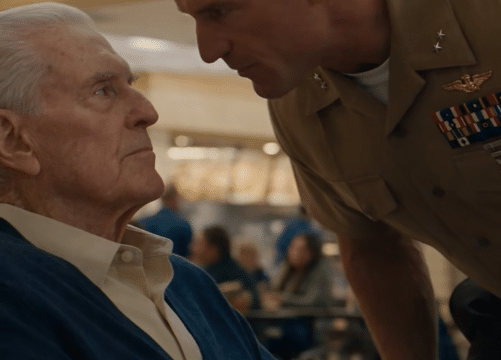
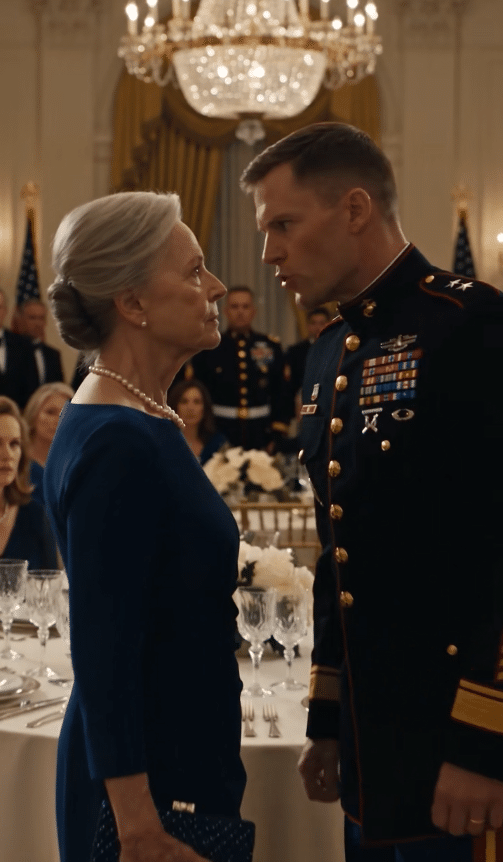
Standing in front of her was a full-dress-uniformed colonel, his polished shoes reflecting the chandelier lights. His expression was not one of embarrassment or regret. It was irritation, as though the elderly woman had personally offended him by refusing to look frightened.
“Your granddaughter just ruined her dress.”
The woman glanced toward the little pool of water near the table. Her granddaughter stood nearby, visibly shaken, holding a napkin in both hands.
The grandmother remained composed.
“It’s water. I’ll have it cleaned.”
It was a simple answer. A reasonable answer. But the colonel seemed to take her calmness as a challenge.
Around them, wealthy donors, military officers, and their spouses began turning away from their conversations. A few recognized that something was wrong, but nobody seemed willing to become involved.
The colonel reached for a wineglass.
Before the grandmother could move, he threw its contents directly into her face and across her dress. Then he hurled the empty glass onto the marble floor.
It shattered.
The sound cut through the ballroom.
And then came the slap.
His hand struck her cheek with such force that her head turned sharply to one side. A moment later, his fist drove into her stomach.
She folded forward, struggling to catch her breath, and dropped to one knee beside a chair.
Her granddaughter gasped.
Several guests stood frozen. One woman covered her mouth. A senior officer at a nearby table started to rise, but the colonel’s commanding presence seemed to paralyze the room.
The grandmother slowly lifted her head.
Her cheek was already reddening, and a faint trace of blood appeared at the corner of her mouth.
The colonel looked down at her with open contempt.
“You and your family don’t belong near command tables.”
He expected tears.
He expected apologies.
Most importantly, he expected everyone watching to understand that he was the most powerful person in that corner of the ballroom.
But he had made one terrible mistake.
He had confused an older woman’s silence with weakness.
And he had absolutely no idea whose family he had just insulted.
Act II
For years, the grandmother had learned that real authority rarely needed to announce itself.
Her name was Eleanor Hayes.
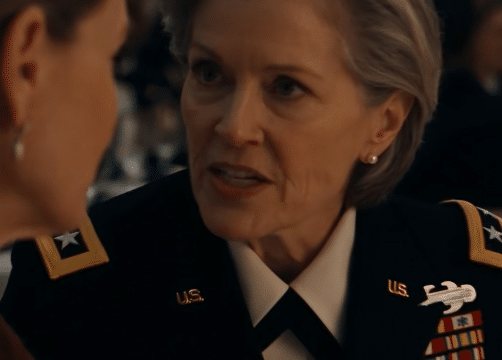
At sixty-seven, Eleanor had silver hair, a quiet smile, and the kind of presence that made people lower their voices without knowing why.
To strangers, she looked like an ordinary grandmother attending a charity dinner with her granddaughter.
She never discussed her military career unless someone specifically asked. She did not introduce herself with impressive titles, and she certainly did not expect special treatment.
But there had been a time when entire command rooms waited for Eleanor to finish speaking before anyone dared respond.
She had served for decades, rising through an institution where mistakes carried consequences far beyond embarrassment. She had commanded soldiers, navigated difficult operations, and watched promising careers collapse because someone believed their rank placed them above accountability.
Eventually, she retired as a Major General.
She had earned every star.
Her granddaughter, Emily, had grown up hearing stories about discipline, sacrifice, and the importance of treating people with dignity regardless of their position.
Eleanor had never taught her that a uniform made someone superior.
She had taught her that a uniform created responsibility.
That evening, Emily had accidentally spilled a little water near her dress while reaching for a napkin. It was an innocent mistake, the sort of thing that happened at crowded dinners.
But Colonel Richard Mercer had seen an opportunity.
Mercer was forty-seven, ambitious, and obsessed with appearances. He loved the attention that came with his uniform, particularly when surrounded by wealthy donors and influential officers.
He had spent years cultivating an image of absolute confidence.
Behind that polished exterior, however, was a man terrified of losing his position.
He knew how to impress people at formal events. He knew which officers to flatter, which donors to approach, and which subordinates to intimidate.
What he did not know was how to recognize genuine leadership.
When Eleanor calmly offered to have the dress cleaned, Mercer interpreted her response as disrespect.
He wanted an apology.
He wanted her to lower her eyes.
Instead, she looked directly at him.
And that was when his temper finally took control.
Now, as Eleanor struggled to regain her breath, Mercer straightened his uniform and glanced around the room.
He seemed satisfied.
He believed he had just reminded everyone who mattered.
But Eleanor was already reaching for her small navy clutch.
Inside it was a phone.
And one call would change the entire evening.
Act III
Eleanor slowly steadied herself against the chair.
Her breathing was still uncomfortable. Her cheek throbbed, and the wine dripped from the ends of her silver hair.
Emily moved toward her grandmother, but Eleanor gently raised one hand.
Not yet.
She took a small napkin and carefully wiped the faint trace of blood from the corner of her mouth.
There was no shouting.
No threat.
No dramatic speech about who she used to be.
She simply opened her phone.
Mercer watched her with a mocking expression.
“Who are you calling?” he asked, although he sounded more amused than concerned.
Eleanor did not answer.
She made the call and delivered only three short sentences.
“Grand Ballroom. East doors. Four minutes.”
Then she ended the call.
For a moment, the ballroom was silent.
Mercer stared at her.
Perhaps he expected her to call hotel security. Perhaps he thought she was contacting a relative who would arrive to argue on her behalf.
Whatever he imagined, it clearly did not concern him.
He gave a short, dismissive laugh.
“Bring your whole family.”
A few guests exchanged uncomfortable glances.
Emily looked at her grandmother, confused but trusting.
She had heard stories about Eleanor’s military past, but she had never seen her grandmother behave this way.
There was something different in her expression now.
The pain was still there, but the fear was gone.
Eleanor slipped the phone back into her clutch.
She did not look toward the entrance.
She did not ask anyone to help her stand.
She simply waited.
Mercer interpreted the silence as surrender. He turned toward a group of donors and adjusted the front of his uniform, seemingly eager to return to the evening as though nothing significant had happened.
But the atmosphere had changed.
Conversations had stopped.
People were no longer watching Eleanor with pity.
They were watching the colonel.
One guest quietly lowered his phone after recording the final moments of the assault. Another approached a senior event organizer and whispered something into his ear.
Mercer noticed none of it.
He was still convinced that the woman on one knee beside the chair had no power to challenge him.
Then, somewhere beyond the ballroom doors, the sound of approaching footsteps began to grow louder.
Four minutes had passed.
And the east entrance was about to open.
Act IV
The ballroom doors swung open.
Two military aides entered first.
Their expressions were serious, their movements disciplined. They did not stop to greet the donors or acknowledge the confused guests.
They simply walked forward.
Then the senior figure appeared behind them.
The camera of attention seemed to shift across the room.
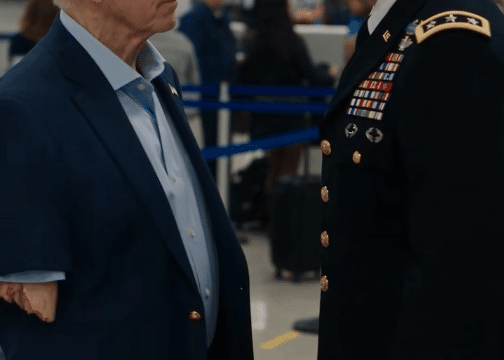
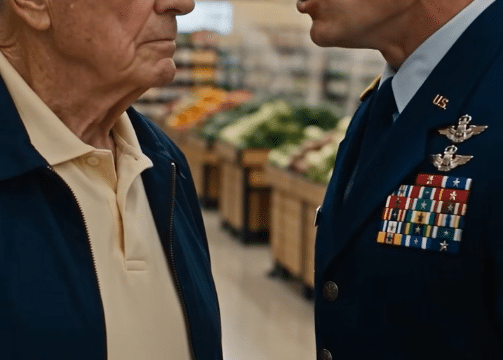
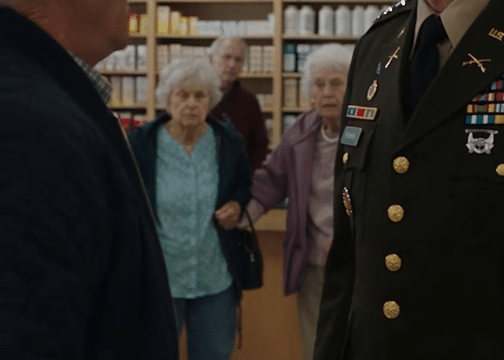
A decorated general entered, his shoulders covered with stars and his uniform carrying rows of medals and ribbons. His formal trousers fell perfectly over polished military shoes.
He was surrounded by an unmistakable atmosphere of authority.
Nobody needed an introduction to understand that this was not an ordinary guest.
The room began to stir.
Several officers immediately straightened. A few senior commanders exchanged surprised looks before turning toward the entrance.
Mercer’s smile slowly disappeared.
At first, he seemed uncertain.
Then he looked more closely at the approaching figure.
The general continued walking.
The aides maintained their positions, moving with the quiet precision of people accustomed to operating around the highest levels of command.
The general did not look toward the donors.
He did not acknowledge the colonel.
His destination was clear.
Eleanor.
Mercer followed the direction of the general’s movement with his eyes.
Then he looked back at the grandmother.
Something changed in his expression.
The color began to drain from his face.
He looked at Eleanor’s silver hair, her pearl necklace, and the dark-blue dress stained with wine.
Then he looked at the decorated shoulders approaching her.
A realization was forming.
But it was the granddaughter who made the final connection.
Emily stepped closer to Eleanor.
The general was not simply responding to an incident at a charity dinner.
He was coming for his family.
Eleanor slowly rose from beside the chair. Her movements were careful, but her posture remained straight.
For the first time that evening, Mercer seemed unable to decide what to do with his hands.
His fingers tightened.
His jaw loosened.
The same man who had struck an elderly woman in front of dozens of witnesses was now standing motionless, unable to look away from the approaching senior officer.
And then he noticed something that made his stomach drop.
The general was not walking toward the colonel.
He was walking toward Eleanor and Emily.
The family Mercer had just declared unworthy of standing near command tables was apparently the very family this decorated officer had come to see.
But the worst part was still coming.
Because Mercer was beginning to understand that the woman he had assaulted was not merely connected to someone important.
She was someone whose name might carry more weight in that room than his entire career.
Act V
Mercer stared at the approaching general.
His breathing became shallow.
The ballroom was so quiet that the soft sound of polished shoes against marble seemed unusually loud.
Eleanor stood beside her granddaughter, her cheek swollen and her dress stained.
She did not smile.
She did not gloat.
She simply watched the man approaching, as though this were an appointment she had known would happen long before the colonel ever picked up that wineglass.
Mercer looked from the general to Eleanor again.
His mind was racing through possibilities.
Had he misunderstood her identity?
Had he overlooked a family connection?
Had someone warned the command about what he had done?
Then the final piece fell into place.
The general was Emily’s father.
Eleanor’s son.
A Lieutenant General.
The realization hit him harder than any reprimand he could imagine.
His eyes widened.
His mouth opened, but for a moment no words came out.
The camera moved closer, isolating his face against the blurred lights of the ballroom.
The arrogance was gone.
The confidence was gone.
All that remained was the terrible understanding that he had publicly assaulted the mother of a senior officer, in front of witnesses, at an event attended by the very people whose trust he had spent years trying to earn.
He finally managed to speak.
“Your son is… him?”
The question hung in the air.
But the real story was no longer about the general’s arrival.
It was about what would happen next.
Because Eleanor had not called her son to threaten Mercer, demand revenge, or turn the evening into a display of family power.
She had called because she knew the truth needed witnesses.
The shattered glass was still on the floor.
The wine stain remained across her dress.
And dozens of people had seen exactly what the colonel had done.
For years, Mercer had believed that authority meant being feared.
That evening, he was about to discover the difference between rank and honor.
Eleanor Hayes had spent a lifetime serving her country.
She had never needed to humiliate another person to prove her worth.
And now, standing in front of the granddaughter she had raised with those same values, she had no intention of allowing a decorated uniform to become an excuse for cruelty.
The colonel had wanted the entire ballroom to know who belonged near command tables.
Instead, the entire ballroom had witnessed something far more important.
The woman he thought had no power was the one person he should never have underestimated.