Act I
“You’re slowing my course.”
Captain Ryan Mitchell snapped the words at the woman standing beside the obstacle lane, his stopwatch swinging against his chest. Around him, soldiers scrambled over wooden barriers, dragged themselves through sand, and raced toward the finish line while he barked times and demanded faster movement.
But the woman wasn’t watching the clock.
She was watching a young soldier clutch his left hand.
He had stopped halfway through the course, his face tight with discomfort. His fingers barely moved, and he kept shaking his hand as though he could force the feeling back into it. Other soldiers rushed past him, afraid that falling behind would draw the Captain’s attention.
The woman stepped onto the edge of the lane and raised a hand, signaling the soldier to stop.
Ryan turned sharply.
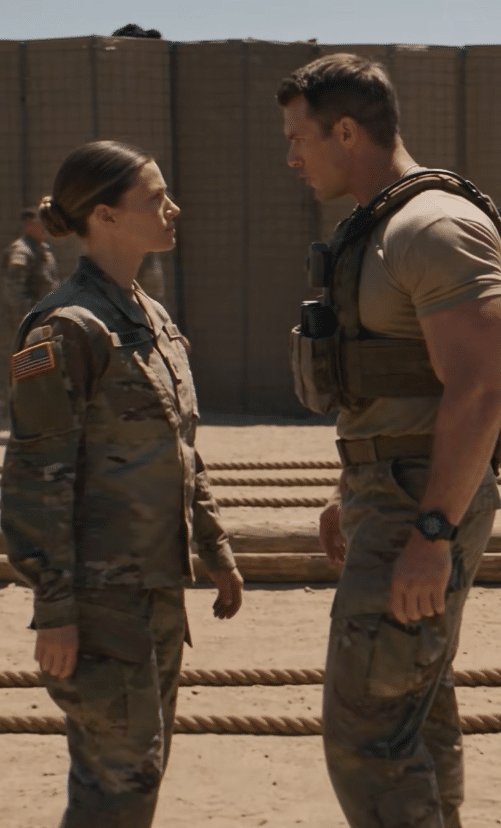
She wore a standard OCP field uniform, tan boots, and her dark-blonde hair was secured in a low bun. There was nothing conspicuous about her appearance. No visible display of rank, no entourage, no polished insignia that demanded attention.
She looked like someone who had come to observe the exercise.
Ryan treated her like someone who had come to interfere.
“He can’t feel his left hand,” she said.
Her tone was calm and factual. She wasn’t arguing about the schedule or challenging his authority. She was identifying a potential medical problem that needed attention before the soldier continued climbing, gripping ropes, or throwing himself over another barrier.
Ryan glanced at the young soldier.
Then he looked at his stopwatch.
The exercise was running behind schedule. Senior personnel were expected to review the results, and Ryan had spent the morning insisting that his unit would post the best times on the installation.
A soldier who stopped was a problem.
A soldier who stopped because someone else told him to was, in Ryan’s mind, an insult.
“Move him off the course if you have to,” he muttered, then turned back toward the woman. “But you don’t stop my run.”
She kept her eyes on the injured soldier.
Ryan stepped closer.
He was thirty, athletic, and proud of the reputation he had built as a demanding officer. He believed pressure produced excellence, that discomfort separated the strong from the weak, and that anyone who questioned his methods was undermining the entire unit.
The woman had no interest in his philosophy.
She was concerned that a soldier who could not feel his hand might be injured, and that pushing him through a timed obstacle course could make the situation worse.
Ryan saw something different.
He saw someone who had refused to obey him in front of his soldiers.
And he decided to make an example of her.
He reached for the canteen hanging at his side.
The woman looked up just as he lifted it.
By the time she understood what he intended, the water was already flying toward her face.
And the entire course was about to witness a mistake that would haunt its commander.
Act II
The water struck her squarely in the face and soaked the front of her uniform.
Ryan flung the empty canteen into the dirt.
It landed with a dull thud.
Several soldiers stopped moving. One stood frozen beside a wooden barrier, his hands gripping the top rail. Another turned from the sand pit, staring at the Captain as though he could not believe what he had just seen.
The woman blinked water from her eyes.
She did not curse him. She did not threaten to report him. She simply wiped the water from her face, keeping her attention fixed on the man who had thrown it.
Ryan took that silence as defiance.
He slapped her hard across the cheek.
Her head turned with the impact. The struck side of her face reddened and began to swell, and a faint trace of blood appeared at the corner of her mouth.
She staggered a step, fighting to regain her balance.
Ryan moved in and drove a forceful kick into her stomach.
The woman folded forward, the breath knocked out of her. She stumbled backward and fell onto the dirt, catching herself with both hands. Her palms scraped against the rough ground as she landed.
For a moment, she remained on her hands and knees, struggling to draw a full breath.
Her cheek burned. Her stomach tightened around the pain. Dirt clung to her palms and the wet sleeves of her uniform.
But she was conscious.
And she did not beg.
Ryan stood over her, his chest rising with anger, as though the violence had somehow proven his point.
“Stay out of my soldiers’ way.”
He delivered the insult loudly enough for the nearest training groups to hear.
Nobody laughed.
The silence unsettled him, but he refused to acknowledge it. He straightened, adjusted the stopwatch at his chest, and looked toward the course as if the incident had been nothing more than an unpleasant interruption.
The woman slowly shifted her weight, preparing to rise.
She was not trying to intimidate him. She was not reaching for a weapon or preparing to retaliate. Her movements were careful and deliberate because her stomach hurt, her breathing was still unsteady, and the dirt beneath her hands offered little support.
The young soldier with the numb hand watched her from the edge of the lane.
He had been the reason she stepped forward.
Now he stood helplessly beside the barrier, his injured hand held against his chest, knowing that the person who had tried to protect him had been punished for it.
At the timing station, Sergeant Major Frank Dawson had seen everything.
At fifty-six, Frank had spent decades watching officers make decisions under pressure. He knew that discipline could be demanding without becoming cruel, and that a good commander never confused obedience with the absence of questions.
He had initially focused on the Captain’s outburst.
Then the woman fell.
Her sleeve rode up her forearm as she caught herself against the dirt.
Frank stopped breathing for a moment.
Three parallel scars crossed the exposed skin.
He knew those scars.
He had seen them before, years earlier, in a place where a routine mission had turned into a desperate rescue and the difference between life and death had come down to one officer refusing to abandon the people trapped beside her.
The woman was still trying to stand.
Frank could barely take his eyes off her arm.
Because the three scars were not just marks from an old injury.
They were the last clue he needed to recognize someone he had never expected to see treated this way.
Act III
Frank Dawson took a step toward the fallen woman.
Then another.
He had served long enough to understand why certain stories survived long after official briefings had been filed away and personnel had moved on to different assignments. Most military stories grew smaller with time. Details blurred. Names became less familiar. The people who had been there retired, transferred, or stopped speaking about what they had witnessed.
But some memories did not fade.
Frank remembered the rescue operation.
He remembered the confusion, the urgency, and the terrible realization that a group of soldiers had been trapped in a position that could not be reached without someone accepting extraordinary risk. He remembered the reports that arrived afterward, some incomplete, others contradicting one another.
And he remembered the officer who had gone back.
She had not been the loudest person in the room before the operation. She had not built a reputation around making others fear her. She had been known for thinking clearly when circumstances became chaotic and for refusing to treat the lives under her command as expendable numbers on a report.
During the rescue, she had sustained an injury to her forearm that left three distinctive parallel scars.
Frank had never forgotten them.
He had seen the marks in person. He had heard the testimony of those who came out alive. And he had watched senior leaders rise when she entered a room, not because they were afraid of her, but because they understood what she had done.
Now those same scars were visible on the arm of a woman lying in the dirt while a young Captain stood over her.
Frank’s face tightened.
The woman had pulled herself into a seated position. She pressed one hand lightly against her stomach and drew several guarded breaths. She did not look toward Frank or ask him to intervene.
She seemed determined to regain her feet without turning her pain into a spectacle.
Ryan noticed the Sergeant Major approaching.
“What?” the Captain demanded. “You have a problem?”
Frank stopped beside him.
His gaze remained fixed on the woman’s forearm.
“Captain… those three scars.”
The words came out low and urgent.
Ryan looked down at the woman’s arm. He saw three pale lines, nothing more than old injuries to him. Scars were common among soldiers. Training accidents, fieldwork, old wounds—there were countless ways to acquire them.
He had no reason to believe these particular marks meant anything.
That was exactly what made his response so dangerous.
Instead of listening to the man who had served beside generations of military leaders, Ryan decided that dismissing the warning would restore the authority he felt slipping away.
“Scars don’t make her special.”
Frank’s expression darkened.
He did not explain the operation. He did not recite the woman’s service record or list the people who owed their lives to her. He simply stared at Ryan with the grave disappointment of someone watching a younger officer walk toward a cliff after being warned that the ground was unstable.
The woman finally raised her eyes.
For the first time since the assault, she looked directly at Ryan.
There was pain in her face, but no panic. Her cheek was swollen, her uniform was wet and dirty, and her breathing remained careful.
Yet the look she gave him carried no need to prove herself.
She already knew what the scars meant.
Ryan mistook her composure for another challenge. He opened his mouth, ready to deliver another lecture about discipline, performance, and staying out of his way.
The woman spoke before he could.
And her next sentence would force him to question everything he thought he knew about the man standing beside him.
Act IV
“They once made your Sergeant Major salute me.”
The woman’s voice was quiet.
It did not sound like a boast. She did not raise her chin or gesture toward the scars. She simply stated a fact and allowed it to settle between them.
Ryan looked at Frank.
The Sergeant Major had gone rigid.
His posture was no longer that of a senior enlisted man trying to manage an unruly Captain. He stood with an unmistakable seriousness, his attention fixed on the woman as though the years between their memories had suddenly vanished.
Ryan had seen Frank angry before. He had seen him challenge poor decisions and demand accountability from officers who believed their rank exempted them from criticism.
But he had never seen him look like this.
There was recognition in his eyes. Respect, too. And beneath both, an alarm that made Ryan’s stomach tighten.
The Captain looked back at the woman.
He tried to fit her appearance to the stories he remembered hearing during his own training. They had been told in fragments, usually by older soldiers who rarely embellished their experiences. A rescue under impossible conditions. An officer who returned when everyone else thought the mission had become unrecoverable. People brought home who would otherwise have been listed as missing or dead.
Ryan had heard the story.
He had never connected it to a face.
He had certainly never imagined that the person behind it might stand on his obstacle course wearing a plain field uniform, quietly stopping a dangerous exercise because a soldier could no longer feel his hand.
The realization came in pieces.
The scars.
Frank’s expression.
The sentence about the salute.
The woman’s complete lack of interest in impressing him.
Ryan’s smirk faltered, then returned in a smaller, strained version of itself. He looked around, searching for some sign that he had misunderstood the situation.
The soldiers had stopped pretending not to watch.
The young man whose hand had gone numb stood beside the barrier, staring at the woman with a mixture of concern and dawning recognition. Several older personnel had turned toward Frank, waiting to see how he would respond.
Nobody offered Ryan the reassurance he wanted.
Frank lowered his chin slightly toward the woman. The gesture was small, but it carried the weight of a respect that had survived years of distance.
Ryan noticed.
He had spent the morning demanding that soldiers meet his time standards. He had treated hesitation as weakness and intervention as disobedience. When someone raised a legitimate safety concern, he had answered with humiliation and violence because he could not tolerate being questioned in public.
Now his Sergeant Major was showing more respect to the woman in the dirt than Ryan had shown to anyone all day.
And the reason was becoming impossible to ignore.
The scars were not a decoration. They were the physical remnants of a moment when the woman had risked herself for other people. Frank had recognized them because he remembered the cost of that decision—and because the people who survived had never forgotten who went back for them.
Ryan looked at her uniform again.
There was no visible display of rank to hide behind. No ceremonial sash. No staff standing around her.
Only a woman who had been willing to interrupt a timed exercise to protect a soldier from a potentially serious injury.
She had acted like a leader before anyone knew who she was.
He had acted like a bully despite having every advantage.
The contrast was brutal.
Ryan’s face began to lose color. He looked at Frank again, hoping the Sergeant Major might dismiss the implication or tell him that he had mistaken the scars for something else.
Frank said nothing.
The silence made the truth feel even heavier.
Ryan had just assaulted a woman whose courage had become part of military history. Worse, he had done it while she was trying to protect one of the very people he claimed to lead.
The stopwatch hanging against his chest suddenly seemed absurd.
He had been so determined to save a few seconds that he had forgotten what the course was supposed to measure.
Not merely speed.
Judgment. Discipline. The ability to make the right decision when pressure made the wrong one tempting.
And he had failed every measure that mattered.
Act V
The woman planted her hands carefully against the ground and rose to her feet.
She moved slowly, protecting her stomach as she straightened. Her scraped palms were dusty, and the three scars remained visible where her sleeve had pulled upward.
She did not ask Frank to salute her.
She did not demand that Ryan apologize in front of the assembled soldiers.
She simply stood, steadied her breathing, and looked toward the young soldier whose hand had started the confrontation.
His fingers were still held close to his chest.
The woman turned her attention to him, the same calm concern returning to her expression. Whatever Ryan had done, whatever the scars meant, her original concern had not changed.
A soldier might be injured.
He needed help.
Frank followed her gaze.
The Sergeant Major immediately signaled for the exercise to pause and for the soldier to receive an appropriate medical assessment. The men around the timing station moved with purpose now, not because someone had threatened their performance numbers, but because the problem had finally been treated as what it was.
A potential injury, not an inconvenience.
Ryan remained where he stood.
He could feel the eyes of his soldiers on him. He wanted to tell them that the situation had been misunderstood, that the woman had interfered with his course, that he had been trying to maintain standards.
But he had heard himself speak.
He remembered throwing the water into her face. He remembered the slap, the kick, and the way she had fallen into the dirt. No version of the story could turn those actions into discipline.
His own son might have offered excuses for him in the past. His fellow officers might have been willing to overlook his temper when it was directed at people with less influence.
But Frank had witnessed the assault. So had the soldiers standing near the barriers.
And the woman had not needed to threaten him with her identity for the truth to matter.
Ryan finally understood the most humiliating part of the encounter.
If she had been an ordinary observer, his behavior would still have been indefensible.
If she had been a junior enlisted soldier, it would still have been an abuse of power.
If the scars had meant nothing to Frank, she would still have deserved to be treated with dignity.
Her history made the consequences more immediate, but it did not create the moral failure. That had been Ryan’s choice from the moment he decided that his schedule mattered more than a soldier’s safety.
Frank looked at the Captain, his expression stern and unwavering.
There would be formal questions about the assault. Witnesses would have to describe what they had seen, and the chain of command would need to determine the appropriate response. Ryan could not simply restart the clock and pretend the incident had never happened.
The woman offered no grand speech as the course remained paused.
She brushed the dirt from her palms, then adjusted the sleeve that had exposed the old scars. For a brief moment, the marks disappeared beneath the fabric again.
But Frank had seen them.
And Ryan had heard enough to know that the story behind them would not disappear with the sleeve.
He looked at the Sergeant Major, then back at the woman. The confidence that had once filled his posture was gone, replaced by the uneasy awareness that the person he had dismissed might understand leadership far better than he ever had.
Frank stood beside her, respectful and silent.
The soldiers waited.
Ryan swallowed, staring at the woman as the meaning of her words finally reached him.
“They once made your Sergeant Major salute me.”
His eyes widened.
“Salute you…?”