Act I
“You don’t interrupt my schedule.”
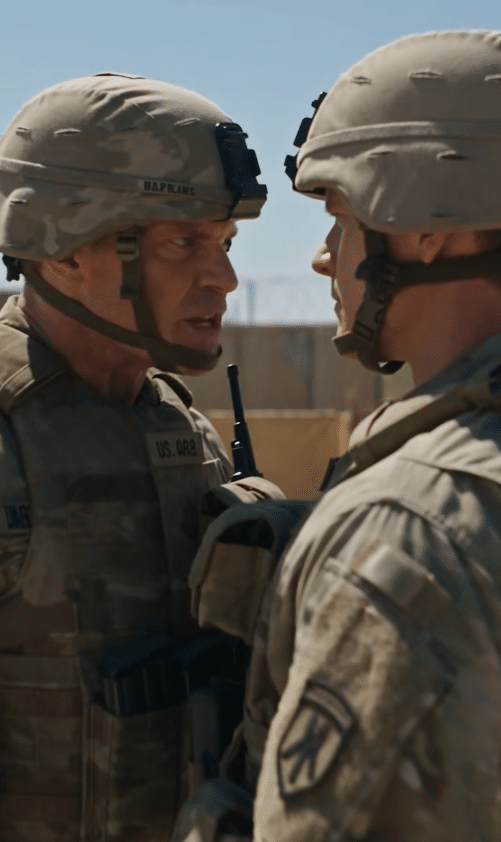
The lieutenant colonel stepped into the young officer’s path, his gloved hands clenched beside the tactical vest covering his uniform. Beyond them, armored vehicles stood behind concrete barriers, and soldiers waited in the sandy live-fire training zone.
The firing sequence had been stopped for one reason: a team had not fully cleared the danger area.
The young officer had seen the problem and halted the exercise before anyone could be exposed to unnecessary danger. He was thirty-six, clean-cut, and unusually young for a brigadier general. His OCP uniform was practical, his tan helmet sat firmly in place, and nothing about his demeanor suggested he needed to prove himself.
The lieutenant colonel saw the interruption differently.
“I interrupt bad decisions.”
The answer was quiet, clipped, and entirely without apology.
For a moment, the older officer stared at him as though he had misunderstood what had just happened. He was forty-three, hard-faced, and accustomed to controlling the range through force of personality. Every minute on the schedule mattered to him, but being challenged in front of his personnel mattered more.
He had expected the younger man to defer.
Instead, the young officer had prioritized safety.
The lieutenant colonel stepped closer.
Nearby soldiers stopped moving. A gunnery sergeant with gray at his temples watched from beside a concrete barrier, his weathered face tightening as he sensed the confrontation turning dangerous.
The lieutenant colonel’s expression hardened.
He punched the young officer violently across the cheek.
The impact snapped the younger man’s head to one side. His cheek reddened and began to swell, with a faint trace of blood appearing at the corner of his mouth.
Before he could recover, the lieutenant colonel drove a hard kick into his stomach.
The young officer folded forward, his breath knocked out of him. A second kick struck his side near the ribs as he dropped, sending him onto his side in the sand.
His helmet came free during the fall and rolled several feet away.
He coughed once, struggling to draw air into his lungs. One hand guarded his abdomen while he worked to steady his breathing. He remained conscious, his expression tightened by pain, but he did not beg or plead.
The lieutenant colonel stood over him.
“You’re nobody on my range.”
No one intervened.
The soldiers nearby recoiled, their eyes moving between the officer on the ground and the man who had struck him. The gunnery sergeant remained motionless, but his attention had shifted from the lieutenant colonel’s face to the young man’s uncovered neck.
Something was visible there.
A long, distinctive burn scar stretched behind the younger officer’s neck, partially concealed until his helmet came off.
The gunnery sergeant went still.
He had seen that scar before—or, more precisely, he had heard the story attached to it from people who had been there when a military vehicle caught fire.
The story concerned an officer who had gone back into the burning vehicle for others and emerged last.
The lieutenant colonel followed the older man’s gaze and sneered.
Then the gunnery sergeant spoke, his voice low and urgent.
“Colonel… I’ve seen that burn before.”
The lieutenant colonel barely looked at him.
“Then you’ve seen another nobody.”
The young officer lifted his head.
Despite the pain, his voice remained controlled.
“Ask who walked out of that fire last.”
The lieutenant colonel’s smirk began to disappear.
He looked at the scar again. Then he looked at the gunnery sergeant, whose expression had changed from alarm to unmistakable respect.
The young man on the ground had not mentioned his rank.
He had not recited his service record.
He had simply asked a question that made the lieutenant colonel reconsider everything he thought he knew.
And suddenly, the man who had claimed to own the range was no longer certain he understood who stood before him.
Act II
The young officer’s name was Daniel Mercer.
Long before he became a brigadier general, Daniel had been the kind of soldier whose reputation grew quietly, passed from one unit to another through stories that rarely appeared in official speeches.
He had not built his career by demanding attention. He built it by making decisions that protected the people entrusted to him, even when those decisions were inconvenient or unpopular.
As a younger officer, Daniel had learned that the most dangerous mistakes often began with someone insisting there was no time to stop.
A schedule could be adjusted.
A missed deadline could be explained.
But a safety failure could change a family forever.
That belief had shaped the way he led. He listened when junior personnel raised concerns, asked questions when procedures were rushed, and refused to treat a warning as an insult simply because it came from someone with less rank.
His approach sometimes frustrated officers who valued appearances over judgment.
Daniel understood that. He had encountered people who interpreted calmness as weakness and consultation as indecision. He had also seen what happened when commanders became so invested in maintaining control that they stopped listening to the people closest to a problem.
He had no intention of becoming one of them.
The live-fire evaluation was supposed to be straightforward. Daniel was observing how the training teams followed procedures under pressure, how they communicated across positions, and whether the range remained safe when the schedule began to tighten.
He was not there to embarrass anyone.
When he noticed that one team had not fully cleared the danger area, he stopped the firing sequence.
The lieutenant colonel running the range saw only the delay.
His name was Mark Voss, and he had spent years cultivating a reputation for being demanding. He believed that a good commander kept people moving, eliminated hesitation, and never allowed a subordinate to make him look uncertain in front of the unit.
Those principles had helped him maintain order during routine training.
But Voss had gradually confused discipline with unquestioned obedience.
He disliked being corrected in public. He took questions personally and regarded interruptions as challenges to his authority. When someone disagreed with him, he often responded by increasing the pressure until the other person backed down.
The younger the person, the more certain he seemed to be that intimidation would work.
Daniel’s appearance encouraged the mistake.
At thirty-six, he looked younger than many officers who had spent years waiting for their next promotion. His face lacked the weathered severity Voss associated with senior leadership. His field gear was understated, and he did not move around the range expecting everyone to recognize his position.
Voss saw a young man who could be pushed around.
He did not see the brigadier general conducting the evaluation.
More importantly, he did not see the man whose judgment had been shaped by a moment that had changed the lives of several soldiers.
The gunnery sergeant did.
His name was Samuel Brooks. At fifty-five, he had spent decades in uniform and had learned to pay attention to details that younger personnel often overlooked. He knew the difference between an officer who talked about responsibility and one who accepted its consequences.
He had heard the story of the burning vehicle years earlier, from people who had served close enough to understand what happened.
During a dangerous operation, a military vehicle caught fire. Smoke and heat made the situation increasingly hazardous, and several service members needed help getting clear. An officer who had already reached relative safety went back toward the vehicle to help those still inside.
He did not leave until the others had made it out.
The officer survived, but the fire left a long burn scar behind his neck.
The story had circulated among those who knew the people involved. It was remembered not because the officer had sought recognition, but because he had refused to treat his own safety as more important than everyone else’s.
Brooks had never forgotten it.
He had not expected to encounter the man himself on an ordinary training range.
Now, as Daniel lay in the sand with his helmet several feet away, the old story had returned with startling clarity.
Brooks could not yet understand why Voss had attacked a senior officer during a safety evaluation.
But he understood one thing.
The lieutenant colonel had made a grave mistake by assuming that the quietest person in front of him was the least important.
Act III
For several seconds, the range seemed to hold its breath.
Daniel remained on his side, his face reddened and swollen, one arm protecting his stomach while he recovered enough air to move. The sand clung to his uniform. His helmet lay on the ground nearby, and the scar behind his neck remained visible.
Brooks watched him with an expression that had become difficult to hide.
“Colonel… I’ve seen that burn before.”
Voss turned toward him.
He heard the warning, but he refused to accept its significance. In his mind, acknowledging Brooks would mean admitting that something about the situation had escaped his control.
So he dismissed the older man.
“Then you’ve seen another nobody.”
The words sounded more forced than before.
Brooks did not answer. He kept his eyes on Daniel, and the silence made Voss increasingly uncomfortable.
The young officer slowly raised himself enough to look directly at the lieutenant colonel.
He did not threaten him.
He did not announce that he was a brigadier general.
He did not attempt to use the scar as a badge of superiority.
Instead, he delivered a sentence that seemed to cut through the entire confrontation.
“Ask who walked out of that fire last.”
Voss’s expression shifted.
The words connected the visible scar to the story Brooks recognized. The story connected the young officer to an act of courage that had become known among people who understood what it meant to go back when every instinct urged them to get away.
Voss had spent the last several minutes treating Daniel as an insignificant obstacle.
Now he was being asked to consider whether the man he had assaulted was the same officer whose actions had earned the quiet respect of experienced service members.
He looked at Brooks again.
The gunnery sergeant’s face held no trace of amusement. There was no admiration for Voss’s aggression, no attempt to soften what had happened, and no sign that the lieutenant colonel could bully him into forgetting the scar.
Brooks had recognized something that mattered.
And Voss had recognized that Brooks knew it.
The lieutenant colonel’s jaw tightened.
He could still tell himself that the young officer had interfered with his schedule. He could still insist that the range needed discipline. But none of those arguments explained why he had punched Daniel, kicked him in the stomach, and struck him again as he fell.
The assault had not been an enforcement action.
It had been a loss of control.
Daniel’s original decision had been about a team that had not fully cleared the danger zone. Voss had turned that safety concern into a personal contest, then used violence when the younger officer refused to back down.
The scar made the contrast impossible to ignore.
The man Voss had called a nobody had once risked his own safety to help others escape a burning vehicle. The man standing over him had just attacked a colleague because a training schedule had been interrupted.
One had placed the lives of others ahead of his own comfort.
The other had placed his pride ahead of their safety.
Voss looked at Daniel’s face, then at the scar behind his neck.
He tried to recover his usual expression.
“It’s a story,” he said, more to himself than to Brooks.
But the gunnery sergeant’s reaction told him the story was not an invention designed to intimidate him.
Brooks had served long enough to know that legends often grew exaggerated in the telling. He did not need every detail to be perfect to understand what the scar represented. He had recognized the connection, and he had seen the character of the man who wore it.
Daniel did not need to persuade him.
The lieutenant colonel had already revealed his own character.
The range remained quiet, with soldiers watching from their positions and no one stepping forward to turn the confrontation into another physical struggle.
Daniel took another controlled breath.
Then he repeated the question in a quieter voice, leaving Voss to find the answer himself.
“Ask who walked out of that fire last.”
For the first time, Voss seemed to understand that the young officer’s calmness had never meant submission.
It had been restraint.
And restraint, he was discovering, was not the same thing as weakness.
Act IV
The realization did not arrive all at once.
Voss looked at the scar, then at Brooks, then back at Daniel. His mind was moving quickly, trying to fit the story to the man in front of him.
He remembered hearing references to the officer who had gone back into the burning vehicle. He remembered how experienced personnel spoke about the incident with a seriousness that did not depend on medals or formal recognition.
The details had traveled through military circles without becoming a spectacle.
People remembered the decision.
They remembered that others had made it out.
And they remembered that the officer who came out last had never treated the experience as a reason to demand special treatment.
Now the story had a face.
Voss’s confidence began to collapse.
He had expected Daniel to respond to the assault with anger, perhaps to threaten him with rank or call for immediate punishment. Instead, Daniel had done something far more unsettling: he had allowed Voss to confront the difference between the person he had assumed he was attacking and the person standing before him.
The revelation was not that Daniel had become important because of the fire.
He had been important before Voss recognized him.
His judgment had mattered when he stopped the firing sequence. His restraint had mattered when he refused to turn the confrontation into a contest of egos. His dignity mattered now, while he was injured in the sand.
The scar simply gave Brooks a reason to recognize the man behind those choices.
Voss had mistaken visible authority for the whole of a person’s worth. Daniel had never needed to display his rank to make the right decision.
The lieutenant colonel tried to steady his expression, but the effort only made him look more rigid.
Around them, the other soldiers remained watchful. Some had seen the entire assault. Others had arrived late enough to understand only that a confrontation had turned violent and that the gunnery sergeant was treating the injured officer with unusual seriousness.
No one needed to explain the change in atmosphere.
A few moments earlier, Voss had stood over Daniel, certain that the range belonged to him. Now he seemed unable to decide where to look.
Brooks finally moved closer—not to attack Voss, but to make sure Daniel could be assessed and the immediate safety of the range maintained. The exercise remained stopped while the incident was addressed.
Daniel stayed conscious, breathing carefully through the pain. His cheek was swollen, and his abdomen hurt with every deeper breath. He made no attempt to hide his injuries, but he also refused to turn them into a performance.
The range had to remain safe.
That had been the principle behind his original decision, and it remained the principle now.
Voss could not erase the fact that the danger zone had not been clear when Daniel stopped the sequence. Nor could he turn the assault into a legitimate response to a scheduling disagreement.
The witness accounts would matter. So would the circumstances that led to the firing sequence being halted, the injuries Daniel sustained, and the actions Voss took after being challenged.
The appropriate command authorities would have to examine the incident. The assault could not be resolved simply because Brooks recognized the scar, and Daniel’s identity did not replace the need for a fair process.
But the hidden clue had changed how everyone understood the confrontation.
Voss could no longer dismiss Daniel as an inexperienced officer trying to make himself look important. Brooks’s recognition had made the lieutenant colonel confront a history he had not bothered to learn.
And the history pointed to a truth that Voss had overlooked from the beginning.
The man he had attacked had stopped a dangerous exercise because people were still at risk.
The man who had attacked him had done so because he could not tolerate being corrected.
One had protected others under pressure.
The other had abused power under pressure.
No rank insignia could make those choices equivalent.
Voss swallowed, his eyes widening as the full implication settled over him. He had not merely misjudged Daniel’s career or standing. He had exposed his own inability to exercise the judgment expected of an officer entrusted with other people’s safety.
He stared at the burn scar one last time.
Then he looked into Daniel’s eyes.
The words came out before he could recover his composure.
Act V
“That was you…?”
Voss’s voice was barely more than a breath.
The final question escaped him as his expression changed from disbelief to fear. For once, he seemed unable to fill the silence with a command, an insult, or an explanation.
He had wanted everyone on the range to see Daniel as insignificant.
Instead, the scar had forced him to see the man he had assaulted in an entirely different light.
Daniel did not answer with a boast.
He did not tell Voss how many people had heard the story or how often his actions had been discussed by those who served beside him. He did not need to transform a dangerous experience into a weapon against the lieutenant colonel.
The story spoke for itself.
A vehicle had caught fire. People had needed help. Daniel had gone back when remaining outside would have been safer, and he had not left until others had made it out.
The burn behind his neck was a reminder of that day, not a demand for admiration.
Daniel had never believed that surviving a fire made him better than anyone else. It had made him more aware of how quickly a decision could affect the lives of people who depended on it. It had taught him that responsibility was measured in actions, especially when fear, confusion, and pressure made the right choice difficult.
That was why he had stopped the live-fire sequence.
A team had not fully cleared the danger area. Continuing would have prioritized the schedule over the people who were supposed to carry it out safely.
Daniel had made the decision without hesitation.
Voss had taken it personally.
The contrast between them could not have been clearer.
As the immediate response to the assault began, Daniel remained focused on the range. Medical personnel needed to assess his injuries, the incident needed to be documented, and the exercise could not resume until the appropriate safety checks had been completed.
Brooks remained close, his expression still marked by the recognition that had changed the confrontation.
He had seen experienced officers boast about their courage. He had seen others rely on decorations and stories to command respect. Daniel had never needed to do either.
The gunnery sergeant had recognized the scar because he remembered what the story meant.
It was not a symbol of invulnerability.
It was evidence that Daniel had once faced a terrible situation and chosen to help others before thinking about how the experience might affect him.
That history did not make him incapable of being hurt. It did not make the assault less serious, and it did not mean the command could skip the procedures required to address Voss’s conduct.
It simply made the lieutenant colonel’s mistake impossible to ignore.
Voss had assumed that a young face meant an inexperienced mind. He had assumed that a calm voice meant a weak one. He had assumed that the person who stopped his schedule was trying to undermine his authority rather than prevent a dangerous error.
And when those assumptions were challenged, he had used violence.
The consequences would have to be determined through the military’s formal process, with witness statements and the facts of the incident examined properly. Voss’s position would not disappear through a single dramatic revelation, just as Daniel’s career did not need to be explained by a scar.
But the event would follow him into that process.
Every witness would have to confront what they had seen. Every account would begin with the same basic question: why had a lieutenant colonel responded to a safety correction by assaulting the officer who made it?
The schedule had been interrupted.
The danger zone had not been clear.
Those were facts that could be established.
So was the violence.
For Daniel, the hardest part was not the realization that Voss had finally recognized him. It was knowing that the confrontation had exposed a deeper problem in the way authority could be misunderstood.
An officer who believed that every challenge was disrespect might eventually silence the very people who could prevent a disaster. A commander who valued appearances more than honest warnings might keep a training exercise on schedule right up until the moment something went wrong.
Daniel had spent his career trying to prevent that kind of failure.
He had learned that leadership was not the ability to make people afraid of contradicting you. It was the ability to hear a warning before the cost of ignoring it became irreversible.
The scar behind his neck carried the memory of the day that lesson had become permanent.
Now it had revealed another man’s failure to understand it.
Voss had wanted to prove that nobody could interrupt his schedule.
But the young brigadier general had interrupted it for the only reason that mattered: someone had not yet cleared the danger.
And in the end, the most important question on that range was never who had the greater rank, who had the more impressive uniform, or who had the most intimidating reputation.
It was who had acted like a leader when the pressure was real.
The man with the burn scar had gone back into a fire for others.
The man who called him a nobody had attacked him for refusing to make a dangerous decision.
No one needed to announce the difference.
Everyone who had witnessed the confrontation had seen it.
And when Voss finally understood who stood before him, his greatest fear was no longer that he had assaulted a decorated officer.
It was that he had revealed exactly what kind of officer he had become.