Act I
The basketball was still bouncing when Marcus Reed realized he had made a terrible mistake.
Not because he had missed a shot. He had just made one.
The ball had left his hands from just beyond the free-throw line, arced cleanly beneath the gray prison sky, and dropped through the hoop without touching the rim. For half a second, the old concrete court went quiet. Then a few inmates along the sideline let out surprised laughs and approving whistles.
Marcus couldn’t help smiling.
At twenty, he had spent most of his first weeks inside trying to become invisible. His orange uniform hung loosely from his shoulders, and his prison-issued clothes still felt unfamiliar against his skin. But the sneakers on his feet were his own, a worn pair his family had sent after weeks of paperwork and waiting.
They were scuffed, faded, and too old to impress anyone.
To Marcus, they were priceless.
They had come from his older brother, Daniel, along with a letter folded carefully inside the package. Daniel had written that the shoes weren’t much, but he wanted Marcus to have something familiar while he worked through the hardest chapter of his life.
Marcus had read that letter so many times he could remember entire sentences without opening it.
Now, standing on the court with the ball rolling toward his feet, he felt something he hadn’t felt in weeks.
For a moment, he felt like himself again.
Then the laughter stopped.
Derek Lawson stepped away from the sideline.
At twenty-nine, Derek was one of the most physically imposing inmates on the unit. He had an athletic build, rolled-up sleeves, and the easy confidence of a man who had spent years teaching other people to watch his moods before they spoke.
Two of his friends stood near the steel fence behind him.
Derek wasn’t angry because Marcus had broken a rule. He was angry because the crowd had reacted to someone else.
“You think you’re something now?” Derek asked.
Marcus caught the ball against his hip.
“No. It was just a shot.”
“A shot?” Derek repeated, glancing at the men who had applauded. “Everybody suddenly impressed with the new kid?”
Nobody answered.
Derek pointed toward Marcus’s feet.
“Take those shoes off.”
Marcus looked down as if he hadn’t heard correctly.
“What?”
“You heard me.”
Marcus’s smile disappeared. He had seen Derek take small things from other inmates before. A seat, a place in line, a basketball someone else had been using. Each time, the victim was expected to surrender whatever had been demanded, then act as though nothing had happened.
Marcus had promised himself he wouldn’t invite trouble.
But those shoes were different.
“These are the only shoes my family sent,” he said quietly.
Derek stepped closer.
“Trash. New inmates don’t shine here.”
The insult struck harder than Marcus expected. He could feel the eyes of the men around the court moving between them, waiting to see whether he would obey.
Marcus thought of Daniel’s letter.
He thought of the way his brother had signed it: Keep your head up. Don’t let this place convince you that you’re worth less than you were before.
Marcus swallowed.
“I’m not trying to show off,” he said. “I just want to play.”
Derek’s expression hardened.
“You don’t get to decide what you do around me.”
Marcus took one step backward.
He kept his shoes on.
That was all it took.
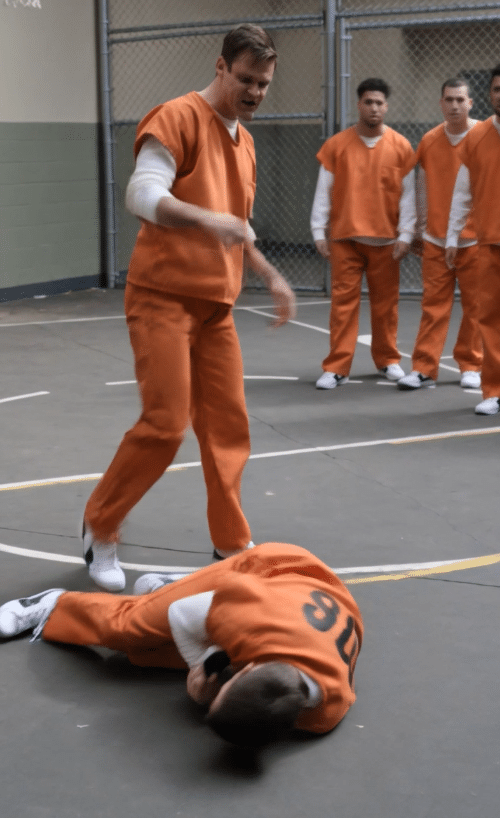
Derek charged across the court and drove one hard kick into Marcus’s chest.
Marcus stumbled backward and hit the rough concrete. His knee scraped the surface, leaving a thin trace of blood. The basketball rolled away, bouncing once before settling near the fence.
Marcus tried to catch his breath.
Before he could get his feet beneath him, Derek delivered exactly two more kicks into his back and side.
Marcus curled in pain, pulling his feet toward himself as if he could protect the shoes by making his body smaller.
Around the court, inmates covered their mouths and stepped behind the painted sideline. No one moved to intervene.
Derek stood over him.
“Take them off before I take them.”
Marcus looked up, his face tightened by pain and disbelief.
He wasn’t trying to win a fight anymore. He was trying to understand how a single basketball shot had become a reason for someone to attack him.
Derek waited for an answer.
Marcus gave him none.
Then the court gate slammed open.
The warden entered first, followed by a rehabilitation sports coach carrying a clipboard. The coach wore a black athletic jacket and dark track pants, and his expression was so cold that the men near the fence stopped moving.
The entire court fell silent.
He looked at Marcus on the ground. Then at the sneakers Derek had tried to take.
Finally, he turned toward the man standing over the young inmate.
“You just kicked away your early release.”
Derek froze.
For the first time since stepping onto the court, he looked genuinely afraid.
“My early release?”
He stared at the coach, waiting for an explanation that would make the words mean something else.
But the coach simply held the clipboard against his side.
And Derek began to understand that the shoes had never been the real issue.
He had just destroyed something he had spent months trying to earn.
Act II
Marcus had not come to prison believing he was a good person who had been unfairly punished.
He knew why he was there.
At eighteen, he had made a series of reckless decisions with a group of older friends who treated petty theft as a game and consequences as something that happened to other people. Marcus had joined them in a break-in at a closed electronics store. He hadn’t planned the crime, but he had participated, and he had helped carry stolen property away.
When the police investigation caught up with them, Marcus discovered that being the youngest person in the group did not make him innocent.
He accepted responsibility for his role.
The sentence that followed had frightened him more than he ever admitted. He had imagined that prison would be difficult, but he hadn’t understood how quickly ordinary things could become complicated: where to sit, when to speak, how long to hold someone’s gaze, and how to distinguish between a genuine warning and a threat designed to keep him obedient.
His family had tried to prepare him.
His mother called every week. Daniel wrote whenever he could. Both reminded Marcus that the consequences of his choices were real, but that his life was not over.
Daniel’s package had arrived during Marcus’s second month.
Inside were the old sneakers, a pair of socks, and a letter explaining why Daniel had chosen them. The shoes had belonged to him for years. He had worn them through late shifts, weekend basketball games, and long walks home after the bus stopped running.
They were not expensive. The soles were worn, and one lace had been replaced with a mismatched one.
But they had history.
Daniel wrote that he remembered Marcus begging to borrow them when they were teenagers. Marcus had always insisted the shoes made him jump higher, even though Daniel knew that was nonsense.
The memory made Marcus laugh when he first read it.
He had sat on his bunk afterward, holding one shoe in his hands, trying not to cry in front of the other inmates.
Prison had stripped away so much of the life he knew. He could not go home for dinner, answer his mother’s calls whenever he wanted, or walk into a familiar room without considering who might be watching.
The sneakers gave him one small connection to the person he had been before his worst decision.
He wore them carefully.
He cleaned the dirt from the sides when he could. He kept the laces tied and avoided dragging his feet across the concrete. When other inmates joked about their worn condition, Marcus laughed along rather than explaining what they meant to him.
He did not want to make the shoes a spectacle.
That was why he had hesitated when Derek ordered him to remove them.
It wasn’t the first time Derek had demanded something from a new inmate.
Derek had learned how to dominate a room without needing to shout constantly. He watched for uncertainty and turned it into leverage. If a newcomer stepped aside too quickly, Derek treated it as proof that the person could be controlled. If someone resisted, he made sure others were watching before escalating the confrontation.
His friends helped maintain the reputation.
They laughed at his jokes, repeated his insults, and discouraged other inmates from challenging him. Most of the time, Derek didn’t have to do anything dramatic. The threat of what might happen was enough.
But Derek’s position inside the prison had recently begun to change.
He had been accepted into a rehabilitation sports program designed to teach discipline, teamwork, and responsible leadership through structured physical activity. Participants helped organize games, maintained equipment, and worked with staff to make recreation safer and more constructive.
The program was not simply a reward for good behavior.
It was part of a broader rehabilitation plan intended to help eligible inmates demonstrate responsibility and prepare for a return to the community. Consistent participation could be included in a broader review of progress, though it did not guarantee a reduced sentence or early release.
Derek had entered the program with a reputation for being difficult.
Initially, he performed well. He was physically capable, understood the game, and could organize a team when he wanted to. He arrived on time, followed the formal instructions, and learned how to speak to staff without turning every interaction into an argument.
For the first time in years, he saw a possible route toward something better.
The program’s rehabilitation coach, Thomas Bennett, had noticed Derek’s improvement. Bennett had spent years working with incarcerated men, and he understood that progress was rarely a straight line. Some participants made mistakes and learned from them. Others performed well when supervised but returned to old behavior the moment they believed nobody important was watching.
Bennett had not declared Derek transformed.
He had simply considered him capable of making a genuine change.
That distinction mattered.
Derek, however, began treating the program as proof that he had become more important than the other inmates. He liked being trusted with responsibilities. He liked the way staff addressed him when he was helping organize a game. He liked the possibility that his participation might strengthen his case for a future release review.
But he had not abandoned the habits that made him dangerous.
He still wanted people to fear him.
And when Marcus made a clean shot and drew a few seconds of attention, Derek felt his authority slipping.
He could have laughed it off. He could have asked for the ball and taken his own shot. He could have used the moment to encourage a younger inmate who was learning to participate without becoming involved in conflict.
Instead, he chose the one response that would reveal how little he had changed.
He demanded the shoes.
When Marcus refused, Derek stopped seeing a young man trying to protect a family keepsake. He saw a challenge to his dominance.
That miscalculation would cost him far more than the satisfaction of winning an argument.
Because Thomas Bennett had not come to the court merely to supervise a basketball game.
He had arrived to make a decision about Derek’s future.
And what he had just witnessed made that decision impossible to ignore.
Act III
Thomas Bennett had worked in prison rehabilitation for more than fifteen years.
He had coached high school basketball before moving into correctional programming, where he discovered that the principles of a team could be applied to a very different environment.
A player had to learn that skill did not excuse recklessness. Strength did not make another person disposable. Leadership meant accepting responsibility when things went wrong, not demanding that someone else absorb the consequences.
Those lessons became the foundation of his sports program.
The goal was not to turn inmates into perfect people through a few games of basketball. It was to create repeated opportunities for them to practice self-control, cooperation, and accountability under pressure.
Some participants embraced the structure.
Others learned to imitate it.
Derek had initially appeared to be one of the promising cases. He showed up consistently, followed the equipment procedures, and was often the first to volunteer when Bennett needed someone to help set up the court.
He also had a talent for basketball.
But the coach had noticed something troubling. Derek treated the program’s responsibilities as a way to gain influence over other inmates. He was helpful when staff were present and dismissive when they were not. He sometimes used his role on the court to decide who deserved to play, who should wait, and who needed to be reminded of their place.
Bennett had spoken to him about the difference between leadership and control.
Derek had listened.
He had even promised to work on it.
But promises were easy to make in an office. The real test came when another person embarrassed you, frustrated you, or received praise you wanted for yourself.
That afternoon, Bennett had been reviewing Derek’s participation record with the warden. Derek had completed several months of the program, and his case was approaching a formal progress review.
The review would consider more than his performance on the court. Staff would examine his disciplinary record, conduct, participation, and evidence of sustained behavioral change. The coach’s report would be one part of that process, not a guarantee of any particular outcome.
Bennett had been preparing to recommend that Derek remain under consideration for continued rehabilitation opportunities.
He believed the inmate had made some progress.
But he also believed that progress had to survive a difficult moment.
As Bennett and Warden Collins approached the court, they heard the sudden reaction to Marcus’s shot. A few approving shouts rose from the sideline, followed by an abrupt silence.
Then they saw Derek moving toward the young inmate.
The warden entered first.
Bennett followed, clipboard in hand.
He saw Marcus fall, saw Derek stand over him, and heard the demand to remove the shoes. The moment was brief, but its meaning was unmistakable.
Derek had used physical violence to punish a younger inmate for refusing to surrender a personal possession.
Worse, he had done it during the very activity intended to help him practice self-control.
Bennett looked at the sneakers, then at Marcus’s scraped knee.
He remembered the conversations in which Derek had insisted he was ready for more responsibility. He remembered the progress reports that described his improving participation. He remembered asking Derek what he would do when someone challenged him and hearing the answer that a leader should remain calm.
The court had supplied the answer Derek’s words could not.
“You just kicked away your early release,” Bennett said.
The statement was deliberately direct.
He did not mean that one person could personally grant or cancel a release date. No coach possessed that authority. Any release decision would depend on the applicable legal process and the judgment of the relevant authorities.
But Derek’s behavior could seriously undermine the favorable assessment he hoped to receive.
The distinction did not make the warning less frightening.
Derek had invested months in building a record that might help his future. He had begun imagining a life beyond the fence, one where he could find work, return to his family, and stop being defined by the worst things he had done.
He had allowed himself to believe the future was becoming possible.
Now the coach was standing in front of him with the warden beside him, and the entire court had witnessed the act that might undo that progress.
Derek tried to speak.
“She disrespected me,” he said, nodding toward Marcus as if that explained everything.
Bennett looked at him without moving.
“He made a shot.”
“He was showing off.”
“He made a shot,” Bennett repeated.
Derek glanced toward the sideline. His friends had fallen silent. The other inmates were no longer watching Marcus to see whether he would surrender the shoes.
They were watching Derek.
The warden instructed staff to secure the area and arrange for Marcus to receive medical attention. She directed that witnesses be identified and the incident documented. Derek was ordered to remain separate from Marcus while the matter was handled.
No one struck Derek.
No one needed to.
Bennett’s clipboard contained the progress records Derek had hoped would help him move toward a better future. The assault would now have to be considered alongside those records.
Derek’s expression began to change.
He had expected anger from Marcus. He had expected fear from the bystanders. He might even have expected an officer to shout at him.
He had not expected the coach to speak about his future as though the future had suddenly become uncertain.
“My early release?” he asked again, this time more quietly.
Bennett did not answer with a promise of punishment.
He answered with the truth.
“Your review depends on the conduct you demonstrate. Today, you demonstrated something we cannot ignore.”
For the first time, Derek looked down at Marcus.
The young inmate was still on the concrete, breathing carefully as staff approached him. His face was tight with pain, but his attention had returned to his shoes.
Derek had wanted to prove that Marcus could be forced to obey.
Instead, he had shown everyone that the authority he claimed to possess was nothing more than intimidation.
And the people who could evaluate his future had seen it for themselves.
Act IV
The immediate response was handled without spectacle.
Staff escorted Marcus for a medical assessment and documented the scrape on his knee, along with his reported pain after the assault. He remained conscious and responsive, but the medical team took care not to dismiss his discomfort simply because the visible injury appeared minor.
The sneakers were checked for damage and returned to him when staff had finished documenting the incident.
Marcus held them in his hands for a moment.
One side was dusty from the concrete. The laces had come loose, and a smear of court grit marked the sole. They were still recognizable as the shoes Daniel had sent.
That mattered to Marcus more than he could explain.
He had spent the entire confrontation trying to protect something that reminded him of home. Now he sat in the medical area, wondering whether he had made things worse by refusing to obey Derek.
A staff member asked him to describe what had happened.
Marcus told the story in order. He explained that he had made the shot, that Derek had ordered him to remove the shoes, and that he had refused. He described the kick to his chest, the fall, and the two additional kicks.
He did not exaggerate.
He did not claim that he had been looking for a fight.
He also did not pretend that the confrontation had been harmless.
When the staff member asked why the shoes were so important, Marcus hesitated.
“My brother sent them,” he said.
Then, after a moment, he explained the letter.
He did not ask anyone to punish Derek because the shoes had sentimental value. He simply wanted the record to reflect that Derek had demanded a personal possession and used force when Marcus refused.
That distinction made his statement clear.
Meanwhile, the warden began the formal review of the incident.
Witnesses were interviewed separately, and staff checked the available information about the basketball session. The administration examined the program’s records and the circumstances surrounding Derek’s participation.
The coach’s report would be submitted as part of the broader review, but the assault itself would be handled under the prison’s disciplinary procedures. The authorities responsible for any future release decision would evaluate the incident according to the relevant rules and legal requirements.
Derek was removed from his immediate responsibilities in the sports program while the matter was reviewed.
For him, that was the beginning of a frightening change.
He had come to rely on the program as evidence that he was becoming a different person. The structure had given him a reason to get up in the morning, a place where his physical abilities were useful, and a goal beyond surviving each day.
He had started talking to his family about what he might do after prison. He had considered coaching youth sports, though he knew that would require trust and opportunities he had not yet earned.
He had imagined walking out of the facility with a plan.
Now every one of those possibilities felt uncertain.
When Bennett met with him again, Derek tried to argue that the incident should be viewed separately from his program performance.
“I did the work,” Derek insisted. “I showed up. I followed the rules. You said I was making progress.”
“You were making some progress,” Bennett replied.
“Then why does one fight erase everything?”
“It doesn’t erase everything you’ve done,” the coach said. “But it tells us something about what you still need to change.”
Derek leaned forward.
“He was a new inmate. He should have known not to challenge people.”
Bennett’s expression hardened.
“Making a basketball shot is not challenging you.”
“He made everyone look at him.”
“And you decided that was a reason to hurt him.”
Derek fell silent.
The coach let the silence remain.
“You keep describing what Marcus did as though it caused your decision. It didn’t. You were responsible for what you chose to do next.”
Derek looked away, his jaw clenched.
He wanted to blame the audience, the court, the atmosphere, or the way prison had taught people to defend their status. He wanted the circumstances to explain the moment so thoroughly that his own responsibility would shrink.
But the facts remained simple.
Marcus had made a shot.
Derek had demanded his shoes.
Marcus had refused.
Derek had attacked him.
The coach continued.
“The program exists to help people learn how to respond differently. If you only act responsibly when nobody challenges your pride, then you haven’t learned the lesson yet.”
Derek’s eyes returned to him.
“So you’re taking away my future?”
“No,” Bennett said. “I’m telling you that your future was never mine to hand you. The review will consider what happened, and the responsible authorities will make their decisions. You can be angry about that, but you can’t make the consequences disappear by blaming the person you hurt.”
It was not the answer Derek wanted.
He had hoped the coach would remember the hours he had spent helping with equipment and the games he had organized. He wanted those actions to outweigh the assault.
Bennett did remember them.
He simply refused to treat them as permission to ignore what had happened.
The warden’s review also uncovered a broader concern about how Derek had been using his influence around recreation periods. Several inmates described being pressured to surrender court time or equipment because Derek believed he could decide who deserved access.
Those accounts were examined individually. Staff did not assume every complaint was true, but they took the reports seriously enough to establish whether a repeated pattern existed.
The sports program introduced clearer expectations for participants who helped organize activities. Responsibilities were to be assigned by staff, not claimed through intimidation. Complaints about bullying or interference would be documented, and participation in the program would depend on conduct as well as attendance.
The court was not meant to become a place where one inmate could appoint himself king.
It was supposed to be a place where people practiced living under shared rules.
For Marcus, the most important change was quieter.
He returned to the recreation area only when he felt ready and under the conditions approved by staff. He did not suddenly become fearless. He still watched Derek carefully when they were in the same space, and he knew that a formal investigation could not erase the memory of being kicked to the ground.
But he had not surrendered the shoes.
He cleaned them as best he could and retied the laces.
Then he folded Daniel’s letter carefully and placed it back among his belongings.
For the first time since the confrontation, he allowed himself to think about the message his brother had written.
Don’t let this place convince you that you’re worth less than you were before.
Marcus had been ashamed of the crime that brought him to prison. He understood that the harm he had caused could not be undone by a letter or by regretting it.
But responsibility did not require him to accept every humiliation another inmate invented.
He could acknowledge his own mistakes without agreeing that he deserved to be controlled.
That was a lesson he would carry longer than any game.
Act V
Derek’s disciplinary review did not end with a dramatic announcement in the middle of the basketball court.
There was no instant cancellation of a release date, no promise that the warden could personally determine his future, and no shortcut around the formal process.
Instead, the incident became part of the record that would be considered by the people responsible for evaluating his conduct and rehabilitation progress.
The findings confirmed that Derek had assaulted Marcus after demanding his shoes. The statements, available records, and circumstances supported the account given by the younger inmate.
Derek faced disciplinary consequences under the facility’s rules. His role in the sports program was suspended while staff assessed whether he could continue participating safely and responsibly.
His progress review was affected as well.
The assault did not automatically decide every question about his eventual release. But it gave the reviewing authorities a serious reason to reconsider whether Derek had demonstrated the sustained self-control and accountability required for favorable consideration.
The future he had imagined was not formally erased in a single moment.
It had become harder to reach.
That distinction mattered, even if Derek could barely accept it.
He had spent months thinking of early release as a destination. In his mind, the program was a road leading toward it, and each successful week brought him closer.
He had not fully understood that rehabilitation was not a performance designed to impress someone holding a clipboard.
It was preparation for living differently.
If Derek could only be respectful when he received praise, then his improvement was fragile. If he could only follow rules when those rules supported his own authority, then he had not learned to live within them.
The court had exposed the gap between the man he wanted to appear to be and the man he still chose to become when he felt threatened.
For a while, Derek blamed Marcus.
He told himself that the young inmate had embarrassed him by making the shot. He complained that the sideline had reacted too enthusiastically. He insisted that the coach had chosen the worst possible moment to make an example of him.
But those explanations grew harder to maintain as the weeks passed.
Marcus had not taken anything from Derek.
He had not threatened him.
He had not even insulted him.
He had simply refused to hand over a pair of shoes that belonged to him.
The more Derek replayed the scene, the less convincing his excuses became.
Eventually, he asked to speak with Bennett again.
“I thought the program meant you believed I could change,” Derek said.
“I did believe you could change,” the coach answered. “I still believe change is possible. But believing in your potential doesn’t mean ignoring what you do.”
Derek rubbed his hands together.
“I thought I was doing better.”
“You were doing some things better.”
“Then why does this feel like everything’s gone?”
Bennett paused before answering.
“Because you built your progress around what you hoped to receive, not around the kind of person you wanted to become.”
Derek stared at him.
The coach continued.
“You wanted the program to help you get closer to release. That’s understandable. But if you treat every opportunity as something you deserve to keep, you miss the point. The opportunity is there to help you practice responsibility. You still have to choose it when doing the right thing costs you something.”
Derek had no quick reply.
For years, he had treated power as the ability to make other people back down. In prison, that belief had hardened into a daily routine. He had taken space, time, and small privileges because he believed the people around him would rather surrender than risk confrontation.
On the basketball court, he had tried to use the same method.
But the shoes had not been his to take.
Marcus had not been his to command.
And the coach had not been there to reward Derek’s reputation. He had been there to evaluate whether Derek was learning to control himself.
Derek could not undo the assault by understanding it afterward.
He could not demand that Marcus forgive him, and he could not insist that the administration treat his earlier progress as proof that the incident should be forgotten.
All he could do was decide what to do next.
Whether that decision would lead to genuine change remained uncertain.
Marcus, meanwhile, wrote a letter to Daniel.
He did not describe every detail of the assault. He knew his brother would worry, and he did not want the letter to become a list of reasons for his family to fear the worst.
Instead, he told Daniel that the shoes had been damaged but were still wearable. He thanked him for sending them and admitted that he had been frightened.
Then he wrote something he had never thought to say before.
He told his brother that he understood the letter now.
Not because prison had made him stronger in some dramatic, effortless way. He was still young, still uncertain, and still learning how to live with the consequences of his decisions.
He understood because he had discovered that keeping his head up did not mean pretending nothing hurt.
It meant refusing to let someone else’s cruelty define the whole story.
When Daniel’s reply arrived, Marcus read it twice.
His brother told him that he was proud of him for telling the truth about what had happened. He reminded Marcus that the family had not sent the shoes because they expected him to become invincible.
They had sent them because they wanted him to remember that he was loved.
Marcus placed the letter with the first one.
The sneakers remained worn. The scrape on his knee healed. The basketball court returned to its ordinary rhythm, with the ball bouncing against concrete and the painted lines fading beneath countless footsteps.
But the incident changed the way people understood Derek’s influence.
The other inmates had watched him demand something from a younger man, then use violence when the demand was refused. They had also watched the warden and coach respond without striking him, without turning the moment into a revenge scene, and without promising a punishment they had no authority to impose.
The reversal had come through accountability.
That was what made it difficult for Derek to dismiss.
He had believed the court belonged to him because other people were afraid to challenge him.
The court had never belonged to him.
The program had never promised him early release.
And the respect he wanted could not be forced from someone by threatening to take away the one thing that reminded him of home.
Months later, Marcus returned to the free-throw line.
He stood with the ball in both hands, wearing the same family-sent sneakers. They looked no newer than before, but he no longer checked the sideline every few seconds to see who might object to his presence.
He took a breath and aimed.
The ball rose, turned slowly through the air, and dropped cleanly through the hoop.
A few inmates clapped.
Marcus smiled, but this time he did not search the crowd for Derek’s reaction. He retrieved the ball and passed it to the next player, letting the game continue.
It was only a shot.
That was all it had ever been.
Across the court, Bennett watched the players move through the exercise. He knew that rehabilitation would not be measured by one clean basket or one dramatic confrontation. It would be measured by choices repeated over time, especially when nobody was watching.
Derek still had a future, though its path was now less certain. If he wanted to earn trust again, he would have to do more than speak about regret. He would have to show that he could live without turning every disagreement into a contest of dominance.
And Marcus still had a sentence to serve, mistakes to confront, and a life to rebuild.
Neither man had been transformed by a single afternoon.
But one of them had learned that dignity did not require permission from a bully.
The other had discovered that the future he wanted could be damaged by the very behavior he claimed to have left behind.
Derek had ordered Marcus to remove his shoes because he believed a new inmate’s pride was something he could crush without consequence.
Instead, he had exposed the truth about his own progress.
He thought those worn sneakers were proof that the new kid needed to be taught his place. In the end, they became the reminder that Derek still had a choice—and that his next chance would depend on what he chose to do with it.