Act I
“This is my seat, ma’am.”
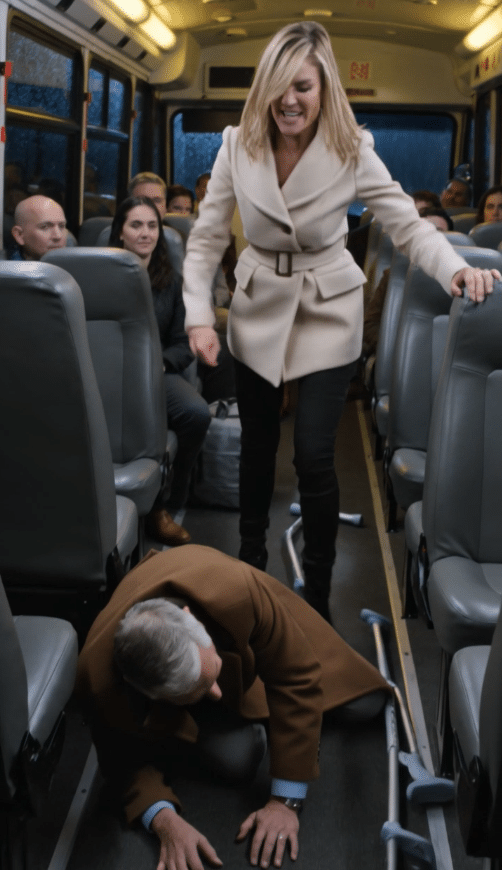
The old man held up his wrinkled paper ticket, his fingers trembling from the cold. Rain streaked the windows of the interstate coach, and the yellow cabin lights cast tired shadows across the narrow aisle. The final departure of the day was minutes away, luggage filled the overhead racks, and every other seat was occupied.
The last available seat should have been his.
A station worker had pointed him toward it moments earlier, checking the number printed on his ticket before directing him down the aisle. But a wealthy woman in a cream luxury coat had settled into the seat first, placing her designer suitcase beside her knees as though she had reserved the entire row for herself.
She glanced at the ticket and then at the old man’s crutch.
“I’m sitting here,” she said.
“I’m sorry, ma’am. This is the seat assigned to me.”
The woman, who looked to be in her early forties, gave him a slow, dismissive smile. Her shoes were spotless despite the rain, and her black pants showed no crease out of place. Everything about her suggested that she had spent years moving through the world without being forced to wait for anything.
The old man wore a faded brown coat, gray trousers, and shoes worn thin at the soles. At seventy-six, he moved carefully, transferring his weight from one leg to the other while keeping his crutch tucked beneath his arm.
He had arrived early. He had paid for his ticket. All he wanted was to sit down before the long journey began.
The woman looked at his crutch again.
“Trash,” she said. “Your crutch can stand.”
A few passengers turned their heads.
The old man blinked, as if he had misheard her. “Please. I’ve been standing in the station for nearly an hour.”
“Then you should have planned better.”
He lowered his ticket slightly.
“Ma’am, I really do have this seat.”
She snatched a glance at the paper but made no effort to move. Instead, she leaned back and adjusted her coat, deliberately taking up more space.
“Do you have any idea how much I paid for this trip?”
The old man shook his head.
“Exactly. You don’t. People like you think a ticket makes you equal to everyone else.”
A young man across the aisle looked up from his phone. An elderly passenger near the window frowned, but neither spoke. The station worker had already stepped away to help another traveler, unaware that a simple seating dispute was turning into something far uglier.
The old man drew a slow breath.
“I don’t want an argument. I just want to sit down.”
The woman stood so suddenly that her designer bag swung against her side.
For one hopeful instant, the old man thought she might finally let him pass.
Instead, she stepped into the narrow aisle and drove a forceful kick into his chest.
He stumbled backward and fell beside his crutch. His elbow struck the floor, leaving a thin trace of blood on his skin. His paper ticket fluttered from his hand and landed beneath the edge of a nearby seat.
A collective gasp moved through the coach.
The old man tried to turn onto his side, reaching painfully for his crutch.
The woman stepped closer.
She kicked him again, then delivered a second follow-up kick to his back and side as he struggled on the floor.
“Ride when people like me are done,” she said.
The passengers recoiled. One woman covered her mouth. A man gripped the seat in front of him so tightly that his knuckles turned white.
Nobody stepped forward.
The old man curled inward, trying to protect himself while reaching for the crutch lying just beyond his fingertips. His breathing came in short, uneven bursts.
The woman looked down at him with irritation, as though he had created an embarrassing inconvenience on her otherwise perfect evening.
Then the bus door opened sharply.
A tall, silver-haired man in a black suit and long coat stepped aboard. Behind him came the station manager, clutching a clipboard and speaking hurriedly about a last-minute departure issue.
The newcomer stopped after only two steps.
He saw the old man on the floor. He saw the fallen crutch. He saw the woman standing over him in her cream coat.
And the expression on his face changed completely.
The woman had spent the evening treating the bus as if it belonged to her. She had no idea who had just stepped aboard.
Act II
The newcomer was Richard Hayes, the sixty-year-old founder and owner of the interstate coach company.
He had built the business over three decades, beginning with a handful of regional routes and gradually expanding into a network serving cities across the country. He knew the company’s financial reports, its drivers, its maintenance schedules, and the long list of ordinary problems that came with moving thousands of people safely every week.
But Richard had never believed that owning a transportation company meant owning the people who traveled on it.
He had grown up in a family that counted every dollar. His father had worked nights, and his mother had cleaned offices before dawn. When Richard was a boy, they had sometimes traveled by coach because it was the only option they could afford.
He remembered his father standing for long stretches when a bus was crowded, refusing to complain even when his knees hurt. He remembered his mother thanking drivers who waited an extra moment for older passengers to board.
Those memories had stayed with him long after the company became successful.
That was why he had come to the station that night. A weather delay had disrupted the final departures, and Richard wanted to see how the staff were handling the backlog before the holiday travel period began.
He had expected complaints about schedules.
He had not expected to find an elderly passenger being attacked over a seat he had already paid for.
Richard moved down the aisle.
The woman turned toward him, startled by the sudden authority in his posture.
“Stay back,” she snapped. “This man was bothering me.”
Richard barely looked at her.
He rushed toward her and delivered one forceful slap across her face, stopping her beside the last seat. She staggered a half-step, raised a hand to her cheek, and stared at him in disbelief.
A thin trace of blood appeared at the corner of her mouth.
Before she could move toward the old man again, Richard positioned himself between them.
“That seat was never yours,” he said. “Now neither is this trip.”
The woman stared at him.
For the first time, she seemed unable to understand what was happening. She had expected the passengers to remain frightened, the station worker to apologize, and the old man to be removed from her way.
Instead, a stranger had stepped between her and the man she had attacked.
“Who do you think you are?” she demanded.
Richard turned toward the victim.
“Sir, can you hear me?”
The old man nodded, though his face tightened with pain as he tried to move.
“Don’t try to get up yet,” Richard said. “We’re getting help.”
He crouched beside him and called to the station manager.
“Call emergency services. Tell them we have an elderly passenger who has been assaulted and needs medical attention.”
The manager immediately pulled out his phone.
Richard looked toward the driver. “Keep the vehicle here. Nobody moves this bus until the incident has been documented.”
Then he turned to the passengers.
“If you saw what happened, please remain available to give a statement. Nobody should feel pressured to stay silent.”
The young man with the phone slowly lowered it.
“I saw the whole thing,” he said.
“So did I,” the elderly passenger by the window added.
The woman in the cream coat let out a disbelieving laugh.
“Oh, this is unbelievable. He was trying to take my seat.”
Richard looked at the crutch lying on the floor.
“He had a ticket.”
“He could have asked more politely.”
“He did.”
The answer came so quickly that the woman fell silent.
Richard pointed toward the paper ticket beneath the neighboring seat. The station manager retrieved it carefully and checked the number against the passenger list.
The ticket was valid. The seat was assigned to the elderly man. There had been no confusion, no duplicate booking, and no reason for the woman to occupy it.
She had simply decided that she wanted it.
“People like him should know their place,” she muttered.
Richard’s eyes hardened.
“What place is that?”
She looked away.
The question had exposed the ugliness beneath her polished appearance. She could justify being impatient. She could complain about the weather, the delay, or the inconvenience of sharing a coach with strangers.
But she could not explain why an old man with a crutch deserved to be kicked for asking to sit in the seat printed on his ticket.
Richard turned back to the victim.
“What is your name, sir?”
“Walter,” the old man whispered. “Walter Bennett.”
“I’m Richard Hayes. Stay with me, Walter. Help is coming.”
Walter looked at the man standing beside him.
“Am I going to miss the bus?”
The question caught Richard off guard.
Walter had been knocked to the floor, injured in front of a crowded coach, and humiliated by someone who had treated him as less than human. Yet his first concern was still the journey he had paid for.
Richard’s voice softened.
“Don’t worry about the bus. Worry about getting checked by the paramedics.”
Walter swallowed.
“I can’t afford to buy another ticket.”
Richard looked at him for a long moment.
“You won’t be asked to buy another ticket tonight.”
Behind them, the woman made an impatient noise.
“This is absurd. I have a business meeting in the morning.”
Richard rose slowly.
“And Walter has a right to travel safely.”
She folded her arms, still struggling to recover her composure.
“You can’t throw me off a bus because of one misunderstanding.”
Richard glanced at the station manager, who was already documenting the seat assignment and contacting the appropriate authorities.
“It’s no longer a seating dispute,” he said. “It’s an assault investigation.”
The woman’s face changed.
For the first time, she looked at the clipboard in the manager’s hand, the passengers preparing to give statements, and the old man’s ticket being placed inside a clear document sleeve.
She had thought the only question was whether she would get to keep the seat.
Now she was beginning to understand that the question was what would happen to her after the bus doors closed.
But Richard’s next question would reveal that the woman had made an even more dangerous mistake than attacking an elderly passenger.
Act III
“What’s your full name?” Richard asked her.
The woman lifted her chin.
“Victoria Langley.”
She said it as though the name should have settled the matter. Then she added that she was a senior partner at a private investment firm and had important clients waiting for her in Chicago.
Richard did not appear impressed.
“Do you have identification?”
Victoria stared at him.
“Excuse me?”
“The station manager needs your details for the incident report. The police will determine what information they require.”
She reached into her designer bag and produced a business card.
“Give that to whoever handles complaints. My office will contact your company tomorrow.”
Richard accepted the card and handed it to the station manager without looking at it.
“Please include it with the report.”
Victoria’s mouth tightened.
“You’re making a very serious mistake.”
“That’s possible,” Richard replied. “Which is why everything needs to be documented properly.”
She looked at him with open contempt.
“You own a bus company. That doesn’t make you a judge.”
“No, it doesn’t.”
His answer seemed to surprise her.
Richard continued, “It also doesn’t give you permission to assault one of my passengers.”
The distinction mattered. He could preserve evidence, ensure staff cooperated, arrange medical assistance, and take steps to protect other passengers. He could not declare Victoria guilty of a crime or dictate what the police would do.
He had no intention of pretending otherwise.
The station manager stepped closer and quietly informed him that the bus’s interior cameras were operating. The recordings covered the aisle and the area around the last seat. The driver had also heard the argument before the attack began.
Richard nodded.
“Secure the original footage. Make a copy for the investigators and document who handles it.”
Victoria’s expression sharpened.
“Cameras? You recorded me without my permission?”
The station manager answered carefully.
“The vehicle has onboard safety cameras. Their use is covered by the company’s passenger policies.”
“Delete it.”
“No,” Richard said.
She stared at him.
“You can’t keep a recording of me.”
“The footage will be preserved according to the company’s procedures and any lawful requests from investigators.”
Victoria took a step toward the manager.
“You have no idea who you’re dealing with.”
The young passenger across the aisle finally stood.
“We know who we’re dealing with,” he said. “We saw what you did.”
Victoria swung toward him.
“You should mind your own business.”
“It became my business when you kicked an old man onto the floor.”
Another passenger nodded.
“I saw it too.”
The woman by the window spoke next, her voice unsteady but firm.
“He showed you his ticket. You knew that seat was his.”
The witnesses were not suddenly fearless. Their hands still trembled, and several looked uncomfortable speaking in front of Victoria. But the first statement had made the next one easier, and the next easier still.
Victoria looked around the coach and found no one willing to support her version of events.
She reached for her phone.
“My attorney will handle this.”
“That is your right,” Richard replied. “You may contact your attorney. But you must not interfere with the evidence or intimidate the witnesses.”
“I haven’t intimidated anyone.”
The young passenger glanced at the woman who had covered her mouth during the assault.
“You told us to mind our business after you attacked him.”
Victoria ignored him.
She made a call, speaking quickly and quietly. At first, her voice carried the confidence of someone accustomed to issuing instructions. She mentioned the coach company, an incident, and an employee who had supposedly struck her without provocation.
Then she stopped talking.
Whoever was on the other end had asked a question she had not anticipated.
“No,” she said. “I don’t know his name yet.”
She glanced at Richard.
“What is your name?”
“Richard Hayes.”
Her expression froze.
She repeated it into the phone.
There was a long silence.
Then she listened, her mouth slowly opening.
The person on the other end had recognized the name. Richard Hayes was not a station supervisor she could pressure into changing a report. He was the owner of the company, the person ultimately responsible for its safety standards, and someone whose public statements about passenger dignity had appeared in local newspapers for years.
But that still did not explain the sudden alarm in her voice.
“What do you mean, you know him?” she whispered.
She listened again.
Richard said nothing.
Victoria ended the call abruptly and stared at her phone as though it had betrayed her.
The station manager approached Richard with his clipboard.
“Sir, there’s another issue,” he said quietly. “The booking system shows that Ms. Langley has a corporate travel account with us.”
Richard looked at the record.
The account had been created through a business travel agreement. It allowed Victoria’s firm to purchase tickets for employees and clients at negotiated rates. It did not grant her special authority over the coach, the staff, or other passengers.
But it meant that her company would receive a formal notice of the incident under the account’s standard procedures.
Richard handed the clipboard back.
“Follow the policy exactly. No special treatment in either direction.”
Victoria heard him.
“You’re going to contact my firm?”
“The station manager will follow the company’s established reporting process.”
“You could ruin my career over one incident!”
Richard’s voice remained quiet.
“You made your choices in front of a bus full of witnesses. I’m not going to hide them, and I’m not going to invent consequences. The evidence will speak for itself.”
For a moment, Victoria looked as though she might scream.
Instead, she clutched her designer bag and glanced toward Walter, who was being kept still while the station staff waited for medical assistance.
He was no longer reaching for his crutch. He had folded his hands against his coat, his face pale beneath the yellow cabin lights.
Victoria looked away first.
She had spent the entire evening assuming that the old man’s poverty made him powerless.
She had not considered that the truth could be witnessed by people who had nothing to gain from protecting her.
Then the station manager opened the passenger manifest, and Richard noticed a detail that made him question whether Walter’s journey had been as ordinary as it first appeared.
Act IV
The passenger manifest showed that Walter Bennett had purchased his ticket three days earlier.
He had chosen the last departure because it was the cheapest option that would get him to his destination that night. His reservation was confirmed, his seat was assigned, and he had followed every instruction the company had given him.
There was nothing unusual about his booking.
Yet the station manager had noticed something else. Walter had requested boarding assistance when he purchased the ticket, explaining that he used a crutch and could not stand for long periods.
The request had been entered into the system.
It had not been passed along to the person responsible for assisting passengers at the gate.
Richard read the note twice.
“Why wasn’t this request flagged for the boarding staff?”
The manager looked embarrassed.
“I don’t know, sir. I’ll have to check the records.”
“Please do.”
Richard’s attention shifted from Victoria to the staff procedures that had left Walter struggling in a crowded aisle. The woman was responsible for her own actions, but the company still had to examine whether its systems had failed to provide the assistance a passenger had requested.
He was not interested in using Victoria as an excuse to avoid that responsibility.
“Make sure the review includes the booking process, the gate handoff, and the driver’s report,” he said. “If there was a failure, I want it corrected.”
The station manager nodded and began writing.
Victoria watched the exchange, apparently searching for an opening.
“So you admit your company failed him,” she said quickly. “Maybe you should be apologizing to me.”
Richard turned toward her.
“We will investigate any failure in our procedures. That has nothing to do with your decision to kick him.”
Her lips pressed together.
“You’re making me sound like some kind of monster.”
“No one needs to describe you as anything. The recording and the witnesses can describe what happened.”
Outside, the rain continued to fall. The final departure remained at the gate, its engine idling beneath the station lights. The other passengers had been asked to wait while the incident was documented, and the narrow aisle seemed smaller than ever.
Victoria shifted her weight from one foot to the other.
“I want to leave.”
“The police have been contacted,” the station manager said. “They’ll advise us on the next steps.”
“I have done nothing that warrants being detained.”
“No one here is making that decision,” Richard replied. “You can explain your account to the officers when they arrive.”
Victoria stared at him, then looked toward the exit.
For the first time, she seemed to understand that the people around her were not obstacles she could move with a sharp word or an expensive name. The station manager had responsibilities. The driver had a report to make. The passengers had their own memories of what they had seen.
And Richard had no intention of using his position to make the evidence disappear.
The paramedics arrived and carefully assessed Walter before moving him from the coach. He winced when they helped him adjust his position, but he remained alert and able to answer their questions. One paramedic supported his head while another checked the scrape on his elbow and asked about his pain.
Walter looked toward Richard.
“Will I still get there tonight?”
Richard crouched beside him.
“We’ll make sure you have a safe way to continue your journey when the medical team says you’re able to travel.”
“I don’t have much money left.”
“I understand.”
Walter looked embarrassed.
“I saved for that ticket. I can’t afford a hotel.”
Richard glanced at the station manager.
“Arrange a safe place for him to stay if the medical team advises against traveling tonight. The company will cover reasonable expenses while we sort out the disrupted journey.”
Walter blinked.
“You don’t have to do that.”
“Yes,” Richard said gently. “We do.”
The promise was not a grand gesture designed for cameras. It was a practical response to a passenger who had been injured during a journey the company was responsible for providing safely.
As the paramedics prepared to take Walter for further evaluation, the young passenger stepped forward.
“Sir, I have the video,” he said to the station manager. “I can send it to the police if they need it.”
“Please keep the original file,” the manager replied. “The officers can explain how they’d like it submitted.”
Victoria’s head snapped around.
“You recorded me?”
The young man did not look away.
“I recorded what happened.”
“You had no right—”
“Enough,” Richard said.
It was the first time he had raised his voice.
Victoria fell silent.
Richard stepped between her and Walter’s stretcher as the paramedics began moving him toward the door. He watched until Walter was safely out of the narrow aisle, then turned back to the woman in the cream coat.
“That seat was never yours,” he repeated. “And neither is this trip.”
The words now carried a meaning Victoria could no longer dismiss.
The company would not allow her to remain on the departure while an assault investigation was underway and staff were trying to protect the other passengers. Any future travel restrictions would be considered under the company’s policies and applicable law, not as an improvised punishment. The immediate priority was to separate her from the victim and allow the authorities to investigate.
Victoria’s face tightened.
“Neither is this trip? Who are you?”
Richard looked at her.
“I’m the owner of this company. And tonight, I’m responsible for making sure our passengers are safe.”
She raised a hand to her cheek, still stunned by the intervention.
“You can’t treat me like this.”
“I can require you to follow the same rules as everyone else.”
For the first time, she had no clever answer.
The station manager escorted her away from the boarding area while the officers arrived to take statements. Richard remained with the staff, ensuring that the footage was preserved and that the other passengers were given a clear way to provide their accounts.
No verdict was announced that night. No one could promise exactly what the investigation would uncover or what penalties might follow.
But the incident was no longer something Victoria could quietly erase.
And when Walter finally learned what had happened to the journey he had spent three days planning, his response would leave Richard with a lesson no business report had ever taught him.
Act V
Walter spent the night under medical observation.
The doctors treated his injuries and monitored him carefully because of his age and the force of the fall. He was sore, shaken, and deeply embarrassed by how the evening had unfolded, but he was able to speak with the medical team and answer their questions.
Richard visited after the initial assessment, carrying a paper bag with Walter’s personal belongings that the station staff had gathered from the coach.
Walter looked up when he entered.
“Is the bus gone?”
“Not yet. The company arranged another departure for the passengers once the officers had finished their initial work. The station manager is making sure your travel arrangements are covered.”
Walter nodded slowly.
“I don’t want everyone waiting because of me.”
“They’re not waiting because of you,” Richard replied. “They’re waiting because someone hurt a passenger, and we need to respond properly.”
Walter looked down at his hands.
“I should have just stood there. Maybe she would have calmed down.”
Richard pulled a chair beside the bed.
“You showed her your ticket. You asked politely. You did everything you were supposed to do.”
Walter was silent for a while.
Then he said, “People don’t like being reminded that someone else needs help.”
Richard thought of his father standing in crowded coach aisles decades earlier, pretending that his aching knees did not hurt.
“Sometimes they don’t,” he said. “But that doesn’t mean the person asking is wrong.”
Walter gave a tired smile.
He explained that he was traveling to stay with his daughter, who had recently moved to a smaller apartment in another state. His wife had died several years earlier, and after a difficult year of medical bills and rising rent, he had decided to move closer to family.
He had sold most of his furniture and packed what remained into two suitcases. The coach ticket had been one of the last things he needed to pay for before beginning the next chapter of his life.
“I didn’t want to ask my daughter for more money,” he said. “She’s got her own family to look after.”
Richard listened without interrupting.
Walter had not been trying to claim something that belonged to someone else. He had not expected special treatment because of his age. He had simply purchased a seat and believed, reasonably, that he would be allowed to use it.
“I kept thinking about the ticket,” Walter admitted. “It sounds silly, doesn’t it? Lying there, I was worried that if I lost the ticket, I’d lose the money too.”
“It doesn’t sound silly.”
Richard leaned forward.
“When you’ve worked hard for every dollar, losing something you paid for can feel like losing more than the thing itself.”
Walter looked at him with surprise.
For the first time that evening, he seemed to see not merely the owner of a large company, but someone who understood what it meant to count the cost of an ordinary journey.
The investigation continued over the following weeks. The coach recordings and the passenger’s video were preserved, and witnesses provided statements about the attack. Victoria’s actions were reviewed by the appropriate authorities, while the company separately examined her conduct under its passenger policies and corporate travel agreement.
Her professional life did not collapse overnight, and the company did not pretend it could dictate the legal outcome. But the incident had serious consequences for her reputation and her business relationships. Her firm requested a formal account, and the company’s leadership reviewed whether her conduct was consistent with its professional standards.
The footage made one thing difficult to dispute: Walter had shown her his ticket, and she had attacked him anyway.
Richard also ordered a review of the station’s boarding-assistance procedures. The investigation found gaps in how special assistance requests were passed from booking staff to gate personnel. Those gaps did not cause Victoria’s violence, but they had made it harder for Walter to board comfortably and had left him struggling in a crowded aisle.
The company changed its handoff procedures, clarified staff responsibilities, and added guidance for responding when a passenger was being threatened. Employees were reminded that they should seek help immediately rather than assuming that a conflict would resolve itself.
Richard insisted on one more change.
He asked the company to make it easier for passengers with mobility needs to request boarding assistance without having to explain their circumstances repeatedly to different staff members.
“People shouldn’t have to prove they deserve basic consideration,” he told the management team. “And if we ask them to tell us what they need, we have to make sure the information reaches the people who can help.”
Months later, Walter completed his move and settled near his daughter. He wrote a short letter to the company thanking the station staff who had helped him after the assault and acknowledging the support that had made it possible for him to continue his journey.
He did not mention Victoria’s name.
Instead, he wrote about the passengers who had eventually spoken up, the paramedics who had treated him with patience, and the people who had ensured that one terrible evening did not cost him the journey he had planned so carefully.
Richard kept the letter in his office.
It was not a testimonial for the company. Walter had not written it to praise a brand or excuse the failures that had allowed the situation to escalate. He had written it because, despite everything, he had been helped when he needed help.
That distinction mattered to Richard.
A company could spend millions on advertisements promising comfort and care. It could put reassuring words on its website and print them on the side of every coach in its fleet.
But the truth of those promises was revealed in small moments: when an elderly man struggled to board, when a passenger asked for the seat he had paid for, when a witness had to decide whether to speak, and when an employee had to choose between looking away and doing the right thing.
Walter had never asked for the company owner’s attention.
He had never expected a dramatic confrontation or a public reversal. He had simply held out his ticket and asked for what was his.
And that was what Richard remembered most.
Not the expensive coat. Not the designer suitcase. Not even the argument that had erupted beneath the yellow cabin lights.
He remembered a seventy-six-year-old man lying beside a fallen crutch, still worried that he might lose the money he had saved for a bus ticket.
The woman had believed her wealth made her more deserving of the seat.
Richard knew better.
A seat could be assigned by a ticket. A journey could be arranged by a timetable. A company could establish rules and enforce them through proper procedures.
But dignity could not be purchased, and cruelty did not become acceptable because it came from someone important.
The last departure of the day eventually left the station.
The rain had eased, and the windows no longer trembled beneath the force of the storm. Passengers settled into their seats, luggage rested overhead, and the road stretched ahead into the dark.
Walter was not on that first departure.
He traveled when he was medically cleared, with a new ticket arranged and assistance waiting for him at the station. When he finally sat down in his assigned seat, he placed his crutch beside him and folded his ticket carefully into his coat pocket.
He looked out the window as the coach pulled away.
For the first time since the attack, he allowed himself to think about the journey ahead instead of the humiliation behind him.
The seat had never been a privilege reserved for the wealthy.
It had been his because he had paid for it.
And the most important thing Richard Hayes learned that night was not that an owner could remove a passenger who endangered others. It was that a company revealed its true character when it protected someone who had no power to demand protection.
Victoria had asked, “Who are you?”
The answer was simple.
He was the man responsible for the bus.
But the real question had always been who Walter was—and whether the people around him were willing to treat him like a human being before someone powerful arrived to remind them.
That night, the answer finally began to change.