Act I
“My baby needs that milk.”
The words barely escaped the exhausted mother’s lips before the wealthy woman ripped the final relief bag from her hands.
Inside were baby milk, canned food, and a few basic supplies—nothing luxurious, nothing anyone would fight over if they had the means to buy their own. But for thirty-four-year-old Emily Carter, standing in a crowded flood relief center with her baby wrapped in a damp towel, that bag meant her child might finally have something to eat.
“Excuse me,” Emily whispered, tightening one arm around her baby. “That was given to me.”
The woman holding the bag looked her up and down.
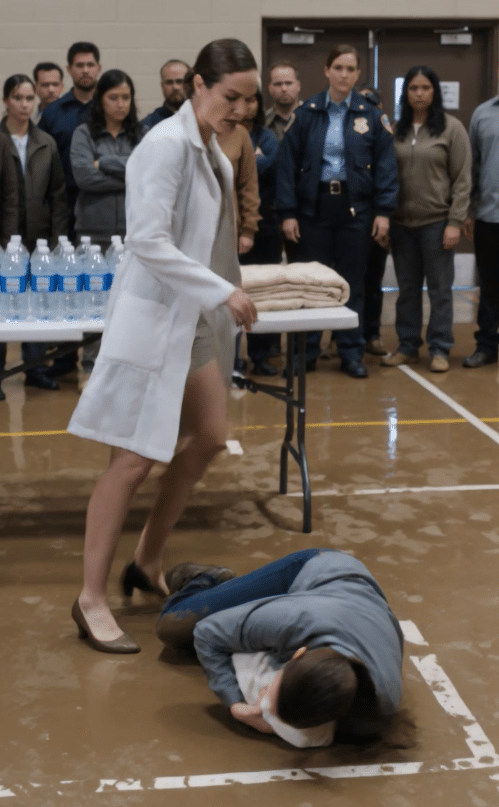
Her white coat was immaculate. Her expensive boots showed no trace of mud despite the flooded streets outside, and her carefully styled hair remained untouched by the rain. A gold bracelet circled her wrist as she glanced at Emily’s soaked gray jacket and mud-stained jeans.
Then she smiled.
“Trash. I pay more taxes than you.”
The insult cut through the noisy gymnasium.
Around them, families stood in lines beneath harsh overhead lights, their wet coats dripping onto the floor. Some had spent the night in flooded cars. Others had abandoned their homes with nothing but the clothes they were wearing. Blankets covered the shoulders of elderly residents, and children sat on folding chairs beside bags of belongings rescued from the water.
At the far end of the gym, volunteers were packing away empty containers and folding tables.
The relief distribution was almost over.
Emily had waited nearly two hours for her turn.
Her name was Emily Carter, and she had arrived at the center shortly before dawn with her eight-month-old daughter, Lily. Their apartment had taken on water during the night, and the rising flood had forced them to leave before they could collect more than a small bag of clothes.
Emily had no car, no savings she could afford to spend, and no nearby family able to take them in.
The towel wrapped around Lily was one of the few things she had managed to grab before escaping.
Now the baby’s tiny face rested against her mother’s shoulder, her cheeks flushed from crying. Emily could feel her daughter’s movements against her chest, and each small sound reminded her how long it had been since Lily had been fed.
The volunteer who had handed her the relief bag looked stunned.
“Ma’am, that was the last infant supply package.”
The wealthy woman lifted the bag slightly.
“Then you should have saved it for someone who actually contributes to this country.”
Emily stared at her.
“I work. I pay what I can. We lost our apartment last night.”
“That’s not my problem.”
“My baby hasn’t eaten.”
The woman rolled her eyes.
“Then you should have planned better.”
Emily felt something inside her tighten.
She had spent the entire night trying to keep Lily dry, warm, and calm. She had waded through water that reached her knees, clutched her daughter against her chest while rescue workers guided families through the flooded streets, and stood in line at the relief center while her wet clothes grew colder.
She had not asked anyone to rescue her from every problem in her life.
She was asking for the food a volunteer had already placed in her hands.
“Please,” she said. “Just give it back.”
The woman’s expression hardened.
She stepped closer, holding the bag out of Emily’s reach.
“You people always want something for free.”
Emily looked toward the volunteer.
The volunteer opened her mouth, but the woman turned sharply, silencing her with a glare.
Then Emily made one final attempt.
“It’s for my daughter.”
The woman looked at the baby.
For a brief moment, Emily thought the sight might soften her.
Instead, the woman’s face twisted with contempt.
She drove a forceful kick into Emily’s chest.
Emily stumbled backward and fell beside the relief table, twisting instinctively to keep Lily protected against her body. Her forearm struck the floor, leaving a thin scrape. The relief bag dropped nearby, its contents still sealed inside.
Lily cried out.
Emily curled around her daughter, trying to shield the child from the hard floor.
A woman in the waiting line gasped. An elderly man covered his mouth, while a volunteer froze with a stack of blankets in her arms.
The attacker stepped toward Emily.
Then she kicked her again, striking her back and side.
Emily tightened both arms around Lily as much as she could, using her own body to protect the baby.
The woman delivered a second follow-up kick.
Three blows.
One frightened mother on the floor.
One baby crying against her chest.
And a relief bag lying just beyond Emily’s trembling fingertips.
The crowd recoiled, but nobody moved quickly enough to stop what was happening.
The wealthy woman looked down at Emily.
“Take what’s left after people like me.”
Then the gymnasium doors swung open.
A woman in a navy official jacket strode into the relief center, accompanied by rescue workers. An agency patch was visible on her sleeve, and her expression changed the instant she saw the scene beside the supply table.
She moved straight toward the attacker.
Before the woman in white could turn away, the newcomer delivered one forceful slap across her face. The sound echoed through the gymnasium.
Then she stepped between the attacker and Emily, shielding the mother and child with her own body.
“That bag just decided who gets help… and who gets investigated.”
The woman in white raised a hand to her cheek.
Her mouth fell open.
Her eyes dropped to the official patch on the stranger’s jacket.
For the first time, the confidence drained from her face.
“Investigated?” she stammered. “You are…?”
She had just discovered that the woman standing in front of her was someone whose authority she could not buy her way around.
And the relief bag she had stolen was about to become the center of an investigation that reached far beyond the gymnasium.
Act II
Emily Carter had never imagined that she would become one of the faces of a disaster.
Before the flood, her life had been difficult but manageable.
She worked part-time at a neighborhood grocery store, picking up extra shifts whenever the manager needed someone to cover an absence. Her husband, Daniel, had left two years earlier, and since then, Emily had been raising Lily on her own.
Money was always tight.
She lived in a modest ground-floor apartment where the windows rattled during storms and the kitchen faucet leaked whenever someone turned it too far. She bought secondhand baby clothes, planned meals carefully, and often skipped little comforts to make sure Lily had what she needed.
Still, she had a routine.
She knew which store marked down bread in the evening. She knew which bus arrived late on rainy mornings. She knew how to stretch a few groceries through the final days before payday.
And she had learned to measure progress in small victories.
A paid electricity bill.
A full container of baby formula.
A night when Lily slept long enough for Emily to finish a load of laundry.
Those things might have seemed ordinary to someone with a comfortable income.
To Emily, they were the foundations of a life she was desperately trying to rebuild.
Then the storm came.
Rain battered the city through the night, and warnings about rising water began appearing on phones across the neighborhood. At first, Emily believed the danger would pass before morning. Her apartment had flooded slightly during previous storms, but never enough to force her out.
By midnight, water was pushing beneath the front door.
She lifted Lily from her crib and wrapped her in a towel while trying to gather diapers, medication, identification documents, and whatever food she could carry. The electricity flickered. A neighbor shouted from the hallway that rescue crews were helping residents leave.
Emily had seconds to decide what mattered most.
She chose Lily.
She left behind furniture, clothes, photographs, and the small collection of things she had kept from her daughter’s first months. By the time she reached the street, the water had spread across the sidewalk, carrying branches and pieces of debris past abandoned cars.
A rescue worker guided her toward higher ground.
At a temporary shelter, she was given a blanket and directions to the gymnasium serving as a relief center.
She arrived exhausted, soaked, and terrified of what she would find when the floodwaters receded.
The volunteers treated her kindly.
Someone found dry clothes for Lily. Another person brought Emily a cup of water and helped her locate a place to sit. For the first time since leaving her apartment, Emily felt that she might be able to get through the day.
Then she heard that the relief center was distributing food and infant supplies.
She waited patiently.
When the volunteer placed the final relief bag in her hands, Emily felt an almost embarrassing wave of relief. The bag wasn’t large, but it contained the things she needed most urgently.
Baby milk.
Food.
Basic supplies that would help her care for Lily while she figured out where they would sleep that night.
She had just begun to turn away when a stranger took it from her.
The woman called herself Victoria Hale.
At forty, Victoria had built a comfortable life through property investments and a family business that managed several high-end rental properties. She drove an expensive SUV, lived in a spacious home outside the city, and had the kind of financial security that allowed her to treat unexpected expenses as minor inconveniences.
The flooding had affected several roads near her neighborhood, but her house remained dry.
She had come to the relief center after hearing that emergency supplies were available.
Her original plan had been to collect a few extra items to keep in her vehicle in case the roads became difficult to navigate again. She had no urgent need for food, and she had not arrived with a baby or another dependent requiring specialized supplies.
But when she learned that the final package was about to be given away, she decided that she wanted it.
Victoria had spent years convincing herself that people with money deserved greater control over the world around them.
She told herself that she had worked harder than others. She had made better decisions. She had taken risks, paid taxes, and built a life through her own effort.
In her mind, those achievements entitled her to preferential treatment.
She rarely considered the possibility that other people had worked just as hard and still been overwhelmed by circumstances beyond their control.
Emily’s wet clothes confirmed everything Victoria already believed.
She saw a woman who had lost her apartment and needed public assistance. She did not see the mother who had carried her baby through floodwater in the middle of the night.
She saw dependence.
She did not see courage.
And when Emily asked for the relief bag back, Victoria interpreted the request as an insult to her status.
She could have walked away.
She could have offered to buy Emily a meal.
She could have left the supplies for the people who needed them.
Instead, she chose humiliation.
Then violence.
The woman who intervened was Commander Rebecca Lawson, a fifty-two-year-old federal disaster response official coordinating relief operations in the affected region.
Rebecca had spent years working alongside emergency management teams during hurricanes, wildfires, and devastating floods. She knew that the first hours of a disaster were often chaotic, but she also knew that chaos could not become an excuse for exploiting vulnerable people.
She had come to the gymnasium to inspect supply distribution, review shortages, and coordinate incoming deliveries with local officials.
She had not known Emily before that morning.
She had no personal connection to the mother or her child.
What she saw was enough.
An exhausted woman on the floor.
A baby crying against her chest.
A wealthy stranger standing over them after taking the last relief package.
Rebecca’s response was immediate, though her own physical intervention would also have consequences and would need to be assessed under the circumstances. Her official authority did not make every action automatically lawful or justified.
But she had made one decision without hesitation.
She would not allow the attack to continue.
Now, standing between Victoria and Emily, Rebecca turned toward the nearest rescue worker.
“Get medical assistance here. Secure the distribution records, and make sure the witnesses are identified.”
Then she looked back at Victoria.
The woman’s hand remained pressed against her cheek.
She had entered the relief center believing that her money made her more important than everyone around her.
She was beginning to understand that she had stepped into a place where money was not the only thing that mattered.
And Rebecca Lawson was about to show her exactly why.
Act III
“Who gave you permission to hit me?” Victoria demanded.
Her voice shook with outrage, but she was already looking past Rebecca toward the people gathered around the relief table.
She expected someone to rush to her defense.
Instead, the crowd had finally begun to move.
A rescue worker hurried toward Emily, kneeling beside her while another staff member carefully checked on Lily. The baby was crying, but she remained protected in her mother’s arms.
The volunteer who had distributed the relief bag stepped forward.
“She took the bag from Emily,” the volunteer said. “I watched her do it.”
Victoria turned sharply.
“Be quiet.”
The volunteer flinched but continued.
“It was the last package. It had baby milk inside.”
“I don’t care what was inside it!”
The words came out too loudly.
Several people recoiled.
Rebecca’s expression hardened.
“You should care,” she said. “Because you took supplies intended for someone who needed them.”
Victoria stared at her.
“And who exactly are you to tell me what I should care about?”
Rebecca did not answer immediately.
She crouched briefly beside Emily, checking that the rescue worker had the situation under control. Emily was holding Lily close, her face pale with pain and fear.
“Help is on the way,” Rebecca told her. “Keep your daughter close. The medical team will take care of you.”
Emily nodded, unable to speak.
Rebecca rose and faced Victoria again.
“You can explain your actions to the appropriate authorities.”
Victoria let out a disbelieving laugh.
“Authorities? For taking a bag of food?”
“For what happened to that mother.”
“She attacked me first!”
The claim startled the volunteer.
“No, she didn’t!”
Victoria pointed at Emily.
“She grabbed me.”
Emily looked up from the floor.
“I only asked for my baby’s milk.”
Her voice was so quiet that several people leaned forward to hear her.
Rebecca watched Victoria for another moment.
Then she turned toward the rescue workers behind her.
“Preserve the incident records. Identify everyone who witnessed the confrontation. If the area is covered by cameras, make sure the relevant footage is retained. And notify the local authorities.”
One of the workers nodded and moved away to make the necessary calls.
Victoria’s expression changed.
She had expected Rebecca to argue with her, to become distracted by accusations, or to back down when threatened.
Instead, the official was treating the incident as something that needed to be documented.
That was far more dangerous to Victoria than an argument.
Arguments could be denied.
Records were harder to dismiss.
She looked toward the distribution table, where volunteers were gathering the remaining supplies.
“You can’t investigate me because I wanted a backup bag.”
Rebecca’s eyes narrowed.
“Wanting supplies is not the issue. Taking a package that had already been given to someone else is one issue. Attacking a mother who was protecting her baby is another.”
Victoria opened her mouth.
Rebecca continued before she could interrupt.
“And neither your income nor your tax payments give you permission to hurt someone.”
The words landed heavily.
Victoria had used her taxes as a weapon because she believed that paying more meant she deserved more. She had assumed that the people around her would accept her argument without question.
But the volunteers had watched Emily wait in line.
The evacuees had watched Victoria take the bag.
And now they had witnessed what happened when Emily tried to protect her child.
The facts were becoming difficult to escape.
A rescue worker approached Rebecca and spoke quietly.
“The distribution log confirms that the package was assigned to the mother. We also have several witnesses willing to provide statements.”
Rebecca nodded.
“Thank you. Keep the records together.”
Victoria’s eyes flicked toward the worker.
“What distribution log?”
“The volunteers record the supplies they hand out,” Rebecca replied. “It helps us track shortages and make sure families receive the assistance they’re eligible for.”
Victoria looked suddenly uncomfortable.
She had assumed the relief center operated on confusion and goodwill alone. She had not considered that the people managing supplies might have records showing exactly who received what.
Rebecca continued.
“The purpose of those records is to make sure relief reaches the people it is meant to help. If someone interferes with distribution or uses the emergency to intimidate others, that needs to be documented.”
“You’re acting as though I stole a fortune.”
“No,” Rebecca said. “I’m acting as though a vulnerable mother and her baby deserve protection.”
Victoria shook her head.
“This is ridiculous.”
She tried to step around Rebecca, but the official remained between her and Emily.
“Stay back while the medical team attends to her.”
“I want my things.”
“Your belongings are not the priority right now.”
Victoria stared at her in disbelief.
For most of her adult life, she had been accustomed to making demands and watching other people scramble to satisfy them. She had learned to use impatience as leverage and outrage as a shortcut.
Now, every attempt to seize control was meeting the same calm resistance.
Rebecca did not raise her voice.
She did not insult Victoria.
She did not threaten to ruin her life.
She simply refused to let the woman redirect attention away from the injured mother.
Then Victoria noticed the patch on Rebecca’s sleeve.
She leaned forward, squinting at the insignia.
“Wait.”
Her voice changed.
“You’re with FEMA?”
Rebecca met her eyes.
“I’m coordinating the federal response here.”
For a moment, Victoria seemed unable to process the answer.
She had heard of the Federal Emergency Management Agency. She had seen its officials on television after hurricanes and floods, directing resources, coordinating assistance, and working alongside local emergency crews.
But she had never imagined that one of those officials would be standing in front of her, witnessing her behavior.
She tried to recover.
“That doesn’t give you the right to threaten me.”
Rebecca’s expression remained controlled.
“I haven’t threatened you. I’ve told you that this incident will be documented and reviewed.”
“Reviewed for what?”
“That depends on what the evidence establishes and what the appropriate authorities determine.”
Victoria looked around.
The people who had been frightened into silence were now watching her openly. The volunteer was speaking with a staff member. Two evacuees had agreed to provide statements, and a rescue worker was arranging for Emily to be examined.
The stolen relief bag lay on a nearby table.
Its contents were still intact.
Baby milk.
Food.
Supplies that had never belonged to Victoria in the first place.
Rebecca glanced toward the bag.
Then she looked back at the woman who had taken it.
“That bag just decided who gets help… and who gets investigated.”
Victoria’s lips parted.
The sentence sounded almost impossible to her.
She had thought the bag was too insignificant to matter.
Now it had become evidence of something much larger.
And Rebecca was about to reveal why the incident could have consequences extending beyond a single afternoon at the relief center.
Act IV
The first thing Rebecca did was make sure Emily and Lily were safe.
She instructed the relief workers to clear space around the mother, asked for medical assistance, and ensured that the baby remained with her while the team assessed Emily’s injuries.
The rescue workers brought a dry blanket and checked Lily for signs of distress. Emily was shaken and in pain, but she remained conscious and focused on keeping her daughter close.
Only after the medical team had taken over did Rebecca return her attention to Victoria.
The wealthy woman had begun pacing beside the supply table.
“This is completely out of proportion,” she insisted. “I came here because the flooding affected my area. I wanted to make sure I had enough supplies in case the roads closed again.”
Rebecca listened.
“Were you told that this package had been assigned to someone else?”
Victoria hesitated.
“I was told it was the last one.”
“That wasn’t my question.”
Victoria’s jaw tightened.
“Yes.”
“And you took it anyway?”
“I pay taxes. I contribute to this country. I don’t see why I should be treated like some criminal for taking a bag of supplies.”
Rebecca folded her arms.
“Paying taxes does not give you ownership of emergency relief supplies that have already been distributed to another person.”
Victoria looked away.
She had no answer that could make the facts disappear.
Rebecca turned to one of the local relief coordinators, who had been reviewing the distribution records.
The coordinator confirmed that the final package had been allocated to Emily because she had an infant and had reported an urgent need for baby supplies. The center had been operating under limited inventory, and the volunteers had been trying to ensure that the remaining resources reached families with the most immediate needs.
Victoria had not been denied assistance because of her wealth.
She had simply arrived after the final package had been assigned.
If she needed supplies, staff could assess her situation and direct her to the appropriate resources. But she had no right to take the package from someone else.
Rebecca asked the coordinator to record the discrepancy and preserve the distribution log.
Then she turned back to Victoria.
“You were free to ask for help. You were free to explain your circumstances. You were free to leave without taking anything.”
Victoria’s expression twisted.
“And I was free to defend myself.”
“From what?”
“She wouldn’t let go of the bag.”
“She was trying to keep the food that had been given to her.”
Victoria looked as though she wanted to shout, but the witnesses were listening.
Every word she said seemed to make her position worse.
Then one of the rescue workers returned with a report from the initial witness interviews.
Several people had seen the entire confrontation. Their accounts were consistent about the order of events: the volunteer handed the package to Emily, Victoria took it, Emily asked for it back, and Victoria attacked her.
The statements would need to be formally collected and assessed, but there was no indication that Emily had initiated a physical confrontation.
Victoria’s claim that she had been defending herself was now facing direct contradiction from multiple witnesses.
Rebecca listened carefully.
She did not declare a criminal verdict. That was not her role.
Instead, she asked that the information be passed to the local authorities and that the relevant evidence be preserved.
“Make sure the reports include the exact sequence of events,” she said. “No assumptions. No embellishments. Just what the witnesses saw.”
The coordinator nodded.
Victoria stared at Rebecca.
“You’re going to let them ruin my life over this?”
Rebecca answered without hesitation.
“I’m going to let the evidence be examined.”
The distinction was simple.
It was also the one Victoria had been trying hardest to avoid.
She had wanted the conversation to become a dispute over status, money, and who deserved more respect. Rebecca kept bringing it back to the mother on the floor and the actions that had led her there.
Finally, Victoria attempted one last argument.
“I have connections. I know people who donate to relief organizations. I could make a phone call and have this whole operation questioned.”
Rebecca regarded her steadily.
“You’re welcome to raise any legitimate concerns through the appropriate channels.”
Victoria’s eyes narrowed.
“You don’t understand what you’re risking.”
“I understand exactly what my responsibility is.”
Rebecca glanced toward the volunteers.
“They are distributing supplies to people who have lost homes, food, and basic necessities. They should not have to fear being assaulted while doing it.”
The words struck the room with quiet force.
One of the volunteers lowered her eyes, wiping away a tear. She had spent the morning helping frightened families find blankets, bottled water, and food. She had not expected to witness a woman being attacked for accepting the final package of baby supplies.
Another volunteer stepped forward and confirmed that she was willing to provide a statement.
Then a man who had been standing near the bottled water table did the same.
The crowd that had frozen in fear was beginning to cooperate.
Not because Rebecca had ordered anyone to be brave, but because she had made it clear that they would be heard.
Victoria looked around at the faces surrounding her.
For the first time, she seemed to understand that the people she had dismissed as poor, dependent, and unimportant were capable of telling a story she could not control.
Her expensive coat could not erase their memories.
Her tax payments could not invalidate their statements.
And her anger could not turn the stolen relief bag into something she had been entitled to take.
Rebecca stepped closer, keeping enough distance to avoid further confrontation.
“Your actions here may have consequences,” she said. “Those consequences will be determined through the proper process. But no one is going to pretend this didn’t happen simply because you have money.”
Victoria looked at the FEMA patch again.
Her hand rose unconsciously toward her cheek.
The anger in her face was giving way to something unfamiliar.
Fear.
Not fear of losing a bag of supplies.
Fear that the people around her had finally stopped treating her as someone who could not be challenged.
She had come to the relief center believing that her status would put her above everyone else.
Now she was facing the possibility that her behavior would be recorded, investigated, and judged by people who were not impressed by her wealth.
The director of the operation had not promised to destroy her.
She had promised something much harder for Victoria to manipulate.
An honest accounting of what happened.
And as the medical team prepared to take Emily for further evaluation, Rebecca delivered one final instruction to the relief coordinator.
“Make sure the mother receives the supplies she was originally given. If we need to replace anything, we’ll find a way.”
Victoria stared at her.
The bag she had stolen was being returned to the woman she had attacked.
The very outcome she had tried to prevent was happening in front of her.
And for the first time that day, she had nothing to say.
Act V
Emily did not immediately realize that the relief bag had been returned.
She was focused on Lily, whose cries had softened into exhausted whimpers. The baby was still wrapped in the towel, her tiny hand gripping the fabric near her mother’s collar.
A medical worker crouched beside Emily and spoke gently, explaining that she needed to be assessed before attempting to stand.
Emily nodded.
“Is my baby okay?”
The worker checked Lily again.
“We’re keeping an eye on her. We’ll make sure she’s all right.”
Emily pressed her cheek against the baby’s head.
She had spent the entire morning trying to protect her daughter from a disaster she could not control. She had fled her apartment, lost most of their belongings, and arrived at the relief center with no clear idea of where they would sleep.
Then, when someone finally offered help, that help had been taken away.
The attack had left her shaken in a way she could not easily explain.
It wasn’t only the pain.
It was the humiliation of having to plead for something as basic as food while strangers watched. It was the fear that Lily might be hurt. It was the awful realization that a person could look at a struggling mother and see nothing worth protecting.
When Rebecca approached her again, Emily tried to sit up.
“Please don’t,” the official said gently. “The medical team will tell you when it’s safe.”
Emily looked embarrassed.
“I’m sorry.”
Rebecca crouched beside her.
“What are you apologizing for?”
“I don’t know. I just—”
Emily stopped.
Her eyes filled with tears.
“I didn’t want to cause trouble for anyone.”
Rebecca’s expression softened.
“You didn’t cause this trouble. The person who hurt you is responsible for their own actions.”
Emily looked down at Lily.
“I only wanted to feed her.”
“I know.”
Rebecca waited until Emily looked at her again.
“And you were right to ask for the bag back.”
Those words seemed to reach somewhere deep inside the exhausted mother.
She had been treated as though asking for help was a moral failure. She had been told that her poverty made her less deserving. She had been kicked to the floor while trying to protect her child.
Now someone with the authority to coordinate emergency assistance was telling her that she had done nothing wrong by asking for food.
Emily began to cry.
Rebecca did not tell her to be strong.
She did not offer a speech about overcoming adversity.
She simply remained beside her while the medical team continued its work.
Eventually, the relief coordinator brought over the recovered bag.
The volunteer checked its contents and confirmed that the baby milk and food were still sealed. Additional supplies were arranged to replace anything missing or damaged, ensuring that Emily would not leave the center without the essentials she needed.
When the bag was placed beside her, Emily stared at it for a long moment.
Then she whispered, “Thank you.”
The volunteer knelt beside her.
“You don’t have to thank us for helping you.”
Emily gave a small, tired smile.
“Maybe not. But I still want to.”
For the first time since the flood began, she felt that someone had seen her as more than another person waiting for assistance.
She was a mother trying to keep her child safe.
That should have been enough.
Across the gymnasium, Victoria was speaking with local authorities and relief staff. The incident was being documented, and witnesses were being asked to provide their accounts. The distribution records and any available footage would be preserved for review.
The investigation would determine what legal consequences, if any, followed from the assault. Rebecca’s official position did not give her the power to pronounce guilt or guarantee a particular punishment.
Nor could she promise that Victoria would never again enter a relief center.
Any restrictions or further actions would have to follow the applicable rules and the decisions of the responsible authorities.
But the incident would not disappear.
That was the difference.
Victoria could hire a lawyer. She could challenge witness accounts. She could offer her own explanation of what had happened.
She could not honestly claim that the bag had never been assigned to Emily.
She could not make the volunteers forget the insults.
And she could not undo the fact that several people had watched her attack a mother who was protecting her baby.
In the days that followed, the flood relief center continued serving families displaced by the disaster.
More supplies arrived. Additional volunteers came to help. The gymnasium remained crowded, and the muddy marks on the floor were repeatedly cleaned only to reappear as evacuees entered carrying wet bags and blankets.
Emily and Lily were eventually connected with temporary housing assistance and local family support services. The process was not instant, and the road ahead remained uncertain, but she no longer had to solve every immediate problem alone.
She learned where she could collect additional infant supplies. She received information about replacing essential documents lost in the flood and finding longer-term accommodation.
There would still be difficult decisions.
There would still be bills.
There would still be nights when she wondered how she could rebuild a home for her daughter from what remained.
But the attack at the relief center had not taken away her right to ask for help.
It had not made her less deserving of food.
And it had not defined the kind of mother she was.
One afternoon, several days after the incident, Emily returned to the center to collect additional supplies. The gymnasium was quieter than it had been during the first chaotic days of the disaster.
The volunteer recognized her immediately.
“How are you and Lily doing?”
Emily adjusted the baby against her shoulder.
“We’re managing.”
It wasn’t a perfect answer, but it was an honest one.
The volunteer placed a package of baby supplies on the table.
Emily thanked her, then looked toward the far end of the gymnasium, where Rebecca was speaking with rescue workers about the next delivery.
The official noticed Emily and walked over.
“How’s your daughter?”
“She’s doing better.”
“Good.”
Emily hesitated.
“Can I ask you something?”
“Of course.”
“Why did you step in?”
Rebecca looked toward the volunteers packing supplies into boxes.
For a moment, she seemed to consider how best to answer.
“Because people in a disaster have already lost enough,” she said. “They shouldn’t have to fight each other for the help that’s supposed to keep them safe.”
Emily looked down at Lily.
“I was afraid nobody would do anything.”
Rebecca nodded.
“I know.”
The answer held no judgment.
Just understanding.
Emily took a breath.
“I thought maybe she was right. Maybe because I don’t have much, I shouldn’t have been asking for so much.”
Rebecca’s expression changed.
“Listen to me. Losing your home doesn’t make you less valuable. Needing help doesn’t make you a burden. And being poor doesn’t mean someone else gets to decide whether your child deserves to eat.”
Emily’s eyes filled again, but she did not look away.
This time, she let the words settle.
She had spent months trying to prove that she could manage on her own. She had treated every setback as a private failure and every request for help as something she needed to justify.
The flood had forced her to confront how little control any one person truly had over the world around them.
The attack had shown her how cruel some people could be.
But the response had shown her something else.
There were people who would stand beside her without demanding that she first prove she deserved it.
Rebecca returned to her work, and Emily left the gymnasium with Lily and the supplies she needed.
Outside, the floodwaters were slowly receding.
Cars remained abandoned along damaged streets. Some houses would require extensive repairs, and others might never be safe to occupy again. Families continued to face uncertainty about where they would live and how they would recover.
The disaster was far from over.
But Emily was no longer standing at the edge of it entirely alone.
And Victoria Hale would have to live with a different kind of uncertainty.
She had entered the relief center convinced that paying more taxes made her more deserving than a mother who needed public assistance.
She had assumed that wealth was proof of merit and poverty was evidence of failure.
She had believed that the final relief bag belonged to whoever could take it.
Then she had attacked the person who needed it most.
The bag itself had been worth very little.
A few basic supplies.
Some food.
Baby milk.
Yet it revealed a truth that money had allowed Victoria to avoid confronting for years: a person’s wealth says nothing about whether they deserve dignity, and another person’s hardship does not make them an acceptable target.
Rebecca Lawson had not known Emily before that morning.
She had no reason to favor her over Victoria, no family connection, and no personal history that demanded loyalty.
She acted because she saw someone vulnerable being hurt.
That was what made the moment matter.
Not the slap.
Not the badge.
Not the wealthy woman’s sudden fear.
It was the decision to intervene when an exhausted mother and her baby had been left defenseless.
As Emily walked away from the gymnasium, Lily rested quietly against her shoulder. The relief bag hung from her free hand, its contents secured for the journey ahead.
She still had no permanent home.
She still had to rebuild almost everything.
But she had food for her child, people who knew what had happened, and the beginnings of a path forward.
Behind her, the volunteers continued distributing supplies.
Another family approached the table, carrying wet blankets and a small bag of belongings rescued from the flood. The volunteer greeted them, asked what they needed, and began gathering the appropriate items.
No one asked them how much they paid in taxes.
No one demanded that they prove they were wealthy enough to deserve help.
The supplies went to the people who needed them.
And the last relief bag was no longer a symbol of greed.
It had become a reminder of what emergency aid was supposed to mean: that when disaster stripped people of their homes, their possessions, and their sense of security, their humanity remained untouched.
Victoria had believed that money placed her above everyone else.
Rebecca had reminded her that authority carried responsibility.
Emily had reminded the people watching that even in the worst circumstances, a mother would fight to protect her child.
And the baby milk that started the confrontation had exposed the difference between having everything and understanding what mattered.
Because when the flood came, Emily lost her home.
Victoria risked her reputation.
But the thing that truly separated them was not what either woman possessed.
It was what each chose to do when confronted with someone else’s need.
One saw a mother who deserved compassion.
The other saw someone she believed she could humiliate.
And in the end, the woman who had claimed she paid more taxes was left facing the question she had never expected anyone to ask:
What is wealth worth when it cannot buy the right to treat another human being as less than human?