Act I
The cardboard box barely touched the leather suitcase.
It was a tiny accident. A sixteen-year-old boy turning through a crowded apartment loading dock, a box slipping slightly in his arms, the corner brushing an expensive suitcase as he maneuvered toward the service elevator.
“Sorry. I was turning with the box.”
The boy said it immediately. His voice was quiet, almost swallowed by the low rumble of the moving truck idling behind him. He shifted the box against his chest, careful not to drop it, and looked at the man standing in front of him.
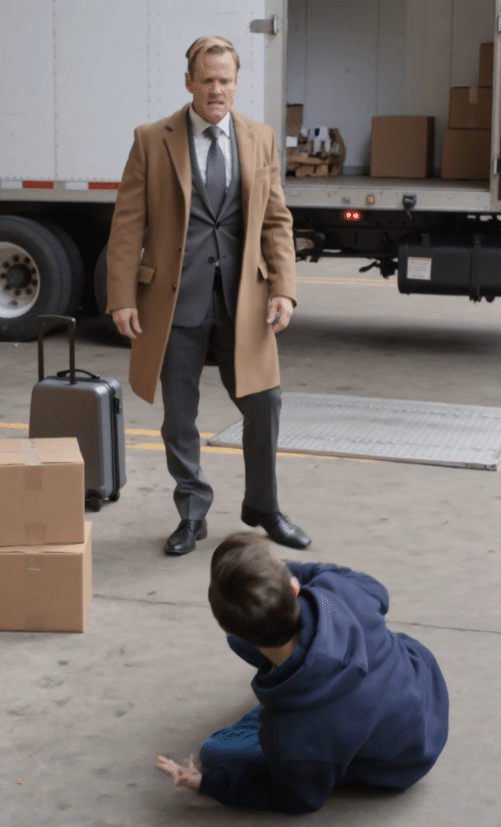
The man was forty-nine, dressed in a perfectly tailored gray suit beneath a camel-colored coat. His leather shoes were spotless. His watch gleamed beneath the fluorescent lights, and his suitcase looked as though it had never been placed on a dirty floor in its life.
The boy, by contrast, wore a faded navy work hoodie, worn jeans, and scuffed boots. His short brown hair was damp with sweat from carrying boxes up and down the building. His hands were rough, his sleeves were frayed, and a strip of packing tape clung stubbornly to one cuff.
They could not have looked more different.
And the older man seemed determined to make sure everyone noticed.
“Trash,” he snapped. “Keep your filthy boxes away from me.”
The boy blinked.
For a second, he looked as though he hadn’t understood the word. He had apologized. He had stopped moving. He had done everything a decent person could do after an innocent mistake.
Yet the man stared at him as if the boy had deliberately insulted him.
“I’m sorry,” the teenager repeated, lowering the box toward a stack beside the elevator. “I didn’t mean to touch your suitcase.”
The man’s expression hardened.
He wasn’t interested in an apology. He wanted an audience.
Around them, the loading dock was busy with the ordinary chaos of moving day. Two movers wrestled a sofa toward the truck. A woman pulled a rolling suitcase behind her while checking her phone. A young couple waited near the elevator with their toddler, and several residents passed through the corridor, eager to get on with their lives.
Then the argument caught their attention.
The man stepped closer to the teenager, looking him up and down with open disgust.
“Do you people even understand how much things cost?” he demanded.
The boy tightened his grip on the box.
“I was just trying to get it out of the way.”
“Then learn how to do your job.”
The teenager swallowed whatever answer had risen to his lips. He was there to work, not argue. Every box he carried meant a little more money, and he needed every dollar he could earn.
He lowered his eyes and tried to step around the man.
That was when the older man’s anger turned into something far more disturbing.
He planted himself in front of the boy, raised his voice so the people nearby could hear, and sneered at the cardboard boxes scattered across the dock.
“You think you can bring this garbage through here and treat the building like a warehouse?”
The teenager looked toward the service elevator.
He was only a few steps from being out of the man’s way.
“I said I was sorry.”
The words were barely out of his mouth when the man kicked him hard in the chest.
The boy stumbled backward and crashed beside the boxes. Cardboard split beneath his weight, and a roll of packing tape skittered across the concrete. He landed awkwardly, one forearm scraping the rough floor as he tried to protect himself.
A sharp breath escaped him.
For one terrible moment, the entire loading dock seemed to stop.
The movers froze with their hands still on the furniture. The woman with the suitcase covered her mouth. One of the residents took a startled step backward, while the young father pulled his child closer.
Everyone had seen what happened.
And everyone seemed to be waiting for someone else to do something.
The boy tried to push himself upright.
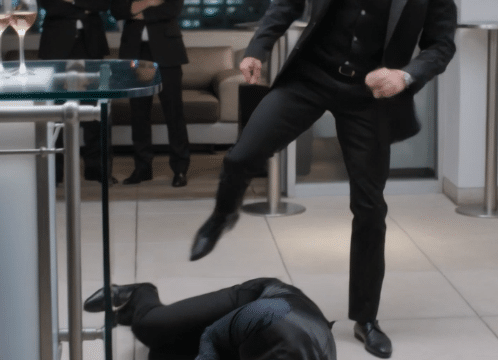
Before he could, the man stepped toward him and delivered two more forceful kicks, one to his back and another to his side.
The teenager curled inward, instinctively shielding himself. His face tightened with pain, and a thin trace of blood appeared along his scraped forearm.
The cardboard boxes lay scattered around him.
The man looked down at the boy as if the assault had been nothing more than a minor inconvenience.
“Carry trash where residents cannot see it.”
No one spoke.
The teenager remained on the floor, struggling to catch his breath. His eyes moved briefly across the faces surrounding him, searching for a single person willing to step forward.
He found none.
Then the service elevator doors opened.
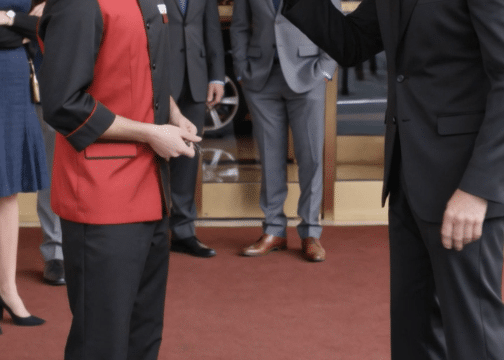
A man in a black vest stepped into the loading dock.
He was fifty-eight, with silver beginning to show at his temples and the composed, watchful expression of someone accustomed to being obeyed. He had been coming down from the building’s operations office when the commotion reached him.
He saw the boxes.
He saw the teenager on the ground.
Then he saw the man in the camel coat standing over him.
Something changed in his face.
He moved so quickly that the nearest mover barely had time to turn. Before the bully could understand what was happening, the newcomer delivered one straight punch to his face, sending him stumbling backward in shock.
The man in the black vest immediately stepped between the attacker and the injured boy.
His voice was low, but it carried across the loading dock.
“He carried more weight today than your name ever will.”
The older man stared at him.
For the first time since the argument began, he looked uncertain.
Then the newcomer turned his full attention toward him, and the bully’s expression changed from outrage to confusion.
“My name?”
He had no idea that those two words were about to become the most expensive question he had ever asked.
Act II
Sixteen-year-old Ethan Miller had learned early that some people decided what he was worth before he ever opened his mouth.
To the residents of the luxury apartment building, he was just another kid in a worn hoodie helping the moving crew. They saw the scuffed boots, the faded clothes, and the cardboard dust on his sleeves. Few bothered to wonder why someone his age was working so hard.
The truth was less complicated than they might have imagined, but it was no less painful.
Ethan’s father had died three years earlier after a sudden medical emergency. His mother, Claire, had spent the following months trying to keep their small family afloat, working double shifts at a diner while struggling to cover rent and the debts left behind.
Then she developed a chronic illness that made it impossible for her to work consistently.
The bills accumulated. Their savings disappeared. Eventually, they lost their apartment and moved into a cramped rental on the other side of the city, where the heating failed whenever the weather turned cold.
Ethan never complained about it at school.
He had seen what worry did to his mother. He knew how she sometimes sat at the kitchen table long after midnight, pretending to read paperwork while calculating which bills could wait another week.
So he found work.
The moving crew had offered him occasional shifts carrying lighter boxes, organizing supplies, and cleaning the truck at the end of the day. The owner had made it clear that Ethan wasn’t expected to handle heavy furniture or dangerous equipment.
The pay wasn’t much, but it was honest.
More importantly, it gave Ethan something he desperately needed: the feeling that he could still do something to help his mother.
Every evening, he counted his earnings carefully. Some went toward groceries. Some went toward the electricity bill. The rest he kept in an envelope inside a kitchen drawer, hoping that if he saved enough, he could eventually take some of the pressure off Claire.
He had learned not to dream too loudly.
Dreams were expensive, and their family had become accustomed to disappointment.
Still, there were moments when the future seemed almost reachable.
That morning, Claire had called him before his shift.
“Don’t forget to eat something,” she had said.
“I will.”
“And Ethan?”
“Yeah?”
“You don’t have to prove your worth by exhausting yourself.”
He had smiled at the phone.
“I know, Mom.”
But he didn’t entirely believe it.
For Ethan, being useful had become a kind of protection. If he worked hard enough, perhaps no one would notice how little his family possessed. If he remained polite, perhaps people would treat him with the dignity they gave everyone else.
He was discovering that neither assumption was always true.
The man who had attacked him was named Richard Caldwell.
Richard lived on the building’s upper floors, where the apartments had private terraces and panoramic views of the city. He belonged to the kind of social circle in which people exchanged business cards before learning each other’s first names.
He had spent decades cultivating an image of success.
His suits were custom-made. His vacations appeared regularly in photographs shared among his professional acquaintances. At charity dinners, he knew precisely when to smile for the cameras and which influential guests deserved the most attention.
He considered himself a man of consequence.
And he had become accustomed to treating inconvenience as an insult.
The suitcase that had triggered his outburst contained documents for a meeting scheduled later that afternoon. Richard had been preparing for a major real estate transaction, one he believed would secure his position among the city’s wealthiest investors.
He was already running late when the cardboard box touched his luggage.
To anyone else, the incident would have been forgettable.
To Richard, it offered an opportunity to remind someone of his place.
The boy was young. He was poor. He wore work clothes. No one important seemed to know him.
Richard assumed there would be no consequences.
That assumption had governed much of his life.
He had mistaken silence for permission, wealth for superiority, and other people’s fear for proof that he deserved their obedience.
Until that morning, the strategy had worked remarkably well.
But the man who had stepped out of the service elevator wasn’t one of Richard’s employees, and he wasn’t someone who could be intimidated by an expensive coat or a carefully polished reputation.
His name was Samuel Grant.
Samuel had built Grant Moving and Logistics from a single secondhand truck into one of the region’s largest moving and property logistics companies. His business handled residential relocations, commercial contracts, secure document transport, and the complex logistics that kept several major apartment developments operating smoothly.
The building where Ethan had been working was one of his most important partnerships.
Samuel knew the loading dock, the elevator schedules, the maintenance staff, and the people who worked behind the scenes. He had spent years insisting that the business succeed by treating workers as human beings rather than disposable labor.
He had started with almost nothing himself.
At nineteen, Samuel had unloaded furniture for a local moving company while sleeping in a room above a mechanic’s garage. He remembered the ache in his back after twelve-hour shifts. He remembered customers who tipped generously and customers who spoke to him as if he were beneath their notice.
Most of all, he remembered a supervisor who had once told him that a man’s character was easiest to recognize when he believed no one important was watching.
Samuel had never forgotten that lesson.
Now, standing between Richard Caldwell and a sixteen-year-old boy, he saw a man who had forgotten it entirely.
But Samuel’s anger wasn’t the only thing Richard needed to fear.
Because the powerful businessman had already begun to understand that the stranger in the black vest knew something about him.
Something he hadn’t expected anyone in that loading dock to know.
And it had nothing to do with the suitcase.
Act III
Richard straightened his coat with trembling fingers.
His cheek stung where Samuel’s punch had landed, but the shock of being struck in front of witnesses seemed to offend him more than the pain itself.
“Have you lost your mind?” he demanded. “Do you know who I am?”
Samuel didn’t answer immediately.
He remained between Richard and Ethan, watching the older man with a stillness that made the silence feel heavier than shouting.
Behind him, Ethan tried to sit up. A mover hurried forward at last, kneeling beside the teenager and asking whether he could breathe comfortably. Another worker called for emergency medical assistance.
Samuel glanced down long enough to make sure someone was attending to the boy.
Then he faced Richard again.
“I know exactly who you are.”
Richard’s expression tightened.
“Then you understand what you’ve just done.”
“I understand what I saw.”
“You assaulted me.”
“And you attacked a child who apologized for accidentally brushing your suitcase.”
Richard looked around the loading dock, apparently expecting the witnesses to confirm his version of events. Instead, he found frightened faces and a dozen pairs of eyes that had watched him kick a teenager lying helpless on the concrete.
For the first time, the audience he had wanted so badly was working against him.
He pointed toward Ethan.
“That boy was out of control. He damaged my property.”
Samuel looked at the suitcase.
There wasn’t even a visible scratch on it.
Then he looked back at Richard.
“Your suitcase is fine.”
“You don’t understand the situation.”
“No,” Samuel replied. “I think I understand it rather well.”
Richard took a breath and tried another approach.
He mentioned the building’s management. He referred to his apartment, his business connections, and the people who would be furious to learn that a resident had been assaulted in his own building.
Samuel listened without interrupting.
The more Richard spoke, the more desperate his threats became.
He seemed unable to imagine that anyone might care about the injured boy more than they cared about his reputation.
Finally, Samuel said the sentence that would change the direction of the entire confrontation.
“He carried more weight today than your name ever will.”
Richard frowned.
“My name?”
Samuel didn’t elaborate.
He reached into the inside pocket of his vest and removed his phone. One brief call brought the building’s operations manager down to the loading dock, followed by the security supervisor.
The supervisor looked at Ethan, then at Richard, and immediately began asking the witnesses what they had seen.
Richard interrupted before anyone could answer.
“This is a private matter. I expect you to handle it discreetly.”
The security supervisor glanced at Samuel.
Samuel gave a small shake of his head.
“Document everything.”
Richard’s jaw tightened.
“You can’t tell me how this building operates.”
“Actually,” Samuel said, “I can tell you how this loading dock operates.”
He turned toward the operations manager.
“Preserve the security footage. All of it. The elevator cameras, the loading area, the truck entrance. I want the original recordings secured before anyone has a chance to overwrite them.”
The manager nodded and hurried away.
Richard’s face lost a little color.
He had assumed the cameras were positioned mainly to monitor deliveries and protect expensive property. He hadn’t considered that they might preserve his own actions with the same indifference.
Samuel continued.
“Get the names of every witness. Make sure the medical team examines the boy. And call the police.”
Richard took a step forward.
“Police? For a little scuffle?”
Samuel’s eyes narrowed.
“You kicked a sixteen-year-old who was lying on the ground.”
“He was being disrespectful.”
“He apologized.”
“He should have known better than to—”
“Stop.”
The single word silenced him.
Ethan sat against a stack of boxes, one arm held close to his body. His face had gone pale, but he was listening. He had never seen an adult speak to a wealthy person that way without immediately apologizing afterward.
Samuel noticed the boy watching him.
For the first time, his expression softened.
“Stay still until the medical team arrives,” he told Ethan. “You don’t need to get up for anyone.”
Ethan nodded.
He wanted to say thank you, but his throat felt too tight.
All his life, he had learned to make himself smaller when someone powerful became angry. Now, for the first time, someone powerful had placed himself in the way of the anger instead.
Richard saw the exchange.
And something about it unsettled him more than Samuel’s threats.
Because Samuel wasn’t behaving like a man trying to impress an audience.
He was behaving like a man who had made a decision.
Richard tried to recover his composure.
“You’re making a mistake,” he said. “I have people who can make this very unpleasant for you.”
Samuel slipped his phone back into his pocket.
“I’m sure you do.”
The answer contained no fear at all.
Then Samuel looked directly into Richard’s eyes.
“And I have records.”
For a moment, Richard forgot to be angry.
His expression changed so quickly that the security supervisor noticed it. The wealthy resident seemed to be searching Samuel’s face for an explanation, trying to identify which conversation, which document, or which buried piece of information had suddenly become relevant.
Samuel gave him nothing.
Not yet.
Instead, he asked the operations manager to bring down the building’s service agreement file.
Richard stared at him.
“What does a service agreement have to do with this?”
Samuel didn’t answer.
The elevator doors closed behind the departing medical team, leaving the loading dock quieter than it had been all morning.
Then the operations manager returned carrying a thick folder.
Samuel opened it to a marked page.
He placed one finger beside a paragraph near the bottom and turned the document toward Richard.
The man’s eyes moved across the page.
And the confidence drained from his face.
Because the name printed there wasn’t merely the name of a resident.
It was the name of someone who had been trusted with far more than an apartment key.
Act IV
Richard Caldwell had built his life around the belief that money could make consequences negotiable.
A complaint could be managed. A mistake could be buried. An inconvenient witness could be persuaded to reconsider what they had seen.
He had never imagined that the most serious threat to his future would emerge from a moving truck’s loading dock.
The document Samuel had opened was part of the building’s logistics partnership agreement. It outlined the responsibilities of the service provider, the property management company, and the contractors authorized to work on the premises.
Richard had signed related documents months earlier.
At the time, he had barely glanced at them.
He had been too busy negotiating a commercial development deal that would place him at the center of a major property expansion. The building was home to several influential investors, and Richard had spent considerable effort making himself appear indispensable to their plans.
But the partnership agreement contained an important provision.
The building’s management had retained Samuel’s company to oversee logistics, contractor compliance, and certain operational reviews connected to the development. Any credible report of serious misconduct involving a resident, employee, or contractor was subject to documented review.
The agreement did not make Samuel a judge, and it gave him no authority to determine Richard’s criminal liability.
What it did mean was that Richard couldn’t simply order the incident to disappear.
The footage would be preserved. The witnesses would be identified. The building’s management would receive a formal report, and the incident would be referred to the appropriate authorities.
There would be records.
And records had a way of surviving threats.
Samuel closed the folder.
“Your name appears on the resident’s acknowledgment,” he said. “You signed it yourself.”
Richard looked at the document again.
“I don’t see what that proves.”
“It proves you knew the rules.”
“The rules don’t give you the right to punch me.”
Samuel held his gaze.
“That’s a separate matter. The police can investigate what happened here, including my actions.”
The answer caught Richard off guard.
He had expected Samuel to defend himself with excuses, or to pretend that the punch had been justified beyond question. Instead, the businessman had acknowledged that his own conduct could be examined.
Richard struggled to find a way to use that admission.
“You’ve just confessed to assaulting me.”
“I told you what happened. The footage will show it.”
“And you think that makes you some kind of hero?”
“No.”
Samuel’s voice was quiet.
“I think the boy deserves to be safe.”
That was all.
No speech about his fortune. No declaration of superiority. No demand that the crowd admire him.
Just a statement that should never have been remarkable in the first place.
Richard looked around.
The movers were no longer looking away. The woman who had covered her mouth earlier had taken out her phone, ready to provide her account of the incident. One of the residents was speaking to the security supervisor, describing the three kicks in precise detail.
The silence that had protected Richard was breaking apart.
Then came the first unexpected revelation.
The operations manager returned with confirmation that the loading dock cameras had recorded the confrontation from multiple angles. The footage showed the cardboard box brushing the suitcase, Ethan apologizing, Richard insulting him, and the assault that followed.
There was no evidence of a threat from Ethan.
No sign of a struggle.
No justification for the violence.
Richard watched the manager’s face as the information was delivered, and his expression grew increasingly rigid.
“You haven’t reviewed the entire recording,” he insisted.
“We’re preserving the full footage,” the manager replied. “The relevant section is clear.”
Richard turned toward Samuel.
“You’re doing this because you want something from me.”
Samuel shook his head.
“I didn’t know you would be here this morning.”
“Then why are you acting as though you’ve been waiting for this?”
For the first time, Samuel hesitated.
Not because he was uncertain about what to do, but because he was deciding how much of the truth Richard deserved to hear in front of everyone.
Then he spoke.
“Because this isn’t the first time your name has appeared in a complaint.”
The loading dock went still again.
Richard’s lips parted.
“What complaint?”
Samuel opened the folder once more, but he didn’t reveal another document.
“Over the past several months, building management has received concerns about how you treated service staff and contractors. Some were minor disputes. Others were more serious. Until today, most of those reports lacked independent evidence.”
Richard’s eyes flickered toward the security supervisor.
“That is confidential information.”
“It was handled through the appropriate channels,” Samuel said. “And none of it changes what happened to Ethan.”
The distinction mattered.
Samuel wasn’t claiming that every earlier accusation was proven. He wasn’t pretending that Richard’s past complaints made him guilty of anything else. He was telling him that the latest incident would not be dismissed as an isolated misunderstanding merely because Richard had the money to demand that it be forgotten.
Richard had spent years believing that each confrontation began and ended according to his wishes.
Now, for the first time, he was being told that his behavior could form a record beyond his control.
Then the second revelation arrived.
A call came through to the operations manager. The building’s management company had been informed of the incident and wanted confirmation of the resident’s identity.
When Richard heard the manager state his full name, he snatched at the opening.
“Good. Put them on the phone. They’ll explain who I am to this man.”
The manager listened for a moment.
Then he handed the phone to Samuel.
Samuel spoke briefly, his expression unreadable. He confirmed the location, the time, the presence of witnesses, and the fact that emergency assistance had been called.
He listened again.
Finally, he said, “Understood. Preserve the existing arrangements until the review is complete, and don’t make any changes to the records.”
He ended the call.
Richard leaned forward.
“What did they say?”
Samuel slipped the phone into his vest.
“They’re opening a formal incident review.”
“That doesn’t answer my question.”
“It answers the question that matters.”
Richard’s voice rose.
“You think you can destroy my reputation over a teenager carrying boxes?”
Samuel glanced toward the service elevator, where Ethan’s discarded packing tape still lay on the floor.
“No,” he said. “You put your reputation in danger when you decided that a teenager’s dignity mattered less than your suitcase.”
The words landed harder than any accusation Richard had heard that morning.
He had wanted the crowd to see him as a man whose status demanded respect.
Instead, they were watching him become a man whose status could no longer protect him from scrutiny.
But Samuel wasn’t finished.
He looked toward the operations manager and asked whether the building’s management had completed its review of the pending commercial partnership.
The manager hesitated.
“Not yet.”
“Then make sure this incident is included in the documentation provided to the review team. No conclusions beyond the evidence. No missing records. Everything goes through the proper process.”
Richard stared at him.
The commercial partnership.
Suddenly, the consequences became clear.
Richard’s development deal depended on a network of investors, property managers, contractors, and service providers who needed to trust one another. A violent public incident involving a resident and a worker wouldn’t automatically erase his business, but it could trigger scrutiny at precisely the moment he could least afford it.
The investors would ask questions.
The management company would demand answers.
The people Richard had spent years persuading to trust him would see the footage for themselves.
And for once, he would have to explain his actions without controlling the room.
He swallowed.
“You can’t let one incident dictate everything.”
Samuel looked at him steadily.
“Then you should have thought about that before you made it happen.”
Richard tried to speak again, but no words came.
For the first time, he understood why Samuel had refused to tell him exactly what would happen next.
The consequences were no longer a threat someone could bargain away.
They were a process already beginning.
And the man who had spent his life demanding to know who everyone else was had finally been forced to confront a question of his own.
What was his name worth when nobody was afraid to say the truth about him?
Act V
The medical team arrived before Richard could find another argument.
They examined Ethan, checked his breathing, and carefully assessed the pain in his chest and side. His injuries were concerning enough to warrant further medical evaluation, though nothing about the scene justified the dramatic claims Richard had been trying to make.
Ethan was helped onto a stretcher.
As the team prepared to take him for further assessment, he turned his head toward the loading dock.
His eyes found Samuel.
“Thank you,” he whispered.
Samuel stepped closer.
“You don’t owe me anything.”
Ethan looked down at his work hoodie.
“I should’ve just been more careful.”
The words came out automatically, as if he were apologizing for the entire morning rather than a box brushing a suitcase.
Samuel’s expression tightened.
“No, son. You should have been treated like a human being.”
Ethan looked at him for a long moment.
Then he nodded, slowly.
It was a small exchange, almost lost amid the movement of medical equipment and the quiet instructions of the responders. But it was the moment Ethan finally stopped trying to take responsibility for someone else’s cruelty.
The teenager was taken away for medical care.
Behind him, the loading dock had changed completely.
The cardboard boxes were still scattered across the concrete. The moving truck still hummed in the background. The service elevator still opened and closed as residents went about their day.
But nobody was pretending nothing had happened.
The security supervisor had collected the witnesses’ details. The camera recordings were being secured. The building’s management had begun its formal review, and the incident was being referred to the appropriate authorities.
Richard was no longer issuing instructions.
He was answering questions.
When he demanded to know whether he could leave, the security supervisor explained that he could not be detained merely because the building was investigating the incident, but he would need to cooperate with the police and any lawful requests concerning the recording and witness statements.
Richard’s jaw tightened.
He had expected someone to make an exception for him.
Nobody did.
Samuel remained nearby until the immediate situation had been handled. His own punch would also need to be examined in context, and he understood that intervening to stop an assault did not mean every action he took was automatically beyond scrutiny.
He was prepared to answer for it.
That, more than his expensive business or his influence over the building’s logistics, was what separated him from Richard.
Samuel did not believe that power exempted a person from consequences.
He believed power created a greater responsibility to accept them.
Over the following days, the loading dock footage became central to the investigation into the assault. The witnesses provided their accounts, and the building’s management completed its review of the incident.
Richard faced the possibility of criminal charges and civil liability, depending on the findings and applicable law. The property management company also reviewed his conduct under the terms of its existing agreements, while the commercial partners involved in his pending development deal reassessed the risks surrounding his involvement.
There was no magical overnight judgment.
No single signature erased his career.
Instead, something more realistic—and, for Richard, more frightening—happened.
The process continued without asking his permission.
His lawyers could advise him. His associates could distance themselves. He could offer explanations, contest allegations, and argue that the consequences were disproportionate.
But he could no longer make the footage disappear by demanding respect.
And he could no longer insist that the teenager he had kicked was too unimportant to matter.
Ethan spent several days recovering and following medical advice. The pain faded gradually, although the memory of the loading dock stayed with him longer than the physical injuries.
For a while, he struggled with the idea of returning to work.
He imagined the service elevator opening. He imagined another expensive suitcase passing close to him. He imagined the same crowd turning away, leaving him alone on the concrete again.
Claire noticed the change almost immediately.
One evening, she sat beside him at their small kitchen table while he picked at the edge of a paper envelope containing his recent earnings.
“You don’t have to go back before you’re ready,” she told him.
Ethan stared at the table.
“We need the money.”
“We’ll figure something out.”
He gave a tired laugh.
“You always say that.”
“And somehow, we always do.”
For the first time in days, he smiled.
The following week, Samuel visited them.
He didn’t arrive with a camera crew or a public announcement. He came in ordinary clothes, carrying a folder with information about safer work opportunities and a contact for a local youth employment program.
He explained that Ethan would not be pressured to return to the loading dock. If he wanted to continue working, Samuel’s company could help him find age-appropriate duties with proper supervision, subject to the applicable employment rules.
There was no demand that Ethan express gratitude.
No expectation that he turn his pain into an inspiring story for someone else’s benefit.
Samuel simply wanted to make sure the boy had options.
Claire listened quietly, her eyes growing wet as she realized that a stranger had taken the time to think about what happened after the cameras stopped recording.
When Samuel finished, she asked him why.
“You could have walked away,” she said. “Most people did.”
Samuel looked toward Ethan.
“Because I know what it feels like when people decide your work makes you less important than they are.”
He paused.
“And because somebody should have stepped forward sooner.”
Ethan lowered his eyes, but this time it wasn’t out of shame.
It was because he was trying to keep his emotions under control.
He had expected the world to demand that he become tougher, quieter, and more careful after what happened. He hadn’t expected anyone to remind him that he deserved respect before he had earned a single dollar.
Meanwhile, Richard’s life continued to unravel in quieter ways.
The people around him had once mistaken his confidence for competence and his wealth for character. Now they were forced to confront a side of him that no tailored suit could conceal.
Some business associates withdrew from negotiations. Others insisted on waiting for the formal review before making decisions. The building’s management examined the complaints already on record, taking care to distinguish substantiated information from allegations that still required investigation.
Richard continued to insist that the incident had been exaggerated.
But the video did not change.
The box brushed the suitcase.
The boy apologized.
Richard insulted him.
Then he kicked him.
And when the teenager fell, Richard kicked him twice more.
No amount of expensive language could turn those actions into something else.
Weeks later, Richard returned to the building for a meeting with management. He arrived without the camel coat he had worn that morning, carrying a different suitcase and keeping his eyes fixed on the elevator doors.
The loading dock was busy again.
A worker pushed a trolley of supplies past him. Two movers carried a box toward the truck. A young employee in a navy hoodie stepped aside to let a resident pass.
Richard looked at the boy for a second too long.
The employee didn’t recognize him.
He had no reason to.
Richard was just another man waiting for an elevator.
That was what disturbed him most.
For years, he had believed that his name entered a room before he did. He had thought his reputation guaranteed him a certain distance from ordinary people, protecting him from the inconveniences and consequences they endured.
Now he understood that a name could be repeated for reasons a person never intended.
It could appear in a report.
It could be attached to a recording.
It could become the answer to a question asked by someone who no longer cared how much money the person had.
The elevator doors opened.
Richard stepped inside without looking at anyone.
And somewhere across the city, Ethan was preparing for his next shift—not because he had forgotten what happened, but because he had finally begun to understand that one cruel man’s judgment did not define his future.
He still had bills to help pay.
He still worried about his mother.
He still wore the same scuffed boots, and his hoodie was still faded from work.
But he no longer believed that poverty made him invisible.
He had learned that lesson on a concrete floor, in front of a crowd that had been too frightened to move.
And he had learned another lesson from the stranger who stepped between him and the man who thought he was untouchable.
Dignity was not something the wealthy granted to the poor.
It was something every person deserved.
The next time Samuel saw Ethan, the teenager was carrying a box through the same service elevator lobby. He moved carefully, checking his path before turning the corner.
The box passed within inches of a resident’s expensive luggage.
Nothing happened.
No one shouted.
No one reached for a weaponized insult.
The resident simply moved aside and let the boy pass.
Ethan continued toward the truck, his shoulders a little straighter than before.
Samuel watched him go, then returned to his work.
He had not rescued Ethan by making him rich, nor had he undone the cruelty of that morning. He had done something smaller and more important: he had refused to let the boy face it alone.
And Richard Caldwell?
He had asked a question in that loading dock because he believed his name was a shield.
“My name?”
The words had sounded like a challenge when he first spoke them.
By the end, they sounded like fear.
Because the man in the black vest had never needed to destroy Richard’s name.
He had only needed to make sure that, for once, the truth was allowed to follow it.