Act I
“Trash. You nearly made my horse throw me.”
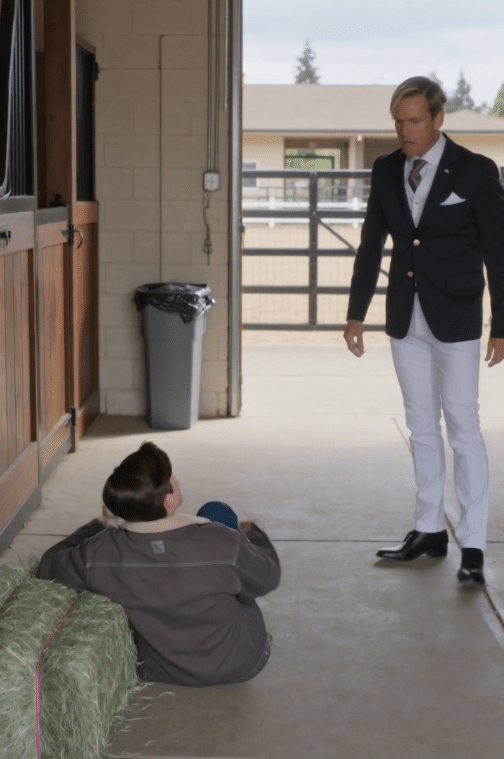
The words exploded through the stable aisle just as sixteen-year-old Ethan Miller stumbled backward against a stack of hay bales.
“I did not scare him. Something startled him.”
Ethan’s voice was quiet, but he tried to hold the wealthy man’s gaze. His faded brown work jacket was dusted with straw, his jeans were worn at the knees, and his old boots had left muddy marks across the otherwise spotless stable floor.
Behind him, a magnificent chestnut horse tossed its head inside the stall, nostrils flaring as it settled after a sudden noise from the riding arena.
The horse had reared slightly moments earlier, startling its rider enough to make him lose his balance for a second.
Nothing had happened to the animal.
Nobody had fallen.
But the rider was furious.
“You think I’m stupid?” the man demanded, stepping closer. “I know what I felt. You made him nervous.”
Ethan shook his head.
“I was replacing the hay. I didn’t touch him.”
The man looked down at Ethan’s work gloves, then at the straw scattered near his boots.
“Of course you didn’t. You’re just the boy who cleans up after everyone else.”
Several riders standing near the adjoining stalls stopped talking.
The man was Richard Caldwell, a wealthy real estate developer who owned one of the most expensive horses at Briarwood Equestrian Estate. He wore a tailored riding jacket, immaculate white breeches, and polished black boots that looked as though they had never touched anything resembling real dirt.
Richard had paid a fortune for his horse, a striking chestnut gelding named Sterling. He expected the animal to perform perfectly, the staff to anticipate his every need, and everyone around him to understand that his time was more valuable than theirs.
Ethan, in Richard’s eyes, was simply another pair of hands.
A poor teenager hired to clean stalls after school.
Someone whose name he had never bothered to learn.
“I’m sorry he got startled,” Ethan said. “I’ll finish the stall and give him some space.”
Richard laughed bitterly.
“You’ll finish the stall?”
He stepped closer until Ethan could smell the expensive leather of his riding jacket.
“That’s all you’re good for.”
Ethan lowered his eyes, trying to avoid provoking him further.
He needed the job.
His mother worked long shifts at a nursing home, and his younger sister had recently started needing expensive tutoring after falling behind at school. Ethan used his wages to help with groceries, utility bills, and whatever else his mother couldn’t cover.
He wasn’t embarrassed by the work.
He was proud of it.
Every evening, he cleaned the stalls, replaced the hay, checked water buckets, and learned to recognize the small changes in a horse’s behavior that inexperienced riders often missed.
He knew that animals could be startled by unfamiliar sounds.
He knew that sudden movement could make a nervous horse react.
And he knew that Sterling had been perfectly calm before the sharp metallic crash from the arena had echoed through the barn.
But Richard didn’t want an explanation.
He wanted someone to blame.
“I’m telling you, I didn’t frighten him,” Ethan repeated. “Something made a noise outside.”
Richard’s expression darkened.
“Are you calling me a liar?”
“No, sir.”
“Then stop making excuses.”
Ethan took a small step toward the stall door, hoping to check on Sterling without getting in the man’s way.
Richard interpreted the movement as defiance.
“You ungrateful little nobody.”
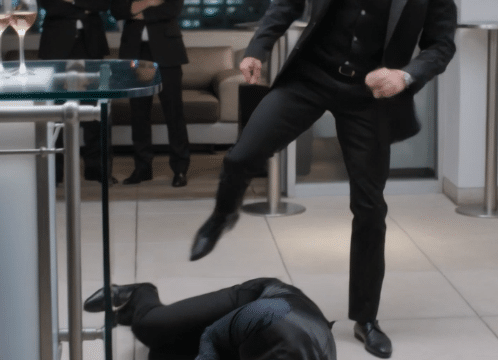
Before Ethan could respond, Richard drove a kick into his chest.
Ethan staggered backward and fell beside the hay bale, his elbow scraping against the rough stable floor. A thin line of blood appeared on his skin as he tried to catch himself.
For one stunned second, he couldn’t understand what had happened.
He had been doing his job.
He had answered respectfully.
He had apologized for something he hadn’t even caused.
And now he was on the ground, struggling to breathe comfortably while a grown man stood over him.
Richard stepped around the fallen hay.
Then he kicked Ethan twice more, once toward his back and once toward his side.
A woman near the stall doors gasped.
One of the stable workers covered his mouth. Two riders backed away, their faces frozen with disbelief.
Nobody moved quickly enough to stop what was happening.
Richard straightened his jacket.
“Clean stalls where riders cannot see you,” he sneered.
Ethan curled slightly on the ground, one gloved hand pressed against his side.
Sterling suddenly snorted from inside the stall.
The sound was loud enough to make several people turn.
Then came the sharp clatter of boots against the concrete floor.
A man in a dark riding coat was charging through the arena gate.
He had heard the commotion from outside and had seen enough through the open stable doors to understand that something was terribly wrong.
Richard turned toward him.
“Finally,” he snapped. “Someone responsible. This boy—”
The newcomer struck Richard once across the face, stopping him mid-sentence.
Richard staggered backward, stunned.
The older man immediately stepped between him and Ethan, then turned toward Sterling and spoke in a low, steady voice until the horse began to settle.
Only after the animal was calm did he look back at Richard.
His expression was colder than anyone in the stable had ever seen.
“That horse just told me who should never ride here again.”
Richard stared at him.
For the first time that afternoon, the wealthy rider looked uncertain.
“Never ride here?”
He had no idea how much those words were about to cost him.
Act II
The man standing between Richard and Ethan was James Whitmore, the sixty-year-old owner of Briarwood Equestrian Estate.
To visitors, Briarwood looked like a private world built for people who could afford to live differently from everyone else.
The property covered hundreds of acres of rolling countryside outside a prosperous American town. Its immaculate stables housed valuable horses, its indoor arena hosted championship training sessions, and its outdoor courses attracted professional riders from across the region.
Memberships cost more than many families earned in a year.
Some clients arrived in luxury SUVs. Others brought their horses in custom-built trailers, accompanied by personal trainers, grooms, and veterinarians.
But James had never believed that wealth made someone a good horseman.
He had grown up on a modest farm in Kentucky, where his father repaired fences and his mother worked as a school secretary. Their first horse was an aging mare with a bad knee, purchased cheaply because nobody else wanted her.
James had learned to ride on that mare.
He had also learned to listen.
His father taught him that horses communicated through movement, breathing, posture, and subtle changes in behavior. A frightened horse couldn’t explain what had startled it. A sick horse couldn’t describe its pain. The person responsible for its care had to pay attention.
That lesson shaped James’s entire life.
He eventually became a respected trainer, then built Briarwood from a small boarding stable into one of the most prestigious equestrian facilities in the state.
Yet he never stopped doing the work himself.
He walked the stables every morning, inspected the stalls, spoke with the grooms, and watched the horses being handled. He knew which animals disliked sudden noises, which ones needed extra time around strangers, and which riders treated their horses as partners rather than possessions.
That was why Richard Caldwell had never particularly impressed him.
Richard was wealthy, connected, and accustomed to getting his way. He had purchased Sterling eighteen months earlier after seeing the gelding perform at a private competition.
The horse was talented, intelligent, and sensitive to his surroundings.
Richard liked telling people how much he had paid for him.
He liked discussing bloodlines, pedigree papers, and the potential resale value of a successful competition horse.
What he rarely discussed was the patience required to earn the animal’s trust.
Sterling had changed hands several times before arriving at Briarwood. He had been trained by experienced riders, but he remained sensitive to abrupt movements and unfamiliar sounds.
James had explained that to Richard during the initial evaluation.
“Give him a moment when something surprises him,” James had advised. “Don’t punish him for reacting. Find out what startled him, then help him settle.”
Richard had nodded.
He had agreed with every word.
Then, as often happened, he had behaved as though the rules applied to everyone except himself.
Ethan Miller was the opposite of Richard in almost every visible way.
He lived with his mother, Laura, and his twelve-year-old sister, Sophie, in a small rental house on the edge of town. Their kitchen table had a loose leg, the family car needed repairs, and Ethan had learned to calculate how much gasoline they could afford before agreeing to an extra shift.
His father had left when Ethan was young, and his mother had worked tirelessly to keep the household stable.
Ethan had begun helping at Briarwood two years earlier, initially doing simple tasks after school.
He cleaned stalls, carried feed, replaced bedding, swept the aisles, and helped prepare equipment before lessons.
He was never the loudest worker.
He rarely complained.
And he never treated the horses as machines.
When one animal became restless, Ethan noticed.
When a mare refused to finish her feed, he reported it.
When a young horse began favoring one leg, he alerted the senior groom before anyone else had noticed the change.
James had started paying closer attention to him.
Not because Ethan was poor.
Not because the boy needed a chance.
But because he had something difficult to teach: the instinct to notice what others overlooked.
One afternoon, Ethan had spent nearly an hour sitting outside a stall with a nervous young mare that had become frightened after being transported to the property.
He didn’t force her to approach.
He didn’t wave treats in her face or try to prove that he could control her.
He simply sat quietly, speaking in a low voice whenever she moved toward him.
Eventually, the mare stepped close enough to sniff his glove.
James had watched from the end of the aisle.
He recognized the patience immediately.
It was the same patience his father had taught him decades earlier.
After that, James began giving Ethan more responsibility. He showed him how to inspect tack, recognize signs of stress, and understand the difference between a horse resisting a command and a horse communicating discomfort.
Ethan listened carefully.
He asked questions.
He remembered the answers.
But he never assumed that being good with horses made him more important than anyone else.
That was part of what James respected most about him.
Richard, meanwhile, had mistaken Ethan’s quiet manner for weakness.
He saw the faded jacket, the worn boots, and the teenager who cleaned up after wealthy clients.
He never considered that the boy might possess more practical understanding of horses than he did.
And now, in front of the very people who had watched him humiliate Ethan, Richard was about to discover that Briarwood’s owner had noticed far more than he realized.
Because James Whitmore had not rushed into the stable simply to stop a fight.
He had seen the way Richard treated the horse.
And he had seen the way Richard treated the boy.
To James, those two things were connected.
Act III
“Ethan, can you hear me?”
James crouched beside the teenager while keeping himself positioned between him and Richard.
Ethan nodded, though his face had gone pale.
“Don’t try to get up too quickly,” James said. “Let the medical team check you first.”
He asked a nearby worker to call emergency services and directed another to secure Sterling’s stall. The horse was calmer now, but James wanted to ensure that no one crowded the animal while the stable aisle remained unsettled.
Then he turned to Richard.
“Step back.”
Richard stared at him in disbelief.
“You just hit me!”
James didn’t move.
“And I won’t let you near that boy again.”
“This is absurd. He endangered my horse!”
“Then explain why he was lying on the ground while you stood over him.”
Richard’s mouth tightened.
“He was disrespectful.”
“By telling you that something startled the horse?”
“He was making excuses.”
James glanced at the scattered hay and the frightened faces of the witnesses.
“Several people saw what happened, Richard.”
For the first time, Richard looked toward the others.
The stable workers who usually rushed to accommodate him were avoiding his eyes. One rider had taken out her phone. Another stood beside the stall door, visibly shaken.
Richard had expected people to support him because he was a paying client.
Instead, they were looking at him as though they no longer recognized the man they had known.
He turned back to James.
“You cannot take his word over mine.”
“I don’t have to.”
James’s voice was quiet.
“I saw enough myself.”
Richard swallowed.
The stable fell silent except for the soft rustling of straw and Sterling’s occasional movement inside the stall.
James looked toward the horse.
“Bring him out only when the aisle is clear. Give him time to settle.”
A senior groom nodded and began carefully preparing the animal.
James waited until Sterling’s breathing had steadied before stepping closer to the stall door. He spoke softly, allowing the horse to recognize his voice.
Sterling lowered his head slightly.
James rested a hand against the animal’s neck, checking its response without rushing.
There was no dramatic transformation.
No magical understanding.
Just a frightened horse gradually returning to calm because someone had given him the space he needed.
James looked back at Richard.
“Sterling was startled by a noise from the arena. Horses react to sudden sounds. That is not unusual.”
Richard folded his arms.
“You weren’t riding him.”
“No. But I know the horse.”
“You don’t know what I felt.”
James nodded once.
“Perhaps not.”
Then his expression hardened.
“But I know what I saw you do afterward.”
Richard had no answer.
James turned toward Ethan.
The boy was still on the ground, waiting for the medical team. His work gloves lay near the hay bale, one of them partially turned inside out.
James picked them up and placed them beside the boy’s jacket.
It was a small gesture, but it made Ethan look away.
He was trying not to cry.
Not because of the pain alone.
Because he had spent two years trying to do everything right at Briarwood, hoping that hard work would eventually allow his family to breathe a little easier.
He had never expected special treatment.
He had never asked to be important.
He had only wanted to finish his shift and go home.
Now he was afraid he would lose his job.
“Mr. Whitmore?” Ethan whispered.
James leaned closer.
“I’m here.”
“Am I fired?”
The question struck James harder than he expected.
He looked at the boy’s frightened expression, then at Richard standing nearby in his expensive riding clothes.
Ethan had been attacked by a wealthy adult, and his first concern was whether he would still have a way to help his family.
“No,” James said firmly. “You are not fired.”
Ethan blinked.
“You haven’t done anything wrong.”
The boy looked down at his hands.
James continued.
“You were doing your job. You tried to explain what happened. None of that gives anyone the right to hurt you.”
Richard let out a sharp breath.
“Are you seriously taking this boy’s side?”
James slowly stood.
“I’m taking the side of the truth.”
Richard’s face reddened.
“You’re risking a valuable client over a stable hand?”
James studied him for a long moment.
Then he asked, “Do you know why I built Briarwood?”
Richard scoffed.
“To train horses and host riders.”
“That is what the business does.”
James gestured toward Sterling’s stall.
“But that isn’t why it exists.”
He explained that Briarwood had been built around a simple principle: horses depended on people, and people had a responsibility to earn their trust.
The facility’s reputation rested not merely on expensive animals or impressive competitions, but on the skill and integrity of everyone who worked there.
A trainer who ignored a horse’s fear could create a dangerous situation.
A groom who concealed an injury could put an animal at risk.
A rider who treated people with contempt could eventually bring that same carelessness into the saddle.
“Anyone can buy a horse,” James said. “Not everyone understands what it means to be responsible for one.”
Richard looked away.
James continued.
“You bought Sterling because you wanted a horse that would make you look accomplished. But owning a talented horse doesn’t make you a good horseman.”
The words landed harder than Richard expected.
He had spent years cultivating an image of himself as a sophisticated rider. He attended prestigious events, purchased expensive equipment, and enjoyed discussing his horse with people who understood the social value of owning an animal like Sterling.
He had never imagined that his behavior toward a stable boy could threaten that image.
James glanced toward the arena gate.
“The noise came from outside. Sterling reacted. Ethan was doing his job.”
Then he looked Richard directly in the eyes.
“And you chose to hurt a sixteen-year-old because you couldn’t control your temper.”
Richard’s expression shifted.
He had expected an argument about customer service, perhaps a temporary suspension or an awkward conversation with management.
He had not expected James to question whether he belonged at Briarwood at all.
“What’s that supposed to mean?” Richard demanded.
James did not answer immediately.
Instead, he watched as two medical responders entered the stable aisle and began assessing Ethan.
Only when he was satisfied that the boy was receiving attention did James turn back to Richard.
“You’re going to learn what it means to be held accountable here.”
For the first time, Richard looked genuinely afraid.
Act IV
By the time the medical team had finished its initial assessment, the entire stable seemed to have changed.
The workers who once hurried to open doors for Richard now stood at a distance. The riders who had previously greeted him with polite smiles were whispering among themselves.
Nobody appeared impressed by his expensive boots.
Nobody seemed concerned about the price of his horse.
They had seen a grown man attack a teenager who had been doing his job.
And they had watched the owner of Briarwood step in to stop it.
James waited until Ethan had been safely taken for further medical evaluation before addressing the people gathered in the aisle.
He did not raise his voice.
He did not need to.
“Everyone who witnessed what happened should provide an accurate statement,” he said. “If you recorded any part of the incident, preserve the original footage and give it to the appropriate authorities.”
Several people nodded.
James made it clear that nobody should exaggerate what they had seen or invent details to punish Richard. The facts were serious enough without embellishment.
Then he turned to the stable manager and requested that the facility’s incident procedures be followed, including a review of Richard’s access to the property.
Richard stared at him.
“You can’t do that.”
James looked at him calmly.
“This is my facility.”
“I pay a fortune to keep Sterling here.”
“And you are entitled to have his care handled professionally under the terms of your agreement.”
Richard seized on the statement.
“Exactly. I have a contract.”
James nodded.
“Which is why the review will be handled properly. We will document what happened, consult the relevant policies, and make a decision based on the evidence.”
Richard’s shoulders relaxed slightly.
He thought he had found an opening.
“You can’t just throw me out because you disagree with me.”
James’s expression did not change.
“I don’t need to make a decision this second to tell you that your behavior will have consequences.”
He glanced toward the arena, where the evening light fell across the riding course.
“Briarwood has rules for everyone. If a client assaults a worker, we investigate. If the evidence supports disciplinary action, we act. And if someone cannot treat our staff safely, their access to this property may end.”
Richard’s face tightened.
“May end?”
James stepped closer.
“Your money doesn’t buy permission to hurt people.”
Richard looked toward the stable manager, expecting someone to intervene.
No one did.
He tried another approach.
“Do you have any idea how much I’ve invested in Sterling? The training, the transport, the equipment? I bring business to this place.”
James nodded.
“I know exactly what you spend on the horse.”
He paused.
“I also know what it takes to care for him.”
Richard’s mouth opened, then closed.
James gestured toward the stable workers.
“These people clean the stalls, prepare the feed, inspect the equipment, and notice when a horse isn’t acting normally. They do the work that allows riders to arrive here and enjoy their time in the saddle.”
He looked back at Richard.
“You may pay for the privilege of riding at Briarwood. You do not pay for the privilege of treating people as if they are disposable.”
Richard’s expression hardened.
“This is because of that boy.”
“No,” James replied. “This is because of you.”
He turned toward Sterling’s stall.
The horse stood quietly now, its head lowered as the senior groom checked the water bucket and examined the stall for anything that might have startled it.
James watched the animal for a moment.
Then he returned his attention to Richard.
“Your horse has done nothing wrong. Ethan has done nothing wrong. The people here have done nothing wrong.”
He paused.
“You are the only person who seems unable to accept responsibility.”
Richard’s face grew pale.
He had built much of his identity around the belief that he was a man who deserved respect. His wealth, his business achievements, and his ownership of Sterling had become proof, in his own mind, that he was different from ordinary people.
Now James was telling him that none of those things mattered if he could not control himself.
Worse, James was prepared to act on that belief.
Richard glanced toward the arena gate.
He had entered Briarwood that morning expecting to enjoy a private ride, perhaps speak with a few other members, and spend an hour in the company of people he considered his equals.
Now he might lose access to the facility entirely.
And the reason was a teenage stable worker he had never bothered to know.
“James,” he said, forcing a calmer tone, “perhaps we should discuss this privately.”
James shook his head.
“The incident happened in public. The investigation will follow the proper process.”
“I’m willing to compensate the boy for his trouble.”
The words hung in the air.
Several witnesses exchanged looks.
James’s expression became unmistakably cold.
“This isn’t a damaged saddle, Richard. You cannot put a price on what happened.”
“I didn’t mean—”
“You can cooperate with the investigation. You can follow the instructions you’re given. And you can stop trying to make this disappear because you believe money should solve it.”
Richard fell silent.
James turned away from him.
Then, as if remembering something important, he looked back toward Sterling.
“That horse just told me who should never ride here again.”
Richard stared.
“Never ride here?”
The question sounded different now.
It was no longer an angry challenge.
It was the voice of a man beginning to understand that the privileges he had taken for granted were not guaranteed.
James did not offer him a dramatic threat or promise to ruin his life.
He simply stood beside the stall, protecting the people and animals entrusted to his care.
And that was enough to make Richard realize he had finally encountered someone his money could not control.
Act V
The investigation took several weeks.
Witnesses provided statements, available recordings were reviewed, and the appropriate authorities determined how the assault would be handled. Ethan’s family received updates through the proper channels, and Briarwood documented the incident as part of its internal review.
James made one thing clear from the beginning.
Ethan would not be punished for being attacked.
The teenager’s job would remain available to him, and his schedule could be adjusted while he recovered. James also arranged for Ethan’s mother to receive the information she needed without having to navigate the process alone.
Laura Miller arrived at Briarwood the following morning.
She had left work as soon as she learned what had happened and driven to the property with her hands trembling on the steering wheel.
When she saw Ethan sitting in the office, a blanket draped around his shoulders, she hurried to him.
“Oh, sweetheart.”
Ethan tried to smile.
“I’m okay, Mom.”
She held him tightly.
For a moment, she said nothing. She simply rested her cheek against his hair, relieved that he was sitting in front of her and able to speak.
Then she pulled back and looked at his face.
“What happened?”
Ethan hesitated.
He didn’t want his mother to worry about money or his job. He didn’t want her to feel that he had somehow failed to protect himself.
But James had encouraged him to tell her everything.
So Ethan explained what had happened in the stable aisle.
He described Sterling’s sudden movement, Richard’s accusation, and the moment the man kicked him to the ground.
Laura listened, her expression changing with every sentence.
When Ethan finished, she took his hand.
“You never have to earn the right to be treated decently,” she said.
Ethan looked down.
“I know.”
“No, I want you to really know it.”
She squeezed his hand.
“You work hard because you’re a good person. You help this family because you love us. But you do not have to let someone hurt you just to keep a paycheck.”
Ethan’s eyes filled with tears.
For weeks, he had been telling himself that he should have handled the confrontation differently. Perhaps he should have stayed silent. Perhaps he should have walked away sooner. Perhaps, if he had been faster or more careful, Richard would not have become angry.
Now his mother was reminding him that no amount of politeness could make him responsible for another person’s violence.
James stood near the office doorway, giving them space.
When Laura finally looked up, she thanked him for intervening.
James shook his head.
“I wish I’d reached the aisle sooner.”
“You stopped him.”
“I should have been there before it happened.”
Laura studied him for a moment.
Then she said, “You can’t be everywhere at once. What matters is what you do when you see something wrong.”
James accepted that quietly.
Over the next several weeks, Ethan gradually returned to his normal routine.
He was cautious around unfamiliar adults, and the sound of hurried footsteps sometimes made him tense. But the people at Briarwood treated him with care, and James made sure the stable remained a place where he could work without feeling that his safety depended on the mood of a wealthy client.
Richard, meanwhile, received formal notice that his conduct was under review.
Briarwood’s management examined the evidence, consulted its policies, and considered the safety of its staff and horses. Following that process, Richard’s riding privileges were suspended pending the outcome of the review, and the facility ultimately ended his membership under the terms of its agreement.
The decision was not made because James wanted revenge.
It was made because Briarwood had a responsibility to protect the people working there.
Richard was informed of the decision in writing.
For the first time in years, he could not solve a problem simply by demanding a meeting with someone important.
His money could purchase a horse, a custom trailer, and the finest riding equipment.
It could not guarantee him access to a place whose owner believed character mattered more than status.
Sterling remained at Briarwood while arrangements were made for his future care. James ensured that the horse’s needs came first, regardless of the dispute with its owner.
The animal was not responsible for Richard’s behavior.
Neither was Ethan.
And neither deserved to become a casualty of a wealthy man’s wounded pride.
As for Ethan, something unexpected happened during his recovery.
James began inviting him to observe advanced training sessions whenever his school schedule allowed. He showed him how experienced riders communicated with their horses through posture, balance, and carefully timed signals.
He explained how trainers assessed temperament, identified stress, and adjusted their approach to suit each animal.
Ethan absorbed everything.
One afternoon, James watched him working with a young gelding that had become anxious around the arena entrance.
Instead of pulling on the lead rope or trying to force the horse forward, Ethan stopped at a comfortable distance and waited.
The gelding shifted its weight.
Ethan remained still.
After a moment, the horse lowered its head and took a small step forward.
James smiled.
“Why didn’t you pull him through?”
Ethan shrugged.
“He wasn’t ready.”
“And how did you know?”
“He kept looking toward the gate. I thought he needed a second to figure out that nothing was going to hurt him.”
James nodded.
“That’s a good answer.”
Ethan looked at the horse.
“He’s not being difficult. He’s just nervous.”
James folded his arms.
“Remember that. A lot of people confuse fear with disobedience.”
The words stayed with Ethan.
He had spent weeks thinking about the moment Richard accused him of frightening Sterling. Now he understood that the same mistake had shaped the entire confrontation.
Richard had assumed the horse’s reaction was someone’s fault.
He had assumed the boy’s explanation was an excuse.
And he had assumed his own anger was justification enough to hurt someone.
James had seen the difference.
A frightened horse needed patience.
An injured teenager needed protection.
A wealthy adult who attacked someone needed accountability.
Those were not complicated principles.
But they were principles Richard had failed to understand.
Months later, Briarwood hosted a regional youth equestrian event. Families gathered beside the arena, horses moved through the warm-up area, and the stable aisle filled with the familiar sounds of hooves, quiet instructions, and rustling hay.
Ethan stood near the arena gate wearing a clean work jacket. His old boots were still scuffed, but his posture had changed.
He no longer looked at the ground whenever someone important walked past.
He had begun taking introductory riding lessons, and James had encouraged him to consider a future in equine care or training.
Ethan was still helping his family.
He still worked after school.
He still counted every dollar before spending it.
But for the first time, he could imagine a future built around something he loved rather than simply the next bill that needed paying.
As he finished preparing a stall, James approached.
“How’s your sister doing?”
“Good. She brought home an A on her last math test.”
James smiled.
“Tell her congratulations.”
“I will.”
James glanced toward the arena.
“Your lesson starts in twenty minutes.”
Ethan’s face brightened.
“I thought I was only watching today.”
“You’ve watched enough.”
James handed him a riding helmet.
“Let’s see what you’ve learned.”
Ethan stared at the helmet for a moment.
He had spent so long believing that his place at Briarwood was beside the stalls, cleaning up after other people, that the invitation felt almost unreal.
“Are you sure?”
James looked at him.
“Ethan, I’ve been sure for a long time.”
The teenager swallowed.
Then he took the helmet.
Across the arena, a horse snorted softly as its rider guided it through a turn. Sunlight streamed through the high windows, illuminating the dust floating above the sand.
Ethan walked toward the mounting area.
For once, he wasn’t going there to work.
He was going there to learn.
James watched him with quiet satisfaction.
He knew that Ethan still had challenges ahead. Talent did not erase financial hardship, and encouragement did not guarantee an easy future.
But the boy had already demonstrated the qualities that mattered most.
Patience.
Honesty.
Humility.
And the courage to keep doing the right thing, even when someone tried to make him feel worthless.
Richard Caldwell had entered Briarwood believing that his expensive horse made him important.
He had mistaken polished boots for character and money for authority.
He had looked at a sixteen-year-old boy in a faded work jacket and seen someone beneath his notice.
James Whitmore had seen something entirely different.
He had seen a young man who understood that trust could not be purchased and fear could not be beaten out of a living creature.
And in the end, the horse had not needed to throw Richard to expose the truth.
All it had taken was one startled movement, one cruel decision, and one person willing to step forward when it mattered.
The stable aisle eventually returned to its familiar rhythm.
Hay was replaced. Water buckets were checked. Stall doors were secured for the evening.
The horses settled into their routines, cared for by the people who understood that responsibility did not end when the riding stopped.
And above the office entrance, the Briarwood name remained exactly where it had always been.
But everyone who had witnessed that afternoon understood something they would not soon forget.
At Briarwood, money could buy the finest horse in the stable. It could never buy the right to treat another human being as less than one.
Richard had believed the stable boy was the person who needed to learn his place.
Instead, he was the one who learned that a place among good people was never guaranteed by wealth.
It was earned through character.
And sometimes, the quietest person in the room was the one who understood that lesson best.
Tighten the repeated moral passagesClarify James’s entrance and intervention