Act I
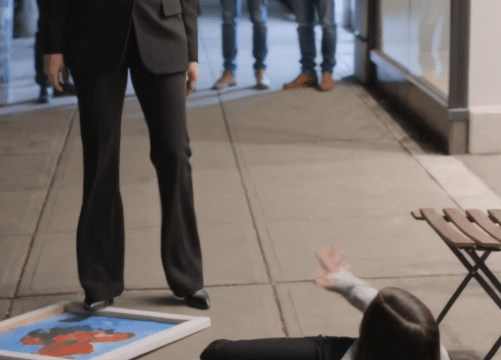
The boy was still holding the cleaning rag when the wealthy man kicked him in the chest.
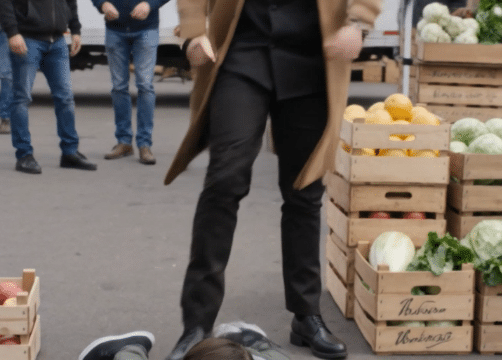
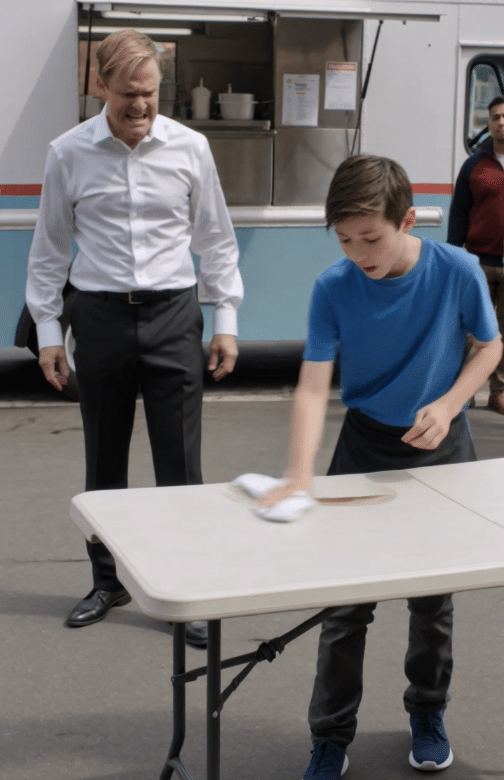
One second, fourteen-year-old Noah Bennett was standing beside a folding table at a crowded American food-truck plaza, trying to wipe away a thin streak of water. The next, he was on the pavement, struggling to catch his breath while the rag lay several feet away and the customers waiting for lunch stared in stunned silence.
The man who had knocked him down barely looked winded.
He was forty-eight, dressed in a crisp white shirt and black trousers, with a silver watch that flashed beneath the afternoon sun. His shoes looked expensive enough to belong in a glass display case. His expression suggested that the entire world existed to prevent even the smallest inconvenience from reaching him.
And apparently, a damp table was an inconvenience worth hurting a child over.
Noah pressed one hand against the ground and tried to sit up. His old blue T-shirt had ridden up beneath the small apron tied around his waist, and his eyes were already filling with tears he was desperately trying not to shed.
He had not spilled a drink on the man’s clothes. He had not insulted him. He had not even refused to clean the table.
There had simply been a streak of water left behind.
“I’m wiping it again now,” Noah said, his voice trembling.
The man looked down at him with open disgust.
“Trash. You can’t even clean a table.”
A woman near the front of the lunch line covered her mouth. Somewhere behind her, a vendor stopped arranging paper cups. Several customers took a step backward, as though the cruelty unfolding in front of them might somehow spread to anyone who remained too close.
Nobody moved toward the boy.
The man stepped closer.
Noah reached for the rag, instinctively trying to retrieve the one tool that might convince this stranger he was still doing his job. But before his fingers could close around it, the man delivered two more forceful kicks, one to Noah’s back and another to his side.
The boy curled inward, fighting to protect himself. A thin trace of blood appeared along his forearm where it had scraped the pavement.
The rag lay just beyond his fingertips.
The man looked at the boy, then at the customers watching him.
“Serve people from the ground.”
He said it as though he had delivered a clever joke.
But nobody laughed.
The food truck behind them was an older vehicle with faded paint, a dent near the service window, and a hand-lettered menu that had been rewritten so many times the prices no longer lined up neatly. Beside it stood the folding table Noah had been cleaning, its legs uneven on the cracked pavement.
It was not a glamorous business.
There were no polished marble counters, no uniformed servers, no expensive patio furniture. There was only a small family operation trying to survive another lunch rush, one paper plate at a time.
To the man in the white shirt, that seemed to make the boy’s dignity optional.
Then a woman’s voice cut through the silence.
“This truck passed because that boy kept it cleaner than you.”
The man turned.
A woman in her fifties was striding toward them, a clipboard tucked beneath one arm and a navy civic jacket moving sharply with each step. Her expression was not the outrage of someone who had just witnessed an unpleasant scene.
It was the controlled fury of someone who had spent years watching people mistake authority for permission.
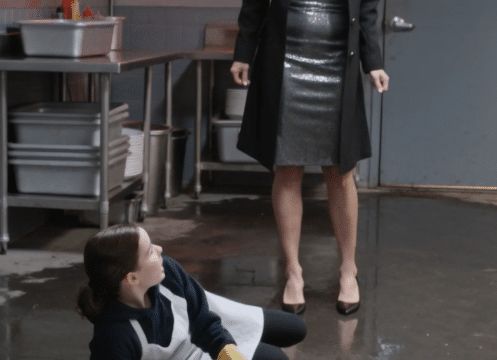
She reached the man, intervened with a single punch that sent him stumbling backward, and immediately placed herself between him and Noah.
The crowd recoiled.
The man touched his face, stunned, his arrogance suddenly competing with a new emotion he did not know how to conceal.
The woman did not look impressed by his expensive watch or immaculate clothes.
She looked at the clipboard in her hand.
Then she looked at the boy on the ground.
And when the wealthy customer finally understood who had arrived, the first crack appeared in his certainty.
Because the woman had not come to buy lunch.
She had come on official business.
And the little boy he had treated like garbage was the last person in the entire plaza he should have underestimated.
Act II
Three hours earlier, Noah Bennett had been awake before sunrise, standing in the narrow kitchen of a small rental house while his mother packed containers of sliced tomatoes.
Their kitchen was so cramped that opening the refrigerator blocked the pantry door. A patch of paint above the stove had bubbled from an old leak, and the refrigerator made a rattling sound whenever its motor started.
But everything was clean.
Noah had learned that cleanliness was one of the few things their family could control.
His mother, Rachel, had been running the food truck for nearly six years. Before that, she had worked in a diner until the owner retired and sold the building. She could make a dozen lunches from ingredients another cook might have thrown away, stretch a pot of soup through a slow afternoon, and remember the favorite orders of customers who visited only once a month.
The truck was called Rachel’s Table.
It was not named after Noah because Rachel wanted him to have a childhood that belonged to him, not a business card that announced his family’s financial troubles. But Noah had started helping her anyway, first by carrying napkins and filling water cups, then by wiping tables and checking that the condiment bottles were clean.
At fourteen, he was old enough to understand their bills and young enough to believe that working harder might somehow make them disappear.
Rachel never asked him to sacrifice school for the truck. She made that clear every morning.
“Your job is to learn,” she would tell him. “Mine is to keep the lights on.”
Noah’s response was always the same.
“And my job is to help you.”
He knew she worried about him. She worried when he lifted heavy boxes, when he stayed outside too long in the summer heat, and when he pretended not to notice that she sometimes skipped lunch so there would be enough food left for dinner.
He also knew she hated accepting help.
After his father left when Noah was seven, Rachel had built her life around a simple promise: she would never let her son believe he was a burden. Even when money became tight, she found a way to make his birthday feel special. Even when the truck needed repairs, she kept a little envelope hidden in a kitchen drawer with money for his school supplies.
Noah had discovered it once.
He had put the money back without taking a dollar.
Since then, he had tried to make himself useful in ways that did not require his mother to ask.
The folding tables at the lunch plaza were part of that effort. Rachel’s Table occupied a modest space among a dozen other vendors, and customers often ate at shared tables beneath portable shade canopies. The city required the food-truck operators to keep their service areas sanitary, but the plaza itself was busy, crowded, and difficult to maintain.
Water dripped from drink cups. Condiment packets fell beneath chairs. People left napkins on the ground.
Noah spent much of each lunch rush cleaning up after strangers.
He did it without complaint.
A clean table meant another customer might sit down. Another customer meant another order. Another order meant his mother could replace the truck’s aging generator before it failed in the middle of a busy day.
That was how Noah thought about work.
Not as proof that he was beneath anyone, but as one small piece of a much larger responsibility.
The man in the white shirt saw something else.
His name was Richard Caldwell, and he had built a reputation in the city as a successful commercial property investor. He owned office buildings, leased retail spaces, and attended charity dinners where people praised his generosity in front of photographers.
He was accustomed to having employees correct problems before he had to mention them twice.
If a restaurant served him a cold meal, the manager usually apologized and removed it from the bill. If a hotel room was not ready, someone found another room. If a parking attendant made him wait, Richard made sure the attendant knew exactly how much his time was worth.
He rarely thought of these incidents as cruelty.
In his mind, they were reminders that standards mattered and that people who failed to meet them needed to be corrected.
What he never considered was how quickly his idea of correction became punishment when the person standing in front of him had no power to push back.
That morning, Richard had been in a bad mood before he reached the food-truck plaza.
A commercial development deal had stalled after a lender questioned several expenses connected to one of his properties. Richard was convinced the delay was temporary, but the questions had irritated him. He had spent the drive across town rehearsing the explanations he would give his attorney and blaming everyone except himself.
By lunchtime, he wanted something simple.
He wanted food. He wanted a place to sit. He wanted the world to stop asking him for patience.
Then he touched the folding table and felt the dampness beneath his fingers.
It was a tiny mistake.
Noah had already noticed it and was reaching for the rag.
But Richard had spent the morning feeling challenged by people he could not intimidate, and now a fourteen-year-old boy in an old T-shirt was offering him the perfect target.
He did not see a child working beside his mother.
He saw someone who could not fight back without risking his livelihood.
And when Richard made his first decision, he had no idea that the consequences would reach far beyond the lunch plaza.
Because the woman approaching the truck had already spent months investigating the very business Richard believed himself important enough to threaten.
Act III
The woman in the navy jacket was Margaret Ellis, a senior city health inspector with twenty-six years of public service behind her.
She had inspected restaurants, cafeterias, school kitchens, catering facilities, and food trucks operating in some of the busiest parts of the city. She had seen kitchens that looked immaculate from the street and concealed serious sanitation problems behind their doors.
She had also seen the opposite.
Small operators with old equipment, limited budgets, and little room for error often worked harder to maintain acceptable conditions than businesses with entire departments devoted to compliance.
Margaret had learned to distinguish between a worn building and a careless operator.
That distinction was the reason she had come to the plaza that day.
For several months, the city had been reviewing complaints about the shared food-truck area. Some vendors claimed that customers were leaving waste behind faster than the operators could clean it. Others alleged that one or two businesses were ignoring basic sanitation rules and forcing their neighbors to deal with the consequences.
Margaret had been assigned to conduct a follow-up review.
She had not come specifically for Noah. She had never met him before that afternoon, and she knew nothing about his family beyond what she could observe in the moment.
But she knew Rachel’s Table.
She had inspected the truck twice during the previous year.
The first inspection had uncovered several minor issues, including a worn seal on a refrigerated compartment and a storage shelf that needed better organization. Rachel had corrected both problems before the required deadline. During the next inspection, Margaret had found the truck’s food-storage records organized, its cleaning supplies properly separated, and its temperature logs complete.
The truck had passed because it met the applicable requirements.
And because the city had established a clear procedure, the inspection report documented exactly why.
Margaret had noticed something else during her visits.
The area around Rachel’s truck was consistently cleaner than many nearby spaces. The shared tables were wiped regularly, the trash containers were not allowed to overflow, and the ground near the service window was usually free of discarded packaging.
Rachel had told Margaret that her son helped with the tables after school and during busy weekends.
Margaret remembered the detail because the boy’s work was not something the city could require him to do. It was simply a contribution he made to his mother’s business.
She had never met him.
She had never spoken to him.
But when she rounded the corner and saw Richard Caldwell standing over a child who was curled on the pavement, the context became impossible to ignore.
The boy was hurt.
The man was still angry.
And a dozen witnesses were frozen in the familiar paralysis that follows public cruelty: everyone hoping someone else will become the first person to intervene.
Margaret acted before she could talk herself into waiting.
Her punch was a sudden, imperfect response to an immediate scene of violence. It did not erase what Richard had done, and it was not a substitute for the authorities who needed to be contacted. But it broke his concentration long enough for her to put herself between him and Noah.
Then she spoke.
“This truck passed because that boy kept it cleaner than you.”
The words were carefully chosen.
She did not claim Noah had personally earned his mother’s permit. She did not suggest that a health inspection was a reward for good behavior. And she certainly did not mean that Richard’s cruelty could be settled by comparing one man’s cleanliness with another’s.
She meant that Richard had looked at a child doing honest work and decided he was entitled to degrade him.
He had mistaken poverty for failure.
He had mistaken a small mistake for permission to abuse someone.
And he had done it in front of people who might never have learned the boy’s name if the afternoon had gone differently.
Richard blinked at her.
“He did?”
For the first time, his voice sounded uncertain.
Margaret turned her head just enough to make sure Noah was still conscious. His breathing was shallow, and he was holding his arm close to his body. She told a nearby vendor to call emergency services, then asked another customer to keep the area clear.
She did not attempt to diagnose Noah’s injuries. She did not ask him to stand.
The boy had spent the last several minutes trying to prove he could still do his job.
Now, someone was finally treating him as a child who needed help.
Richard took a step backward.
“You can’t just hit me,” he said, touching his face.
“No,” Margaret replied. “And what you did to him is going to be documented.”
The clipboard in her hand suddenly seemed to matter to Richard far more than the punch.
He glanced at the city identification clipped to her jacket, then toward the food truck. His eyes moved between the official seal and the boy on the ground, as though he were trying to calculate which part of the scene represented the greater danger to him.
He still did not understand the full situation.
He believed the inspector was threatening him with a routine complaint, perhaps a fine or a citation. He had dealt with officials before. He knew how to make calls, hire lawyers, and turn a public dispute into a private negotiation.
What he did not know was that Margaret had arrived with an open inspection file concerning the plaza’s shared sanitation responsibilities.
And the file included complaints about people who treated the rules as optional when they believed nobody important was watching.
Richard had just given the city a very different kind of evidence.
Yet the most damaging fact was not what Margaret had witnessed him do.
It was what he would do next.
Act IV
By the time the first emergency responders arrived, the lunch line had dissolved into a loose ring of customers and vendors.
Noah remained on the pavement while a responder assessed him. The thin mark on his forearm was minor compared with the pain he described in his chest and side, and nobody was willing to assume that he was fine simply because he could speak.
Margaret stayed nearby long enough to ensure that the situation was under control.
Richard, meanwhile, had begun to recover his confidence.
He straightened his shirt and checked the silver watch at his wrist, an oddly ordinary gesture in the middle of an extraordinary scene.
“This is ridiculous,” he announced. “The kid left a wet table. I asked him to clean it.”
Several witnesses looked at him.
He seemed to take their silence as encouragement.
“Then he got in my way. I didn’t know I was supposed to stand there and let him—”
“Let him what?” Margaret asked.
Richard stopped.
“Don’t twist my words.”
“I’m asking you to explain your actions.”
“I already explained them.”
“No. You explained why the table was damp. You haven’t explained why a child is on the ground.”
The distinction landed harder than an accusation.
Richard looked toward the people surrounding them. A few had their phones out now. The woman who had covered her mouth earlier was speaking quietly with another customer, and the vendor near the truck had moved closer to Noah.
The audience Richard had once treated as an inconvenience was becoming a record of what he had done.
He turned back to Margaret.
“Do you know who I am?”
It was the question he relied on when ordinary arguments stopped going his way.
Margaret had heard it in restaurant kitchens, hotel lobbies, and administrative offices. Usually it came from someone who believed a title, a bank account, or a powerful acquaintance should exempt them from the rules that applied to everyone else.
She looked at him for a moment.
“No,” she said. “But I know what I saw.”
Richard’s jaw tightened.
“I’m a major property owner in this city. I contribute to local charities. I have relationships with people at City Hall.”
“Then you’ll understand why records matter.”
Margaret opened the clipboard and began writing down the time, the location, and the names of the people who had witnessed the incident. She made clear that the assault would need to be reported to the appropriate authorities and that any official follow-up would be handled through the proper process.
Her tone remained controlled.
That seemed to anger Richard more than shouting would have.
He wanted her to become unreasonable. He wanted the punch to become the entire story, because a story about an inspector losing her temper was easier to manage than a story about a wealthy man kicking a child over a damp table.
“You struck me,” he said. “I’m going to make sure you lose your job.”
Margaret lowered her pen.
“What happened before that will be investigated. So will my response.”
For a moment, Richard appeared satisfied. He had found an opening, or thought he had.
Then Margaret added, “And the inspection file will remain separate from the assault investigation. Nobody is going to change a health report because of what happened here.”
Richard’s expression shifted.
He had been preparing to argue that the inspector was retaliating against him. But she was telling him that the city had records, procedures, and a distinction between the issues he was trying to merge.
The food truck’s inspection history would not become a bargaining chip.
Neither would Noah’s injuries.
And the city’s review of the plaza would not disappear because Richard had decided to threaten an official.
A uniformed officer arrived and began speaking with the witnesses. Another responder remained with Noah. Margaret provided her account and identification, making no attempt to hide the fact that she had intervened physically.
She would have to answer for that decision.
So would Richard.
For the first time that afternoon, the wealthy customer appeared to realize that consequences did not always arrive in the form of a person he could call.
Sometimes they arrived as several independent records, each documenting a different part of the truth.
One witness had seen him kick Noah.
Another had heard him insult the boy.
The vendor had watched the attack from only a few feet away. More customers had seen the final kicks, and at least two had recorded portions of the incident on their phones.
Richard could dispute a memory.
He could question a motive.
But he could not make all those people forget what they had seen.
Margaret finished her notes and stepped aside as the responders prepared to transport Noah for further evaluation. The boy looked toward the folding table, where his rag still lay on the ground.
Even now, he seemed worried about leaving the work unfinished.
Margaret followed his gaze.
“Leave it,” she told him gently. “You don’t have to clean anything right now.”
Noah stared at her, bewildered.
It was such a small sentence.
Yet it was the first time since the attack began that anyone had given him permission to stop trying to earn his right to be there.
Richard heard it too.
He watched the boy being helped away, then looked at Margaret’s clipboard again. His face had lost the color it had carried when he first stepped into the plaza.
But he still had one question.
He still wanted to know why a senior city official cared so much about a boy who wiped tables.
And the answer would expose the one thing Richard had failed to understand about the entire afternoon.
The boy was never the problem.
The way Richard had chosen to treat him was.
Act V
Rachel Bennett arrived at the hospital with her apron still tied around her waist.
A vendor had called her after Noah was taken away, and she had driven across town so quickly that she could barely remember the traffic lights along the way. Her hands shook as she approached the examination room, and when she saw her son sitting on the bed with a blanket around his shoulders, she covered her mouth and closed her eyes.
Noah tried to smile.
“I’m okay, Mom.”
Rachel crossed the room and held him carefully, mindful of the places where he was sore.
“You don’t have to tell me you’re okay,” she whispered. “You just have to let me be here.”
The medical team evaluated his injuries and monitored him for complications. The story did not become a miracle in which pain vanished the moment someone powerful arrived. Noah remained frightened, sore, and shaken by the fact that a stranger had decided he deserved to be hurt.
That evening, Rachel sat beside him and listened as he described the incident.
He told her about the damp table, the first kick, the rag slipping away, and the customers who had watched without moving. When he reached the moment the woman in the navy jacket appeared, he paused.
“She said the truck passed because I kept it clean.”
Rachel’s eyes filled.
She knew what Margaret meant. The inspector had been acknowledging the care Noah gave to a place that did not belong to him, a responsibility he had accepted because he loved his mother.
But Rachel also understood something her son was only beginning to learn.
His work had never been the price of his dignity.
He had deserved protection before anyone mentioned an inspection report.
He had deserved kindness before anyone recognized the name of his family’s business.
And he had deserved to be safe simply because he was a child.
The next morning, the food-truck plaza looked almost exactly as it had before the attack. The same vehicles stood beneath the same sun. Customers returned with their lunch orders, and vendors prepared their ingredients, trying to resume the routines that kept their businesses alive.
But the folding table beside Rachel’s truck was empty.
Rachel had closed for the day.
She needed time to be with Noah, and she refused to pretend that nothing had happened merely because reopening would bring in money.
Meanwhile, the incident was moving through the proper channels.
Witness statements were collected. Available video was preserved. The assault was referred for review by law enforcement, and Richard’s threats against Margaret were documented as part of the account of what had happened after she intervened.
Margaret also submitted her own report concerning the physical strike she had delivered. Her years of service did not place her beyond scrutiny, and she did not ask the city to overlook her actions because she had intended to protect a child.
She had made a decision in a frightening moment.
She would have to answer for it.
That was what made her authority different from Richard’s idea of power. She believed rules mattered even when applying them meant examining her own conduct.
The city’s sanitation review continued separately. Rachel’s inspection records showed that she had corrected earlier deficiencies and maintained the required standards. The plaza’s shared facilities were reviewed, and officials followed up on the complaints that had brought Margaret there in the first place.
No inspection was rewritten to punish Richard.
No permit was magically revoked because he had humiliated Noah.
The consequences that followed came through documented evidence and established procedures, not a private vendetta.
For Richard, that proved far more uncomfortable than he expected.
He had assumed the incident would disappear once he left the plaza. He had expected his attorney to handle any complaint and his reputation to carry him through the rest.
Instead, he faced a formal investigation into the assault, while the videos and witness accounts made the central facts difficult to dispute. The people who had seen him kick a child were not interested in how much property he owned.
His public image began to crack.
The charitable dinners and polished photographs could not erase the footage of a boy on the pavement. Nor could a statement about high standards explain why a grown man had responded to a wet table with violence.
Richard’s representatives attempted to characterize the encounter as a heated disagreement.
But the table had been damp.
Noah had offered to wipe it again.
And Richard had attacked him.
Those facts remained stubbornly simple.
In the weeks that followed, Rachel returned to the plaza. The old truck still rattled when its generator started, and the painted lettering on its side still showed the wear of years spent outdoors.
Noah returned too, though not immediately.
When he was ready, he stood beside the folding table with a fresh rag in his hand. For a while, he worked quietly, wiping away water rings and straightening the napkin holder. His mother watched him from the service window, careful not to turn his return into a test of courage.
Then a customer placed a cup on the table and accidentally spilled a little water.
Noah looked down at the puddle.
For a brief moment, the afternoon of the attack came back to him: the expensive shoes, the furious voice, the sudden impact, the helpless faces in the crowd.
His fingers tightened around the rag.
Then he breathed out and wiped the water away.
Not because he was afraid of being punished if he failed.
Not because he needed to prove that he deserved to stand there.
He did it because it was a simple task he knew how to do, and because he was slowly learning that one cruel person did not get to define the meaning of his work.
Later, Margaret returned to the plaza as part of her official follow-up. She spoke with the vendors about sanitation procedures and made sure the inspection process remained transparent. When she saw Noah, she greeted him without fanfare.
She did not call him a hero.
She did not tell him that his suffering had been worth it because it had exposed a bad man.
She simply asked how he was doing and listened to the answer.
That mattered more than Noah could explain.
He had spent so much of his childhood trying not to worry his mother that he had become skilled at hiding his own fear. Now he was beginning to understand that accepting help did not make him weak, and that being hurt was not a failure he needed to repair through harder work.
The folding table remained where it had always been.
It was still inexpensive. It still had uneven legs. It still collected water rings whenever customers set down their drinks.
Nothing about it had become extraordinary.
But people who visited Rachel’s Table began to notice the boy behind the counter differently. Some had seen the video. Others had heard the story from a vendor. A few came simply because they wanted to support a small family business that had endured a terrible day.
Rachel appreciated every order, but she refused to turn Noah’s pain into a sales pitch. She did not hang a photograph of him in the truck’s window or use the assault as a slogan.
She wanted her son to grow up with memories of good food, long afternoons, and the satisfaction of helping build something with his own hands.
Not just memories of the day a stranger tried to make him feel worthless.
As for Richard Caldwell, his wealth remained his wealth. His properties did not vanish overnight, and the world did not transform into a place where cruel people instantly lost everything they owned.
But he could no longer control the story simply by deciding how it should be told.
The investigation proceeded on the evidence. His conduct was no longer a private display of temper that could be dismissed as an unfortunate misunderstanding. It was a public act witnessed by people who had finally found their voices.
And the woman who had confronted him was not going to make the facts disappear, whether those facts concerned the assault or her own response.
Months later, on another busy afternoon, a customer brushed against the folding table and left a narrow trail of water across its surface.
Noah reached for the rag.
Then he noticed a little girl standing nearby, watching him carefully. She could not have been more than six, and she was holding her father’s hand.
“Does it have to be perfectly dry?” she asked.
Noah glanced at the table, then at her.
“Not perfectly,” he said. “Just clean enough for the next person.”
He wiped the streak away and set the rag beside the napkins.
Behind him, his mother laughed softly at something a customer had said. The truck’s service window was busy, the afternoon sun glowed against its faded paint, and the ordinary noise of the plaza rose around them.
Noah was still the same boy who had been kicked to the pavement.
He still wore inexpensive clothes. He still helped his mother clean tables. He still understood that every sale mattered when a family was trying to keep a small business alive.
But he no longer believed that his circumstances made him less worthy of respect.
The man in the white shirt had looked at a damp table and seen an excuse to humiliate someone he considered beneath him.
The city inspector had looked at the same scene and seen a child who needed protection, a witness who needed to be heard, and an official process that needed to do its work.
And Noah, in the end, learned the truth neither man could give him or take away.
His dignity had never depended on how clean he could make a table.
It had been there before the first customer arrived, before the first inspection, before the first order of the day.
It had been there even when he was lying on the pavement, reaching for a rag while people watched.
The table only needed wiping.
The cruelty had always belonged to the man who mistook a child’s poverty for permission.