Act I
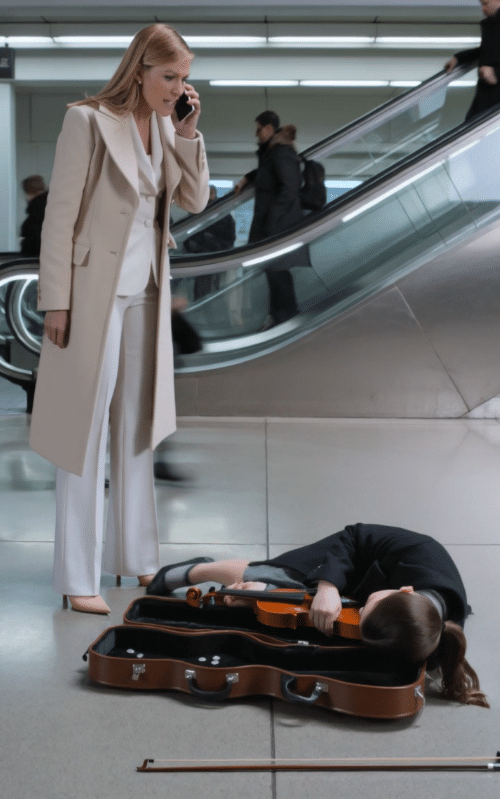
The violin was still ringing when the woman in the cream coat kicked the girl to the ground.
Fifteen-year-old Emily Hayes fell beside her open violin case, her old black coat twisting beneath her as the bow slipped from her hand. A few coins scattered across the cold station floor, spinning beneath the hurried feet of commuters who had been pretending not to notice her.
For one terrible second, the entire world seemed to move around her.
Trains thundered beyond the platform walls. Commuters hurried toward the escalators. Overhead announcements echoed through the station, swallowed by the constant rhythm of rolling suitcases and hurried footsteps.
And a woman in an immaculate white suit stood over Emily as if the girl had deliberately ruined her life.
Her name was Victoria Ashford. At forty-five, she was a wealthy real estate investor who spent most of her days moving between private meetings, luxury hotels, and business calls that other people were expected to accommodate.
She had been on the phone when Emily began playing.
The music had drifted through the station, soft and melancholy, threading between the noise of commuters. Emily was playing near a broad concrete pillar, far enough from the main entrance to avoid blocking the flow of people.
Victoria had stopped nearby to finish an important call.
The violin had irritated her.
She looked at Emily’s faded coat, the gray skirt, and the open case containing a handful of coins. In her mind, the girl was not a young musician trying to earn money. She was an inconvenience that had somehow wandered into a place where it did not belong.
Victoria ended her call and turned toward her.
Emily immediately lowered the violin.
“I can move farther away.”
Victoria’s expression hardened.
“Trash. Your noise is ruining my call.”
Emily glanced at the commuters passing behind her.
“I didn’t mean to—”
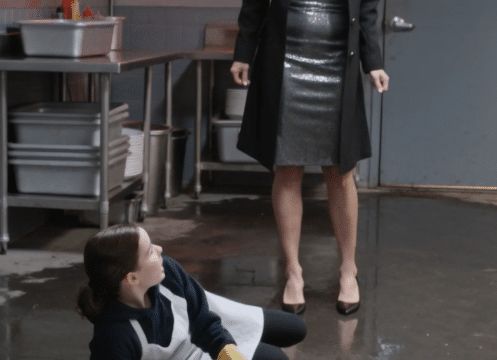
Victoria kicked her before she could finish.
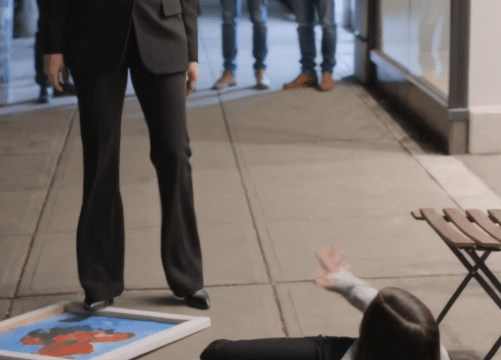
The impact sent Emily backward onto the floor. Her bow slipped from her fingers, and the violin case tipped onto its side.
Emily gasped, one hand instinctively reaching for the instrument.
A thin trace of blood appeared on her scraped elbow.
She looked up at Victoria, bewildered and frightened, still trying to understand how a few notes of music could have provoked such cruelty.
Victoria stepped closer.
Then she kicked Emily twice more, striking her back and side.
Emily curled around herself, reaching toward the violin to keep it from being knocked beneath the feet of the crowd.
“Play where nobody hears you,” Victoria said.
A man near the ticket machines stopped walking. A woman covered her mouth. Several commuters looked toward the station staff, silently hoping someone else would take responsibility.
Nobody moved quickly enough.
Emily’s fingers trembled as she reached for the fallen bow. The violin lay only inches away, its polished wooden body catching the harsh fluorescent light.
It was the one possession she could not imagine losing.
Then a voice cut through the station.
Not a shout.
Not a panicked demand.
A single, furious sound of disbelief.
An older man in a long black coat rushed down from the escalator. His gray scarf shifted as he crossed the concourse, his eyes fixed on Victoria and the girl lying beside the open case.
He reached them, delivered one sharp slap across Victoria’s face, and stepped between her and Emily.
Then he bent down and picked up the fallen bow.
He held it carefully, as though it were something precious.
When he looked at Victoria, his expression was colder than the station’s concrete walls.
“That sound is worth more than your silence.”
Victoria stared at him, one hand pressed to her cheek.
She recognized the face, though at first she could not understand why a man of his stature would be standing between her and a street musician.
The commuters had begun whispering.
A station employee hurried toward them. Another person raised a phone to record the scene.
Victoria looked at the violin, then at the man holding the bow.
Her voice came out smaller than she intended.
“Who is she?”
The man did not answer immediately.
Instead, he turned toward Emily and looked at the instrument she was trying to protect.
He recognized the violin’s unusual markings.
And when Emily finally lifted her eyes to meet his, he realized that the girl on the station floor might be carrying a musical legacy that had disappeared from the world years earlier.
Act II
Emily Hayes had learned to play the violin in a kitchen that was barely large enough for a table.
Her mother, Rachel, worked as a hospital laundry attendant, spending long shifts sorting sheets, towels, and gowns. Her hands were often dry from industrial detergent, and she came home exhausted enough to fall asleep sitting upright on the couch.
Emily’s father had died when she was eight.
Afterward, their lives narrowed into a series of careful calculations. Rent came first. Groceries came next. School supplies, transportation, and everything else had to fit into whatever remained.
Music had been the one thing Rachel refused to let disappear.
Emily’s grandfather, Samuel Hayes, had been a violinist who performed with regional orchestras before an injury ended his career. He never became famous, but he possessed an extraordinary ear and a patience that seemed endless.
When Emily was six, he gave her a small violin.
It was not new. The varnish had worn thin near the chin rest, and a faint scratch ran along one side. But Samuel had cared for it meticulously, replacing strings when he could afford them and teaching Emily how to clean it after every practice.
He never told her that she was destined to become a star.
He simply taught her to listen.
“Don’t play the notes because they’re written there,” he used to say. “Play them because you know what they mean.”
Emily did not understand the lesson at first.
She wanted to play faster. She wanted to perform difficult passages that made adults look impressed. She wanted to be able to do what the older students could do.
Samuel always brought her back to the beginning.
A single note.
A quiet phrase.
A melody played slowly enough that she could hear where one feeling ended and another began.
When Emily was nine, he taught her a lullaby his own mother had sung during the difficult years of his childhood. The melody was simple, almost fragile, but it seemed to hold an entire family inside it.
Emily loved that piece most of all.
After Samuel died, she kept the violin beside her bed.
For months, she barely played it. The instrument reminded her too much of the grandfather who had taught her that music could make even a small room feel larger.
Eventually, Rachel encouraged her to begin again.
“You don’t have to play for anyone,” her mother told her. “Just don’t let yourself lose the thing he gave you.”
Emily started practicing every evening.
She learned from library books, free online lessons, and recordings borrowed from the public library. She could not afford a private instructor, so she studied finger positions from videos and replayed difficult passages until her hands ached.
She practiced before school, after dinner, and sometimes late at night when the apartment was quiet.
Her progress was uneven.
Some weeks, she improved rapidly. Other weeks, she became frustrated by a passage that seemed impossible to master. Without a teacher, she occasionally developed bad habits that took months to correct.
But she kept going.
At school, Emily rarely spoke about her music. She wore the same few outfits throughout the year and declined invitations that required spending money. She was not ashamed of her family, but she had learned how quickly other teenagers could turn a difference into a joke.
When Rachel’s hours were reduced, Emily began playing in public places for tips.
She chose locations where foot traffic was steady and where she could remain visible. She played familiar classical pieces, traditional melodies, and the lullaby her grandfather had taught her.
Some commuters paused.
Most continued walking.
A few dropped coins into the open case. Occasionally, someone asked what she was playing.
Emily never expected much.
On a good evening, she might earn enough to buy groceries or help cover a utility bill. On a bad one, she went home with little more than sore fingers and cold feet.
Rachel did not like the idea of her daughter playing for money.
She worried about safety, about school, and about the way strangers might treat a teenager alone in a busy station.
But Emily insisted that she wanted to help.
She promised to stay in public areas, keep her phone charged, and return home at a set time. Rachel agreed reluctantly, knowing that forbidding the work would not make their financial problems disappear.
The violin became both a burden and a source of pride.
It reminded Emily of what she had lost, but it also gave her something she could still build.
By the time Victoria Ashford encountered her, Emily had developed a quiet routine. She would finish school, complete her homework, eat something small, and take the train into the city.
She usually played for an hour.
Then she counted her coins and headed home.
That evening, she had been playing the lullaby Samuel taught her.
She was thinking about her mother, who had mentioned that their heating bill was due in two days. Emily wanted to earn enough to contribute without making Rachel feel that she had failed.
She was not trying to attract attention.
She was trying to help.
Victoria, however, saw only a poor girl making noise in a place where a wealthy woman wanted quiet.
And the moment Emily fell, the world divided into two kinds of people: those who saw an inconvenience being removed, and those who finally saw the human being who had been standing there all along.
The man coming down the escalator belonged to the second group.
He had spent decades listening to musicians.
And he knew that what he had just heard was not ordinary.
Act III
The man in the black coat was Adrian Vale, one of the most celebrated conductors in the world.
At sixty-two, he had led major orchestras across Europe and North America. His interpretations of the great symphonies had earned international awards, and his recordings were studied by young musicians who hoped to understand how he could make a familiar piece sound entirely new.
He was known for his discipline.
During rehearsals, he could stop an orchestra over a single note that sounded careless. He demanded precision from every musician, regardless of reputation. Yet he was equally famous for recognizing talent in performers who had never stood on a major stage.
Adrian had not been born into wealth.
His mother had worked as a piano teacher in a cramped apartment, accepting students whose families could pay and giving free lessons to those who could not. His father had repaired instruments, sometimes working through the night to finish a job before a performance.
Adrian grew up surrounded by music, but his path had not been easy.
He had failed auditions. He had endured humiliating reviews. He had watched younger musicians receive opportunities that he believed he deserved.
For a time, he nearly abandoned conducting.
What changed his life was an older violinist named Elena Marlowe.
Elena was a renowned performer who had retired from public concerts after a family tragedy. She taught only a handful of students and rarely appeared at public events.
Adrian met her when he was a young assistant conductor struggling to find his own voice. She listened to him describe his ambitions and asked him a question that seemed almost cruel in its simplicity.
“Do you want people to admire your authority, or do you want them to hear the music?”
He had no answer.
She taught him to listen before he led. To understand that an orchestra was not a machine waiting for commands, but a collection of human beings whose individual voices had to become something greater together.
Adrian never forgot her.
Years later, after he became internationally known, he established a small scholarship program for young musicians who lacked access to expensive training. He funded instrument repairs, lessons, travel, and audition fees.
He refused to turn it into a publicity campaign.
He knew how easily a young musician could be crushed by the feeling that every opportunity was a favor someone might later demand to be repaid.
The scholarship was meant to open doors, not create debts.
On the evening he encountered Emily, Adrian had been traveling between rehearsals and a meeting with a concert presenter. He had taken the escalator down toward the station concourse when a melody drifted through the noise.
He almost kept walking.
Then the girl played a particular phrase.
It was not the most technically difficult passage. The notes were simple, and the tempo was restrained. But there was a slight hesitation before the final note, followed by a gentle release that made the melody sound as though it were remembering someone who would never return.
Adrian stopped.
He knew that interpretation.
Not the melody itself. The way the phrase breathed.
Elena Marlowe had taught it to a student decades earlier, explaining that the final note should not sound like an ending. It should sound like a door left open.
Only a few people had ever heard her teach that particular detail.
Adrian turned toward the pillar.
There stood a teenage girl in an old black coat, playing a worn violin with the concentration of someone who had nowhere else to put her feelings.
He was still listening when Victoria Ashford began shouting.
The assault unfolded so quickly that Adrian’s first thought was disbelief. Then he saw Emily fall and watched Victoria kick her again.
He rushed forward.
The slap was a sharp, impulsive response to a violent scene. It was not a substitute for calling emergency services, and Adrian knew that once the immediate danger passed, the incident would have to be handled by station security and the appropriate authorities.
But in that moment, he wanted the woman to stop.
After he stepped between Victoria and Emily, he picked up the fallen bow.
The girl looked up at him.
Her eyes were wet, and her breathing was uneven. She seemed more worried about the violin than about the injury to her elbow.
Adrian crouched at a careful distance.
“Can you tell me if your side hurts?”
Emily nodded faintly.
He signaled to a nearby station employee to call for medical help, then turned his attention back to the instrument.
The violin had fallen onto its side, but its body appeared intact. Adrian checked it without lifting it unnecessarily, then looked at the label inside the instrument’s case.
His expression changed.
The label bore the name of a small workshop that had closed decades earlier. More important, there was a handwritten mark near the edge—a distinctive pattern of initials and numbers that Adrian had seen only once before.
On a violin belonging to Elena Marlowe.
Adrian stared at the instrument.
He had assumed Elena’s personal collection had been dispersed after her death. He knew that several of her instruments had gone to former students, while others had been donated to a music foundation.
But this one had been different.
Elena had kept it in a locked cabinet and rarely allowed anyone to handle it. She once told Adrian that it had belonged to a young musician whose future had been interrupted before it could begin.
The instrument was not a priceless Stradivarius. Its monetary value was modest compared with the instruments owned by famous soloists.
Its importance was personal.
Elena had commissioned it for a gifted student named Clara Hayes.
Clara had been Elena’s most promising pupil in years, a young violinist with an extraordinary ear and a gift for making simple melodies feel alive. She had been preparing for an international competition when a family emergency forced her to leave the music world.
She never returned to the stage.
Adrian had heard fragments of the story, but Elena had rarely spoken about it. She kept Clara’s name close, as though the memory belonged to a private part of her life.
Now, on the floor of a crowded train station, he was looking at a violin that might have belonged to that same young musician.
He turned toward Emily.
“Where did you get this violin?”
Emily’s hand tightened around the edge of the case.
“It belonged to my grandfather.”
“What was his name?”
“Samuel Hayes.”
Adrian’s face went still.
Samuel.
The name struck him with the force of a long-forgotten chord.
He looked at Emily again, this time not as a frightened teenager with a damaged bow, but as someone standing at the intersection of two stories he had believed were over.
Then he heard the lullaby in his memory.
The melody Elena had once played for him after a rehearsal, explaining that Clara had written it when she was young.
Adrian had not heard it in decades.
Yet Emily had been playing it as though it had always belonged to her.
And suddenly, the question was no longer simply who the girl was.
It was how much of a lost musical history had survived inside her.
Act IV
Station security arrived moments later, followed by emergency personnel.
Emily was examined before anyone attempted to move her far. Her injuries required medical attention, and she was frightened enough that the first questions came out in short, uncertain answers.
Adrian stayed nearby but gave the responders room to work.
Victoria, meanwhile, had begun to recover her composure.
She straightened her cream coat and adjusted the sleeve of her white suit. Her phone was still in her hand, and she kept glancing at the screen as if an important call might rescue her from the scene.
“You assaulted me,” she told Adrian.
He looked at her.
“You attacked a child.”
“She was playing right next to me.”
“She offered to move.”
“She was disturbing people.”
Adrian’s expression hardened.
“Then you could have asked her to stop.”
Victoria looked around at the gathered commuters, searching for anyone who might agree with her. A few people lowered their eyes. Others kept watching.
She was a major donor to several arts organizations and served on the board of a private cultural foundation. Her name appeared in gala programs, auction catalogs, and glossy magazines celebrating influential patrons.
She was accustomed to being welcomed wherever she went.
But the station was not a private club, and Emily was not someone Victoria could have removed with a phone call.
The station manager confirmed that witnesses had seen the assault. Several commuters had recorded portions of the confrontation, and cameras covered the concourse.
The manager arranged for the available footage to be preserved and made sure the responding authorities could obtain it through the appropriate process.
Adrian did not ask anyone to hide what he had done, either.
His own physical intervention would be part of the account. He understood that striking Victoria was not something to celebrate, and he did not attempt to use his reputation to excuse it.
What mattered now was that Emily was safe and that the attack would be properly investigated.
As the medical team prepared to take Emily for further evaluation, Adrian asked whether he could carry the violin case.
Emily hesitated, then nodded.
He lifted it carefully.
The case was old and patched near one corner. Inside were a folded cloth, a small packet of spare strings, and a sheet of music with notes written in faded pencil.
Adrian recognized the handwriting.
Elena’s.
He stared at the page for several seconds, almost forgetting the crowd around him.
The notation contained a few corrections in the margin. Beside one phrase was a small instruction: Let the silence finish the thought.
It was exactly the kind of note Elena used to write when she was teaching a student to understand the music rather than merely reproduce it.
Adrian looked toward Emily.
“Did your grandfather teach you this piece?”
“He taught me the first part,” she said. “My mom helped me find the rest in his papers.”
“Did he ever tell you about Clara Hayes?”
Emily’s expression changed.
“Clara was my grandmother.”
Adrian slowly lowered the music sheet.
For years, he had wondered what became of Elena’s gifted pupil. He had known that Clara left the concert world and that the family moved away. He had never learned the full reason.
He had not realized that the girl whose playing had stopped him in the station was Clara’s granddaughter.
Emily explained that Clara had suffered a serious hand injury in her twenties after a road accident. She recovered enough movement for ordinary life, but playing at a professional level became painful and unreliable.
She had tried to return to music.
The auditions were devastating. Pieces she had once played effortlessly became unpredictable. She could no longer trust her hand through long performances, and the pressure to prove that she had recovered made every failure feel unbearable.
Eventually, Clara stopped performing.
She married, raised a family, and kept her violin hidden away. She rarely spoke about the career she had lost.
Samuel had been her husband, and he had helped preserve the instruments and music that Clara could no longer bear to look at.
When Emily was little, Clara taught her a few notes, but it was Samuel who continued the lessons after Clara’s health began to decline.
He never told Emily to become a professional musician.
He only told her that music was part of their family’s history, and that she should decide for herself what it meant.
Clara died when Emily was twelve.
Before she died, she asked Samuel to give Emily the violin when the girl was ready.
Samuel waited until Emily was old enough to care for it properly. Then he placed the instrument in her hands and told her that the violin had once belonged to someone who had loved music enough to keep it alive even after the world stopped applauding.
Emily had never understood the full meaning of those words.
Now Adrian did.
The girl had inherited more than an old instrument.
She had inherited a tradition of listening, a musical language passed quietly from one generation to the next.
Adrian looked toward Victoria, who had been listening despite herself.
“That sound is worth more than your silence,” he repeated, his voice low and controlled.
Victoria stared at him.
“Because she’s related to some famous musician?”
“No,” Adrian replied. “Because she is a person, and you had no right to hurt her.”
He let the words settle before continuing.
“The music is important. Her family history is important. But she deserved to be treated with respect before I knew any of it.”
For the first time, Victoria seemed to understand that the revelation was not going to save her.
She had been hoping that Emily’s identity would turn the assault into a scandal involving a famous artist, a valuable instrument, and a wealthy patron. Such a story might be embarrassing, but it would also make sense to her world.
She knew how to navigate reputation.
She did not know how to answer a simple moral truth.
Emily had been worth protecting before anyone recognized her violin.
The music only revealed what Victoria had refused to see.
Act V
Emily spent the night under medical observation.
By morning, the worst of her immediate pain had eased, though she remained shaken by the assault. Her mother, Rachel, arrived as soon as she heard what had happened, leaving work early and taking the first train she could catch.
When she saw Emily sitting in the hospital bed, she rushed to her side.
“Are you hurt?”
“A little.”
Rachel held her daughter close, then looked at Adrian, who had waited until the medical team confirmed that Emily was stable before approaching them.
He introduced himself and explained what he had witnessed.
Rachel knew his name. Even people who did not follow classical music had seen his photograph in concert advertisements or read about his performances.
She seemed unable to reconcile the famous conductor standing in front of her with the story she was hearing.
“You were there?” she asked.
“I was,” Adrian said.
He did not describe himself as a hero. He explained that he had intervened because he saw a child being attacked, and that the incident had been reported to station security and the appropriate authorities.
Then he told Rachel what he had recognized in Emily’s violin.
When he mentioned Clara Hayes, Rachel’s face changed.
She had grown up hearing stories about Clara’s musical life, though her mother rarely spoke about the years before the accident. The family had kept the violin and the old sheet music, but they had never imagined that the instrument might still be recognized by someone who had known Clara’s teacher.
Adrian asked permission to examine the violin more closely once Emily was comfortable.
The instrument was not damaged beyond a few superficial marks, but its bow needed attention, and several parts required careful maintenance. Adrian arranged for a trusted instrument repairer to inspect it, with the family’s consent.
He also asked Emily whether she would be interested in meeting a violin teacher he knew.
Not a famous soloist who would demand that she become a prodigy.
A patient instructor who could help her build proper technique, protect her hands, and decide whether she wanted to pursue music seriously.
Emily was silent for a long time.
“I can’t afford lessons,” she finally said.
Adrian nodded.
“I know.”
He explained that his foundation offered a small number of private scholarships to young musicians who lacked access to formal training. The support could cover lessons, instrument care, and travel to auditions if Emily eventually wanted to pursue them.
There would be no publicity requirement.
She would not be asked to perform at a gala or stand beside a donor for photographs. She could accept the opportunity and still decide that music would remain a personal part of her life.
Emily looked at her mother.
Rachel was crying quietly.
“You should choose because you love it,” she told her daughter. “Not because you think you owe anyone something.”
Emily looked down at the violin case.
For the first time, the possibility of learning properly seemed real.
She accepted a meeting with the teacher.
The first lessons were difficult.
Emily had developed habits from teaching herself, and correcting them required patience. She sometimes became frustrated when a passage sounded worse before it sounded better. Her teacher made her slow down, practice scales, and pay attention to the tension in her wrist.
Adrian did not interfere with the lessons.
He visited occasionally to ask how she was progressing, but he never demanded that she impress him. He understood that talent could be damaged by too much expectation, especially when a young musician had already learned to associate every mistake with failure.
The scholarship gave Emily access to something she had never had: time to learn without constantly worrying about how much each lesson cost.
She still went to school. She still helped her mother. She still played music for herself in the evenings.
But she no longer had to stand in a crowded station every night simply to help cover the household bills.
Over time, her playing changed.
The notes became more controlled. Her bow moved with greater confidence. She learned to hear the difference between playing a melody correctly and making it feel alive.
One afternoon, Adrian asked her to play the lullaby.
Emily stood in a quiet rehearsal room with the violin beneath her chin. Her hands trembled at first, and she looked toward the floor as she began.
The opening phrase was soft.
The second carried a little more warmth.
When she reached the final passage, she remembered Samuel’s voice telling her not to hurry through the silence.
She let the last note fade naturally.
Adrian did not speak immediately.
He had heard extraordinary musicians play in the world’s greatest concert halls. He had heard performances polished by decades of training and instruments worth more than entire houses.
Yet something about Emily’s playing reached him differently.
It was not flawless.
It was honest.
He could hear Clara’s sensitivity in the phrasing, Samuel’s patience in the restraint, and Emily’s own voice beginning to emerge between them.
When the room finally fell silent, Adrian lowered his head.
“Your grandmother understood this music,” he said.
Emily swallowed.
“Do you think I can be good enough?”
Adrian considered the question carefully.
“I think you can learn. I think you have something worth developing. And I think you should give yourself the chance to find out.”
He would not promise her fame.
He would not tell her that a great career was guaranteed.
He offered something more useful: a path she could walk one step at a time.
Meanwhile, the investigation into Victoria’s assault proceeded separately from Emily’s musical future. Witnesses provided statements, and the available recordings were reviewed by the appropriate authorities. Victoria’s professional and charitable associations also faced questions about whether her conduct was consistent with the values she publicly claimed to support.
She could not make the incident disappear by explaining that she disliked street music.
Nor could she transform her actions into a misunderstanding simply because the person she had attacked turned out to have a connection to a celebrated musical tradition.
The consequences followed through ordinary channels: statements, reviews, and decisions made on the basis of evidence.
Adrian’s own response to the confrontation was also subject to scrutiny. He cooperated with the process rather than asking his reputation to shield him from questions about his actions.
For Emily, the most important outcome was not Victoria’s embarrassment.
It was that the assault did not become the end of her story.
Months later, Emily performed at a small student recital organized by her teacher. Rachel sat in the front row, holding a folded tissue in her hands.
Adrian attended quietly from the back of the room.
Emily wore a simple black dress borrowed from a family friend. Her violin had been cleaned and repaired, though the old marks remained. She had insisted that the repairer preserve them.
They were part of its history.
Before she began, Emily looked toward her mother.
Rachel smiled.
Then Emily lifted the bow.
She played the lullaby Samuel had taught her, the piece Clara had once learned from Elena, the melody that had crossed decades before finding its way into a crowded train station.
The room became still.
No one hurried toward an escalator. No one checked a phone. No one complained that the music was interrupting an important call.
For a few minutes, people simply listened.
When Emily finished, the applause came slowly at first, then rose around her.
Rachel stood, crying openly.
Adrian remained seated for a moment, his hands resting together, remembering the first time he had heard the melody beneath the cold station lights.
He had thought he was witnessing the beginning of a revelation.
He had been wrong.
The revelation was not that Emily came from a remarkable family, or that her violin carried a story worth telling, or that a famous conductor could recognize a rare talent in a girl no one else had noticed.
It was that none of those things had been necessary for her to deserve kindness.
Victoria Ashford had heard music and seen an inconvenience.
She had looked at a poor teenager and assumed the world would agree that the girl belonged somewhere out of sight.
Adrian Vale had heard the same music and recognized a voice worth listening to.
But the truth went deeper than either reaction.
Emily had been worthy of respect before the first note. Before anyone recognized her grandmother’s name. Before the scholarship, the recital, or the applause.
The music had not made her valuable.
It had given the world a chance to hear what was already there.
And as the final note faded from the rehearsal room, Emily held her violin close, understanding at last what her grandfather had meant.
Some things survive because someone refuses to let them disappear.
Sometimes it is a melody.
Sometimes it is a family story.
And sometimes it is the quiet dignity of a young girl who keeps playing, even when the world tells her to be silent.