Act I
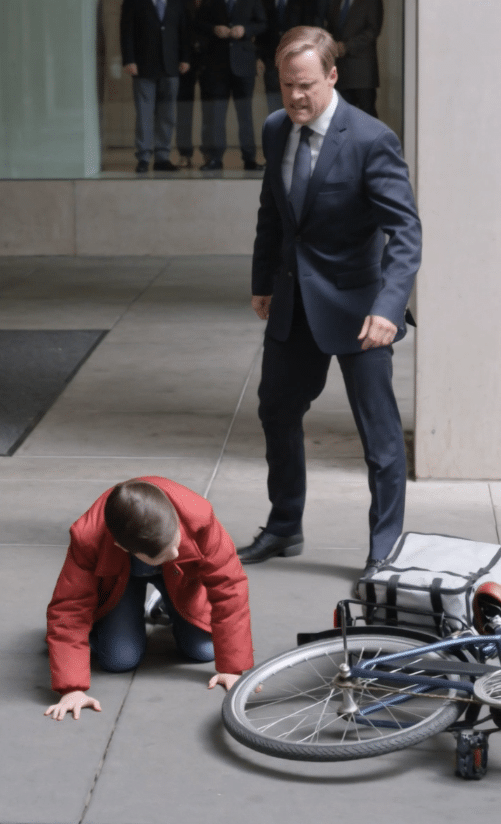
The delivery boy was still trying to protect his food bag when the man in the navy suit kicked him again.
Sixteen-year-old Ethan Cole lay on the sidewalk beside his battered bicycle, one hand gripping the rack to keep the insulated delivery bag from falling. His helmet had shifted sideways, and a thin trace of blood marked his scraped elbow.
Around him, office workers froze beneath the towering glass entrance of one of the city’s most prestigious office buildings.
The man standing over him barely looked winded.
His name was Richard Vaughn, a forty-one-year-old office director with a silver watch, polished shoes, and a black leather briefcase that probably cost more than Ethan’s bicycle. He had spent years building a career in which people stood when he entered a room, returned his calls immediately, and apologized when he was inconvenienced.
Ethan had inconvenienced him by standing near the revolving doors.
That was all.
The teenager had stopped for a few seconds to check the delivery address on his phone. The restaurant’s app had sent him to the building’s main entrance, and he wanted to make sure he had the correct suite number before carrying the order inside.
Richard had been trying to leave.
He saw the old red jacket, the scuffed jeans, and the bicycle with its peeling paint. He saw a boy who looked as though he belonged on the curb rather than near a building where executives paid thousands of dollars a month for office space.
And he decided the boy had no right to be there.
Without warning, Richard drove a kick into Ethan’s chest.
The boy fell hard beside the bicycle. The insulated bag shook violently on the rear rack, and a plastic container rattled inside.
Ethan tried to sit up, gasping as pain tightened through his chest. His elbow scraped the pavement when he reached for the bike.
“I’m checking the delivery address.”
Richard stared down at him.
“Trash. Don’t block people with real jobs.”
Ethan blinked, stunned by the words almost as much as by the attack. He was accustomed to rude customers, impatient restaurant staff, and people who complained about delivery times as though he personally controlled traffic.
He had never been kicked for reading an address.
“I wasn’t blocking anyone,” he wanted to explain, but Richard was already stepping closer.
The director delivered two more forceful kicks, striking Ethan’s back and side. The teenager curled instinctively, one arm shielding his ribs while the other reached toward the food bag.
He was frightened, hurt, and desperately worried that the order would spill onto the sidewalk.
That was the detail that made the scene unbearable.
Even while a grown man assaulted him, Ethan was thinking about the job he might lose if the food arrived damaged.
A woman in a gray business suit covered her mouth. Two men near the revolving doors exchanged horrified looks. A security guard inside the lobby turned toward the commotion, but for one terrible moment, nobody reached the boy.
Richard adjusted his briefcase and looked at Ethan with open contempt.
“Deliver from the curb.”
Then the revolving doors began to turn.
A broad-shouldered man in a black suit stepped out, took in the fallen bicycle, the injured teenager, and Richard standing over him.
He moved so quickly that the people nearest the entrance barely had time to react.
The older man crossed the sidewalk, delivered one sharp punch to Richard’s face, and immediately positioned himself between the director and Ethan.
Richard staggered backward, one hand flying to his cheek.
“What the hell—”
The stranger did not raise his voice.
He looked at the fallen teenager, then at the glass doors behind them.
“This door opened for him before it opened for you.”
Richard stared at him.
Something about the man’s face, his authority, and the way the security guard had suddenly straightened made the director’s anger falter.
His gaze shifted toward the revolving doors.
Then back to the boy.
“For him?”
The question escaped before Richard could stop it.
He had no idea that the teenager he had just kicked onto the sidewalk was connected to a story the building’s owner had spent years trying to make right.
And he was about to discover that the person he considered worthless had a place in that building that money alone could never buy.
Act II
Ethan Cole had never imagined himself working near people who owned skyscrapers.
Most days, he barely had enough time to imagine the following week.
He lived with his mother, Laura, in a small apartment on the third floor of an aging residential building on the other side of downtown. The elevator had been broken for months, the kitchen window refused to close properly, and the heating system made a rattling sound that grew louder whenever the temperature dropped.
But it was home.
Laura worked as a medical billing clerk until her employer cut her hours during a restructuring. She was not careless with money, nor did she make extravagant purchases. She simply earned too little to absorb an unexpected expense.
When their old car finally stopped running, the repair estimate was more than they could afford.
Laura sold the car rather than take on another loan.
Ethan began delivering food after school.
At first, he planned to work only on weekends. Then he realized that two or three deliveries on a weekday could cover groceries, bus fare, and a portion of the utility bill.
He bought a used bicycle from a neighborhood mechanic, saved for a secondhand helmet, and attached a phone holder to the handlebars with a strip of black tape.
His red jacket had belonged to his older cousin. The zipper sometimes caught halfway up, but it was warm enough for most evenings.
Ethan was not proud of the work because it made him feel important.
He was proud because it helped.
Laura tried to hide how much the extra money meant to her. Whenever Ethan placed a few bills on the kitchen counter, she would tell him to save some for himself.
“You’re sixteen,” she reminded him. “You’re supposed to be thinking about school, friends, and what you want to do with your life.”
“I am thinking about it.”
“Really?”
“Yeah. I want to graduate without us worrying about the electricity getting shut off.”
Laura would shake her head, caught between laughing and crying.
“You shouldn’t have to think about that.”
“I know.”
But knowing something was unfair did not make the bill disappear.
Ethan kept working.
He learned which restaurants prepared orders quickly and which ones left drivers waiting beside the kitchen door. He memorized the downtown streets, discovered which intersections were dangerous after dark, and learned to check every address twice.
His ratings mattered. A delayed delivery could cost him a tip, and a complaint could affect how many orders the app offered him.
He was careful because he had to be.
The delivery that brought him to the skyscraper had come from an expensive restaurant near the financial district. The order was for a corporate office on an upper floor, and the customer had paid a generous delivery fee.
Ethan had been pleased when the request appeared.
The ride was longer than usual, but the tip estimate suggested he might earn enough to buy the new school shoes he had been putting off for months.
He checked the address at the entrance because the building had two towers with separate suite numbering systems. He did not want to take the order to the wrong floor.
That brief pause was all it took to draw Richard Vaughn’s attention.
Richard, meanwhile, had spent most of his adult life climbing a different kind of ladder.
He began as a junior analyst at a commercial real estate firm, learning quickly that confidence could sometimes carry a person farther than competence. He worked late, cultivated influential relationships, and became skilled at presenting other people’s accomplishments as evidence of his own leadership.
Eventually, he became a director at Meridian Capital Partners, one of the largest tenants in the building.
His salary was substantial. His apartment overlooked the river. His wardrobe was tailored, his watch was expensive, and his professional calendar was filled with meetings where people carefully considered every word before speaking.
Richard interpreted these things as proof that he had earned the right to be treated differently.
He rarely noticed the people who made his life convenient.
The security officers who held doors. The cleaners who arrived before dawn. The restaurant workers who prepared his lunches. The drivers who navigated traffic to bring him coffee between meetings.
They existed around the edges of his attention, appearing when needed and disappearing when they were not.
Delivery workers bothered him most.
He considered them a sign that the city was becoming disorderly, that anyone could wander into a prestigious building and demand access. He complained about bicycles near the entrance and had once asked management to move a food courier’s waiting area farther down the block.
When Ethan stopped near the revolving doors, Richard saw an opportunity to enforce what he believed was a natural hierarchy.
He did not ask whether the boy had a delivery.
He did not ask whether he needed help finding the correct entrance.
He simply attacked him.
And because Richard had spent years confusing power with permission, he believed the incident would end the way most minor conflicts in his life ended: with someone else apologizing and the world moving on.
He had never considered that the building itself might remember Ethan.
Because the man who had just stepped out of those revolving doors was not merely another executive.
He was the person who had built the company that owned the tower.
And he had a reason to care about a delivery boy he had never met.
Act III
The man in the black suit was Daniel Mercer, the fifty-six-year-old founder and owner of Mercer Urban Group.
His company owned the skyscraper, several neighboring office buildings, and a growing portfolio of commercial properties across the city. His name appeared on charitable foundations, redevelopment projects, and business awards.
But Daniel was not known among his employees for demanding special treatment.
He had grown up in a modest apartment above his father’s repair shop. His mother worked long shifts at a hospital, and his father spent much of his life fixing appliances that other people had given up on.
Money had been scarce.
Daniel remembered waiting outside the shop after school, watching his father repair a broken washing machine for a family who could not afford a replacement. Sometimes his father charged them less than the work was worth. Sometimes he accepted payment in installments.
When Daniel asked why, his father had given him an answer that stayed with him.
“People don’t become less human when they have less money.”
Daniel had carried those words into adulthood.
His company was successful, but he had never forgotten the people who worked behind the scenes. He required building managers to treat contractors and service workers respectfully, and he regularly met with maintenance staff rather than relying entirely on reports from executives.
He had also established a small education and employment fund in memory of his late father.
The fund helped young people from low-income households pay for training, school supplies, and work equipment. It was not a grand public initiative. Daniel preferred to keep it quiet, partly because he disliked the way charity could become a performance.
Several years earlier, one of the fund’s programs had helped a boy named Michael Cole.
Michael had been a bright, hardworking teenager whose father disappeared from his life when he was young. His mother worked multiple jobs, and Michael often took odd jobs to help cover household expenses.
He was the sort of student who arrived early, stayed late, and rarely asked for anything.
Daniel first encountered him through a community education program that offered paid apprenticeships in building maintenance and engineering. Michael had repaired a broken electrical display at a public workshop after the instructor had given up on it.
Rather than pretending to understand the system, Michael had asked questions until he figured it out.
Daniel remembered that determination.
He later helped fund Michael’s technical education, and the young man eventually earned a scholarship that allowed him to study engineering without taking on overwhelming debt.
Years passed.
Michael graduated, began working in the construction industry, and built a career of his own. He was not famous, and he never became one of Daniel’s executives. But he kept in touch with the education program, occasionally volunteering to speak with students who were trying to find their way.
Then, six years before the incident outside the skyscraper, Michael died in a highway collision while driving home from a job site.
He was twenty-six.
The news reached Daniel through the program’s director, who told him that Michael had been supporting his family and had recently become a father.
Daniel attended the memorial.
There, he met Michael’s mother, Laura Cole, and her young son, Ethan.
The child was quiet, clutching a small toy car while the adults spoke. He was too young to understand why his father would not come home.
Daniel did not make grand promises. He knew grief could not be fixed with a check or a speech.
But he promised Laura that the education fund would remain available to Ethan when he was old enough to use it.
It was a promise he intended to keep.
Over the years, Daniel had received occasional updates through the program. Laura had worked hard to raise her son, and Ethan had continued in school. Daniel knew the boy was growing up, but he had never met him again.
He did not know that Laura had recently lost hours at work.
He did not know that Ethan had started delivering food after school.
And when Daniel stepped through the revolving doors that afternoon, he did not recognize the teenager lying beside the bicycle.
He recognized the name only after he had intervened.
A security supervisor approached, visibly shaken, and explained that the injured boy had given his name to the emergency dispatcher.
“Ethan Cole,” the supervisor said.
Daniel went still.
He looked down at the teenager again.
The red jacket, the old bicycle, and the frightened expression were unfamiliar. But the name connected the scene to a promise he had made years earlier.
He had once assured a grieving mother that her son would not be forgotten.
Now, that boy was lying on the pavement outside his building after being attacked by one of the executives who rented space inside it.
Daniel felt a surge of anger, but beneath it was something heavier.
He had no right to assume that Ethan needed rescuing simply because he was struggling. The boy had been working, making his own decisions, and trying to support his family.
But he did have the right to expect basic safety.
Daniel turned toward Richard.
“This door opened for him before it opened for you.”
The words carried a meaning Richard could not yet understand.
The revolving doors had opened for Ethan in a way they had never opened for Richard—not because the boy was wealthier, more influential, or more important on an organizational chart.
They had opened because someone had once recognized his potential and made a promise that still mattered.
Richard stared at Daniel.
“For him?”
And the building owner knew the answer was about to cost the director far more than a bruised cheek.
Act IV
The security team called emergency services and secured the entrance.
Daniel remained beside Ethan while the boy was assessed. He did not attempt to move him again, and he made sure the bicycle and delivery bag were kept clear of the sidewalk so emergency personnel could reach him safely.
Richard stood several feet away, furious that the situation had slipped beyond his control.
“You can’t just hit me and take his side,” he snapped.
Daniel looked at him.
“I saw you kick a child who was trying to do his job.”
“He was blocking the entrance.”
“He was checking an address.”
Richard glanced toward the gathering crowd.
“You don’t know the whole story.”
“I know what I saw.”
The simplicity of the answer left Richard with nowhere to go.
He tried a different approach.
“I’m a director at Meridian. I manage one of your largest tenants.”
Daniel nodded once.
“I know who you are.”
Richard’s shoulders loosened slightly. He seemed to believe that recognition meant the conversation had returned to familiar territory: business relationships, professional courtesy, the quiet understanding that important people protected one another.
Then Daniel continued.
“And that makes what you did more serious, not less.”
The security supervisor confirmed that multiple witnesses had seen the assault. One office worker had recorded part of the confrontation, and the building’s exterior cameras had captured the sidewalk near the entrance.
Daniel instructed the team to preserve the footage and cooperate fully with the authorities. He did not ask anyone to delete a recording, soften a witness statement, or keep the matter out of the public eye.
Richard’s expression hardened.
“You’re going to let a delivery kid ruin my career?”
Daniel’s eyes narrowed.
“No. You may have done that yourself.”
The words struck harder than Richard expected.
He had assumed Daniel would consider the incident a public-relations problem. He expected a quiet meeting, a private apology, perhaps a settlement that would keep the matter from becoming a story.
Instead, the building owner was treating it as a question of conduct.
Daniel had the management team review the relevant building policies, including the rules governing tenant behavior, security incidents, and treatment of delivery personnel. He also contacted Meridian’s senior leadership to ensure the company knew what had occurred.
There would be an independent review.
Richard would not be allowed to use his title to influence it.
When the ambulance crew prepared to take Ethan for medical evaluation, Daniel stepped aside to give them room. Before they loaded the boy, Ethan looked toward his bicycle.
“My order,” he said weakly.
A paramedic assured him that the delivery could wait.
Ethan looked distressed.
“If it gets marked late, I might lose the tip.”
Daniel heard him.
For a moment, the anger on his face gave way to sadness.
Even after being attacked, the boy was still worrying about a few dollars. He was not thinking about the expensive building, the director’s title, or the people watching. He was thinking about whether he could afford the shoes he needed for school.
Daniel turned to the security supervisor.
“Make sure the restaurant is notified that there was an assault. The order wasn’t late because of the driver.”
He then looked at Ethan.
“You don’t need to worry about the delivery right now. Get checked out.”
Ethan hesitated.
“I can’t just stop working.”
“I understand,” Daniel replied. “But you don’t have to settle everything this minute.”
The boy looked as if he wanted to argue, but the paramedics were ready to take him.
Daniel did not promise him a perfect future. He did not offer him a job on the spot or pretend that his family’s problems could be solved with a dramatic gesture.
He simply stayed until Ethan was safely on his way.
Across the sidewalk, Richard watched the ambulance leave.
His cheek was beginning to swell where Daniel had struck him. He was angry about the punch, but he was more frightened by what might happen next.
Meridian’s senior leadership contacted him before the end of the day. They requested a formal account of the incident and informed him that he would be placed on leave while the matter was investigated.
The building’s management company preserved the available security footage. Witnesses were contacted, and the police were provided with the information needed to assess the assault.
No one announced a verdict on the sidewalk.
The evidence would have to speak for itself.
But Richard’s professional position was already in danger. The company could not reasonably ignore an incident in which one of its directors had been seen attacking a teenage delivery worker outside a major office building.
By evening, a short video of the confrontation had begun circulating among office employees. It showed the boy beside his bicycle, Richard standing over him, and Daniel stepping between them.
The footage did not explain the education fund or the promise Daniel had made to Ethan’s mother.
It did not need to.
The contrast was unmistakable.
One man had used his status to humiliate someone he considered beneath him.
Another had used his position to stop the attack and insist that the incident be investigated.
For Richard, the most frightening part was no longer the video.
It was the realization that the person who could determine the building’s response had no interest in protecting his title.
And the boy he had dismissed as trash was someone Daniel Mercer had promised never to forget.
Act V
Ethan spent the next several hours undergoing medical evaluation.
His injuries were painful, and the experience had left him shaken. He was relieved when his mother arrived, but he looked embarrassed when she asked what had happened.
“I was just checking the address,” he told her.
Laura sat beside him and held his hand.
“I know.”
“I didn’t mean to block him.”
“You don’t have to explain why you were standing on a sidewalk.”
Ethan stared at the floor.
“I thought if I lost the delivery, I’d lose the tip.”
Laura closed her eyes briefly.
For months, she had watched her son become more careful, more responsible, and more worried about things a teenager should not have to carry alone. He checked the household budget before buying school supplies. He turned down invitations because he had a delivery shift. He apologized whenever he thought he had cost the family money.
She had been proud of his determination.
Now, she wondered how often that determination had been mistaken for permission to ask too much of him.
When Daniel arrived at the hospital, he did not enter the room immediately. He first spoke with Laura in the hallway, introducing himself and explaining that he had witnessed the attack.
She recognized his name.
For a moment, neither of them spoke.
Then Daniel told her that Ethan had done nothing to deserve what happened and that the relevant evidence was being preserved.
Laura thanked him, but her voice trembled.
“I never wanted him to feel like he had to be strong all the time.”
Daniel understood more than she expected.
He told her about the education fund and reminded her that his promise had not expired simply because years had passed. If Ethan still wanted to pursue training or higher education, the program remained available to him.
There was no obligation to accept, and no expectation that the family would appear at an event or tell their story publicly.
Laura looked toward the hospital room.
“Michael would have wanted him to finish school,” she said quietly.
“I know,” Daniel replied.
They sat with that memory for a moment.
Michael had been dead for six years. No amount of money could restore the conversations he would never have with his son or the ordinary afternoons he would never share with his family.
But Daniel could honor the promise he had made without pretending to replace the father Ethan had lost.
A few days later, Daniel visited the Cole apartment.
He arrived without a camera crew or a public-relations representative. He brought the information about the education fund, a list of local academic and vocational programs, and the contact details of a counselor who could help Ethan explore his options.
Ethan listened carefully.
He was grateful, but he was also wary. He did not want people to think he had received help only because a powerful man had seen him being assaulted.
Daniel seemed to understand.
“You were doing your job before I arrived,” he told him. “Nothing that happened afterward changes that.”
Ethan looked down at his hands.
“I just wanted to deliver the food.”
“And you should have been able to.”
That was the heart of it.
Ethan did not need to be someone’s former scholarship recipient, someone’s charitable project, or the son of a man Daniel remembered fondly to deserve safety. The promise connected them, but it did not create his worth.
It merely reminded Daniel of what he already believed.
A person’s dignity was not something wealthier people could grant or withdraw.
Meanwhile, the investigation into Richard’s conduct continued.
The building’s security footage and witness statements were reviewed. Meridian conducted its own internal assessment, and the relevant authorities determined the next steps based on the available evidence.
Richard’s leave became a formal disciplinary process. His senior colleagues had to consider not only the incident itself but also whether he could be trusted to represent a company that operated in a public-facing environment.
The consequences did not arrive as one cinematic announcement.
They came through meetings, documentation, decisions, and uncomfortable questions. His title could not make the footage disappear, and his professional connections could not erase the witnesses who had seen the attack.
Eventually, Meridian removed Richard from his leadership position after concluding that his conduct was incompatible with the standards expected of its executives. Any legal consequences remained a matter for the appropriate authorities.
Richard had spent years believing that his career made him important.
Now, the career he had used to look down on others could no longer shield him from his own actions.
The building remained busy.
Office workers still hurried through the revolving doors each morning. Security guards continued greeting visitors. Couriers arrived with food, documents, and packages, many of them riding bicycles older than the ones parked outside the nearby restaurants.
But building management made a change.
Delivery workers were given clearer instructions for checking in, and staff were reminded that couriers were entitled to respectful treatment. Security personnel were directed to address genuine access concerns without allowing tenants to intimidate or threaten workers.
It was a modest adjustment, but an important one.
The entrance was still a place where executives walked in polished shoes and visitors admired the glass walls.
It was also a place where a teenager could arrive with a food order and expect to be treated like a human being.
Several weeks later, Ethan returned to work.
His old red jacket was still worn at the cuffs. His bicycle still rattled over uneven pavement, and he still checked every delivery address twice.
He had not suddenly become wealthy.
His mother still had bills to manage, and Ethan still had homework to finish after his shifts. Life did not transform overnight simply because one powerful person had intervened.
But he had something new.
He knew that asking where to go was not a reason to be ashamed. He knew that working an ordinary job did not make him less deserving of respect. And he knew that if someone tried to convince him otherwise, their confidence did not make them right.
One afternoon, he approached the skyscraper again with a delivery strapped to the back of his bicycle.
A security guard recognized him and held the door long enough for him to check in.
“Delivery for the twenty-third floor?” the guard asked.
Ethan checked his phone.
“Twenty-third floor. Suite 2314.”
“Elevators are straight ahead.”
“Thanks.”
He wheeled his bicycle toward the designated area and carried the order inside.
Above him, the revolving doors continued turning, reflecting the city in their curved glass panels.
Daniel Mercer happened to be in the lobby that afternoon. He saw Ethan pass through, carrying the delivery bag, and gave him a small nod.
Ethan nodded back.
There was no need for a speech.
The boy had a job to do, and the building was simply allowing him to do it.
Richard Vaughn had once looked at Ethan’s old jacket and bicycle and decided the boy belonged outside.
He had mistaken poverty for insignificance and a brief pause for an offense worthy of violence.
Daniel had looked at the same boy and remembered a promise, a family, and the simple principle his own father had taught him decades earlier.
People don’t become less human when they have less money.
That was why the building’s doors had opened for Ethan long before Richard understood what they meant.
Not because Ethan was secretly more powerful than the director.
Not because he had a wealthy benefactor waiting to rescue him.
But because he had been doing honest work, and honest work deserved respect.
The skyscraper’s doors opened for executives, investors, visitors, cleaners, and delivery workers every day.
Only one man had believed that his title made him more entitled to pass through them.
And when the truth finally caught up with him, the question that remained was not why Daniel had stood up for the boy.
It was why Richard had ever believed the boy was beneath him in the first place.