Act I
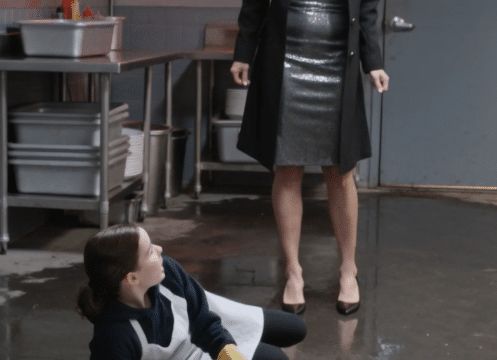
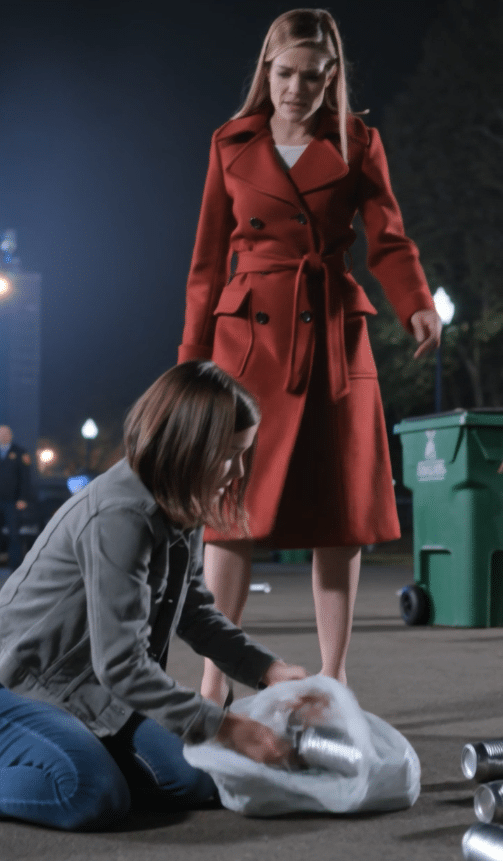
The cans were still rattling when the woman in the red coat kicked the girl again.
Sixteen-year-old Lily Carter fell beside her recycling bag, one knee scraping against the pavement. Aluminum cans scattered across the walkway, rolling beneath the feet of concertgoers who had been laughing moments earlier.
The stage lights were fading behind them. Cleanup crews were gathering trash near the fences, and the last crowds were making their way toward the parking lots.
Lily had been collecting empty cans for nearly three hours.
To her, each one mattered.
A handful meant a few extra dollars. A full bag meant groceries. On a good night, she could earn enough to cover the electricity bill her mother had been worrying about all week.
But the woman standing over her saw none of that.
She saw a dirty jacket, worn jeans, cloth gloves, and a girl who had allowed a recycling bag to brush against the edge of her expensive heel.
The woman’s name was Vanessa Whitmore. She was thirty-nine, wealthy, impeccably dressed, and accustomed to moving through the world as if inconvenience were something other people were paid to prevent.
Her red coat was tailored. Her handbag carried a designer label. Even her expression seemed expensive, polished into a permanent look of disapproval.
She had just left the concert’s VIP section when Lily’s bag lightly touched her shoe.
Vanessa stopped as though someone had deliberately insulted her.
Before Lily could step away, Vanessa drove a kick into the girl’s chest, sending her backward onto the pavement.
Lily struggled to breathe. Her bag toppled beside her, and a few cans bounced toward a trash bin.
She pushed herself up with trembling hands, wincing as she moved her injured knee.
“I’m sorry. I’m just cleaning these up.”
Vanessa stared at her with disgust.
“Trash. Don’t drag garbage near me.”
Lily lowered her eyes, not because she agreed, but because she had learned that some people became crueler when they thought they were being challenged.
She tried to gather the cans.
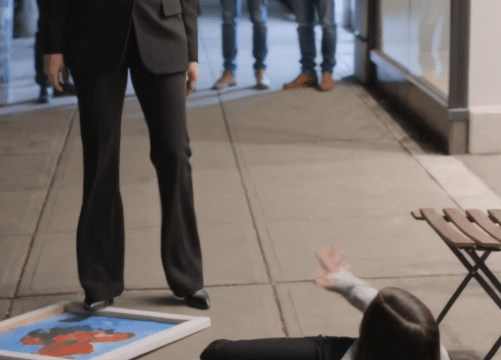
Vanessa stepped closer and kicked her twice more, striking her back and side. Lily curled instinctively, protecting herself while reaching for the bag that had spilled across the walkway.
A thin trace of blood appeared on her scraped knee.
Nearby, a man stopped with a half-empty drink in his hand. A woman covered her mouth. Two cleanup workers froze beside a cart full of black garbage bags.
Nobody moved.
Vanessa looked down at Lily as if the girl had made the evening unpleasant on purpose.
“Pick yourself up with the trash.”
Lily swallowed hard.
She was sixteen years old, exhausted, and lying on a public sidewalk while strangers watched. Yet even then, her hand moved toward the nearest can.
She did not want to leave anything behind.
She could not afford to.
What Vanessa did not realize was that someone else had seen the entire attack—someone who had arrived at the park for a routine inspection and had no intention of letting the moment disappear into the night.
A woman in a navy suit broke away from a small group near the concert entrance.
She moved quickly, her expression hardening as she crossed the pavement.
Then she reached Vanessa, delivered one sharp slap across her face, and stepped between the woman and Lily.
The entire walkway fell silent.
The stranger looked down at the injured girl before turning back toward Vanessa.
“She cleaned more of this city than you ever will.”
Vanessa touched her cheek, stunned.
Then she recognized the woman standing in front of her.
Her face lost its color.
“The mayor…?”
And suddenly, the cans scattered across the pavement were no longer the most embarrassing thing in the park.
Act II
Lily Carter had learned to recognize the value of things most people threw away.
An empty soda can was worth only a few cents. A discarded water bottle was worth less than a cup of coffee. A cardboard box might earn her almost nothing.
But she had discovered that small amounts became meaningful when she collected enough of them.
Her mother, Denise, had taught her that lesson without ever intending to.
Denise worked as a hotel housekeeper, leaving home before sunrise and returning with aching shoulders. She rarely complained, even when her feet swelled after a double shift or when a manager changed her schedule without warning.
Lily’s father had left when she was nine. After that, Denise had become both parents, stretching every paycheck and making sure her daughter never felt responsible for the choices adults had made.
They lived in a small apartment above a laundromat, where the washing machines rattled through the floor and the hallway smelled of detergent.
Their furniture was secondhand. Their kitchen table had a chipped corner. In winter, Denise kept a blanket folded beside the couch because the apartment never seemed to hold heat properly.
Still, Lily had never thought of their home as a place to be ashamed of.
It was where her mother made pancakes on birthdays, even when they had to use the last of the milk. It was where they watched old comedy shows on a television that sometimes lost its picture. It was where Denise listened patiently whenever Lily came home upset about school.
Then Denise injured her wrist at work.
At first, she told Lily it was nothing. A little pain, she said. A few days of rest would fix it.
But the pain persisted, and the doctor warned her that continuing to lift heavy loads could make the injury worse. Her employer reduced her hours while she recovered, and the smaller paychecks arrived just as rent and utility bills came due.
Denise tried to hide her worry.
Lily noticed anyway.
She saw the way her mother studied grocery prices, returning items to the shelf when the total climbed too high. She heard the quiet conversations about payment plans and overdue bills. Once, she woke after midnight and found Denise sitting at the kitchen table, calculating expenses on the back of an envelope.
The following morning, Lily made a decision.
She would collect cans.
At first, Denise objected.
“You should be concentrating on school,” she told her.
“I am.”
“Lily.”
“I’ll do my homework first. I promise.”
Denise looked at her daughter’s worn sneakers and the thin soles that had begun to separate near the toes.
“You don’t have to carry all this.”
Lily shrugged, trying to make the situation sound smaller than it was.
“I’m not carrying everything. Just cans.”
That made Denise smile, but her eyes remained worried.
They agreed on rules. Lily would collect only in safe public areas, stay aware of her surroundings, and never follow strangers into isolated places. She would come home before it got too late and tell her mother where she planned to go.
The work was not glamorous.
After school, Lily walked along park paths and sidewalks, carrying a large reusable bag. She learned which public spaces filled with discarded bottles after weekend events and which businesses allowed recyclables to be collected from designated bins.
Some people ignored her.
Others watched with suspicion, as if picking up what they had thrown away somehow made her responsible for their discomfort.
A few were kind. One food-truck owner began saving his empty cans for her. An older man who walked his dog every evening left a clean paper bag beside a bench whenever he saw her coming.
Lily thanked everyone, even the people who gave her nothing.
She was not collecting cans because she believed she deserved less than anyone else.
She was doing it because her family needed the money.
And because every time she brought home a little more than she had expected, her mother could relax for a few hours.
On the evening of the concert, Lily had planned to collect for forty-five minutes and head home.
But the crowd was enormous, and the ground was covered in cans and bottles. She could see dozens of containers that would otherwise be swept into the general waste.
She thought about the money they could bring in.
She thought about the grocery list on their refrigerator.
So she stayed.
As the final song ended, Lily moved along the edges of the crowd, careful not to get in anyone’s way. She collected the bottles near the food stalls and the cans left beside the temporary fencing.
She was almost ready to leave when the bag brushed Vanessa Whitmore’s shoe.
It was an accident so small that Lily barely understood why the woman had stopped.
Then came the kick.
In a matter of seconds, the ordinary task that had helped Lily keep her family afloat became a public humiliation she would remember for years.
But the woman in the red coat had made a terrible mistake.
She had looked at Lily’s clothes and decided she knew the girl’s worth.
She had seen someone with no apparent power and assumed there would be no consequences for treating her cruelly.
What she had failed to notice was that the city itself was watching.
And its mayor had just seen enough.
Act III
Mayor Eleanor Brooks had not planned to stay late at the concert.
At forty-six, she had learned that public events rarely ended when the schedule said they would. There were usually a few more conversations, another handshake, or a final inspection that someone had forgotten to arrange.
That evening, she was walking through the park with two members of the city’s events team, checking the cleanup operation before the grounds were reopened to the public.
The concert had drawn thousands of people. The city had invested in security, sanitation, temporary lighting, and traffic management. Brooks wanted to know whether the crews had enough equipment and whether the paths would be safe for the morning’s visitors.
It was not glamorous work.
She preferred it that way.
Before entering politics, Brooks had spent years working in municipal administration, learning how easily a policy could look successful on paper while failing the people it was meant to serve. She had watched neighborhoods wait months for basic repairs and seen public spaces deteriorate because officials were more concerned with announcements than maintenance.
As mayor, she insisted on seeing things firsthand.
She had walked through flooded underpasses after storms, visited shelters during freezing weather, and sat at folding tables in community centers where residents explained problems that had been ignored for years.
Her staff sometimes complained that she made too many unscheduled visits.
Brooks considered that a useful criticism.
A person could prepare a room for a mayor. It was much harder to prepare an entire city.
That was why she was still in the park when Vanessa Whitmore attacked Lily.
At first, Brooks saw the girl fall.
Then she saw the woman standing over her.
She heard the insult and watched Vanessa deliver the two follow-up kicks. For a fraction of a second, Brooks could not believe what she was witnessing.
The girl was plainly trying to collect discarded containers.
The woman was plainly trying to hurt her.
There was no misunderstanding that could explain the violence.
Brooks hurried forward and struck Vanessa across the face before placing herself between the woman and Lily.
The slap was impulsive, and she knew it. She had no interest in pretending that her own action was the correct way to handle every public confrontation.
But in that moment, her first instinct had been to stop the immediate threat.
Now, with Lily on the ground and Vanessa staring at her, Brooks forced herself back into the role the situation required.
She turned toward her events team and instructed them to call emergency services and security. One staff member moved to keep the surrounding crowd from pressing closer, while another began identifying witnesses.
Only after the girl was no longer directly threatened did Brooks face Vanessa again.
The wealthy woman had regained enough composure to look offended.
“You hit me!”
Brooks’s expression remained cold.
Vanessa looked from the mayor to the small crowd gathering behind them. She seemed to be calculating what the scene meant for her.
She was a prominent donor to several local organizations. Her name appeared at charity dinners and business events. She had attended private receptions with council members and once sponsored a holiday gala that raised money for families in need.
She was accustomed to people treating her generosity as evidence of her character.
Now, she was standing in a public park with a reddening cheek, facing the mayor after assaulting a teenager.
Brooks did not know Lily’s name yet. She did not know the family’s financial circumstances or how long the girl had been collecting cans.
She did not need to know those things to understand what she had witnessed.
The mayor looked at Lily’s recycling bag, then at the containers scattered across the pavement.
“She cleaned more of this city than you ever will.”
The words were not a speech. They were a judgment.
Vanessa’s lips parted.
For the first time, the confidence in her expression wavered.
She knew who Brooks was. Everyone who followed city politics knew the mayor’s face, and Vanessa had attended enough civic events to recognize her immediately.
“The mayor…?”
Brooks did not answer the question.
She turned toward Lily instead.
The girl was conscious but visibly shaken, one hand pressed against her side and the other resting near the torn edge of her bag. She looked embarrassed by the attention, as though she had somehow caused the scene by being there.
Brooks crouched nearby, careful not to move her unnecessarily.
Help was coming.
For now, that was what mattered.
Vanessa watched the mayor’s attention shift away from her, and her expression changed from outrage to calculation.
She had spent years building a reputation that opened doors.
She had never considered what might happen if the people who opened those doors began asking what she did when nobody important was watching.
Act IV
By the time the first security officers arrived, the story had already begun spreading through the crowd.
A concertgoer had recorded part of the confrontation on a phone. A cleanup worker had seen the initial kick. Another witness had heard Vanessa’s insults clearly enough to repeat them.
The evidence was not dependent on a single person’s memory.
Several people had watched the same thing happen.
Brooks made sure that emergency personnel could reach Lily without obstruction. She asked her staff to preserve the relevant footage, collect witness contact information, and document the scene. The appropriate authorities would determine what charges, if any, were warranted after reviewing the evidence.
No one was to decide the outcome simply because a mayor was present.
And no one was to bury the incident because the woman involved was wealthy.
Vanessa stood near the path, holding her designer bag with both hands. Her anger was giving way to a different emotion: the fear of being seen clearly.
“This is being blown out of proportion,” she insisted.
Brooks looked at her.
“An accident involving a bag is one thing. Kicking a teenager on the ground is another.”
“She got dirt on my shoe.”
“Then you could have asked her to move.”
Vanessa’s jaw tightened.
“I didn’t know who she was.”
The answer hung between them.
Brooks’s expression grew even colder.
“That doesn’t matter.”
For a moment, Vanessa seemed genuinely confused.
She had expected the conversation to revolve around status. She was used to weighing people by their professional titles, their influence, and the favors they might exchange. She assumed that if Lily had been a wealthy donor’s daughter, a local celebrity, or the child of a powerful official, the attack would have been treated as an outrage.
But the mayor was telling her that Lily’s identity was irrelevant.
The girl did not need to be connected to anyone important to deserve safety.
A cleanup supervisor approached Brooks and explained that the park crew had been struggling to clear the enormous volume of recyclables left after the concert. Many cans were mixed with general trash, making recovery difficult.
He glanced at Lily’s bag.
“She was picking up the ones people left along the paths. We saw her doing it before the show ended.”
Brooks looked toward the girl.
“How long has she been here?”
The supervisor shook his head.
“I’m not sure. A while.”
One of the cleanup workers, a woman named Marisol, stepped forward.
“I’ve seen her before,” she said. “She comes to the park after busy weekends. She’s always careful to stay out of the crews’ way.”
Brooks listened without interrupting.
The more she learned, the clearer the situation became. Lily had been doing unpaid work that helped keep the park clean, while collecting a small amount of money from materials other people discarded. She had not been obstructing the event deliberately. She had been trying to make the most of an opportunity.
And when a wealthy stranger decided the girl was beneath her, Lily had apologized.
Even after being attacked, she had tried to retrieve the cans.
Brooks felt a familiar heaviness in her chest. She had spent years attending meetings about poverty, sanitation, youth employment, and public safety. She had read reports filled with percentages and projected costs.
But the reality of a city was never contained in a report.
It was in the sixteen-year-old who worked after school because her family needed money. It was in the cleanup worker who recognized her because she had been there before. It was in the bystanders who had watched an assault and were now struggling with the knowledge that they had not moved quickly enough.
Brooks turned to her staff.
She wanted the city’s youth services team to speak with Lily and her mother, with no pressure to accept help and no publicity attached to it. She also wanted the sanitation department to review how recycling was handled at major public events, including whether safe, designated collection areas could be made available.
The goal was not to turn one injured teenager into a campaign slogan.
It was to ask why a girl had to put herself in harm’s way to earn a few extra dollars, and what the city could do to make such work safer.
Vanessa heard the mayor’s instructions.
Her face tightened.
“You can’t make this about city policy just because I was involved.”
Brooks turned toward her.
“I’m making it about what happened here.”
“And what about my reputation?”
For the first time, Brooks seemed almost tired.
“Your reputation is not my responsibility. Your actions are.”
The security officers continued their work. Witnesses provided statements, and Vanessa was asked to remain available while the incident was assessed. The city would not declare her guilty in the middle of the park, but neither would it protect her from scrutiny.
Vanessa looked around for someone who might take her side.
No one did.
The concertgoers who had admired her coat and recognized her from charity events were now keeping their distance. The cleanup workers were focused on the scene, not her. The people who had watched the assault were no longer pretending it had been a private disagreement.
Brooks finally stood and looked toward the ambulance crew.
Lily was being carefully assessed, and her recycling bag had been moved out of the way. A cleanup worker had gathered the loose cans into a separate container, making sure they would not be swept into the general waste.
Vanessa followed the mayor’s gaze.
The girl was still holding on to the bag.
Even now, she seemed worried about losing the money she had worked so hard to collect.
That was when Vanessa appeared to understand something she had never considered.
Lily had not been trying to get close to her.
She had not been trying to embarrass her or demand anything.
She had simply been trying to earn enough to get through another week.
And Vanessa had treated that effort as if it were an insult.
The mayor’s presence had made the consequences unavoidable.
But it was the girl on the pavement who made the truth impossible to ignore.
Act V
Lily was taken for medical evaluation, and her mother arrived at the hospital before the night was over.
Denise Carter came through the emergency department doors still wearing her work clothes, her injured wrist supported by a brace beneath her sleeve. She had been told only that Lily had been hurt in the park.
When she saw her daughter sitting on the bed, pale and shaken, she stopped walking.
Then she hurried to her side.
“Lily?”
“I’m okay, Mom.”
It was the same answer Denise had given her countless times over the years, usually when she was tired, in pain, or worried about money.
Hearing it from her daughter broke something open inside her.
Denise pulled up a chair and took Lily’s hand, careful of the scraped knee.
“What happened?”
Lily looked at the floor.
“My bag touched this lady’s shoe. I said I was sorry, but she got mad.”
She described the kicks in a small, uneven voice. She told her mother about the cans spilling across the walkway and the woman who had called her trash.
Then she explained that the mayor had stepped in.
Denise stared at her.
“The mayor?”
Lily nodded.
“She was there with some people from the city.”
Denise looked as though she wanted to ask a hundred questions, but she reached for her daughter’s hand instead.
“You didn’t do anything to deserve that.”
Lily’s eyes filled.
“I should’ve moved the bag.”
“No.”
Denise’s voice was gentle, but firm enough to stop the thought before it could settle.
“You can move a bag. You can apologize for an accident. You can make a mistake. None of that makes it okay for someone to hurt you.”
Lily lowered her head and began to cry.
She had held herself together in the park because she was afraid that if she started crying, she would never stop. She had held herself together in front of the strangers who watched her fall. She had held herself together when the mayor appeared, when security arrived, and when the paramedics asked her questions.
Now, with her mother beside her, she finally let go.
Denise held her carefully, whispering that she was safe and that none of this was her fault.
Outside the hospital room, the story continued to unfold.
Witness statements and available video were provided to the appropriate authorities. Vanessa’s actions drew public scrutiny, and the organizations with which she had been associated began reviewing their own policies and relationships. Any legal consequences would depend on the evidence and the decisions of the authorities, not on the mayor’s anger alone.
Brooks refused to turn the incident into a public spectacle.
She did not release Lily’s private medical information or ask the teenager to stand beside her at a press conference. She did not present the girl as a symbol without first considering what that attention might cost her.
Instead, she asked the city’s youth services office to contact Denise privately and explain what support might be available.
The family could accept or decline.
No photographs were required.
No public gratitude was expected.
That mattered to Denise more than she could explain.
For years, she had watched people offer help in ways that made the recipient feel indebted or ashamed. This was different. The city was acknowledging a problem without demanding that Lily become the face of it.
A few weeks later, the park’s cleanup operation changed.
The sanitation department established clearly marked recycling collection points after major events. Organizers were encouraged to make the arrangements visible before crowds began leaving, and the city reviewed ways to keep collection areas safe and accessible.
It was not a solution to poverty.
It would not repair Denise’s wrist overnight or make every bill disappear.
But it was a practical change, prompted by a moment that could easily have been dismissed as an unfortunate confrontation.
Lily returned to school and resumed helping her mother where she could. When she eventually returned to the park, she found the cleanup crews using the new collection stations.
Marisol, the worker who had spoken up that night, recognized her immediately.
She greeted Lily warmly and showed her where the designated recycling bins were located.
“You don’t have to rush around the whole park anymore,” Marisol told her. “They’ve made it easier to sort everything.”
Lily looked at the clearly marked containers.
For the first time, she felt that the city had noticed the work she was doing.
Not because she had been attacked.
Not because the mayor had witnessed it.
Because the work itself had value.
On a later visit, Mayor Brooks stopped by the park again. She was there for another inspection, dressed simply and accompanied by a small staff team.
She recognized Lily near the recycling station and approached without cameras or ceremony.
“How are you feeling?”
“Better, thank you.”
Brooks glanced at the containers.
“Looks like the new setup is working.”
Lily nodded.
“It makes it easier.”
The mayor smiled.
“That’s what it should do.”
There was no dramatic promise, no envelope filled with money, and no sudden transformation in Lily’s life. Brooks did not pretend that one policy adjustment could fix every hardship the girl faced.
She simply listened as Lily explained how the collection stations helped the cleanup crews and made it easier for people to keep recyclable materials separate.
Before leaving, Brooks thanked her.
Lily looked surprised.
“For what?”
“For caring about a place that belongs to all of us.”
After the mayor walked away, Lily stood for a moment beside the bins, watching the cleanup team work beneath the afternoon sun.
She thought about the night of the concert: the red coat, the scattered cans, the sharp pain that had made the world seem distant. She remembered how the crowd had frozen and how alone she had felt on the pavement.
She also remembered the moment the mayor stepped between her and Vanessa.
It had not made the pain disappear.
It had not erased the fear.
But it had reminded Lily that the way someone treated her was not a measure of what she deserved.
Vanessa Whitmore had looked at a poor teenager in an old gray jacket and seen nothing worth respecting.
The mayor had looked at the same girl and seen someone working hard, someone deserving of protection, someone whose dignity did not depend on her bank account.
That difference was the heart of the story.
The woman in the red coat had believed that wealth made her untouchable. She had mistaken attention for respect and status for character.
But a city was not made valuable by its most expensive buildings or its wealthiest residents.
It was made valuable by the people who cleaned its streets, cared for their families, helped strangers, and kept doing honest work even when nobody thanked them.
Lily had been picking up what others left behind.
Vanessa had been the one who showed everyone what she carried inside.
And long after the concert lights had faded, that was what people remembered.