Act I
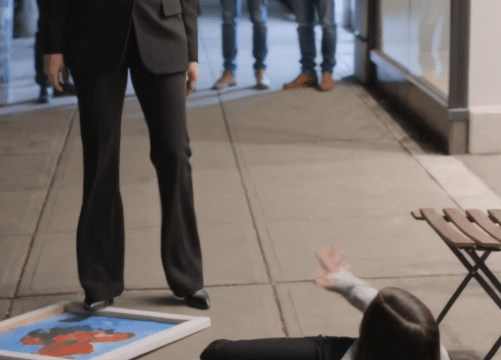
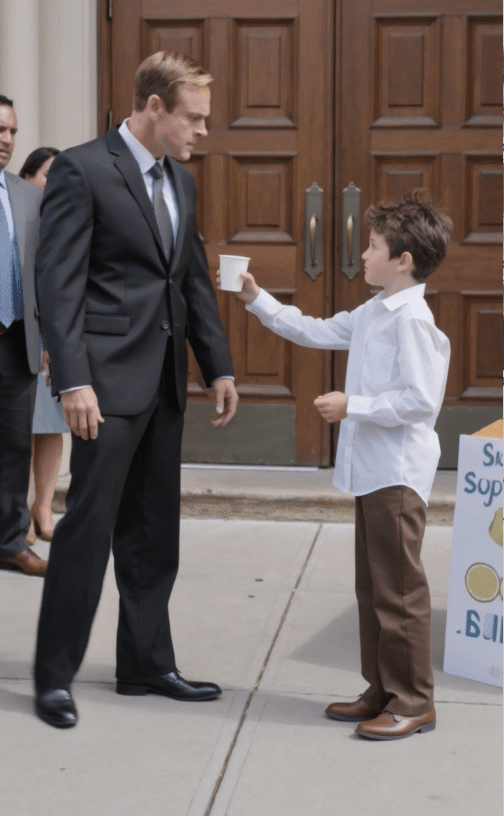
The boy was still trying to save the charity sign when the businessman kicked him again.
A paper cup rolled across the sidewalk, spilling lemonade between the cracks. The little folding table rocked violently, and the handwritten sign taped to its front began sliding toward the wet pavement.
EVERY DOLLAR HELPS A CHILD FIGHT CANCER.
Twelve-year-old Noah Bennett reached for it.
His palm scraped against the concrete, leaving a thin trace of blood, but he barely seemed to notice. His eyes were fixed on the sign. If it fell into the spilled lemonade, the words would become unreadable, and the people leaving the church might never know why he had spent the morning standing there.
The man in the black suit looked down at him with open disgust.
His name was Richard Caldwell, a wealthy real estate developer whose silver tie, polished shoes, and expensive watch announced his success before he spoke. He had just left Sunday service, where several church members had thanked him for supporting the building renovation fund.
Then he had encountered a lemonade stand.
One paper cup sat a little too close to the edge of the walkway.
That was all it took.
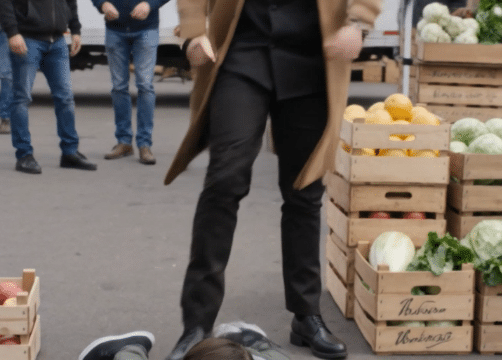
Caldwell had complained that the table narrowed the path. Before Noah could move it, the businessman drove a forceful kick into the boy’s chest, sending him sprawling onto the sidewalk.
Now Noah struggled to catch his breath, one hand pressed against his chest and the other reaching for the sign.
“I can move the table, sir.”
His voice trembled, but he was trying desperately to be polite.
Caldwell looked at the sign as if the words offended him.
“Trash. Your little stand blocks real donors.”
Several churchgoers stopped near the doors. An older woman covered her mouth. A man holding a Bible took one step forward, then hesitated when Caldwell turned his head.
The businessman stepped closer to Noah.
“Beg where people can ignore you.”
Then he kicked the boy twice more, striking his back and side as Noah curled protectively around himself and tried to keep the sign from falling into the spilled lemonade.
A few people gasped.
Nobody moved quickly enough.
Noah’s eyes filled with tears, but he did not scream. He had promised himself that morning he would stay until the last churchgoer had passed, because every dollar mattered and he was still far from his goal.
He had no idea that someone standing just beyond the church doors had witnessed everything.
The man was fifty-nine, dressed in a navy suit, with a face that had spent years in boardrooms negotiating donations worth millions. He was the director of one of the country’s largest charitable foundations.
He did not know Noah.
He did not know the boy’s family.
But he knew what that sign meant, and he knew what had happened to the child holding it.
He rushed forward, struck Caldwell once across the face, and positioned himself between the businessman and the boy.
Then he looked directly at Caldwell.
“You just kicked the reason today’s donation doubled.”
Caldwell blinked, stunned.
“Doubled?”
For the first time that morning, the wealthy businessman looked frightened.
Because the director was not talking about the lemonade.
He was talking about something Caldwell had never bothered to notice.
And the boy on the ground was worth far more to the people leaving that church than the man in the expensive suit could possibly imagine.
Act II
Noah Bennett had not always sold lemonade outside churches.
Six months earlier, he had been the kind of boy who worried about ordinary things: homework, baseball practice, whether his sneakers would last until the end of the school year. He lived with his mother, Sarah, in a small rented house where the kitchen window stuck whenever it rained.
His father had died when Noah was eight.
Afterward, Sarah had worked two jobs to keep their lives steady. She packed lunches at an elementary school in the mornings and cleaned offices several evenings a week. She never described their situation as desperate, even when the electricity bill sat unopened on the counter until payday.
She had taught Noah that being poor was not something to be ashamed of.
But she had also taught him that asking for help was not the same as giving up.
Then Sarah became sick.
At first, the symptoms seemed manageable. She was tired all the time and sometimes struggled to finish a sentence without stopping to catch her breath. Noah assumed she was working too much.
When she finally went to the hospital, the doctors found an aggressive form of cancer.
The diagnosis changed everything.
There were appointments, treatment plans, medication schedules, and conversations that became quiet whenever Noah entered the room. His mother tried to protect him from the frightening details, but children often notice the things adults work hardest to hide.
He noticed the unopened mail.
He noticed when Sarah said she wasn’t hungry because the groceries needed to last until Friday.
And he noticed the way she looked at the hospital bills before folding them carefully and placing them beneath a stack of magazines.
One evening, Noah overheard her speaking to a hospital financial counselor.
She thanked the woman for explaining the assistance program, then apologized for not being able to pay the remaining balance immediately.
When the call ended, Sarah sat at the kitchen table with both hands wrapped around a cold mug of tea.
Noah stood in the doorway.
“Mom?”
She quickly wiped her eyes.
“I’m okay, sweetheart.”
He knew she wasn’t.
He walked over and hugged her. She held him tightly, pressing her cheek against his hair as if she could keep the entire world away by holding on hard enough.
That night, Noah lay awake thinking about money.
He knew he couldn’t get a job at his age. He couldn’t pay hospital bills with the few dollars he had saved in a jar on his dresser. He couldn’t make his mother’s treatment easier by promising to do better in school or by finishing his chores without being asked.
But he could do something.
The next morning, he took an old folding table from the garage and cleaned it with a damp cloth. He found a pitcher, a stack of paper cups, and a handwritten recipe for lemonade that his mother had taught him years earlier.
Then he made a sign.
The first version was crooked, with letters that grew smaller whenever he ran out of room. He rewrote it twice before settling on a simple message asking people to buy lemonade and help children receiving cancer treatment.
At first, he raised money for the children’s hospital because it was where his mother received care. He wanted other families to have help when medical bills threatened to swallow everything they owned.
He didn’t know how to organize a fundraiser.
He didn’t have a website, a social media following, or a wealthy relative who could make a phone call to the right person.
He had a folding table.
A pitcher of lemonade.
And the stubborn belief that a small act could still matter.
His mother had been hesitant when he first told her what he planned to do.
“You don’t have to fix everything, Noah.”
“I know.”
“You’re twelve.”
“I know that, too.”
She had smiled sadly.
“So why do you want to do this?”
Noah had looked down at the sign in his hands.
“Because somebody should.”
Sarah hadn’t known what to say.
In the end, she helped him cut the cardboard, made sure the lemonade was prepared safely, and walked with him to the first church fundraiser. She stood nearby while he offered cups to strangers, embarrassed by the attention but proud of his determination.
The first Sunday brought in forty-three dollars.
The second brought in seventy-one.
By the third, people had started recognizing him.
A retired teacher bought a cup every week, even when she admitted she didn’t particularly like lemonade. A father brought his two children and explained that helping someone else was one way to learn gratitude. A church volunteer gave Noah a stack of fresh paper cups and helped him straighten the sign.
Every contribution went toward the hospital’s children’s assistance fund.
Noah kept the money in a sealed envelope and recorded each amount in a school notebook. He wanted to know exactly how much he had raised, and he wanted anyone who asked to see where the money was going.
His goal was five hundred dollars.
He was still short of it when Richard Caldwell walked out of the church.
And the morning that should have been another small step toward that goal became the day Noah learned how cruel a person could be when he believed money made him better than everyone else.
Act III
The man who stepped between Noah and Caldwell was named Martin Hayes.
He had spent more than thirty years working in charitable giving, first as a hospital administrator and later as the executive director of the Horizon Children’s Foundation. His organization funded treatment assistance, family housing, pediatric research, and emergency support for parents who could not afford to stay near their hospitalized children.
Hayes had seen suffering in nearly every form.
He had sat beside parents waiting for test results. He had listened to exhausted doctors explain why a promising treatment was not available to every family. He had watched people with almost nothing give away what little they had because another family was struggling even more.
He had also met wealthy donors who expected their names to be engraved on buildings before they would write a check.
Hayes knew the difference between generosity and vanity.
That morning, he had come to the church for a scheduled meeting with its charitable committee. The foundation was considering a new partnership with the children’s hospital, and the church had offered to host a small fundraising event.
As Hayes left the building, he saw the crowd gathering around the lemonade stand.
At first, he thought a cup had spilled.
Then he saw the businessman standing over the boy.
He heard the insult.
He watched the kick.
And by the time Caldwell delivered the second blow, Hayes was already moving.
His punch was sudden and forceful, enough to stagger Caldwell backward. Hayes immediately turned his attention to Noah, shielding the boy with his own body while looking for someone to call emergency services.
He did not know the child.
He did not know why the fundraiser mattered so much to him.
He only knew that an adult had deliberately hurt a child who had been trying to raise money for a hospital.
That was enough.
Caldwell pressed a hand to his face.
“Do you know who I am?”
Hayes did not answer.
His attention remained on Noah, who was trying to sit up while guarding his side. The boy’s breathing was shallow, and his fingers were trembling. The lemonade pitcher lay on its side, sending a thin stream across the pavement.
The charity sign had survived, though one corner was wet and bent.
Noah reached for it.
Hayes gently moved it out of the puddle.
“Stay still for a moment,” he said, keeping his voice calm as he called for medical help.
Noah looked at him with wide, frightened eyes.
“My sign—”
“I’ve got it.”
“Please don’t let it get ruined.”
Hayes glanced at the sign.
The letters were uneven. The cardboard had been cut by hand. A strip of tape held one corner together, and a small stain from an earlier spill crossed the bottom.
It was the most honest fundraising sign he had seen in years.
He placed it carefully beside the table, where it would remain dry.
Then he noticed the notebook lying near Noah’s shoes.
The pages were filled with dates, amounts, and brief notes about the people who had donated. Some had given a dollar. Some had bought lemonade for their entire families. One entry read, Mrs. Walker—said she couldn’t stay, but came back after getting cash.
The latest page contained a carefully written total.
Hayes stared at the number.
It was not a fortune. It was not even enough to fund a single major medical procedure.
But it represented weeks of work by a child who could have spent those Sundays playing with friends. It represented every cup poured, every thank-you spoken, and every time Noah had returned home with aching feet because he didn’t want to close the stand before the last person had a chance to give.
Hayes looked at the boy again.
Something about the notebook stayed with him.
He had spent the morning reviewing the foundation’s preliminary fundraising figures. One of the church’s anonymous donors had pledged to match community contributions to the children’s hospital, up to a substantial limit.
The matching gift had been intended to encourage small, local fundraisers.
The donor had specifically asked the foundation to identify a grassroots effort that showed people giving because they genuinely cared, not because they expected recognition.
Hayes had been looking for that effort all morning.
He had not expected to find it on a sidewalk, beside a little table covered in spilled lemonade.
Nor had he expected to find a wealthy businessman trying to destroy it.
Caldwell straightened his jacket, his face reddening.
“You have no idea what you’re getting involved in,” he snapped at Hayes.
Hayes slowly stood.
He looked at the businessman, then at the charity sign.
“You just kicked the reason today’s donation doubled.”
The words had not been an insult.
They were a warning.
Caldwell looked from the sign to the notebook, struggling to understand why a children’s fundraiser could possibly have anything to do with a major charitable donation.
“Doubled?”
Hayes said nothing more.
He didn’t need to.
The details Caldwell had ignored were beginning to connect, and the answer was about to become much more expensive than a spilled cup of lemonade.
Act IV
The first person to break the silence was the church’s senior volunteer coordinator.
She had watched Noah set up his table every Sunday, and she knew how carefully he counted the money he collected. She also knew that his mother was ill, though Noah had never used her illness to pressure anyone into donating.
“He comes here every week,” she said quietly.
Caldwell turned toward her.
She did not look away.
“He doesn’t ask people for money for himself. He tells them about the hospital, and he thanks them whether they buy anything or not.”
A man standing near the church steps nodded.
“My daughter was treated there last year. He remembered her name.”
Another churchgoer spoke up.
“He helped my wife carry groceries to the car last Sunday. He didn’t even tell us about the fundraiser until we asked.”
The voices were hesitant at first, but they kept coming.
Not because anyone had suddenly become fearless.
Because Hayes was standing beside the boy, and the people who had witnessed the assault were finally realizing that silence would only leave Noah alone with what had happened.
Caldwell’s expression hardened.
“You’re all making this into something it isn’t. The table was blocking the walkway.”
The volunteer coordinator glanced at the small folding table.
“It was six inches too close to the edge.”
Six inches.
That was the entire offense.
Caldwell had assaulted a child because a lemonade stand had inconvenienced him for a few seconds. Now, surrounded by people who had watched it happen, he was trying to turn the child’s mistake into an excuse for his own behavior.
Hayes looked at him with a level expression.
“Move the table if it’s in the way. Ask someone to help. Call a volunteer. There were a dozen ways to solve this without hurting him.”
Caldwell adjusted his silver tie.
“You don’t know anything about the situation.”
“I know what I saw.”
The sentence landed harder than a shout.
Hayes had no interest in winning an argument with a man who was still searching for a way to blame a twelve-year-old. He wanted Noah examined, the incident documented, and the witnesses identified.
The police were contacted, and an ambulance was requested to assess the boy’s injuries. Hayes made sure the charity notebook and sign were kept safe while the adults around them began collecting the scattered cups.
Caldwell watched the scene reorganize itself without his permission.
For the first time that morning, his expensive clothes did not seem to offer him any advantage. His polished shoes stood beside a spilled puddle of lemonade, and the people he had expected to impress were looking at him with disgust.
Then Hayes turned toward the church committee members who had been waiting near the doors.
“There is something you should know about the matching gift.”
Caldwell’s eyes narrowed.
Hayes explained that the Horizon Children’s Foundation had been preparing a substantial matching donation for the hospital’s family assistance program. The donor had agreed to match qualifying community contributions, with the final amount determined by the fundraising total reported that day.
The gift had been arranged in advance.
It was not a reward invented to punish Caldwell.
But Noah’s fundraiser had become the clearest example of exactly what the donor hoped to support: ordinary people contributing what they could to help children whose families were facing impossible medical bills.
The foundation had reviewed the church’s preliminary figures that morning.
Noah’s lemonade stand had brought in far more community support than anyone had expected, especially after several local families shared his effort with friends. The matching contribution would therefore double the total credited to the hospital’s campaign.
That was what Hayes had meant.
Noah had not raised the money alone, and he was not the sole reason the hospital would receive the gift. But his small fundraiser had helped bring people together around a cause that many had previously supported only from a distance.
The boy had made the need personal.
He had made generosity feel possible.
And that was precisely why the donor had chosen to match the contributions.
Caldwell stared at Hayes.
“You’re telling me this little stand caused a major donation?”
“I’m telling you that people saw a child working hard for other children,” Hayes replied. “They responded to him. They responded to the cause.”
He glanced at the bent sign.
“And you decided he was trash.”
Caldwell’s face flushed.
He tried to speak, but no convincing answer emerged. Every explanation he might have offered sounded smaller against the image of Noah kneeling on the pavement, trying to protect a cardboard sign while an adult kicked him.
Hayes continued, his voice controlled.
“The donor asked us to identify the kind of community effort that deserved support. This is what we found.”
He did not reveal the donor’s identity. He did not announce a secret connection between Caldwell and the foundation, because there was none. He did not claim that one violent act could automatically erase a charitable pledge.
He simply made clear that the foundation would not allow the assault to be buried beneath the excitement of a successful fundraiser.
The incident would be documented, and the foundation’s leadership would review any future relationship with organizations or individuals involved in the event.
Caldwell had spent years using his wealth to influence the way people saw him.
Now the people who had seen him at his worst were the ones deciding what his reputation meant.
He looked toward Noah.
The boy was sitting near the church steps while a paramedic checked him. His face was pale, and he was still holding the edge of his charity sign. Even through the pain, he kept glancing toward the little table, worried that the fundraiser would be ruined.
Caldwell followed his gaze.
For the first time, he seemed to understand that Noah had never been competing with him.
The boy had not tried to steal attention, challenge his status, or embarrass him.
He had been trying to help sick children.
Caldwell had brought the entire confrontation into existence himself.
And no donation, however large, could change that.
Act V
The paramedics decided Noah needed further medical evaluation, and Hayes accompanied him while the church volunteer coordinator gathered the boy’s belongings.
Before they left, Noah looked back at the table.
The pitcher had cracked when it fell. Several paper cups were crushed beneath shoes, and the handwritten sign was bent at one corner. The notebook had a damp patch along its cover, though the pages containing the donation totals were still readable.
“Can somebody save the sign?” Noah asked.
Hayes crouched beside him.
“We’ll save it.”
Noah nodded, relieved.
He did not ask what would happen to Caldwell. He did not ask whether the businessman would lose his money or his reputation. He did not even ask whether the matching donation was guaranteed.
He only wanted to know that the fundraiser could continue.
That small detail stayed with Hayes long after the ambulance doors closed.
He had worked with wealthy donors, corporate executives, and public officials who measured success in buildings named after them. Noah measured success in cups of lemonade sold and the number of families who might receive help because he had stood on a sidewalk and asked strangers to care.
The difference was impossible to ignore.
At the hospital, Noah was examined for injuries from the kicks. Sarah arrived as soon as she received the call, still wearing the cardigan she had put on that morning before Noah left for the church.
When she saw her son on the bed, her face crumpled.
She crossed the room and held him carefully, afraid of hurting him.
“I’m sorry, Mom,” Noah whispered.
Sarah pulled back just enough to look at him.
“Why are you apologizing?”
“The table was too close to the walkway.”
For a moment, she could not speak.
Then she brushed the hair away from his forehead.
“You are never responsible for someone choosing to hurt you.”
Noah looked down at his hands.
He had spent the morning believing that if he had moved the table sooner, spoken more clearly, or somehow been less inconvenient, none of it would have happened.
Sarah made him look at her.
“You hear me? You can make a mistake. You can spill something. You can stand in the wrong place. None of that gives another person the right to do what he did.”
Noah’s eyes filled with tears.
This time, he let himself cry.
Sarah held him until his breathing settled. Then she asked him about the fundraiser, because she knew it was still on his mind.
He told her about the spilled lemonade, the sign, and the man who had stepped between him and the businessman. He told her that the charity director had promised to keep the notebook safe.
He did not mention the donation doubling until the end.
Sarah stared at him.
“Your little fundraiser helped do that?”
Noah shrugged, suddenly shy.
“People bought lemonade.”
She laughed through her tears.
It was the first time that day either of them had smiled.
The following week, the church held a meeting to discuss what had happened. Witnesses provided statements, and the incident was reported to the appropriate authorities. Caldwell faced scrutiny over his actions, and the foundation reviewed its dealings with the business interests connected to him.
There was no instant miracle in which every consequence arrived at once. The investigation took time, and the facts had to be established properly.
But the assault could not be dismissed as a misunderstanding.
Too many people had seen it.
And too many of them had finally decided to speak.
The hospital’s matching gift proceeded according to the terms already agreed upon. The children’s assistance fund received the increased support, helping families who were struggling to cover treatment-related expenses and the costs of remaining near their children during long hospital stays.
The church also organized a new fundraising effort.
This time, Noah did not stand alone beside a small table.
Volunteers brought fresh pitchers, stacks of paper cups, and a sturdy sign mounted on a wooden frame. Local families arrived with baked goods, donated supplies, and envelopes containing contributions of every size.
A retired teacher offered to help Noah keep the accounts. The volunteer coordinator arranged for the fundraiser to continue safely without blocking the sidewalk. Someone brought him a new notebook with a clean cover and enough pages to record every donation.
Noah still insisted on writing the totals himself.
When Hayes returned to the church, he found the boy standing behind the new table, carefully pouring lemonade into a paper cup.
The sign was different now, but the message remained the same.
Every dollar helps a child.
Hayes bought a cup and placed a donation in the collection box.
Noah looked up.
“Thank you, sir.”
Hayes smiled.
“You’re the one who deserves the thanks.”
Noah glanced at the crowd, confused by the attention.
“I didn’t do that much.”
Hayes looked around at the families, volunteers, and churchgoers who had come together because one twelve-year-old had refused to believe that a small act was meaningless.
“You did more than you think.”
Across town, Richard Caldwell was learning that wealth could buy expensive clothes, impressive invitations, and a place at important tables. It could not force witnesses to forget what they had seen. It could not turn cruelty into leadership, and it could not make a child’s pain disappear simply because the child had no influence.
The money he had spent years using to shape his reputation was no longer the most important thing people knew about him.
They remembered the lemonade.
The charity sign.
The boy on the sidewalk.
And the moment a wealthy man decided that someone who looked poor was beneath his consideration.
Noah, meanwhile, returned to school, helped his mother through her appointments, and continued raising money when he was able. Some Sundays brought a handful of donations. Others brought more than he could count before the table had to be packed away.
He never became wealthy overnight.
He never needed to.
His effort mattered because it had been real, and the children who benefited from the hospital fund did not care how expensive his shoes were or whether his family owned a large house.
They needed help.
He had found a way to offer it.
Months later, the original charity sign was placed in a frame at the church—not as a monument to violence, but as a reminder of why the fundraiser had begun. Its lettering was uneven, and one corner still showed the faint mark left by the spilled lemonade.
Below it, a small plaque recorded the community’s contributions to the children’s hospital.
There was no mention of Caldwell’s wealth.
No list of his business achievements.
No photograph of his polished shoes.
Only the names of the volunteers and a message about the families who had received support.
Hayes sometimes stopped in front of the display when he visited the church. He remembered the sound of the glass breaking, the frightened silence of the crowd, and the boy who had worried more about his charity sign than about his own scraped hand.
He also remembered what he had told Caldwell.
You just kicked the reason today’s donation doubled.
The words had frightened the businessman because he had assumed the boy’s value depended on an invisible connection to wealth and influence.
But Noah’s value had never come from the donation.
It came from what he had chosen to do when he had very little to give.
And that was the lesson Caldwell had failed to understand until everyone was watching.
A person’s worth is not measured by the money in their pocket, the clothes they wear, or the people they know. Sometimes, the smallest person on the sidewalk is doing more good than the richest person in the room.