Act I
“You trying to blame my son for that scratch?”
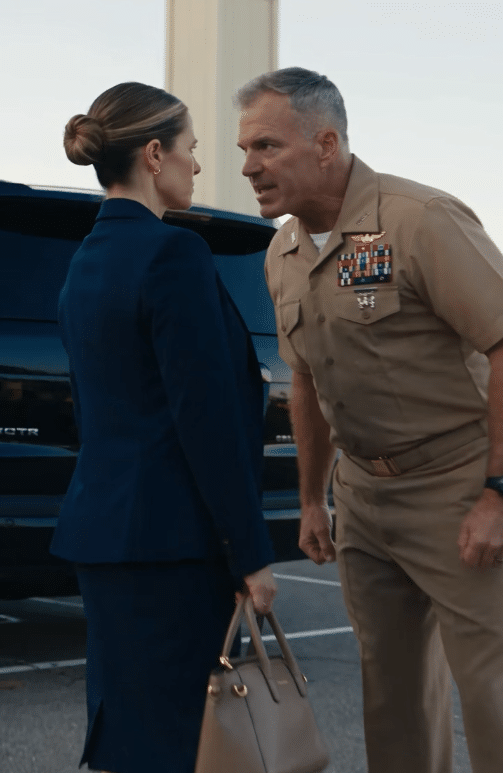
Colonel Richard Hayes stormed across the base parking lot, his immaculate uniform catching the morning sunlight. Beside a black SUV stood his twenty-two-year-old son, Ethan, looking irritated rather than apologetic. A few feet away, a woman in a navy business suit examined a thin scratch along the side of her car.
She was forty-five, with brown-blonde hair secured in a neat bun, a cream blouse, and a simple leather handbag. Nothing about her appearance suggested military authority. She looked like a businesswoman trying to resolve an inconvenient problem before getting on with her day.
“I only asked for his insurance.”
Her voice was calm. She wasn’t demanding money or threatening to call the police. She had simply noticed the damage after Ethan’s SUV lightly touched her car and asked him to exchange information.
But Hayes had already decided his son was being attacked.
Ethan had called his father moments earlier, describing the incident as though a stranger had accused him of deliberately damaging her vehicle. Hayes arrived ready for a fight, convinced that his rank entitled him to settle the matter before anyone could question his family.
He looked at the scratch, then at the woman.
“You should know better than to challenge my family.”
She held his gaze.
“I asked for insurance.”
That answer should have embarrassed him enough to stop.
Instead, it made him angrier.
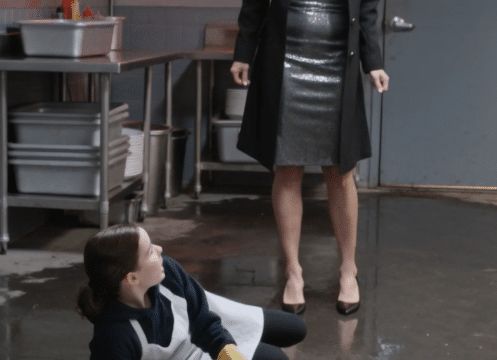
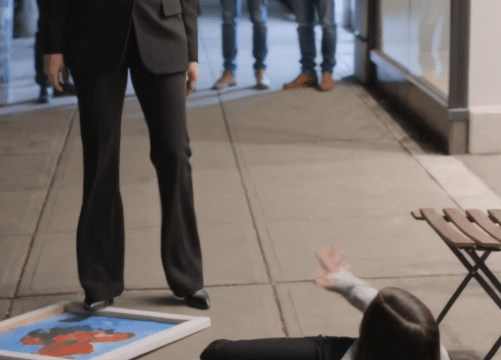
Hayes pulled the lid from a cup of cooled coffee and flung the contents into her face. Brown liquid splashed across her hair, cream blouse, and navy jacket. Before she could wipe it away, he slammed the empty cup against the asphalt.
Then he struck her across the cheek.
Her head snapped sideways. The force of the slap sent her stumbling, and a red mark rapidly spread across the struck side of her face. A faint trace of blood appeared at the corner of her mouth.
Hayes followed with a hard punch to her stomach.
She folded forward, the air knocked from her lungs, and stumbled backward before dropping to one knee on the asphalt. Her palm scraped against the ground as she caught herself.
For a moment, she could do nothing but fight for breath.
Ethan stared at her.
The argument he had complained about had become something else entirely. His father was no longer protecting him from an unreasonable demand. He was assaulting a woman who had asked for an insurance exchange.
Yet Hayes seemed to believe the spectacle proved his authority.
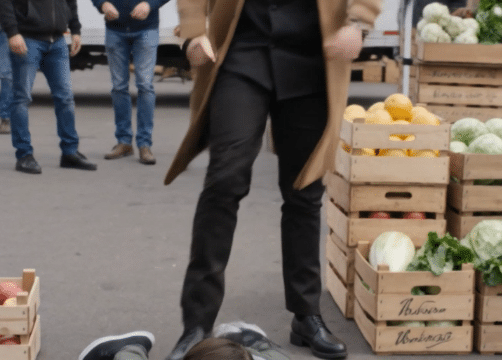
He stood over her, breathing hard, his uniform still immaculate apart from a few specks of coffee.
“You should know better than to challenge my family.”
The woman kept her head lowered for a second. Her stomach hurt, her cheek was swelling, and coffee dripped from the edge of her sleeve.
Then she slowly looked up.
There was pain in her eyes, but no pleading.
No panic.
She pushed herself upright, carefully steadied her breathing, and wiped the corner of her mouth. Around them, people had stopped walking. A security guard near the gate watched from his post, while two personnel beside a parked vehicle exchanged stunned looks.
Nobody had expected a parking dispute to turn into an assault.
Hayes expected tears. Perhaps an apology. Maybe even a hurried retreat.
Instead, the woman reached into her handbag and took out her phone.
She didn’t shout or threaten him.
She made one call.
“East Gate parking lot. Five minutes.”
Then she ended it.
Hayes stared at her before letting out a contemptuous laugh.
“Call whoever you want.”
He was certain no one was coming who could make him regret what he had done.
He was wrong.
Five minutes later, the sound of approaching engines would turn his confidence into something he had never expected to feel in front of his own son: fear.
Act II
Colonel Hayes had spent nearly twenty-five years learning how to make people respond when he entered a room.
He understood the power of a uniform, the weight of a commanding voice, and the subtle pressure created when everyone knew that a disagreement could affect their careers. He had built his professional identity around being the man who handled problems decisively.
Over time, however, decisiveness had become an excuse for impatience.
He expected junior officers to anticipate his wishes. He expected enlisted personnel to carry out instructions without asking unnecessary questions. And when someone challenged him, he often treated the disagreement as a personal insult rather than an opportunity to reconsider his position.
His family had grown accustomed to the same treatment.
Ethan had learned that calling his father could make uncomfortable situations disappear. Parking tickets could be contested. Difficult conversations could be redirected. People who complained about his behavior often discovered that Hayes was more interested in defending his son than understanding what had happened.
That morning, Ethan had been backing his SUV out of a parking space when the vehicle made light contact with the woman’s car.
The damage was minor.
Ethan had immediately stepped out, inspected the vehicles, and become defensive when the woman asked to exchange insurance information. He insisted that the mark had already been there. She had calmly explained that she had watched his SUV touch the car.
Instead of resolving the matter, he called his father.
By the time Hayes arrived, Ethan had convinced himself that the woman was trying to exploit him. His father had arrived convinced that his son needed protection.
Neither had considered that the simplest solution was also the fairest one: exchange information, document the damage, and let the appropriate insurance companies handle the dispute.
Now, standing beside the SUV, Ethan was beginning to understand what his father’s protection actually looked like.
His father had not merely argued with the woman. He had thrown coffee in her face, struck her, punched her in the stomach, and left her kneeling on the asphalt.
Ethan opened his mouth.
“Dad—”
Hayes silenced him with a glance.
It was an old gesture, one that had ended countless conversations at family dinners and private gatherings. Ethan had always obeyed it.
This time, he looked away.
Across the parking lot, the woman slipped her phone back into her handbag. She adjusted her jacket as best she could, though the coffee stains had soaked into the fabric. Her cheek throbbed, and each breath reminded her of the punch.
Yet her attention had shifted beyond Hayes.
She glanced toward the base gate, checking the time.
Her calmness irritated him more than any insult could have.
“What’s the matter?” Hayes asked. “Waiting for someone important?”
She said nothing.
He stepped closer, trying to recover the control he had begun to feel slipping away. “You made a mistake bringing this onto a military installation.”
The woman looked directly at him.
“You made this a military matter when you used your rank to intimidate someone over a scratch.”
The sentence landed harder than he expected.
Hayes’s jaw tightened. He was accustomed to people backing away when he invoked his position. The idea that someone might view his rank as part of the problem rather than a reason to submit was almost incomprehensible to him.
Ethan shifted uneasily beside the SUV.
He had seen his father angry before. He had seen him argue with neighbors, berate service workers, and demand exceptions when rules became inconvenient. But he had never watched him strike someone who remained so completely unwilling to play the role of a frightened victim.
The woman was not trying to win an argument.
She was waiting.
Hayes followed her gaze toward the gate and laughed again.
“You think somebody’s going to roll out the red carpet because you made a phone call?”
She didn’t answer.
A security camera mounted near the entrance continued recording. The guard in the booth had a clear view of the parking spaces. Several witnesses stood close enough to have heard the exchange and seen the assault.
Hayes had acted in public, in uniform, beside a military installation.
He had left a trail of evidence without appearing to notice.
But his greatest mistake was still ahead of him.
He believed the call had been made to summon someone who would intimidate him. He assumed the woman had a powerful connection and was bluffing to regain control.
He had no idea that her call was not an appeal for help from someone who needed protection.
It was a precise request from someone accustomed to command.
And when she said five minutes, she meant it.
Then the first military vehicle appeared beyond the gate, and Colonel Hayes stopped laughing.
Act III
The engines came first.
A deep mechanical rumble rolled through the parking lot, growing louder as a disciplined line of dark command SUVs and military vehicles approached the entrance. The guard at the booth straightened. Personnel near the security barriers turned toward the road.
Hayes glanced at the vehicles, then back at the woman.
For a moment, he seemed almost relieved.
A convoy was hardly unusual near a large military installation. Senior personnel arrived for briefings, inspections, and official visits. The sight of several vehicles together did not automatically mean trouble.
He folded his arms.
“Looks like your five minutes are up,” he said, attempting to sound amused.
The vehicles passed through the gate in controlled succession. Rather than continuing toward the main buildings, they turned into the parking lot.
One SUV slowed.
Then another.
The convoy arranged itself into a precise line, leaving a clear path toward the woman and the colonel. Engines settled into silence one by one, and doors began opening.
The atmosphere changed with startling speed.
This was not a group of people arriving for an ordinary meeting. The movements were coordinated. The drivers knew where to stop, and the personnel stepping out carried themselves with the quiet precision of people accustomed to working around senior command.
Hayes’s expression tightened.
He looked toward the woman again.
She had not moved.
Coffee still marked her blouse. One cheek was red and swelling, and she held her handbag at her side as though she were waiting for a delayed appointment rather than standing beside the man who had just assaulted her.
The center vehicle’s door opened.
A senior military figure began to step out.
The camera caught only decorated shoulders, rows of ribbons, the upper portion of a formal uniform, hands, and polished shoes. The face remained hidden behind the angle of the vehicle and the tight framing.
No one announced a name.
No one explained the arrival.
The figure stepped onto the asphalt and closed the distance toward the woman.
Hayes recognized the significance before he fully understood it.
The decorations were unmistakable. So was the disciplined movement of the personnel around the vehicle. The way they made room for the arriving figure was not casual courtesy. It reflected a level of authority that Hayes rarely encountered outside formal command settings.
His shoulders stiffened.
The woman watched the approaching figure without changing her expression.
For the first time since he had arrived, Hayes seemed unable to decide what to do with his hands. He adjusted his uniform, then stopped halfway through the movement. His gaze flicked toward Ethan, as though his son might somehow explain why a senior military arrival had come directly to this parking lot.
Ethan had no answer.
He was staring at the decorated figure.
The convoy had transformed a private dispute into something neither of them could control. A moment earlier, Hayes had believed he could use his rank to dictate the terms of the encounter. Now, surrounded by vehicles and personnel who appeared to answer to a much higher level of command, he was forced to consider the possibility that his authority had never been as absolute as he imagined.
The senior figure continued toward the woman.
No dramatic announcement followed. There was no shouted order, no theatrical display, and no attempt to humiliate Hayes in return.
That made the scene more unsettling.
The person approaching her seemed entirely certain of where they needed to go and whom they had come to meet.
Hayes swallowed.
He had spent years expecting others to show deference to his uniform. Now he found himself watching the movements of someone whose authority was expressed through quiet precision rather than volume.
The woman finally turned slightly toward the approaching figure.
It was a small movement, almost imperceptible.
But it was enough to make Hayes understand that the convoy had not arrived by coincidence.
She had expected it.
She had known exactly how long it would take.
And she had made that call while kneeling on the asphalt, her face bruised, her blouse stained with coffee, and her breathing still recovering from the blow to her stomach.
Hayes’s confidence began to fracture.
The person stepping out of the center vehicle had not come to rescue a stranger. The way the woman waited made it clear that this arrival had been arranged by someone who expected to be obeyed.
Act IV
The senior figure stopped beside the woman.
The framing revealed decorated shoulders, a formal uniform, and hands that moved with practiced restraint. The face remained outside the camera’s view, hidden by the angle and the shallow depth of field.
No name was spoken.
No rank was announced.
Yet the personnel emerging from the convoy had already made the hierarchy clear. They stood with disciplined attention, leaving space around the senior figure while maintaining awareness of the parking lot.
The woman did not bow her head or rush forward.
She simply stood upright, her injuries visible, and waited for the next moment to unfold.
Hayes stared at the decorated uniform.
He recognized enough to understand that the person before him occupied a level of command far above his own. But the real shock was not the senior figure’s rank. It was the fact that the woman he had treated as powerless appeared to have direct access to someone of such authority.
He had assumed she was an ordinary civilian.
He had assumed her calmness was weakness.
He had assumed the call was an empty threat.
Each assumption was collapsing in front of him.
Ethan took a small step away from his father.
It was not dramatic. He did not denounce Hayes or attempt to distance himself with a speech. He simply moved, creating a little space between himself and the man whose actions had brought the convoy into the parking lot.
Hayes noticed.
That small movement hurt more than he expected.
For years, his son had trusted him to solve problems. Ethan had called him because he believed his father could make the world yield. Now Ethan was watching him discover that there were limits to what rank could excuse.
Hayes turned back toward the woman.
“You know who that is?” he asked, his voice noticeably lower.
She looked at him.
“You should be more concerned about what you did.”
The words were not shouted. They did not need to be.
Hayes looked away first.
The senior figure moved closer, stopping within a few feet of the woman. One hand lifted slightly, as though offering assistance, but the woman remained steady on her feet.
She was hurt, but she was not helpless.
That distinction had escaped Hayes from the beginning.
He had seen a woman without visible insignia and assumed there was no authority behind her composure. He had seen a simple request for insurance and interpreted it as an attempt to challenge his family. He had mistaken her refusal to argue for an inability to defend herself.
Now the evidence was standing in front of him.
Not evidence of a secret that could erase the assault, but evidence that his assumptions had been disastrously wrong.
The senior figure’s face remained hidden. The audience could see the decorations, the polished footwear, and the controlled movements, but nothing that would make the identity immediately obvious.
Hayes could see more than the audience could.
Recognition spread across his face.
His lips parted. His eyes widened, and the color began to drain from his cheeks. He looked from the decorated shoulders to the woman, then back again, trying to reconcile what he knew with what he had done.
He straightened instinctively.
The movement was almost automatic, a reflex learned over years of military service. His posture became rigid, his shoulders squared, and his expression shifted from anger to uncertainty.
He was no longer the officer controlling the scene.
He was a colonel facing someone whose presence demanded an entirely different response.
The convoy remained silent behind the arriving figure. No one needed to shout at Hayes or physically restrain him. The witnesses were already there, the security cameras were still recording, and the damage to the woman’s face could not be dismissed as a misunderstanding.
Ethan stared at his father, waiting for him to speak.
But Hayes could not find the words.
The woman adjusted the strap of her handbag, then stood still. She did not demand that the senior figure punish the colonel on the spot. She did not point at her injuries or turn the moment into a performance.
She had made one short call.
The response had arrived.
Everything else would have to be handled through the proper process, with witnesses, records, and a formal account of what had happened.
Hayes understood that now.
And that understanding frightened him more than an angry confrontation ever could.
The senior figure was close enough for Hayes to recognize the person he was facing, but the final realization would leave him with only one word.
Act V
“Sir…?”
The word escaped Colonel Hayes in a tight, uncertain whisper.
His face had gone pale. His eyes remained fixed on the decorated figure, whose face the audience still could not see. For the first time that afternoon, Hayes looked like a man who understood that the next few seconds could change the course of his career.
The woman stood beside the arriving senior officer, her navy suit stained with coffee and her cheek visibly swollen. She held herself upright, though pain still tightened her breathing.
Hayes looked at her again.
Only minutes earlier, he had treated her as someone whose concerns could be crushed beneath the weight of his uniform. He had thrown coffee into her face, struck her, and punched her in the stomach because she had asked for insurance information after a minor parking accident.
He had told her she should know better than to challenge his family.
Now he was the one struggling to speak.
The senior figure remained composed. The camera offered no face, no name, and no explanatory speech. The decorated shoulders and controlled presence were enough to show that the person standing there held extraordinary authority within the military chain of command.
But the convoy’s arrival did not change the basic facts.
Ethan’s SUV had lightly touched the woman’s car. She had asked for insurance information. Hayes had responded with violence.
No rank could make those events disappear.
The security cameras had recorded the parking lot. Witnesses had watched the assault. The woman had visible injuries, and the colonel’s own words had made his motive painfully clear.
The senior officer’s presence would ensure that the matter received attention, but the consequences would still need to follow a proper process. Statements would have to be collected. The footage would need to be preserved. Hayes would have to answer for his actions through the appropriate military and legal channels.
For once, his uniform would not shield him from scrutiny.
Ethan looked down at the asphalt.
The scratch on the car had seemed so important when the argument began. It had become an excuse to call his father, then a justification Hayes used to attack someone who had refused to be intimidated.
Now the damage to the vehicle was almost irrelevant.
The real damage was standing beside it.
Hayes had exposed his temper in front of his son, the base security personnel, and everyone who had witnessed the assault. More importantly, he had shown that when his authority felt threatened, he was willing to use violence instead of judgment.
The woman glanced briefly toward the convoy, then returned her attention to Hayes.
She did not smile.
She did not need to remind him that she had warned him about the consequences of using his rank to intimidate someone. He was standing inside those consequences now.
The senior figure shifted slightly toward her, offering a quiet indication of support. The woman’s posture remained controlled, but for the first time, the strain in her expression softened by a fraction.
She had not called because she was incapable of handling the situation.
She had called because the incident had crossed a line that could not be resolved through a simple exchange of insurance information. The assault involved an officer in uniform, a public parking lot, multiple witnesses, and a clear abuse of authority.
It needed to be documented.
It needed to be addressed.
And it needed to be handled by people who could not simply be shouted down.
Hayes seemed to understand the difference at last.
He had believed power meant being able to force an outcome. The convoy represented something he had failed to respect: authority exercised through responsibility, procedure, and accountability.
The woman had not needed to threaten him.
She had not needed to reveal her rank.
She had simply made a call and waited five minutes.
Behind the senior figure, the vehicles remained lined up with precise spacing. Personnel stood ready, their attention fixed on the situation without turning it into a spectacle. The base gate continued operating in the background, indifferent to Hayes’s panic.
The world had not stopped for his mistake.
But his own world had changed.
Ethan finally looked up at his father. There was no admiration in his expression now, only the uncomfortable realization that the man he had trusted to solve his problems had become the problem himself.
Hayes tried to speak again, but no words came.
The woman turned slightly toward the senior figure, and the camera stayed behind the decorated shoulders. Her identity, her exact position, and the full reason for the convoy remained unspoken.
The final image returned to Hayes.
His eyes were wide. His jaw had tightened, but the anger was gone. The colonel who had arrived ready to intimidate a stranger now stood motionless, confronted by someone he recognized and a truth he could no longer outrun.
“Sir…?”
The question hung in the air.
Then the scene cut to black.
Five minutes earlier, Hayes had believed his rank made him untouchable.
Now, with the convoy behind him and the evidence of his own actions all around him, he finally understood that rank was never supposed to be a weapon against the people standing in front of him.
And the woman he had mistaken for powerless had never needed to raise her voice to prove it.