Act I
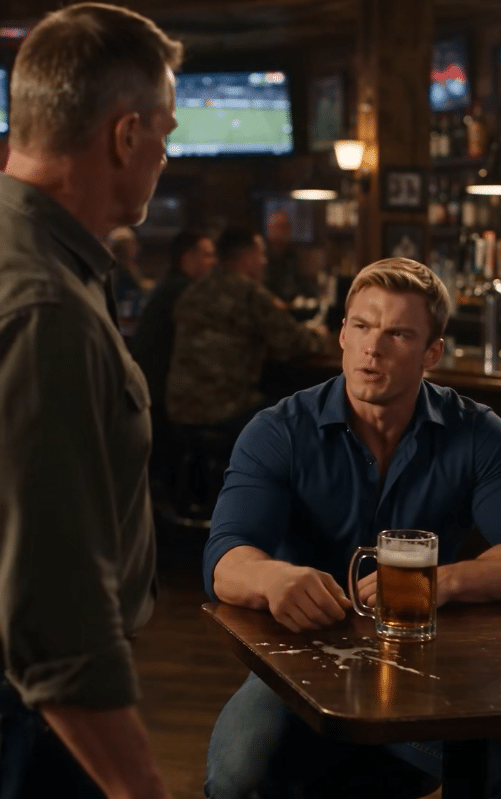
The beer was still dripping down the stranger’s face when Captain Ryan Cole decided to make the situation worse.
“You spill on me and just walk away?”
His voice carried across the crowded military bar, cutting through the clatter of glasses and the low conversations beneath the televisions. A few patrons turned toward the disturbance. Most had come to relax after duty, not watch a thirty-one-year-old officer pick a fight over a little spilled beer.
The stranger stood beside the table in a charcoal button-down shirt and dark jeans, his brown leather boots planted firmly on the wooden floor. At forty, he looked like an ordinary man who had stopped for a drink after a long day. A little stubble shadowed his jaw, and his civilian jacket hung over the back of his chair.
He glanced at the beer on Cole’s hand.
“It was an accident.”
That should have ended it.
Cole was sitting with two junior officers, enjoying the attention that came with being the loudest man at the table. He had spent the evening telling stories about his assignments, correcting other people’s accounts, and making sure everyone understood that he was a captain.
The spilled beer offered him an excuse to turn that performance into a spectacle.
Instead of accepting the apology, he snatched up his pint glass and flung the remaining beer into the stranger’s face.
The stranger blinked against the sudden splash.
Before he could wipe the liquid from his eyes, Cole smashed the glass against the floor. It shattered with a sharp crack that silenced the nearest tables.
Then Cole punched him across the cheek.
The stranger staggered, his face turning with the force of the blow. Redness spread across the struck cheek, and a thin trace of blood appeared at the corner of his mouth.
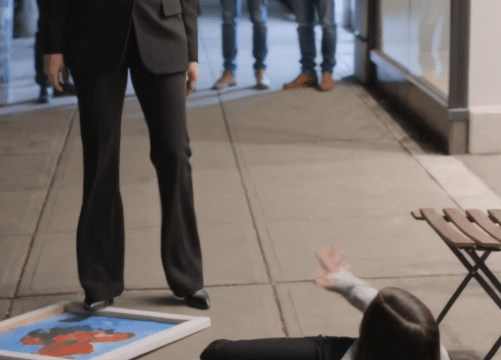
Cole followed him, circling behind as the injured man tried to regain his balance. A hard kick to the back sent the stranger pitching forward. His palms scraped against the wooden floor as he caught himself, preventing his face from striking the boards.
He barely had time to breathe before Cole kicked him again.
Then the captain planted his boot firmly against the stranger’s back, pinning him to the floor for a moment while the entire bar watched.
Nobody rushed forward.
A bartender froze with a glass in his hand. One of Cole’s companions half rose from his seat, then stopped when he saw the captain’s expression. Several older veterans turned from the bar, their faces hardening as they took in the scene.
Cole leaned forward, enjoying the silence.
“Stay down, bar trash.”
The stranger’s cheek was swelling. His breathing was strained, and his scraped palms pressed against the floor. But when he looked up, there was no pleading in his eyes.
Only a cold, steady focus.
Across the room, a sixty-seven-year-old man in a denim jacket slowly stood from his chair.
Silver-haired and weathered by decades of military service, Frank Dawson had been nursing a drink near the far end of the bar. He had barely noticed the argument at first.
Then the stranger turned his face toward the light.
Dawson stopped breathing for a second.
He knew that face.
Not from a photograph in a newspaper. Not from a ceremony or a formal portrait. He knew it from a place where names became memories, where men learned to measure leadership by who came back for them when everything went wrong.
His fingers tightened around the edge of the table.
He stared at the injured man, searching for some sign that his eyes were deceiving him.
Then a name he had not spoken aloud in years rose from the depths of his memory.
“Iron Wolf?”
The words were barely louder than a whisper.
Yet the reaction was immediate.
Two veterans near the bar straightened. An older man in a military sweatshirt slowly turned around. Conversations died one by one, until the space around Cole’s table felt unnaturally quiet.
Cole looked over his shoulder, irritated.
“What?”
Dawson did not answer him.
He was still staring at the man on the floor.
And for the first time that night, Captain Cole sensed that the room was no longer watching him with admiration.
They were watching him with something much closer to dread.
Because the stranger he had just humiliated was known by a name that had survived battles, funerals, and years of military silence—and Dawson knew exactly what that name meant.
Act II
Ryan Cole had never been the kind of man who enjoyed being ordinary.
At thirty-one, he had already learned how to wear confidence like a uniform. He kept himself in excellent shape, dressed sharply even when off duty, and spoke with the certainty of someone who assumed that hesitation was a weakness other people possessed.
He was not unintelligent. He had worked hard to earn his commission and had performed well enough to advance. But somewhere along the way, he had begun to confuse being respected with being feared.
Around senior officers, Cole could be disciplined and agreeable. Around peers, he competed for attention. Around junior personnel, he often treated every conversation as an opportunity to remind someone where they stood.
The bar was where that habit became most visible.
Away from formal evaluations and official briefings, Cole liked to play the part of the officer everyone knew. He bought drinks when it earned him an audience, told stories that made his assignments sound more dangerous than they had been, and turned minor disagreements into tests of loyalty.
His two companions had learned the routine. When Cole made a joke at someone else’s expense, they laughed. When he exaggerated a story, they let him finish. When he began criticizing a stranger over a spilled drink, they waited for the situation to become entertaining.
Neither had expected him to throw a glass.
Neither had expected him to attack a man who had offered a simple explanation.
And neither knew what to do once the stranger was lying on the floor.
Across the room, Frank Dawson was remembering a very different kind of officer.
Dawson had served for more than three decades before retiring as a first sergeant. He had supervised young soldiers, worked through deployments that seemed to stretch forever, and sat beside families who wanted answers no report could fully provide.
He had seen brave men become legends in the eyes of those who survived them.
He had also seen men who looked impressive in uniform collapse when real responsibility arrived.
The difference, Dawson had learned, was rarely visible at first.
Some people wanted command because it gave them the power to make decisions. Others wanted it because they liked being obeyed. The first kind understood that rank came with obligations. The second discovered those obligations only when someone forced them to confront the consequences of their choices.
Dawson had met both kinds.
But he had never forgotten Iron Wolf.
Years earlier, Dawson had served in a formation that knew the nickname well. It was not an official title, and it never appeared on a uniform. It had spread through conversations after a series of brutal operations, carried by men who rarely agreed on anything else.
The name belonged to an officer who had a reputation for remaining unnervingly composed when situations became chaotic.
He was not famous for shouting the loudest or delivering speeches that made men cheer. He was known for his refusal to abandon people when doing so would have been easier. When a plan broke apart, he became more focused. When frightened soldiers began making mistakes, he steadied them. When someone needed to take responsibility, he stepped forward instead of searching for someone lower in rank to blame.
The nickname had begun as a half-joking reference to his stubbornness.
It had become something else after the men who served under him realized how often he had placed himself between them and disaster.
Dawson remembered one night in particular.
A convoy had been forced to halt far from its intended destination after an unexpected crisis left several personnel stranded and communications unreliable. Confusion spread through the command post. Reports contradicted one another, the available options narrowed, and everyone understood that the decisions made in the next few hours could determine who made it home.
The officer Dawson knew as Iron Wolf had listened without interrupting.
He asked precise questions. He checked what could be checked. He refused to promise an outcome he could not guarantee.
Then he made the decision that gave the nickname its lasting weight.
He went toward the people who needed help.
The operation was never simple, and it was not without cost. There were injuries, difficult choices, and consequences that followed the survivors long after the immediate danger had passed. But the men who returned remembered the officer who had refused to treat their lives as acceptable losses.
Dawson had been younger then. He had watched the aftermath unfold, seen the exhaustion in the survivors’ faces, and learned how little the word hero could capture about what they had endured.
Iron Wolf had never seemed interested in the label.
That was why seeing the man on the floor was so disorienting.
The stranger had not entered the bar with an entourage. He had not introduced himself to the veterans or demanded recognition from the younger officers. He had sat at a table, ordered a drink, and tried to enjoy an ordinary evening.
Even when Cole confronted him, he had not used his authority to win the argument.
He had simply said the spill was an accident.
Now he was lying beneath a captain’s boot, his face bruised and his hands scraped against the floor, while people who knew his history stood frozen.
Dawson took a step forward, then stopped.
The assault had ended, but the situation was still unfolding. He could not erase what had happened by shouting the right name, and he would not pretend that a legendary reputation made the injured man immune to pain.
He looked directly at Cole.
The captain was still wearing a smirk, although it had begun to look forced.
“Some washed-up nickname doesn’t scare me.”
He spoke loudly enough for his companions to hear, as if mocking the name could restore the authority he felt slipping away.
Dawson’s expression darkened.
The problem was no longer whether Cole had heard of Iron Wolf. It was whether he understood that the men who remembered the name had earned their respect the hard way.
And whether he was about to make the worst mistake of his life by assuming that a legend was only a story.
Cole had dismissed the nickname, but he had not yet understood why the veterans around him were suddenly standing straighter than they had when he first entered the bar.
Act III
The stranger slowly lifted his head.
Cole’s boot had left him sore and breathless, and every movement required an effort he refused to show. He drew his knees beneath him, pushed against the floor, and rose carefully until he was sitting upright.
The captain stepped back just far enough to avoid appearing threatened.
He wanted the room to believe he was still in control. The broken glass, the spilled beer, and the injured stranger should have been enough to make him feel victorious.
Instead, the silence was beginning to bother him.
He looked at Dawson again.
“Some washed-up nickname doesn’t scare me.”
This time, the words sounded less like a boast and more like a demand. Cole wanted someone to laugh, someone to tell him that the old man was being dramatic, someone to turn the room back into the place it had been five minutes earlier.
Nobody obliged.
The stranger wiped the corner of his mouth with the back of his hand. He glanced briefly at the faint trace of blood, then looked back at Cole.
“It scared better men than you.”
He did not raise his voice.
He did not lean forward.
He delivered the sentence with the quiet certainty of someone who had no need to prove that he meant it.
Cole’s smirk faltered.
There was something unsettling about the way the man said it. He sounded neither proud nor angry. He spoke as though the nickname belonged to a chapter of his life he had long since put away, and Cole’s opinion of it was too small to matter.
Dawson felt the years fall away.
He remembered the first time he had heard the nickname used without humor. A young soldier had been shaking after a difficult night, trying to hide how frightened he had been. Someone mentioned that Iron Wolf was on the way, and the soldier’s breathing slowly settled.
Not because the officer was invincible.
Because the people who had served with him believed he would do everything he could to bring them through.
That belief had survived long after the details of individual missions had blurred.
Dawson remembered men who rarely spoke about their service becoming unexpectedly quiet when the name came up. He remembered one veteran standing at a memorial with his hand pressed against a folded program, staring at the names as though he were counting the people who had not made it home.
Iron Wolf was not a nickname that made everyone feel safe.
It was a name that reminded them how much safety could cost.
And now the man who carried it was sitting on the floor of a bar, injured by a captain who thought the world existed to validate him.
Dawson straightened.
He wanted to say more. He wanted to tell Cole about the people who had trusted that officer with their lives, about the decisions made under pressure, and about the men who had survived because someone refused to abandon them.
But he understood something important.
If he explained everything, Cole might hear only another story. He might treat the past as an exaggerated legend, something old soldiers repeated when they wanted the younger generation to admire them.
The stranger’s presence made the truth harder to dismiss.
He was not a story told by a stranger across a bar.
He was the man himself.
The veterans around the room began to understand the same thing. One of them lowered his glass without drinking. Another took off his cap and held it against his chest, not as part of a performance but because he suddenly seemed unsure what else to do with his hands.
Their reactions were subtle, but Cole saw them.
His eyes moved from one face to another.
“What is this?” he demanded.
Nobody answered.
For years, Cole had assumed that reputation worked in only one direction. A captain could enter a room and command attention because of his rank. A junior officer could gain respect by displaying confidence. An older veteran could be dismissed as someone whose best years were behind him.
But the people in the bar were responding to something beyond the uniform Cole wore or the civilian clothes the stranger had chosen.
They were responding to a shared memory.
Cole had never been part of it.
He could mock the nickname, but he could not make the veterans forget what it meant. He could insist that the stranger was just another man, but he could not explain why Dawson looked as though he had seen a ghost.
Most troubling of all, he could not understand why the injured man was not trying to capitalize on the moment.
A lesser person might have threatened him. Someone eager for revenge might have announced a rank, demanded apologies, or promised to have Cole removed from the service.
The stranger did none of those things.
He looked at Cole with an expression that seemed almost tired.
That restraint made the captain’s behavior look even smaller.
Cole had thrown beer because he wanted to humiliate a stranger. He had broken a glass to make sure everyone noticed. He had punched, kicked, and pinned a man to the floor because a simple apology had failed to satisfy his pride.
Now he was trying to laugh away a name that had made experienced veterans go silent.
The contrast was becoming impossible to hide.
Dawson took another step closer, his eyes never leaving the stranger.
He did not salute. He did not announce a title. He simply stood with the rigid respect of a man who had recognized someone whose actions mattered more than any story told about him.
Cole noticed.
His face lost some of its color.
For the first time, he looked at the stranger as though he might actually be seeing him.
The nickname had not revealed everything—but it had given Cole enough information to realize that the man on the floor was not someone he could afford to underestimate.
Act IV
The stranger finally got to his feet.
He moved carefully, keeping one hand near his side as he straightened. His cheek had swollen noticeably, and the pain in his back was clear in the way he controlled each breath. But he stood without assistance, his expression composed despite the damage Cole had done.
Nobody applauded.
Nobody cheered.
The silence was more powerful than either.
Cole took half a step backward before he seemed to realize he had moved. He corrected himself immediately, lifting his chin and trying to rebuild the confidence that had carried him through the assault.
But the room had changed around him.
His two companions were no longer smiling. One stared at the shattered glass near the table. The other kept glancing toward the door, as though he had begun calculating how he might explain his presence when someone inevitably asked what he had witnessed.
The bartender had set down the glass he had been holding.
Dawson remained standing, his posture straight and his eyes fixed on the stranger.
The captain looked at the older veteran again.
“You know him?”
Dawson did not answer the question directly.
Instead, he watched the stranger for a moment longer, as though confirming that the man he remembered and the man before him were truly the same person. Time had changed his face. The years had added a little stubble and deepened the lines around his eyes. But the composure was unmistakable.
The stranger had always possessed a peculiar stillness. It was not the stillness of someone who felt no fear, but of someone who had learned not to let fear make decisions for him.
Dawson remembered it from the field.
He saw it now.
Cole tried to recover his footing through sarcasm.
“It’s a bar, not a reunion for old war stories.”
The remark fell flat.
An older veteran near the counter looked at him with open disappointment. Another turned away, refusing to give him the attention he so desperately wanted.
Cole had spent the evening trying to become the center of the room.
Now he could barely hold the room’s attention for a sentence.
The stranger reached for a clean napkin on the nearest table and pressed it lightly to the corner of his mouth. He looked down at the broken glass, then at the beer spreading across the floor.
It was an ordinary gesture, almost absurdly practical after what had happened.
He seemed more concerned about the mess than about the spectacle Cole had made of him.
That was when the captain’s expression shifted again.
The stranger was not behaving like a man who had been defeated. He was not acting like a victim waiting for someone else to restore his dignity. Nor was he behaving like someone eager to reveal that he possessed power greater than the man who had attacked him.
He was simply refusing to become what Cole wanted him to be.
A frightened man would have justified himself.
An angry man might have lashed out.
A vain man would have used the attention to demand recognition.
The stranger did none of those things.
He stood in the middle of the bar, bruised and steady, while the people who knew his past recognized something Cole had failed to see.
The nickname had never been about being the most dangerous man in a room.
It had been about what he did when other people were in danger.
Cole swallowed.
He glanced at Dawson once more, then at the veterans whose expressions had turned solemn. Their reactions were no longer ambiguous. Whatever Iron Wolf meant, it was not a joke to them.
And if the man standing before him truly was the person they remembered, Cole had just done something far more serious than picking a fight with a stranger.
Still, no one handed him a convenient explanation.
No one recited the man’s service history. No one listed his decorations or described the missions that had built his reputation. The room offered no dramatic speech that could turn the stranger into a legend in a single moment.
The recognition came through the people who had known the name before Cole ever heard it.
Dawson’s rigid posture.
The older veterans’ sudden silence.
The way nobody attempted to laugh off the assault anymore.
Cole had mistaken the lack of visible status for a lack of importance. He had assumed that a civilian shirt meant an ordinary man, and that an ordinary man could be humiliated without consequences.
He had judged someone by the surface because he had never learned how to recognize the deeper signs of leadership.
The stranger met his eyes.
There was no triumph in his expression.
That, more than anything, unsettled Cole.
The man had no need to enjoy the reversal. He had not arranged the scene or summoned an audience. He had merely entered a bar, suffered an accident, and answered an aggressive question honestly.
Everything that followed had been Cole’s own choice.
The captain’s shoulders stiffened, then began to sag. His eyes widened slightly, and his mouth opened as though he wanted to ask another question.
But he already knew what he needed to ask.
The only thing he did not know was whether he wanted to hear the answer.
For the first time that night, Ryan Cole was no longer wondering how to punish the stranger—he was wondering how badly he had misjudged the man he had just attacked.
Act V
“General…?”
The word escaped Cole before he could stop it.
His face had gone pale, and the confidence that had defined him all evening was gone. He stared at the stranger as though the ordinary clothes had suddenly become impossible to reconcile with the man standing inside them.
A general.
Not a retired officer trading stories at a bar. Not an old veteran whose nickname had survived longer than his influence. An active-duty major general, forty years old, standing in front of him with a swollen cheek and scraped palms.
Cole had attacked a senior general officer in a crowded public place.
The realization did not arrive as a dramatic revelation from the stranger. It arrived through the evidence of the room: Dawson’s recognition, the veterans’ response, and the quiet certainty of a man who had never needed to announce himself to command respect.
Cole’s mouth moved, but no immediate apology came out.
For once, he had run out of words.
The stranger did not use the moment to threaten him. He did not list the punishments that might follow or remind Cole of the distance between their ranks. His expression remained controlled, though the pain in his face was impossible to miss.
He had been assaulted.
His status did not make the blows hurt less, and his reputation did not excuse what had happened. The fact that he was a general changed the implications of the incident, but it did not create the reason the assault was wrong.
It had been wrong from the beginning.
A man had spilled beer by accident. He had explained what happened. The captain had chosen humiliation, then violence, because his pride demanded a more satisfying answer.
Now that choice stood in the open.
Cole glanced around the bar, searching for some indication that the people watching him might still believe his version of events. But there was no version left that could make the broken glass disappear or transform the kicks into a reasonable response.
His companions had seen everything.
The bartender had seen everything.
The veterans had seen everything.
And Dawson, the man who had spoken the nickname, knew exactly why the stranger’s restraint mattered.
The general’s identity would need to be verified through proper channels, and the assault would need to be documented. Witnesses could provide statements, and the incident could be referred to the appropriate authorities for review. Cole’s rank would not settle the matter in his favor, and the stranger’s rank would not eliminate the need for a fair process.
But no formal investigation was required to understand the central truth.
Cole had abused someone because he believed he could.
The general looked at him for another moment.
He did not smile.
He did not offer the satisfaction of a dramatic threat.
Then he turned his attention away from the captain, refusing to let the man’s panic become the center of his own evening. His movement was slow because of the pain in his back, but his posture remained upright.
Dawson stepped closer, his face carrying a mixture of relief and concern.
For an instant, the two men looked at each other without speaking. Decades of service stood between them, along with memories that neither could fully explain to the people surrounding them.
Dawson had recognized the nickname before he had been certain of the face. Now he understood why the name had felt so heavy on his tongue.
Iron Wolf had not disappeared into the past.
He had simply stopped asking the world to remember him.
The general glanced toward the broken glass on the floor.
The evening had begun with a minor accident. It had ended with a captain confronting the truth about his own character in front of the people whose respect he had tried so hard to win.
There would be no easy way for Cole to recover from that moment. His conduct would be reviewed, and his companions would have to decide whether they were willing to tell the truth about what they had witnessed. His future would depend on evidence, accountability, and decisions made beyond the walls of the bar.
But even before those consequences arrived, something important had already been lost.
The illusion that rank could turn cruelty into leadership.
Cole had believed that authority meant making others afraid to challenge him. Iron Wolf had earned his reputation by doing the opposite: by giving people reason to trust him when fear threatened to overwhelm them.
One man had demanded respect through violence.
The other had earned it through responsibility.
That was why the veterans had gone silent.
That was why Dawson had stood.
And that was why the captain’s final question had sounded less like a request for information than the first honest recognition of his own mistake.
The stranger had never needed to reveal his identity to win the argument.
His actions had already said enough.
Cole had tried to humiliate an ordinary man over a spilled drink. He had thrown beer in his face, broken a glass, struck him, kicked him to the floor, and pinned him beneath his boot.
Then an old colleague spoke two words.
Iron Wolf.
And suddenly the captain was forced to confront the distance between the man he had imagined he was and the man everyone else had just seen.
The general stood quietly amid the amber lights and scattered glass, his cheek bruised, his back aching, and his dignity intact.
Cole remained frozen, pale and speechless.
For the first time in his career, the young captain understood that the most frightening person in the room might not be the one who shouted orders, demanded attention, or tried to make everyone else feel small.
Sometimes it was the quiet man who had nothing to prove.
And sometimes the name that silenced an entire room was not a threat at all.
It was a reminder of the kind of leader a uniform was supposed to represent.
Iron Wolf had never needed to tell the room who he was.
The room remembered.
And now, so would Ryan Cole.