Act I
“I’m cleaning it before anyone slips.”
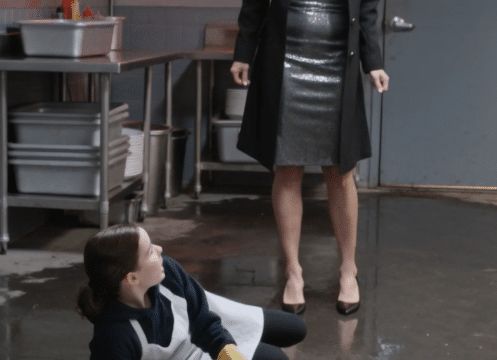
Rachel Morgan knelt on the polished floor of a luxury apartment hallway, pressing a small towel against a thin stream of rainwater creeping beneath a doorframe. A plastic bucket sat beside her, another towel lay folded near her knee, and the hem of her green sweater was already damp.
She had been cleaning for less than five minutes when a pair of polished leather shoes stopped inches from the water.
“What is this?”
Rachel looked up.
The man standing over her wore a crisp white dress shirt, black trousers, and a gold watch that probably cost more than everything in her cleaning bucket combined. His name was Victor Langley, a forty-five-year-old resident known for his expensive tastes and his extraordinary ability to turn minor inconveniences into someone else’s emergency.
He looked down at the wet floor as if Rachel had deliberately poured a bucket of dirty water across his private property.
“It’s coming from the storm,” she explained. “I’m cleaning it before anyone slips.”
Victor lifted one polished shoe and examined the sole.
Then he looked at her green sweater, her simple shoes, and the bucket beside her.
“Trash. You turned this hallway into a slum.”
Rachel stared at him, momentarily speechless.
Outside, rain hammered against the building’s windows. Water had been seeping into the corridor since the storm began, forming a narrow line along the baseboard. Rachel had noticed it while returning from the laundry room and realized someone could easily lose their footing.
She had knocked on the nearest doors.
No one had answered.
So she had fetched towels and a bucket.
It was a small act of consideration, the kind of thing people did in a shared building without expecting applause. Rachel was a resident, not a cleaner, and nobody had asked her to do the work.
She simply did not want an elderly neighbor or a child to walk through the water and fall.
Victor saw none of that.
He saw a wet floor near his expensive shoes, and he decided the person cleaning it was responsible for ruining his morning.
“There’s water coming from somewhere,” Rachel said carefully. “I’m trying to keep it from spreading.”
“Then call maintenance.”
“I already sent a message. They’re on their way.”
“Then stop making a mess.”
Rachel glanced at the water line.
“If I stop, it’ll spread farther.”
Victor’s face tightened.
He was accustomed to living in a building where staff members responded quickly to his requests. He had complained about elevator delays, questioned cleaning schedules, and once demanded that a maintenance worker replace a hallway light because its color temperature did not match the fixtures in his apartment.
Most people learned to avoid arguing with him.
Rachel had no desire to argue now. She wanted to finish wiping the water away before it reached the carpeted section of the corridor.
She dipped the towel into the bucket and wrung it out.
Victor stepped directly into her path.
“Do you understand what those shoes cost?”
Rachel looked at his feet.
“No.”
“Of course you don’t.”
“I’m sorry the water got near them. But it’s coming from the wall, not from anything I’ve done.”
That answer should have ended the conversation.
Instead, it seemed to convince Victor that she was challenging him.
He moved closer, blocking her access to the wet section. His expression hardened into the particular kind of anger that comes from discovering that another person will not immediately accept blame.
“You people always have an excuse.”
Rachel rose slowly, holding the damp towel in one hand.
“I’m not making excuses. I’m trying to stop a leak.”
Victor looked at her as though she had insulted him.
Then he kicked her forcefully in the chest.
Rachel fell backward beside the bucket, her elbow striking the hard floor. The bucket tipped onto its side, sending a small wave of water across the tiles. Pain caught her breath, and a thin trace of blood appeared where her forearm had scraped the ground.
For a moment, she could only stare at the ceiling lights.
She had not expected a disagreement about a wet floor to become an assault.
She tried to push herself upright, reaching toward the bucket to keep it from sliding into the walkway.
Victor stepped closer.
He kicked her twice more, striking her back and ribs as she struggled to move away from the spreading water.
A door opened farther down the corridor.
Someone gasped.
A resident standing near the elevator covered her mouth, while another person stepped back into a doorway. They had heard the argument, but the speed and brutality of the attack seemed to leave them frozen.
Victor stood over Rachel, his polished shoes now surrounded by the water she had been trying to contain.
“Keep your mess inside.”
Rachel looked up at him, struggling to breathe evenly.
The irony was almost unbearable.
She had been trying to keep the hallway safe.
Now she was lying on its floor, injured, while the man responsible for hurting her acted as though she had inconvenienced him.
Then, at the far end of the corridor, two figures emerged from the elevator.
One was a woman in a gray trench coat carrying an insurance inspection file. The other was the building’s penthouse owner, a reserved man named Charles Whitmore, whose name appeared on documents connected to some of the property’s most valuable units.
They stopped when they saw Rachel on the floor.
The woman immediately moved toward her, placing herself between Rachel and Victor.
Then she looked at the water running beneath the wall, followed its path toward the ceiling junction, and opened her file.
When she spoke, her voice was calm enough to make the hallway feel colder.
“She found the leak before it reached your ceiling.”
Victor’s expression changed.
He looked up.
Then he turned toward Charles.
Finally, his eyes returned to the insurance file.
“My ceiling?”
He had been so concerned about a little water near his shoes that he had never thought to ask where it was coming from.
Now he was beginning to understand that the real damage might be happening somewhere he had never bothered to inspect.
And the woman he had just kicked was the only person in the hallway who had noticed it in time.
Act II
The insurance inspector, Evelyn Price, knelt beside Rachel and asked her to remain still while she checked whether emergency medical assistance was needed. She kept her voice gentle, her movements deliberate, and her attention focused on the injured woman rather than the man standing behind her.
Charles Whitmore stepped beside them.
“Victor, move away from her.”
Victor hesitated.
“This is a misunderstanding.”
Charles looked at the overturned bucket, the towels, and the water spreading across the floor.
“What part?”
“She made a mess in the hallway.”
“She was cleaning up water.”
“She should have called someone.”
“She did,” Charles replied. “Maintenance received the message several minutes ago.”
Victor glanced toward the elevator.
He was accustomed to explanations being accepted when he delivered them confidently. The presence of Charles, however, complicated matters. Charles was not merely another wealthy resident who could be pressured into silence. He owned the penthouse at the top of the building and held a controlling interest in the company that managed several of its residential properties.
He rarely involved himself in ordinary disputes.
When he did appear, people paid attention.
Evelyn reached for a clean towel and placed it near Rachel’s arm. She asked a nearby resident to contact emergency services and another to keep people away from the wet section of the corridor.
The residents who had watched the assault finally began moving.
One brought a fresh towel.
Another stood near the elevator to warn people not to enter the hallway.
A third offered to retrieve Rachel’s phone, which had slid several feet across the floor.
Nobody had helped while Victor was attacking her.
Now that someone with authority had arrived, their fear began to give way to action.
Rachel noticed.
She did not blame them aloud, but the memory of those frozen faces would stay with her longer than she expected.
Evelyn looked toward the baseboard.
The water had not simply collected on the surface. It was emerging from a narrow seam where the wall met the floor, then following the slight slope of the tiles toward the elevator corridor.
She had been inspecting the building’s insurance exposure after the storm caused reports of damp ceilings and water intrusion on several floors. The original call had concerned a small stain in a penthouse service area.
That stain had seemed manageable.
Until Evelyn reviewed the building plans.
The penthouse sat directly above a portion of the corridor where pipes and drainage lines passed through a concealed service space. A leak there could travel along structural joints before becoming visible in a room below.
The first signs might appear far from the actual failure.
That was why Evelyn had requested access to several areas during the inspection.
She had not expected a resident to discover the leak before the scheduled examination.
Nor had she expected to find that resident injured on the floor.
Charles crouched beside the damp baseboard and studied the water line.
“How long has this been happening?”
Rachel swallowed and answered carefully.
“Only a few minutes since I noticed it. I sent maintenance a message and started wiping it up.”
“You saw where it was coming from?”
“Not exactly. It seemed to be coming from behind the wall.”
Evelyn exchanged a glance with Charles.
That was consistent with the concern already recorded in her file.
A small amount of water had appeared near the penthouse’s ceiling junction earlier that morning. The maintenance team had initially suspected condensation from the storm, but the location did not match the usual pattern.
Evelyn had insisted on checking the adjoining structural spaces before the building dismissed it as a minor issue.
Now the water in the hallway gave her a second point of reference.
She stood and opened the file.
“Charles, we need to isolate the affected line and inspect the service cavity immediately.”
Victor let out an incredulous laugh.
“You’re talking about shutting things down over a little water?”
Evelyn turned toward him.
“We’re talking about identifying a leak before it causes more damage.”
“It’s a hallway.”
“It’s part of a connected structure.”
Victor glanced at his shoes again.
The water had reached the edge of one sole.
“This is exactly what I’m talking about. People make a mess, and everyone else has to deal with it.”
Charles looked at him with a level expression.
“You are still blaming her?”
“She was kneeling in the middle of the hallway.”
“Because she was cleaning it.”
Victor’s jaw tightened.
For the first time, he seemed to realize that neither Charles nor Evelyn was going to accept his version of events simply because he repeated it.
The inspector returned to the file and pulled out a floor plan marked with colored lines. One line indicated the suspected route of the leak. Another showed the service area above the corridor.
The two points aligned.
Evelyn’s expression grew serious.
She had seen enough to know that the water was not merely an inconvenience. It was a warning.
But there was something else in the file that made Charles stop speaking.
A note from an earlier inspection had identified a possible failure in a section of pipework connected to the penthouse’s private renovation. The repair had been listed as completed months before.
If the leak originated there, the building would need to determine whether the earlier repair had actually been performed, whether the work had been documented correctly, and whether the failure was related to the storm or to an unresolved defect.
Those were not questions anyone could answer by looking at a wet hallway.
They required records, access, and a careful examination.
Victor had spent the last several minutes treating the water as a personal insult.
He had no idea that the inspector was now comparing the visible leak against a file that could determine responsibility for damage inside his own apartment.
And when Charles looked up toward the ceiling above Victor’s unit, his expression made it clear that the problem was much larger than a wet pair of shoes.
Act III
The building’s maintenance team arrived within minutes and shut off the affected water line while technicians prepared to inspect the service cavity.
Rachel was taken for medical evaluation, with a resident accompanying her until her friend could arrive. Before leaving, she asked whether the hallway had been secured.
Even injured, she was worried that someone might slip.
Evelyn assured her that the area would be blocked off and that maintenance would handle the water.
Only then did Rachel allow herself to leave.
Charles watched her go with a troubled expression.
He had lived in the building long enough to recognize the difference between someone seeking attention and someone acting out of responsibility. Rachel had not demanded that the residents watch her clean. She had not called for special treatment. She had simply seen a hazard and tried to prevent it from hurting someone else.
Victor had interpreted that ordinary decency as evidence that she was beneath him.
Now the insurance inspection was revealing a much less convenient truth.
The water had traveled from a concealed service line near the upper floors. Its path suggested that the visible seepage was only the final stage of a problem that had developed behind the walls.
Technicians accessed the service cavity and began tracing the line.
The first report was cautious.
They had found evidence of prolonged moisture near a connection that had supposedly been repaired during the penthouse renovation. The exact cause still required testing, but the condition was inconsistent with a simple splash of rainwater entering beneath the hallway door.
Evelyn reviewed the previous work order.
The paperwork stated that the repair had been completed and inspected. A contractor’s invoice described replacement components and pressure testing.
Yet the service connection appeared to show signs that required further investigation.
Charles read the report twice.
“Who signed off on this?”
“The renovation contractor submitted the completion record,” Evelyn said. “The building’s maintenance office accepted the paperwork. We’ll need to compare the documents with the physical findings before reaching a conclusion.”
Victor stood nearby, increasingly restless.
“This has nothing to do with me.”
Evelyn did not look up.
“We haven’t established that.”
“I own the apartment. I don’t repair pipes.”
“No one is suggesting that you personally installed them.”
“Then why are you looking at my ceiling?”
“Because the suspected line runs through the service area connected to your unit.”
Victor folded his arms.
He had purchased the apartment several years earlier and renovated it extensively. The work had included custom lighting, imported stone, built-in cabinetry, and a redesigned bathroom with fixtures selected from a luxury catalog.
He had been proud of the result.
Guests often complimented the apartment, and Victor enjoyed explaining how carefully he had chosen every finish. He believed that paying for premium materials and experienced contractors meant the work would be done correctly.
When the renovation had finished, he had received a thick folder of invoices, warranties, and completion documents.
He had barely looked at them.
The contractor had assured him that everything was in order, and Victor had accepted that assurance as sufficient.
Now the inspector was asking to examine a repair that had supposedly been completed as part of that project.
Evelyn turned to Charles.
“There is another issue.”
She removed a page from the back of the file. It contained a record of earlier moisture complaints and a note indicating that a previous inspection had recommended follow-up testing.
The follow-up report was missing.
Charles frowned.
“Missing?”
“We have the initial recommendation and the invoice marked complete. We do not yet have the supporting test results.”
“Could they have been filed incorrectly?”
“Possibly. We’re checking the archive.”
Victor shifted his weight.
“Are you suggesting someone lied?”
Evelyn met his eyes.
“I’m saying the records are incomplete. Until we establish what happened, nobody should make assumptions.”
The irony was impossible to miss.
Victor had spent the afternoon making assumptions about Rachel.
He had decided she was responsible for the water because she was cleaning it. He had decided she was careless because she wore ordinary clothes and used a plastic bucket. He had decided that humiliating her would solve the problem.
Now, when the evidence pointed toward an unresolved maintenance issue, he demanded caution.
Charles noticed the contradiction too.
“That’s exactly what we should have done in the hallway,” he said.
Victor’s face reddened.
“I don’t need a lecture.”
“No,” Charles replied. “You need to understand what happened.”
He gestured toward the damp floor.
“Rachel saw water and tried to keep people safe. You saw water and decided to hurt her. Those are two separate facts, and neither one changes because of the inspection.”
Victor looked away.
He could no longer pretend that the assault was merely a heated exchange. The witnesses had described what happened, and the camera footage would establish the sequence clearly.
The building’s legal representative was already being notified. Any criminal or civil consequences would be handled through the appropriate process, while the insurance investigation continued independently.
No finding about the leak could excuse what Victor had done.
But the leak itself was becoming a serious matter.
The technicians discovered that the moisture had spread farther than the first visible patch suggested. It had followed a concealed route behind part of the wall and reached a junction near the penthouse ceiling.
The affected area needed to be opened and inspected before anyone could determine the full extent of the damage.
Charles asked Evelyn what the insurance file indicated.
She looked at the marked plans.
“If Rachel hadn’t noticed the water when she did, we might have discovered it much later.”
“How much later?”
“Possibly after visible damage appeared in the ceiling below. Depending on how quickly the leak progressed, that could have meant damaged finishes, electrical concerns, or a much larger repair.”
Charles glanced upward.
The penthouse ceiling was finished with custom plasterwork and recessed lighting. A serious leak could have damaged the decorative surfaces, but the financial cost was only part of the concern.
Hidden water intrusion could create hazards that were not obvious until the damage had spread.
Rachel had not known the technical details.
She had simply seen water and refused to leave it unattended.
Evelyn closed the file.
“She found the leak before it reached your ceiling.”
The sentence now carried a different weight.
It was not an attempt to make Rachel sound like a hero for wiping up a puddle. It was a statement about timing: her quick response had drawn attention to a problem before its full consequences became visible.
And as the inspection continued, one question became impossible to ignore.
If the earlier repair had been completed properly, why was water now traveling through the same area?
The answer would determine who was responsible for the damage.
It would also reveal why Victor had been so certain that the hallway problem was someone else’s fault.
Act IV
The inspection took two days.
During that time, maintenance kept the affected corridor closed, technicians examined the service connection, and the building’s management office gathered records from the renovation contractor.
The initial findings established that the leak had not originated from the water Rachel was wiping from the floor. It was coming from a concealed connection near the penthouse service line, where moisture had traveled through the surrounding structure.
The storm had made the problem visible.
It had not necessarily created it.
The distinction mattered.
If the leak had resulted entirely from sudden storm damage, the insurance review would follow one path. If it involved defective workmanship, an incomplete repair, or a failure to follow the required testing procedure, responsibility could be different.
Evelyn refused to jump to conclusions.
She compared the photographs from the inspection with the contractor’s completion report. The invoice described work on the same section of pipe, but the supporting pressure-test documentation could not be located in the original file.
The contractor was asked to provide its records.
Charles also requested copies of the penthouse renovation documents, including the approvals for work affecting the service line.
Victor was furious when he learned that the inspection would continue.
“My apartment is being treated like a crime scene.”
“No one has accused you of anything,” Charles said. “We’re investigating a leak.”
“You’re opening up my ceiling.”
“Only the area necessary to determine the cause.”
“Do you have any idea what that ceiling cost?”
Charles regarded him quietly.
“Yes.”
That answer seemed to frustrate Victor more than an argument would have.
Charles knew the value of the penthouse finishes. He also knew that decorative surfaces could be repaired or replaced. What concerned him was the possibility that a maintenance failure had gone undocumented and that the building might have accepted a completion report without the necessary evidence.
The investigation eventually uncovered a troubling gap.
The contractor had provided an invoice indicating that the repair was complete, but its first response did not include the requested test records. A technician who had worked on the renovation confirmed that the service connection had been addressed, yet could not initially establish whether the final inspection had been carried out as specified.
That was not enough to prove deliberate misconduct.
It was enough to justify further scrutiny.
The building’s insurer arranged for an independent technical assessment, while management reviewed the approval process for the earlier repair. The investigation would determine whether the work had been defective, whether documentation had been mishandled, and which parties bore responsibility under the relevant agreements.
Meanwhile, the assault investigation proceeded on its own track.
The hallway camera captured Victor approaching Rachel, confronting her, and kicking her to the ground. The witnesses’ accounts were consistent with the footage. There was no evidence that Rachel had threatened him or deliberately created the water hazard.
Victor could not credibly claim that he had acted to protect his property.
The water had been a minor inconvenience before he turned it into a violent incident.
The building issued a formal notice that physical aggression and intimidation would not be tolerated in common areas. Victor was required to cooperate with the investigation, and the incident was referred to the appropriate authorities.
For the first time, he could not solve a problem by complaining to someone he believed had less power than he did.
The evidence was independent of his status.
The camera did not care what his shoes cost.
The witnesses did not need to know his income.
The medical record did not change because he owned a luxury apartment.
And the insurance report would not rewrite the facts simply because the repair involved his ceiling.
When Rachel returned to the building after receiving medical care, Charles asked whether she felt comfortable discussing what had happened.
She agreed to speak with him briefly.
She was still moving carefully, and the experience had left her shaken. But her voice was steady.
“I wasn’t trying to interfere with anyone’s property,” she said. “I saw water spreading across the floor. I thought somebody might fall.”
Charles nodded.
“You did the right thing.”
“I don’t want people thinking they have to ignore something dangerous because they might upset a neighbor.”
That sentence stayed with him.
The building had invested heavily in security systems, insurance coverage, maintenance contracts, and elegant finishes. It had rules for emergencies and procedures for reporting defects.
Yet in the moment that mattered, the person who responded first had been a resident with a towel and a bucket.
Rachel had acted before anyone else arrived.
She had not waited to find out whether the leak belonged to her unit or someone else’s. She had not asked whether the floor was expensive enough to deserve attention. She had simply recognized a risk and tried to reduce it.
Victor had done the opposite.
He had seen a person helping and interpreted her presence as an insult.
Charles later told the board that the building needed to improve how it responded to common-area hazards, including making it easier for residents to report leaks and ensuring maintenance requests were acknowledged promptly.
The board agreed to review the procedures.
The insurance investigation continued, and the damaged service area was repaired once the technical assessment established the necessary work.
The final report did not transform Victor into the sole cause of every problem. The original leak involved a chain of technical and administrative questions that required evidence to resolve. Responsibility for the repair would be determined through the appropriate process.
But one fact was already beyond dispute.
Rachel had not caused the leak.
She had discovered the visible warning sign and tried to keep others safe.
And Victor had attacked her for it.
When he was later required to acknowledge the assault as part of the building’s formal proceedings, he looked down at the papers rather than at Rachel.
He had spent years believing that the luxury of his apartment made him exceptional.
Now the only thing that distinguished him in the hallway was what the evidence showed he had done.
Yet the final lesson was not about watching a wealthy man lose face.
It was about the ceiling above him.
The leak had been hidden from view, traveling behind finished walls where nobody could see its progress. By the time it became obvious, the damage might already have spread.
The same was true of Victor’s behavior.
His contempt had not appeared out of nowhere that afternoon. It had grown through countless small moments in which he treated other people as obstacles, servants, or inconveniences.
The storm had exposed one problem behind the walls.
The assault had exposed another.
And neither could be repaired by pretending it was someone else’s mess.
Act V
The hallway was reopened after the repairs were completed.
The damp section of wall had been inspected, the affected materials were replaced where necessary, and the maintenance team tested the repaired connection before signing off on the work. Management also introduced a clearer reporting procedure so residents would know whom to contact when they discovered water intrusion or another immediate hazard.
The insurance review established the appropriate next steps for the building and the parties involved in the earlier repair. Any questions about workmanship or responsibility were handled through the documented process rather than through accusations in the hallway.
The building did not become perfect overnight.
Pipes still needed maintenance. Storms still tested the windows and drainage systems. Residents still disagreed over noise, deliveries, parking, and the ordinary frustrations of living close to other people.
But one thing had changed.
People no longer treated a maintenance concern as something that should be ignored until an employee arrived. They knew that reporting a hazard promptly could prevent a larger problem, and management had made it easier to do so.
Rachel returned to her routine gradually.
For a while, she found herself watching the floor whenever she passed the place where she had fallen. The polished tiles had been cleaned, the baseboard repaired, and the hallway restored to its quiet elegance.
Nothing visible remained of the confrontation.
But Rachel remembered the moment when she had looked around and seen residents frozen in their doorways.
She understood that people could be frightened. She understood that an unexpected act of violence could make even a simple decision feel dangerous.
Still, she hoped they would act differently if they ever witnessed something similar again.
A few neighbors apologized for standing back.
Rachel listened without demanding that they feel worse than they already did.
“I know it happened quickly,” she told one of them. “Next time, call for help. Don’t assume someone else will.”
The woman nodded, visibly relieved that Rachel was willing to speak with her.
In the weeks that followed, several residents checked on Rachel whenever they passed her door. One left a small note thanking her for helping draw attention to the leak. Another offered to carry her groceries while she was still recovering.
Rachel appreciated the kindness, but she did not want the incident to become the defining story of her life.
She wanted to return to ordinary things.
Making coffee in the morning.
Calling her sister on Sunday afternoons.
Walking through the building without wondering whether a small inconvenience might provoke someone into rage.
And, most of all, she wanted to remember that doing the right thing had not been a mistake.
Charles understood that distinction.
When he next saw Rachel, he thanked her again for noticing the water before it spread farther. He told her that the building was reviewing the way it handled repairs and common-area hazards.
Rachel smiled faintly.
“I hope it helps the next person who notices something.”
“It will,” he said. “We’re making sure of it.”
She did not ask whether Victor had lost money or whether the insurance review had cost him anything. She did not ask whether his reputation had suffered.
Those questions were no longer the point.
The consequences of the assault would be handled through the appropriate channels. The repair dispute would be resolved according to the evidence and the relevant agreements. Rachel did not need to orchestrate a public downfall to prove that what happened to her was wrong.
The truth was enough.
Victor, meanwhile, had to live with the knowledge that his own reaction had become part of the official record.
The investigation into the leak had not proven every suspicion about the earlier renovation, and it did not establish that Victor had personally caused the technical failure. But it had confirmed that the water was coming from a concealed service connection, that the previous documentation required scrutiny, and that Rachel’s intervention had drawn attention to the problem before its full extent was visible.
He could no longer claim that she had created the mess.
He could no longer pretend that the assault had been a reasonable response to a trivial inconvenience.
And he could no longer make the people around him forget what they had witnessed.
The next time Victor passed Rachel in the elevator lobby, he kept his eyes on the floor display.
He did not insult her.
He did not demand that she move aside.
He simply stood in silence as the numbers changed.
Whether he felt genuine remorse or merely understood that his behavior now carried consequences was something only he could know.
Rachel did not chase an apology.
She had learned that a person’s dignity could not depend on whether someone who mistreated them eventually understood what they had done.
Sometimes the most important thing was to reclaim the ordinary space that had been taken from you.
One rainy afternoon, several weeks after the repairs, Rachel stepped into the hallway and noticed a small wet patch near the entrance.
For a moment, she stopped.
Then she looked more closely.
It was only water tracked in on someone’s shoes. There was no seepage from the wall, no growing line beneath the baseboard, and no sign of a concealed leak.
She fetched a towel anyway.
As she wiped the patch away, a neighbor came out of the elevator and offered to hold the door while she finished. Another resident passed with a package and paused to ask whether the floor needed a warning sign.
The moment was unremarkable.
That was what made it meaningful.
Nobody mocked her for cleaning.
Nobody treated the towel as proof that she did not belong.
Nobody decided that a wet floor gave them permission to humiliate someone.
They simply noticed a person taking care of a shared space and offered a hand.
Rachel wrung out the towel and put it away.
Above them, the repaired ceiling remained dry.
The hallway lights reflected cleanly across the polished tiles. Beyond the windows, clouds gathered over the city, but the building was ready for the next storm.
Charles would later remember Rachel’s response more clearly than the invoices or the technical findings.
She had not known whether the leak would cost hundreds of dollars or thousands. She had not known whose insurance might cover the repair, or whether the problem had been caused by faulty workmanship or a failed connection.
She had known only that water on a polished floor could make someone fall.
So she had tried to stop it.
That was the kind of judgment no luxury finish could replace.
The building could repair a ceiling, replace damaged materials, and rewrite an inspection procedure. It could preserve video evidence and hold people accountable when they crossed a line.
But it could not manufacture compassion through an expensive renovation.
That had to come from the people who lived there.
Victor had looked at Rachel and seen someone he believed he could order around. He had looked at the water and seen an inconvenience to his expensive shoes. He had never considered that the person kneeling on the floor might be protecting him from a problem he could not see.
The inspector’s words had changed the entire hallway.
“She found the leak before it reached your ceiling.”
Victor had thought the water was Rachel’s mess.
He had thought the hallway was beneath his concern until it touched his shoes.
He had thought his wealth placed him safely above the ordinary problems of other people.
But the leak had been moving quietly behind the walls, and the woman he humiliated was the first to recognize the warning.
In the end, the ceiling was repaired.
The evidence was preserved.
The assault was documented.
And Rachel returned to the hallway with her head held high, knowing that she had acted with care even when someone answered that care with cruelty.
Victor had been terrified of a little water touching his shoes. He never imagined that the woman he kicked to the floor was the one who had noticed the danger hanging over his head.