Act I
“She’s leashed. Nothing happened.”
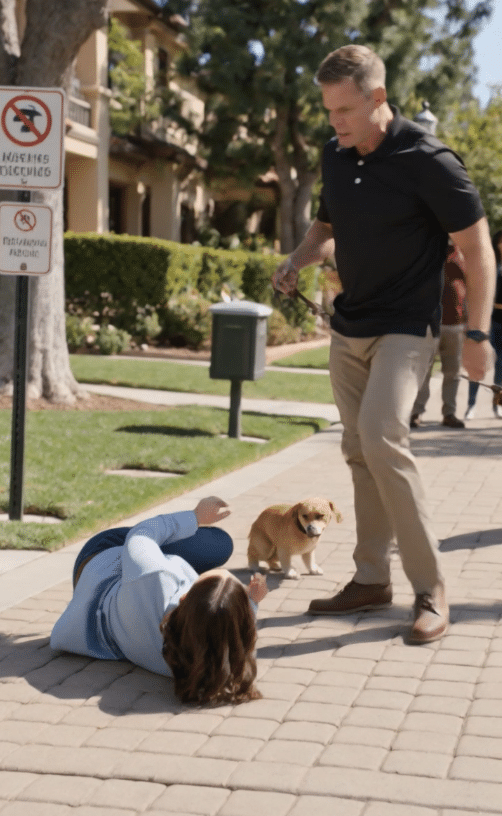
Emma Carter tightened her grip on the leash as a man in a black polo shirt stepped directly into her path. Their dogs had done nothing more than sniff each other for a second on the tree-lined walking trail, but the man yanked his expensive purebred backward as though Emma’s little dog had committed an unforgivable offense.
“Trash. Keep that street dog away from mine.”
Emma blinked at him, momentarily stunned.
Her small brown-and-white rescue dog, Daisy, stood beside her in a simple red harness. The leash was short, the path was wide, and Daisy had done exactly what a well-behaved dog was supposed to do: approach another animal cautiously, sniff, and wait for her owner.
The other dog, a handsome golden retriever named Bentley, had been equally calm.
Until his owner decided there was a problem.
“She’s leashed,” Emma repeated. “Nothing happened.”
The man looked Emma up and down.
She wore a light blue jacket, jeans, and white sneakers. There was nothing flashy about her clothes, nothing that announced money or status. Her hair was tied back, and one of her sneakers had a faint streak of mud from an earlier walk.
The man seemed to take all of that as permission to treat her with contempt.
His name was Richard Hale. At thirty-nine, he had become accustomed to living in a world where people stepped aside when he approached. He owned a large home in the community, drove an expensive SUV, and took obvious pride in Bentley, a purebred golden retriever whose pedigree he mentioned whenever someone complimented the dog.
Richard had paid a considerable sum for Bentley.
He had purchased premium food, imported accessories, and an elaborate leather leash. He had even arranged professional photographs of the dog for his social media accounts.
To Richard, Bentley was more than a companion.
He was a symbol of the life Richard believed he had earned.
Daisy, by contrast, had come from an animal rescue organization.
She was small, mixed-breed, and missing a tiny patch of fur near one ear. Her adoption papers described her as gentle but initially cautious around strangers. Emma had never cared about her ancestry. She cared that Daisy had learned to trust again, that she no longer trembled at every unfamiliar sound, and that she had begun sleeping peacefully through the night.
Emma had adopted her two years earlier.
Since then, the dog had become part of the quiet routine that helped Emma through some of the hardest months of her life.
Richard did not know any of that.
He saw a woman in ordinary clothes walking an inexpensive dog, and he decided he had already learned everything worth knowing about her.
“Maybe you didn’t notice,” he said, tightening Bentley’s leash, “but some of us actually care about what our dogs are exposed to.”
Emma glanced at Bentley.
“He seems fine.”
Richard’s jaw tightened.
“Don’t tell me what’s fine for my dog.”
“I wasn’t trying to—”
“Then move.”
Emma took a small step to the side, leaving more than enough room for him to pass. Daisy followed obediently, her tail low but relaxed.
Richard could have continued walking.
Instead, he moved with them, blocking the path again.
A couple walking a white terrier slowed several yards away. An older man holding a leash stopped near a bench. The trail, usually filled with the ordinary sounds of footsteps and birds, suddenly felt uncomfortably quiet.
Emma tried to keep her voice calm.
“There’s room for both of us to get through.”
Richard gave a short, humorless laugh.
“You people always think the rules are for everyone else.”
“What rules have I broken?”
That question seemed to offend him more than anything she had said.
His expression hardened. He stepped closer, forcing Emma to look directly at him.
For one fleeting moment, she thought he might simply shout and leave.
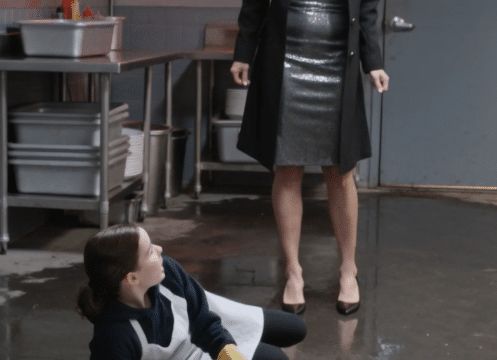
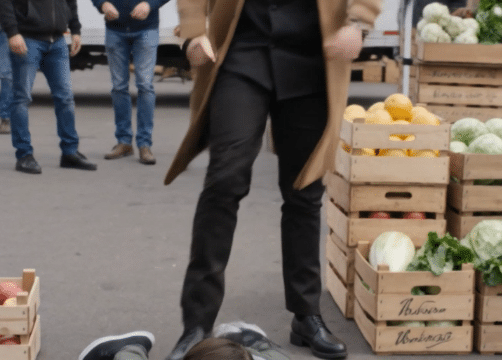
Then he kicked her forcefully in the chest.
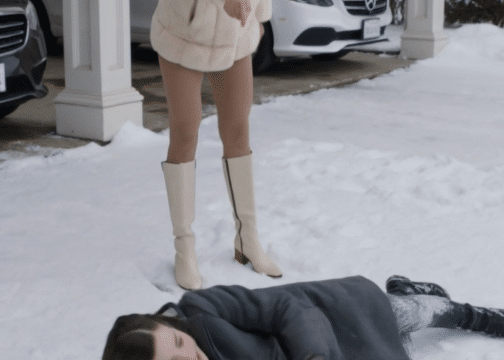
Emma fell onto the paved path, instinctively pulling Daisy’s leash close so the frightened dog would not bolt into the road. Her elbow struck the ground, leaving a thin trace of blood across the skin.
Daisy barked sharply and scrambled toward her.
Before Emma could rise, Richard stepped closer and kicked her twice more, the blows landing against her back and ribs.
Emma curled around herself, trying to shield Daisy with one arm while keeping the leash in her hand.
The little dog pressed against her side, trembling.
Nearby residents froze.
The woman with the terrier covered her mouth. The older man took a step backward, pulling his own dog away. No one seemed able to comprehend that an argument over two dogs briefly sniffing each other had turned into a deliberate assault.
Richard stood above Emma, breathing hard.
“Walk it where cheap dogs belong.”
Emma stared at him from the pavement.
She was frightened, hurt, and struggling to catch her breath, but her hand remained wrapped around Daisy’s leash.
The dog whined and nudged her fingers.
Then someone came running down the path.
A woman in a white veterinary coat over a navy shirt hurried toward them, clutching a medical file. She was Dr. Laura Bennett, the veterinarian who served the residential community and several nearby animal rescue organizations.
She moved straight toward Emma, placing herself between the injured woman and Richard before kneeling beside Daisy.
Then she looked up at Bentley.
Her expression changed.
She opened the file in her hands and fixed her eyes on Richard.
“That dog is the reason yours is alive.”
Richard’s face went blank.
He looked at Daisy.
Then at Bentley.
Finally, he stared at the medical file.
“My dog?”
For the first time that afternoon, Richard Hale had no idea what the other person knew.
And Dr. Bennett was holding a record that could change everything he believed about the animal standing beside him.
Act II
Dr. Bennett did not begin by explaining herself.
She first checked that Emma was conscious and able to respond. She asked a nearby resident to contact emergency services and instructed another to keep the surrounding dogs at a safe distance.
Daisy stayed close to Emma, pressing her small body against the woman’s side.
When Dr. Bennett reached toward her, the dog flinched.
Then she recognized the veterinarian’s voice.
Her posture softened just slightly, and she allowed Dr. Bennett to examine her without pulling away.
Richard watched impatiently.
“What’s this supposed to prove?” he demanded.
Dr. Bennett did not look at him.
“Right now, I’m making sure she’s safe.”
“I’m talking about my dog.”
“And I’m talking about the woman you just attacked.”
Richard glanced toward the witnesses, apparently expecting someone to intervene on his behalf.
Nobody did.
The man with the white terrier had finally taken out his phone. The older resident was speaking quietly to another dog walker, describing what he had seen.
Richard’s confidence began to falter, but he tried to conceal it behind irritation.
“This woman let her animal approach mine.”
“Both dogs were leashed,” Dr. Bennett replied.
“You weren’t here.”
“No. But several people were.”
She closed the file halfway and turned her attention back to Emma.
The veterinarian had known Emma for nearly two years, though their relationship had never been especially dramatic. Emma brought Daisy in for routine checkups, vaccinations, and the occasional concern about the dog’s sensitive stomach.
She never demanded special treatment.
She asked careful questions, followed the care instructions, and always thanked the staff before leaving.
What most people at the clinic did not know was that Emma volunteered with a small rescue network that helped cover emergency treatment for animals whose owners could not afford it.
She did not advertise the work.
She preferred to pay a bill quietly, arrange transportation, or connect a struggling family with someone who could help.
Dr. Bennett had met dozens of generous people through veterinary medicine.
Emma was different in one important respect.
She understood that saving an animal was only the beginning. The animal also needed a safe home, patience, and someone willing to remain committed after the initial excitement of adoption had passed.
Daisy was proof of that.
When Emma first brought her to the clinic, the dog had been underweight and frightened. She startled at raised voices and crouched whenever someone reached too quickly over her head.
Emma had never demanded that Daisy become affectionate overnight.
She sat on the floor during appointments, spoke softly, and gave the dog time to approach her.
Over months, Daisy learned that a hand could offer comfort rather than punishment.
Dr. Bennett had watched the transformation happen one visit at a time.
She had also seen Emma return to the clinic with donations, food, and supplies for animals whose owners were facing unexpected hardship.
Once, Emma had quietly covered the cost of emergency treatment for an elderly man’s dog after learning that he had postponed the appointment because he was worried about the bill.
Another time, she helped arrange a foster placement for a litter of abandoned puppies that had arrived during a storm.
She never asked for recognition.
In fact, when the clinic’s manager suggested thanking her publicly, Emma had politely declined.
“I don’t want people helping animals because they think someone is watching,” she had said. “They should do it because the animal needs help.”
Dr. Bennett had remembered those words.
Now, kneeling on the path beside Emma, she watched Daisy press her nose against the injured woman’s hand.
“Stay with me, sweetheart,” Emma whispered to the dog.
Richard gave an impatient shake of his head.
“This is absurd. My dog is perfectly healthy. Nothing happened to him.”
Dr. Bennett finally stood.
“You’re right about one thing. Bentley appears stable right now.”
Richard seized on the statement.
“Exactly.”
“But that doesn’t mean you understand what happened before you brought him into this community.”
The confidence drained from his face for a second.
Bentley stood beside him, looking from Richard to the veterinarian. The golden retriever seemed confused by the tension, occasionally shifting his weight and glancing toward Daisy.
Dr. Bennett looked down at the open file.
The folder contained vaccination records, examination notes, and a series of documents relating to Bentley’s medical history before Richard adopted him.
Richard had been told that Bentley came from a reputable breeder. He had paid a premium price and received papers that made the transaction look straightforward.
But the records Dr. Bennett was holding told a much more complicated story.
A story about an animal whose life had once depended on a chain of decisions made by people who never expected their names to be connected.
A story in which Daisy had played a part.
And a story Richard had never bothered to investigate because he believed the price he paid had already told him everything he needed to know.
Act III
Three years earlier, Bentley had not been a prized companion.
He had been a sick young dog at an overcrowded breeding operation that was eventually shut down after serious welfare concerns were reported. Several animals were transferred to rescue organizations and veterinary facilities for assessment.
Bentley was among them.
At first, the signs were easy to miss.
He was friendly and responsive, and he had the golden coat that would later make him so desirable to prospective buyers. But his medical examination revealed a dangerous infectious condition that required urgent treatment and careful monitoring.
Without intervention, the disease could have become fatal.
The clinic contacted rescue organizations to coordinate treatment and locate any animals that might have been exposed. The work was complicated, expensive, and emotionally draining. Staff members stayed late, volunteers transported animals between facilities, and foster homes were arranged for dogs that needed isolation or continued observation.
Among the dogs already receiving care was Daisy.
She had been rescued from a separate situation and was recovering at a partner facility when the veterinary team began investigating a possible link between the cases. Her own history had left her vulnerable, but her medical records contained information that became important to the investigation.
Daisy’s previous treatment history, combined with the rescue network’s intake records, helped veterinarians trace the timing of a suspected exposure and narrow down which animals might have been at risk.
That information allowed the team to make decisions faster.
Bentley received the treatment and monitoring he needed.
He survived.
The veterinary team continued to track his recovery, documenting each examination and the steps taken to ensure he could eventually be placed in a permanent home.
Daisy’s role had not been dramatic in the way people imagined heroism.
She had not fought off another animal or performed some extraordinary feat.
Her importance lay in the records associated with her case and in the work of the people who had cared for her. The information gathered during her treatment helped the team understand the situation more clearly, reducing uncertainty at a moment when delay could have had serious consequences.
To Dr. Bennett, that was reason enough to remember her.
But the story did not end when Bentley recovered.
The investigation into the breeding operation uncovered serious failures in recordkeeping and animal care. Some paperwork was incomplete, some medical histories had been misrepresented, and several dogs had been transferred without the clear documentation their future owners deserved.
Bentley’s records had to be reconstructed from veterinary notes, rescue intake forms, and follow-up examinations.
Dr. Bennett had spent months helping ensure that the medical information followed him.
She knew how important it was for a future owner to understand an animal’s history, particularly when that animal had survived a serious illness.
Eventually, Bentley was cleared for adoption.
Richard arrived at the clinic’s partner adoption event with a list of preferences. He wanted a purebred dog with a documented lineage, a healthy appearance, and the kind of temperament that would suit his lifestyle.
He was drawn to Bentley immediately.
The dog was handsome, friendly, and calm around people. Richard liked the way he looked beside him and how easily other residents reacted when they saw the pair together.
The adoption was handled through the proper channels, with veterinary follow-up and the necessary records provided.
But Richard paid far more attention to Bentley’s appearance and pedigree than to the dog’s earlier life.
He wanted the story of a beautiful dog he had acquired.
He did not want to hear about overcrowded facilities, rescue volunteers, complicated medical histories, or the difficult months that had come before.
Whenever someone asked where Bentley came from, Richard gave a polished answer about responsible breeding and careful selection.
He had never understood the full extent of the rescue network’s involvement.
Nor did he know how many people had contributed to Bentley’s survival before he entered Richard’s home.
That was why Dr. Bennett’s words struck so deeply.
“That dog is the reason yours is alive.”
Richard looked at Bentley again.
The golden retriever seemed entirely ordinary at that moment. He was standing on a quiet residential path, wearing a well-fitted collar and holding his head slightly to one side.
Nothing about him suggested the frightening uncertainty of his early medical history.
Nothing about him revealed the people who had worked to save him.
Richard swallowed.
“What does she have to do with Bentley?”
Dr. Bennett glanced at Emma, who was now being assisted into a more comfortable position while waiting for medical care.
“More than you know.”
She did not explain everything.
The veterinary records contained private medical information, and she was not going to turn them into a public spectacle. But she could tell Richard enough to make clear that his understanding of Bentley’s past was incomplete.
Daisy’s case had been part of the medical investigation that helped protect animals like Bentley.
Emma had also been one of the people who helped keep the rescue network operating when its resources were stretched dangerously thin.
Richard stared at the small dog.
The animal he had called trash had been part of a chain of events that helped save the life of the dog he treated as a status symbol.
But even that was not the whole truth.
Because the most important thing Emma had done for Bentley was not written in the veterinary file.
It had happened after the medical crisis, when the rescue network was trying to find a future for the animals that had survived.
And when Dr. Bennett finally opened the last section of the folder, Richard began to understand that the story he had told himself about Bentley’s rescue was missing its most important chapter.
Act IV
The path had grown almost completely silent.
Richard stood with Bentley’s leash wrapped around his hand, staring at Dr. Bennett’s file.
The residents nearby had stopped pretending not to listen. Some were still frightened by what they had witnessed, while others looked angry that an ordinary encounter between two leashed dogs had ended with Emma injured on the pavement.
Dr. Bennett stepped closer to Emma again, keeping herself between her and Richard.
“Don’t approach her,” she said firmly.
Richard remained where he was.
“I want to know what this has to do with my dog.”
“Then listen.”
She opened the folder fully.
Bentley’s adoption had taken place after months of recovery, and the rescue network had worked hard to ensure he went to a home that could meet his needs. The team had evaluated prospective owners, reviewed veterinary requirements, and discussed the importance of patience with an animal whose early life had been unstable.
Emma had been involved in that work.
She had helped coordinate practical support for foster homes and had contributed to the emergency fund that allowed the network to continue treating animals while their cases were being resolved.
Her support had not purchased Bentley.
It had not given her ownership rights over him.
And it did not mean that Richard owed her some personal debt that could be collected whenever she chose.
The truth was more meaningful than that.
Emma had helped sustain the network that made Bentley’s recovery and adoption possible. Daisy’s case had also contributed to the veterinary investigation that helped the team understand the risks facing the animals.
Bentley was alive because a group of people had taken responsibility for animals they did not own, in circumstances where doing the right thing was difficult and expensive.
Emma had been one of those people.
Richard had entered the story at the end and mistaken himself for its beginning.
Dr. Bennett looked directly at him.
“You adopted a dog who survived because people cared for him before you ever met him. Emma was one of the people who helped make that possible.”
Richard’s mouth opened, but no answer came.
For years, he had used Bentley as proof that he had good taste and the resources to obtain the best. He talked about the dog’s bloodline, his diet, his grooming, and the money spent on his care.
He had never considered how many people had helped Bentley reach the point where any of those things were possible.
He had thought the dog began his life as a valuable possession when Richard brought him home.
In reality, Bentley’s story had begun in circumstances Richard preferred not to imagine.
And Daisy, the little dog he had dismissed as a street animal, was connected to that history.
Richard looked at Emma.
She was pale and visibly shaken. A thin mark of blood remained on her elbow, and her hand was still curled protectively around Daisy’s leash.
The dog had not left her side.
Richard tried to recover his composure.
“I didn’t know any of this.”
Dr. Bennett’s expression did not soften.
“You didn’t need to know any of it to understand that she had done nothing to you.”
The sentence landed harder than an accusation.
Richard glanced toward the other residents.
A few were recording the scene from a distance. Others were holding their dogs close, their faces drawn with disbelief. The man with the white terrier had already provided his account of the assault, and another witness was waiting to speak with the responding authorities.
Richard could no longer control the story by insisting that Emma had violated a rule.
The dogs had been leashed.
The encounter had been brief.
There had been no attack, no injury to Bentley, and no reason for the confrontation to continue.
He had turned a minor moment into a violent act because he believed the person in front of him was beneath him.
The file could explain Bentley’s medical history.
It could not excuse Richard’s behavior.
Dr. Bennett closed the folder and returned her attention to Emma. She asked whether Daisy had any injuries and checked the dog’s collar and harness, making sure nothing had become caught during the fall.
Daisy was frightened but appeared physically unharmed.
When Emma whispered her name, the dog pressed closer.
That small gesture seemed to disturb Richard more than anything else.
He had spent money to give Bentley a comfortable life. He fed him, walked him, and provided for his needs. Yet he had just demonstrated how little he understood about the bond between an animal and the person responsible for protecting it.
Emma had been hurt while trying to keep Daisy safe.
Even after being attacked, she had kept hold of the leash.
Richard had looked at the same moment and seen an opportunity to humiliate someone.
The difference between them was no longer hidden.
When emergency responders arrived, witnesses began giving their accounts. Richard was instructed to remain available while the incident was documented, and the assault was referred for appropriate follow-up.
Dr. Bennett stayed with Emma until she was safely in the care of medical professionals. She also made sure Daisy would have a quiet place to wait while Emma received treatment.
Before the veterinarian left the path, she turned once more toward Richard.
“Bentley deserves to be treated as a living being, not a symbol of your status. So does every other animal on this path.”
Richard looked down at his dog.
Bentley leaned against his leg, trusting him completely.
For the first time, Richard seemed to understand that the animal had no idea what his owner had just done.
Bentley had not chosen his pedigree.
He had not chosen his price.
He had not chosen the history that brought him into Richard’s home.
He was simply a dog who trusted the person holding his leash.
And Richard had nearly destroyed that trust by treating another living creature as if it had no right to exist beside him.
The truth was becoming impossible to escape.
But there was one final question Richard could not stop asking himself.
If Daisy had helped save Bentley, and Emma had helped save dogs like Bentley, what did that make the woman he had just called trash?
Act V
Emma’s injuries required medical attention, and the incident did not disappear simply because Richard had been confronted with the truth.
The witnesses provided statements. The available recordings were preserved, and the assault was handled through the appropriate process. The residential community reviewed its response to violent incidents on shared paths, reinforcing that no disagreement over pets could justify physical aggression.
Richard had to face the consequences of what he had done.
His wealth did not make the witnesses disappear.
His expensive watch could not change the sequence of events.
And Bentley’s pedigree could not transform an assault into a misunderstanding.
In the days that followed, residents discussed the incident in quieter conversations. Some were shocked that someone who appeared so polished could behave so cruelly. Others admitted that they had seen Richard belittle people before but had never imagined he would become violent.
Emma did not encourage the gossip.
When she was well enough to return to the walking path, she came back with Daisy on her usual leash. She walked slowly at first, pausing whenever the dog wanted to sniff a tree or inspect a patch of grass.
The path looked exactly as it had before.
The same trees cast shadows across the pavement. The same signs reminded residents to leash their dogs and clean up after them. People passed one another with the familiar nods of a community that had grown used to sharing space.
Yet Emma noticed small differences.
The woman with the white terrier stopped to ask how she was feeling. The older resident who had witnessed the attack offered to walk with her for a short distance. Another neighbor brought Daisy a small toy and apologized for not knowing how to help in the moment.
Emma accepted their kindness without pretending that everything had been easy.
“I’m glad you checked on me,” she told them. “And I hope that if something like this happens again, someone calls for help immediately.”
They promised they would.
Daisy, meanwhile, was eager to reclaim the ordinary pleasures of her walk. She sniffed the base of a tree, investigated a fallen leaf, and paused to watch a bird hop along the edge of the path.
Emma laughed softly.
For a moment, she was simply a woman walking her dog.
That ordinary peace had been the very thing Richard tried to take from her.
At the veterinary clinic, Dr. Bennett later checked Daisy’s records and made sure Emma had everything she needed for follow-up care. They spoke briefly about the incident, but Emma did not want it to become the defining story of her life.
She preferred to talk about the rescue network.
A new group of foster volunteers had joined. Several animals were waiting for medical assessments, and the emergency fund needed replenishing before the next intake.
The work continued.
That was one of the things Emma believed people misunderstood about rescue efforts. They imagined a single dramatic moment in which an animal was saved, followed by a happy ending.
But most of the work happened afterward.
It happened in the late-night phone calls, the veterinary bills, the careful introductions, the foster placements, and the patient repetition of small routines. It happened when an animal who had learned to fear people slowly discovered that a home could be safe.
Daisy’s recovery had taken time.
Bentley’s recovery had taken time too.
Neither dog had survived because of status or money alone. They had survived because people had chosen to care for them when doing so demanded effort, patience, and sacrifice.
Dr. Bennett understood that better than most.
She had seen animals arrive frightened and leave with families who adored them. She had also seen the damage caused when people confused ownership with entitlement.
A person could purchase the finest leash, the most expensive food, and a dog with an impressive pedigree.
None of those things guaranteed compassion.
Compassion appeared in what someone did when no one was applauding.
Emma had shown it when she adopted Daisy and gave her time to recover. She had shown it when she helped the rescue network support other animals. She had shown it again on the walking path, when her first instinct after being knocked down was to protect the small dog beside her.
Richard had shown something very different.
He had seen an ordinary woman and an inexpensive dog and decided they deserved less respect than he did.
He had mistaken wealth for worth.
And in doing so, he had revealed more about himself than he ever intended.
A few weeks later, Dr. Bennett saw Richard walking Bentley near the community entrance.
She did not approach him.
Neither did he approach her.
Bentley walked calmly beside his owner, occasionally pausing to sniff the grass. Richard kept the leash short, but his posture had changed. He seemed more aware of the other people using the path, more careful about allowing enough room for passing dogs.
Whether that change came from genuine reflection, embarrassment, or the consequences of the incident, Dr. Bennett could not know.
What mattered was that the community had made one thing clear: the path belonged to everyone who used it responsibly.
No dog was entitled to attack another.
No owner was entitled to intimidate a neighbor.
And no one could claim moral superiority simply because they had paid more for what they owned.
Bentley continued to receive appropriate care. Daisy continued to walk beside Emma. The rescue network continued its work, helping animals find homes and giving them the chance to build lives beyond their difficult beginnings.
The veterinary file remained what it had always been: a record of care, treatment, and the many hands involved in keeping an animal alive.
It was not a trophy.
It was not a weapon.
It was evidence of something Richard had overlooked.
A life could be saved by people whose names never appeared on a pedigree certificate.
A frightened animal could become a beloved companion because someone chose patience over convenience.
And the smallest creature in the room could carry a story far greater than its appearance suggested.
On a quiet afternoon, Emma and Daisy passed the same stretch of path where the confrontation had happened.
A golden retriever approached from the opposite direction.
Daisy paused.
The other dog sniffed the air, then wagged his tail.
Emma gave the owner space to guide his dog past, and the two animals greeted each other briefly before continuing on their separate ways.
No shouting.
No accusation.
No humiliation.
Just two dogs behaving like dogs, and two people sharing a path.
Daisy looked up at Emma, her ears perked.
Emma smiled and continued walking.
She did not need the other residents to know every detail of what she had done for the rescue network. She did not need Richard to apologize before she could recognize her own worth. And she did not need a medical file to prove that Daisy mattered.
She had known that from the moment she brought the little dog home.
Still, Dr. Bennett’s words remained with her.
That dog is the reason yours is alive.
The sentence had been directed at Richard, but its meaning extended far beyond him.
It was a reminder that lives were connected in ways people could not always see. The dog dismissed as cheap had been part of a chain of care that helped save another animal. The woman dismissed as unimportant had given her time and resources to creatures who could never repay her.
Richard had believed he was standing above them.
In truth, he had been standing in the middle of a story built by people whose kindness he had never bothered to notice.
And the most revealing part of the entire encounter was not that Daisy had helped save Bentley.
It was that Emma had never needed Bentley—or anyone else—to be worth saving before she cared.
Richard had judged a dog by its price and a woman by her clothes. But when the truth came out, the smallest dog on the path had a history of compassion behind her that money could never buy.