Act I
“It was delivered to the wrong floor.”
Ethan Cole stood beside the delivery shelf in the marble lobby, holding a paper food bag with a printed name and apartment number. He had found it outside the elevator on the twelfth floor, nowhere near the apartment listed on the label, and had carried it downstairs so it could be returned to its rightful owner.
The man striding toward him in a black suit didn’t see an act of courtesy.
He saw someone he could accuse.
“Trash. You were stealing my food.”
Ethan glanced at the bag, then at the man approaching him. His navy jacket was slightly worn at the cuffs, his jeans ordinary, his sneakers scuffed from years of use. Nothing about his appearance suggested wealth, and nothing about his expression suggested he was looking for trouble.
“I found it upstairs,” Ethan explained. “The delivery driver left it on the wrong floor.”
The man snatched the bag from his hands.
His name was Grant Whitmore, a forty-seven-year-old resident of the building who had built his public identity around expensive suits, exclusive invitations, and the conviction that people should know their place before he had to tell them.
He looked Ethan up and down.
“You expect me to believe that?”
Ethan nodded toward the label.
“Your apartment number is on it. I was bringing it back.”
Grant glanced at the bag, but instead of reading the delivery label, he tightened his grip on it.
“You think I’m stupid?”
“No. I think there was a mistake.”
That answer made Grant’s face harden.
People usually gave him what he wanted. The concierge apologized when he complained. Contractors found ways to accommodate his schedule. Neighbors who disagreed with him often decided that silence was easier than another confrontation.
Ethan, however, had done something Grant found deeply irritating.
He had explained the situation without acting afraid.
Grant stepped closer, forcing Ethan to move back toward the delivery shelf.
“You people always have an excuse.”
Ethan looked around the lobby. A woman waiting for the elevator lowered her eyes. A resident carrying a gym bag slowed his steps, sensing the confrontation but clearly hoping to avoid becoming part of it.
At the security desk, the guard looked up from his paperwork.
Ethan remained calm.
“Check the label. You’ll see.”
Grant glanced down at the bag.
For an instant, something like uncertainty crossed his face. The apartment number was visible, and the delivery sticker showed that the food had indeed been assigned to his unit.
But admitting the truth would have meant acknowledging that Ethan had done him a favor.
Grant preferred another explanation.
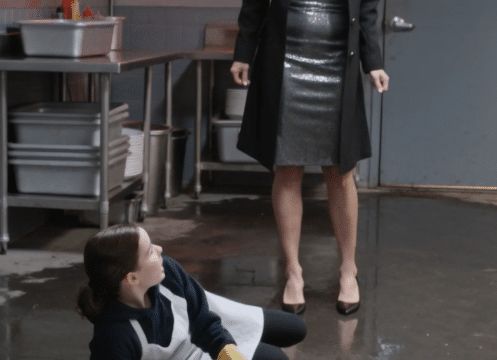
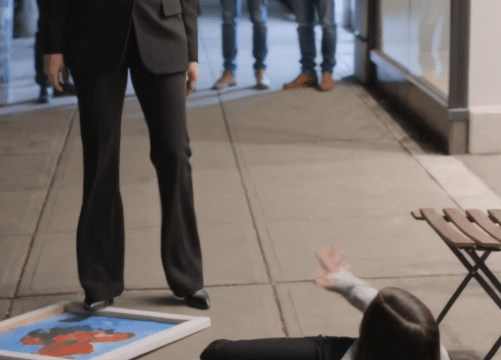
He set the bag on the shelf, stepped directly in front of Ethan, and kicked him forcefully in the chest.
Ethan stumbled backward and fell beside the shelf, his elbow striking the polished floor. A thin trace of blood appeared where his skin had scraped against the hard surface.
The lobby erupted in startled gasps.
Before Ethan could get up, Grant stepped closer and kicked him twice more in the back and ribs.
Ethan curled inward, struggling to catch his breath. With one trembling hand, he pointed weakly toward the security camera mounted above the delivery shelf.
Grant followed the gesture and sneered.
“Steal from someone poorer.”
The words hung in the air.
Nobody moved toward Ethan. A woman covered her mouth, and the resident with the gym bag retreated toward the elevators. Even the guard seemed momentarily frozen by the speed and brutality of what had happened.
Then the guard looked down at the tablet on his desk.
He had begun reviewing the camera footage.
His expression changed.
A moment later, the elevator doors opened, and a woman in a dark gray suit stepped into the lobby. She moved with the quiet certainty of someone who had never needed to raise her voice to command a room.
She went straight to Ethan first, placing herself between him and Grant.
Then she turned toward the man in the black suit.
“The camera caught him fixing your mistake.”
Grant’s expression shifted.
He looked at the camera above the shelf, then down at the delivery label.
For the first time, he seemed to realize that the story he had invented might not survive the evidence.
“My mistake?”
The woman didn’t answer immediately.
And that silence frightened Grant more than an accusation ever could.
Act II
The woman was Margaret Hayes, the owner of Whitmore House, one of the most expensive residential buildings in the city.
Most residents knew her name from formal notices, property documents, and the occasional appearance at a board meeting. She rarely visited the lobby without a specific reason, and she had little interest in performing authority for people who already knew she possessed it.
Grant knew exactly who she was.
He had spent years trying to cultivate a relationship with her, inviting her to private dinners and sending carefully worded messages whenever the building faced a decision that might affect his comfort or influence.
He had also made the mistake of assuming that because Margaret rarely intervened in everyday disputes, she was unaware of what happened inside her own property.
That assumption was about to cost him dearly.
But Margaret’s arrival was not the only unexpected part of the afternoon.
Ethan Cole had lived at Whitmore House for nearly three years. He occupied a modest apartment on one of the lower residential floors, where the rent was lower than the penthouses but still expensive enough to make budgeting a constant discipline.
He worked as a freelance architectural restoration consultant, specializing in old buildings that needed more than a cosmetic renovation. His job required patience, technical knowledge, and an eye for details other people overlooked.
He spent much of his time visiting construction sites, reviewing original plans, and helping owners preserve the parts of a building that gave it character.
His clothes reflected the practical side of that work. A jacket that could survive dust and rain mattered more to him than a designer label. Comfortable shoes mattered more than polished leather. He had no interest in looking wealthy simply to convince strangers that he deserved respect.
Grant had mistaken that indifference for weakness.
He had seen Ethan carry packages, hold doors for older residents, and return misplaced deliveries. Once, he had watched Ethan help a maintenance worker move a heavy box away from an elevator entrance.
Grant had interpreted every one of those moments as evidence that Ethan was unimportant.
He never considered that a person might choose to be helpful without needing recognition.
The truth was that Ethan had grown up in a family where small acts of responsibility were treated as ordinary obligations. His mother had worked as a school administrator, and his father had been a building engineer who taught him that a property was only as well cared for as the people inside it allowed it to be.
His father had often said that the condition of a building could tell you a great deal about the character of the people responsible for it.
A polished lobby meant very little if the people walking through it treated one another like obstacles.
Ethan had carried that lesson into adulthood.
He wasn’t wealthy by the standards of Whitmore House, but he was comfortable. He paid his bills, kept his commitments, and preferred spending money on things that mattered rather than objects designed to impress people he barely knew.
He had moved into the building because its location suited his work and because the apartment had enough space for the books, drawings, and architectural records he used for his projects.
He had never imagined that returning someone’s dinner would put him on the floor.
The delivery itself had been simple.
A driver had left Grant’s food on the twelfth floor instead of the fourteenth. Ethan had discovered the bag while returning from a site visit, noticed the name on the label, and carried it downstairs because he knew food left unattended could easily disappear or grow cold.
He hadn’t expected thanks.
He hadn’t even expected Grant to believe him immediately.
He had simply assumed that reading the label would resolve the confusion.
Instead, Grant had turned a minor inconvenience into an act of public violence.
At the security desk, the head guard continued reviewing the footage while Margaret stayed beside Ethan. She asked whether he could breathe comfortably and instructed the guard to call for medical assistance.
Ethan winced as he shifted, but he managed to nod.
Margaret then looked toward Grant.
“Step away from him.”
Grant obeyed, though the movement seemed to offend his pride.
“Margaret, this is being blown out of proportion,” he began. “I thought he was stealing from me.”
“You thought?”
“He was holding my food.”
“Because it had been delivered to the wrong floor.”
Grant’s eyes flicked toward the guard’s tablet.
He could see the problem now.
The footage would show Ethan approaching the shelf with the bag, checking its label, and placing it where it belonged. It would show Grant arriving, taking the bag, and attacking the man who had returned it.
There would be no convenient gap in the story.
No missing explanation.
No reasonable way to claim that the attack had been an accident.
Still, Grant believed he could talk his way out of it.
He had done so before.
He had no idea that Margaret had been investigating a much larger problem inside Whitmore House—and that the incident on the lobby floor had just connected two pieces of evidence she had been unable to explain.
Because Ethan Cole was not merely another resident whose name appeared on a lease.
He was connected to the future of the building in a way Grant had never imagined.
And Margaret had come downstairs carrying the information that would make that connection impossible to ignore.
Act III
Six months earlier, Margaret Hayes had begun reviewing the long-term management of Whitmore House.
The building was profitable, prestigious, and consistently in demand. Its public spaces were immaculate, its apartments commanded premium rents, and its residents expected a level of service that left little room for visible mistakes.
But Margaret had grown concerned about the way the property was being managed.
Complaints about maintenance were disappearing from the records. Service contracts had become unusually expensive. Several repairs had been approved without adequate documentation, and the staff who raised questions seemed to find themselves transferred to less desirable shifts.
At first, the problems appeared unrelated.
A faulty elevator sensor here. A delayed repair there. A maintenance invoice that seemed excessive, followed by another that carried nearly identical wording.
Margaret had asked the building’s management company for an explanation.
The answers were polished and unconvincing.
She suspected that someone had learned how to make the building look perfect while quietly allowing its internal systems to deteriorate.
That possibility mattered for more than financial reasons.
Margaret’s late husband had helped restore Whitmore House decades earlier, when it was an aging residential property with beautiful bones and an uncertain future. They had invested in its restoration because they believed an apartment building should provide more than an impressive address.
It should be safe, well maintained, and managed with integrity.
After his death, Margaret had continued to oversee the property. She had refused several lucrative offers to sell it to investors who planned to renovate the public spaces, increase rents sharply, and reduce the building’s long-term maintenance obligations.
She wanted Whitmore House to remain a place where people could build lives, not simply a trophy that changed hands whenever the market became attractive.
That commitment had made her cautious.
She knew a property could lose its character long before the paint began to peel.
The investigation eventually led her to a proposal for a major redevelopment and management restructuring. The documents were technically sophisticated, but several sections contained inconsistencies that suggested the person preparing them had little regard for the building’s actual condition.
Margaret hired an independent adviser to review the plans.
That adviser recommended someone whose professional background combined architectural restoration, property systems, and financial due diligence.
His name was Ethan Cole.
Margaret did not initially know that Ethan lived in Whitmore House. She knew him through his work, which had earned quiet respect among property owners who cared about preserving buildings rather than simply increasing their resale value.
Ethan’s firm had helped investigate a similar redevelopment proposal elsewhere, uncovering inflated repair estimates and maintenance work that had been billed but never properly completed.
He had a reputation for asking the questions other consultants overlooked.
When Margaret’s adviser approached him, Ethan agreed to review the Whitmore House plans under a confidential consulting arrangement.
He had already identified several concerns by the time the lobby incident occurred.
Some maintenance invoices appeared to charge the property for duplicate work. Other records listed repairs that did not match the building’s inspection history. A proposed service contract also contained language that would make it difficult for Margaret to replace the management company without incurring a substantial penalty.
None of those details, by themselves, proved deliberate misconduct.
But together, they justified a deeper examination.
Ethan had been comparing the documents against the building’s original plans and recent inspection reports when he began noticing a recurring name.
Grant Whitmore.
Grant was not the building owner, nor was he formally responsible for maintenance. But he had become an influential member of the residents’ advisory committee and had repeatedly promoted the same management company that Margaret’s review was examining.
He had argued that the company should receive a long-term contract without the usual competitive process.
He had also urged residents to support a redevelopment plan that would give certain floors priority access to new facilities and upgraded services.
The proposals benefited him directly.
Grant occupied a large apartment with a favorable lease arrangement negotiated years earlier. Under the new plan, his unit would receive improvements at a fraction of the cost other residents would pay.
He insisted that his involvement was simply a matter of protecting property values.
Ethan wasn’t convinced.
He had found correspondence suggesting that Grant had been given advance access to documents that other residents had not seen. He had also discovered that several maintenance complaints had been marked resolved before the work was completed.
The pattern raised serious questions about who had influenced the management decisions and why.
Margaret was waiting for additional verification before confronting anyone.
She did not want suspicion to become accusation without evidence. She wanted the original records, the vendor statements, and a clear account of who had authorized each decision.
Then the security footage from the lobby reached her.
The head guard had initially flagged the incident because Grant’s behavior appeared severe enough to require formal reporting. When the guard reviewed the recording, he noticed something that made the situation even more troubling.
Ethan had not merely returned the food to the shelf.
He had placed it beneath the correct apartment marker, ensuring that the bag was returned to the appropriate pickup area rather than left where another delivery could be confused with it.
Grant’s own name and apartment number were visible on the label.
The footage showed no theft, no confrontation initiated by Ethan, and no physical threat from the man in the navy jacket.
It showed Grant attacking a resident who had corrected a delivery mistake.
When Margaret watched the recording, she recognized Ethan.
She also recognized the significance of the timing.
The man Grant had treated as an insignificant stranger was the independent consultant helping her understand what had gone wrong inside her building.
Ethan had been examining the very records that Grant had spent months encouraging her to approve.
Margaret had not come downstairs intending to reveal a dramatic secret. She had come because a resident had been injured, and because the security footage needed to be preserved before anyone could interfere with it.
But once she understood what had happened, she knew the incident could no longer be treated as an isolated dispute.
Grant’s behavior raised a question that extended beyond the lobby.
If he was willing to attack someone over a delivery bag, what had he been willing to do when his financial interests were threatened?
Margaret approached him with the footage already reviewed and the independent investigation still underway.
She had the authority to protect the building, preserve its records, and ensure that the incident was handled properly.
What she did not yet know was how much Grant would reveal simply by trying to explain himself.
Act IV
“The camera caught him fixing your mistake.”
Margaret repeated the sentence slowly, allowing Grant time to look at the label on the bag.
His face had lost some of its color.
“You’re making assumptions,” he said.
“No. I’m looking at evidence.”
She turned toward the head guard, who confirmed that the footage had been preserved. He had also documented the incident and recorded the names of the witnesses who were willing to provide statements.
Grant looked from the guard to Margaret.
“I’m a resident here. You can’t treat me like a criminal because of a misunderstanding.”
Margaret’s expression did not change.
“Being a resident does not give you permission to assault another resident.”
“He was holding my food.”
“Because it was left on the wrong floor.”
Grant looked up at the security camera.
Then he looked down at the label again.
The mistake was unmistakable. His name was printed clearly, alongside the apartment number and delivery instructions. Ethan had done precisely what he said he had done.
Grant had no defense for the attack itself.
So he reached for the defense he understood best.
Money.
He reminded Margaret of the rent he paid, the fees he contributed, and the influence he had among other residents. He suggested that the building’s reputation could suffer if the incident became public. He even hinted that he knew people who would be interested in hearing about a management dispute if she chose to turn a simple altercation into a larger controversy.
Margaret listened without interrupting.
Then she looked at him.
“Are you threatening the building’s reputation to avoid answering for what you did?”
Grant hesitated.
“That isn’t what I said.”
“It is what you implied.”
She turned to the guard.
“Preserve every relevant recording and incident report. Make sure the appropriate authorities receive whatever documentation they request.”
The guard nodded.
Margaret then looked at the residents who had witnessed the attack.
“If you saw what happened, please provide an accurate statement. No one is asking you to speculate. Just tell the truth.”
The woman near the elevator stepped forward first.
Then the man with the gym bag.
Their willingness to speak seemed to unsettle Grant more than Margaret’s authority had.
He had expected fear to keep everyone silent.
Instead, people were beginning to describe exactly what they had seen.
An ambulance arrived, and the responders examined Ethan before helping him sit upright. He was shaken and in pain, but conscious. Margaret stayed nearby until they had assessed him, then made sure his contact information and the incident details were recorded.
Ethan glanced at the delivery shelf.
“Did the food stay there?”
The question startled the guard.
Even Margaret paused.
The bag was still sitting beside the shelf, its paper handles bent but intact.
“Yes,” the guard replied.
Ethan nodded faintly.
“Good. It wasn’t mine.”
Margaret studied him for a moment.
He had been assaulted, humiliated, and left on the floor, yet his first concern was still that the delivery should reach the person who had ordered it.
Grant heard the exchange.
Something in his expression tightened.
He could not understand why Ethan refused to behave the way Grant expected a victim to behave. There was no angry performance, no demand for special treatment, no attempt to turn the lobby into a stage.
Ethan simply wanted the situation handled correctly.
That quiet restraint made Grant’s behavior look even worse.
Margaret waited until Ethan had been taken for further medical evaluation before returning to the matter that had brought her to the building.
She asked Grant to attend a formal meeting regarding the incident and instructed the management company to cooperate with the ongoing review. She also made clear that no records related to the investigation were to be altered, deleted, or withheld.
Grant attempted to interrupt.
Margaret raised one hand.
“This conversation is over for now.”
He stared at her.
“You’re choosing him over me?”
“I’m choosing the evidence.”
For several seconds, Grant looked as though he might argue again.
Then he noticed the head guard watching him, the residents still standing near the elevator, and the camera above the delivery shelf.
He had spent years assuming that status could bend any situation toward him.
Now every object in the lobby seemed to be recording the opposite lesson.
The delivery label documented the mistake.
The camera documented the correction.
The witnesses documented the assault.
And Margaret’s presence meant the incident could not simply disappear into an internal complaint that no one ever followed up on.
Grant left the lobby under the watch of the building’s staff, but his problems were only beginning.
The next morning, Margaret’s independent adviser presented the preliminary findings of the management review. The records showed inconsistencies serious enough to warrant further investigation, including questionable invoices and decisions that appeared to have bypassed normal oversight.
Grant’s name appeared in correspondence connected to the disputed proposals.
That did not, by itself, establish criminal wrongdoing. Margaret insisted that the findings be examined properly, with the relevant documents preserved and the people involved given an opportunity to respond.
But Grant could no longer rely on his reputation to make the questions disappear.
His influence inside the building was suspended from the review process. The proposed long-term management contract was put on hold, and an independent audit was commissioned.
For the first time, people began asking why Grant had been so determined to push the agreement through.
The lobby attack had not proven every suspicion about him.
It had done something almost as consequential.
It had stripped away the assumption that he deserved unquestioned trust.
And once that assumption was gone, the documents could finally speak for themselves.
Act V
Ethan returned to Whitmore House several days later.
His injuries were painful, but he was recovering. The incident had left him with an ache that lingered when he moved too quickly and a memory of the lobby floor that surfaced whenever he approached the delivery shelf.
He had never wanted to become the center of a dispute.
He had certainly never expected a misplaced dinner to lead to a formal investigation of the building’s management.
Yet he refused to let the attack determine how he would live there.
On his first evening back, he entered the lobby carrying a small grocery bag. The head guard rose from his desk.
“Good to see you back, Mr. Cole.”
Ethan smiled.
“Good to be back.”
The guard looked as if he wanted to say more, perhaps to apologize for freezing during the attack. Ethan recognized the expression.
“You didn’t know what was happening,” he said. “Just make sure the footage stays safe.”
“It will.”
Ethan nodded and headed toward the elevators.
The delivery shelf had been reorganized. Each floor now had a clearly marked section, and the building had introduced a more reliable system for handling packages left at the wrong address.
It was a small improvement, but a practical one.
Margaret had insisted that the building review its procedures rather than treating the incident as nothing more than a resident dispute. The new system was part of a broader effort to improve accountability among staff and contractors.
The management audit continued.
Over the following weeks, the independent reviewers identified several questionable charges and documentation gaps that required further examination. The management company was asked to provide additional records, and decisions involving the disputed contracts were postponed until the review could be completed.
Grant was no longer able to steer those decisions from his position on the residents’ advisory committee.
The consequences were not delivered through a theatrical public punishment. They came through ordinary procedures that he had assumed would never apply to someone like him.
His role in the committee’s deliberations was restricted while the relevant matters were examined. His conduct in the lobby was addressed separately through the appropriate legal and building processes.
He faced questions he could not answer with an expensive suit or a familiar name.
And the people who had once avoided challenging him began speaking more openly.
Some described complaints they had previously withdrawn because they feared making an enemy of an influential neighbor. Others recalled times when Grant had used his status to pressure staff into prioritizing his requests.
Their accounts did not automatically prove every allegation, and Margaret refused to treat them as substitutes for evidence.
But the atmosphere changed.
Residents began to understand that courtesy did not require submission, and that a person who paid more money was not entitled to demand more dignity than everyone else.
As for Ethan, he returned to his consulting work.
He completed his review of the redevelopment proposal and submitted his findings through the proper channels. He identified the discrepancies he could substantiate, distinguished them from questions that required further investigation, and recommended safeguards to prevent similar problems in the future.
Margaret valued that precision.
She offered him the opportunity to continue advising on the building’s restoration plans, but Ethan insisted that his work remain independent. He did not want the lobby incident to become a reason for anyone to question his professional judgment.
Margaret agreed.
“You shouldn’t have to earn the right to be treated fairly by doing me a favor,” she told him.
Ethan considered that.
“Neither should anyone else.”
The answer stayed with her.
For years, Margaret had believed that responsible ownership meant protecting a building’s value, maintaining its structure, and ensuring that the people entrusted with its management followed the rules.
All of that mattered.
But Ethan’s answer reminded her that the character of a property was also shaped by the way people treated one another in its most ordinary spaces.
A lobby was not simply marble, glass, and carefully arranged lighting.
It was where residents crossed paths, where delivery workers waited, where employees did their jobs, and where a stranger might discover that something had been left in the wrong place.
The real test of a community was what happened next.
Grant had failed that test spectacularly.
Ethan had passed it without knowing anyone was watching.
Several weeks after the incident, Margaret stopped by the delivery shelf during a routine visit. The lobby was busy, but calm. A courier was sorting packages while the guard helped an older resident arrange a grocery delivery.
A paper food bag sat beneath the marker for the tenth floor.
A moment later, a young resident approached, checked the label, and carried it toward the elevators.
No one accused him of stealing.
No one demanded to see his credentials.
He simply corrected the mistake and went on his way.
Margaret watched him disappear.
Then she looked up at the security camera above the shelf.
It had been installed to protect residents and staff, to document incidents, and to establish what had happened when accounts conflicted. For Grant, it had become an unwelcome witness.
For Margaret, it had revealed something more important.
The camera had not created the truth.
It had simply made it harder for power to conceal it.
She thought of Ethan lying on the polished floor, pointing toward the lens even while he struggled to breathe. He had understood that the truth mattered, even when he had no reason to believe anyone would stand up for him.
She thought of the delivery label, his plain sneakers, and the food bag he had carried downstairs because it belonged to someone else.
And she thought of Grant’s final expression when she told him what the footage showed.
“My mistake?”
Yes.
It had been his mistake to assume that a modest jacket meant a powerless man. His mistake to confuse a delivery error with an act of theft. His mistake to believe that wealth could turn cruelty into authority.
But the deepest mistake had come long before the attack.
Grant had built his world around the belief that people mattered in proportion to what they could offer him.
Ethan had lived by a different principle.
Do the right thing, even when nobody is watching.
That was why he had returned the bag.
That was why he had pointed toward the camera.
And that was why, when the owner of the building finally arrived, the most important person in the lobby was not the man wearing the expensive suit.
It was the man he had tried to make invisible.
The food had been delivered to the wrong floor.
Ethan had corrected it.
Grant had mistaken kindness for weakness and turned a small inconvenience into a public act of violence.
But the camera caught everything.
And when the truth finally reached the person with the authority to act, Grant discovered that the one thing he had always trusted—his own importance—was not nearly as powerful as he believed.
Because the man he kicked to the floor was the very man helping the building’s owner uncover what had been happening beneath its polished surface.