Act I
“ I forgot my wallet. I’m almost done.”
Emily Brooks kept her eyes on the coins scattered across the checkout counter, counting them one at a time while the cashier waited patiently. Beside the coins sat a small bottle of medicine and a carton of milk, the two things she had come into the mini-mart to buy before heading home.
Behind her, a woman in a white coat and red dress let out an irritated sigh.
Emily glanced over her shoulder.
“I’m sorry. I just need another second.”
The woman lifted a platinum credit card between two perfectly manicured fingers.
“Trash. Coins don’t belong in this neighborhood.”
The words were loud enough for everyone in line to hear.
Emily felt the cashier’s eyes flicker toward her, then quickly return to the register. Two residents standing near the refrigerated drinks exchanged uncomfortable looks. Nobody said anything.
The woman was Vanessa Sterling, a forty-three-year-old resident whose name was familiar to nearly everyone in the upscale community. She drove an expensive car, wore designer clothes, and treated ordinary inconveniences as personal insults.
She also had a reputation for making sure other people knew exactly how much more important she believed herself to be.
Emily turned back to the counter.
“I didn’t bring my wallet,” she explained. “I have enough for these. I’m not asking anyone to pay for them.”
Vanessa laughed.
“Do you hear yourself? You’re standing here holding up an entire line because you can’t manage to bring a wallet.”
Emily’s cheeks warmed.
She had not planned to forget it. She had rushed out after receiving a message from her elderly father, who had called to say that his medication was running low and that he had barely eaten that morning. Emily had grabbed her keys, walked to the nearest shop, and only realized her mistake when she reached the register.
She had enough coins in her coat pocket to cover the purchase.
That should have been the end of it.
“I’m almost finished,” she repeated quietly.
Vanessa stepped closer.
“Pay like you belong here.”
Emily slowly lifted her head.
“I live here.”
For one brief moment, the two women stared at each other.
Vanessa seemed genuinely offended that someone dressed in a plain gray cardigan, a simple black dress, and low shoes had answered her without apologizing.
“People like you are exactly why standards fall,” Vanessa said. “You move into a nice community and think that means you can behave however you want.”
Emily looked at the medicine.
“My father needs this.”
“Then you should have planned better.”
“I did plan. I just forgot my wallet.”
Vanessa’s expression sharpened.
The cashier tried to keep counting the coins, hoping the transaction would end before the argument became worse. But Vanessa had stopped caring about the medicine, the milk, or the line behind her.
She wanted Emily to feel small.
She wanted everyone watching to understand who she believed had the right to stand at that counter.
Emily reached for the last coin.
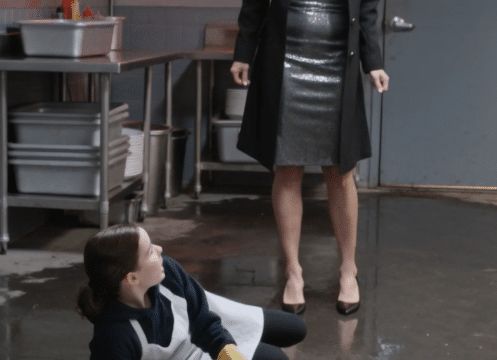
Vanessa suddenly moved behind her, took a step back, and kicked her forcefully in the back.
Emily lurched forward into the counter’s edge before falling to the floor. The milk tipped onto its side, and the medicine slid dangerously close to the edge of the checkout surface. A thin trace of blood appeared on Emily’s forearm where it had scraped against the counter.
She gasped, struggling to catch her breath.
Before she could get up, Vanessa stepped closer and kicked her twice more in the back and ribs.
The cashier recoiled behind the register.
A man waiting near the drinks covered his mouth. An older woman backed away from the counter, her hand pressed against her chest.
Emily curled protectively toward the medicine, trying to keep it from sliding off the counter and landing beneath someone’s feet.
Vanessa looked down at her.
“Pay like you belong here.”
The store fell silent.
Then a door behind the counter flew open.
A man in a white shirt, dark pants, and a black apron hurried out from the storage room. He saw Emily on the floor, the fallen milk, and the medicine sitting near the edge of the counter.
His face changed instantly.
He moved between the two women, shielding Emily from Vanessa, then turned toward the woman in the white coat.
“That register is still open because of her.”
Vanessa blinked.
The store owner looked at her as if she had just made a mistake whose consequences she could not yet comprehend.
He didn’t explain himself.
He didn’t need to.
Vanessa glanced at the register, then at the man standing between her and the injured woman.
For the first time, her certainty began to fracture.
“Because of her?”
And suddenly, the few coins on the counter seemed like the least important thing in the room.
Act II
Vanessa Sterling had spent years believing that money made life simple.
If a service was inconvenient, she complained until someone fixed it. If an employee failed to meet her expectations, she demanded a manager. If a neighbor disagreed with her, she reminded them that people paid a great deal to live in the community and should behave accordingly.
She rarely considered the possibility that someone might be struggling.
In her mind, hardship was usually the result of poor planning, laziness, or a lack of ambition. Anyone who had less than she did must have made inferior choices, and anyone who questioned her assumptions was probably trying to excuse their own failures.
That worldview had followed her into the mini-mart.
The shop stood near the entrance of an upscale residential development, tucked between a concierge office and a small landscaped courtyard. It sold groceries, toiletries, household essentials, and the everyday items residents often needed without wanting to drive to a supermarket.
The owner, Daniel Mercer, had run it for eleven years.
Unlike the glossy retail spaces in the nearby shopping district, Daniel’s store was modest. The shelves were tightly packed, the checkout counter had a few scratches, and the refrigerator occasionally made a rattling sound that he kept promising to repair.
But the shop had become an important part of the neighborhood.
Daniel knew which residents worked night shifts, which elderly customers preferred their groceries delivered, and which parents came in late after realizing they had run out of milk. He remembered the names of regular customers and often noticed when someone who usually visited every week suddenly stopped appearing.
He did not build his business by making people feel wealthy.
He built it by making them feel welcome.
Emily Brooks had become one of his regular customers several years earlier.
At twenty-seven, she worked as a medical billing specialist at a nearby clinic. Her salary was steady, but her finances had become increasingly complicated after her father, Robert, suffered a series of health problems that made living alone difficult.
Robert had always been fiercely independent. After retiring from his job as an electrician, he had spent years repairing things around the house, volunteering at a community center, and helping neighbors with small projects.
He hated asking for assistance.
When his health began to decline, Emily took on more responsibility without making a public announcement about it. She arranged appointments, helped with household expenses, and visited him whenever her schedule allowed.
Some months were manageable.
Others were not.
An unexpected prescription cost, a utility bill, or a missed shift could leave her calculating every purchase until payday. She had learned to plan carefully and make small sacrifices without allowing her father to feel that he had become a burden.
The morning of the incident, she had received a call from Robert saying that his medicine was running low.
Emily left home in a hurry.
She had intended to use her debit card, but her wallet remained on the kitchen table beside a stack of unopened mail. By the time she realized her mistake, she was already at the register.
The coins in her coat pocket were enough to cover the purchase.
She was embarrassed, but not desperate. She expected the cashier to count the money, hand her the bag, and let her go home.
She never expected to be attacked.
Daniel, meanwhile, had been in the storage room checking an inventory discrepancy when he heard the commotion. At first, he assumed that two customers were arguing over the line.
Then he heard the impact against the counter.
By the time he reached the checkout area, Emily was on the floor.
The sight had stopped him cold.
He recognized her immediately. He knew she was the kind of customer who apologized when someone else bumped into her, who returned shopping baskets rather than leaving them in the parking lot, and who had once stayed after closing to help him gather groceries scattered by a broken paper bag.
But the recognition that mattered most was something Vanessa could not possibly have understood.
Emily had been part of Daniel’s life long before she ever entered his store.
And the story of why his business survived its most difficult years began with a night when he had nearly lost everything.
Act III
Eleven years earlier, Daniel Mercer had been close to closing the mini-mart for good.
He had opened the shop with money borrowed from his savings and a small loan from a local lender. For the first few years, the business grew slowly but steadily. Residents liked having a place nearby where they could buy bread, milk, batteries, and medicine without leaving the development.
Then a construction project blocked the road leading to the shop.
Customers began shopping elsewhere. Delivery costs increased, and a refrigeration failure spoiled a significant amount of inventory. Daniel used his savings to replace the equipment, expecting business to recover once the road reopened.
It didn’t recover quickly enough.
Bills accumulated.
The landlord refused to delay rent indefinitely, and Daniel’s lender began pressing him for payments he could no longer comfortably make. He worked longer hours, cut his own expenses, and tried to convince himself that another good month would solve everything.
Then his mother became seriously ill.
Daniel spent his days running the store and his evenings visiting her. His attention was divided, his sleep deteriorated, and every unexpected expense felt like another door closing.
One cold evening, after a long day at the hospital, he returned to the shop and found an overdue notice tucked beneath the door.
He sat behind the counter and stared at it for nearly an hour.
He had reached the point where keeping the business open meant risking what little he had left. Closing it would mean losing the livelihood he had spent years building, but continuing might leave him with debts he could never repay.
He was preparing to make that decision when Emily’s father walked in.
Robert Brooks had known Daniel for years. He had helped repair the shop’s electrical wiring when Daniel first opened it, refusing to accept the full payment because he knew how difficult the first few months could be.
That evening, Robert noticed the overdue notice beside the register.
Daniel tried to hide it.
Robert asked what was wrong.
Daniel finally told him.
He described the debt, the falling sales, the damaged inventory, and the possibility that the store would close within weeks. He spoke with the exhausted honesty of a man who had run out of ways to pretend he was fine.
Robert listened without interrupting.
Then he asked one question.
“How much time do you need?”
Daniel shook his head.
“It’s not that simple.”
“I’m not asking whether it’s simple.”
Robert didn’t have a fortune. He was a working electrician who had spent most of his life saving carefully and helping people when he could. But he understood the difference between a business that had failed and a business that had been pushed to the edge by circumstances.
He also understood what the store meant to the neighborhood.
Older residents relied on it. Parents stopped there on their way home from work. People who could not easily travel to a supermarket used it for necessities.
If Daniel closed, the community would lose more than a convenient place to shop.
Robert spoke to a few people he trusted and helped arrange a short-term financial bridge. He contributed what he could, connected Daniel with a local small-business adviser, and helped him negotiate a more realistic repayment schedule.
Other residents stepped in, too.
A retired accountant volunteered to review the shop’s expenses. A local supplier agreed to adjust delivery terms temporarily. Neighbors who had been buying only occasional items began making a point of shopping there regularly.
No single person rescued the business alone.
But Robert had been the first to refuse to let Daniel face the crisis in silence.
And his help gave Daniel enough time to rebuild.
Within a year, the store was stable again. Daniel repaid the money he had borrowed, honored the agreements he had made, and slowly restored his savings.
He never forgot who had stood beside him.
Years later, when Robert’s health began to decline, Daniel tried to return the kindness in small, practical ways. He kept certain essentials in stock, checked in when he saw Emily shopping, and occasionally arranged for groceries to be delivered when Robert could not leave home.
Emily never asked him to do more than he could afford.
In fact, she often insisted on paying even when Daniel offered a discount.
“Dad helped you when you needed it,” she once told him. “That doesn’t mean you have to spend the rest of your life paying us back.”
Daniel had smiled.
“Maybe not. But it means I remember.”
What Emily didn’t know was that Daniel had kept the original paperwork from those difficult years. The loan restructuring documents, the handwritten repayment schedule, and a letter Robert had written to the small group of residents who helped save the shop were stored in a folder in his office.
The letter had never been meant for public attention.
It simply thanked everyone who had believed that a neighborhood business was worth saving.
Over time, Daniel came to think of the store as a promise: that the people who had helped him would always have a place there, and that nobody should feel ashamed for needing something small.
He had quietly maintained that principle for years.
If an elderly customer came up short by a few dollars, he sometimes let them settle the difference later. If a parent needed milk before payday, he found a practical solution when he could. He never advertised those moments or treated them as favors that entitled him to gratitude.
The shop was a business.
But it was also part of the community’s safety net.
And the person who had helped make that possible was Robert Brooks.
The woman Vanessa had kicked to the floor was his daughter.
When Daniel saw Emily lying beside the medicine and milk, he was not simply watching a customer get hurt.
He was watching the daughter of the man who had helped save everything he had built.
Yet even that was not the whole reason he spoke the way he did.
Because Daniel’s decision to keep the register open had been shaped by something else Robert taught him: a business was not truly successful if the people who needed it most were afraid to walk through its doors.
And Vanessa had just demonstrated exactly what happened when someone forgot that.
Act IV
Daniel did not rush toward Vanessa.
He stayed beside Emily until he was certain she was protected, then asked the cashier to call emergency services. He told the other customers to give her space and carefully moved the medicine away from the edge of the counter.
Only then did he stand.
Vanessa held her platinum card as if it were a shield.
“What’s the problem?” she demanded. “She was holding up the line.”
Daniel stared at her.
“She forgot her wallet.”
“She shouldn’t be shopping if she can’t pay properly.”
“She had enough money to pay for what she needed.”
Vanessa glanced at the coins scattered across the counter.
“It’s ridiculous.”
Daniel’s expression hardened.
“You kicked a woman because she was counting change.”
“She was disrespectful.”
“She was trying to buy medicine.”
Vanessa looked around, apparently expecting the customers to support her. She was used to being treated as someone whose complaints deserved immediate attention.
Instead, the cashier stood pale and silent behind the register. The older woman near the refrigerator had tears in her eyes. A young man waiting by the entrance was already offering to give a statement about what he had witnessed.
Vanessa’s confidence began to waver.
“You’re taking her side because you know her,” she said.
Daniel took a breath.
“I know her father.”
He let the words hang there.
Vanessa frowned.
“What does that have to do with anything?”
Daniel turned briefly toward the register.
“That register is still open because of her.”
For a moment, Vanessa seemed unable to understand the sentence.
She looked at the cash drawer, then at Daniel, as if he had suggested that Emily had secretly purchased the entire store.
“Because of her?”
Daniel didn’t answer immediately.
He had spent years choosing not to publicize the details of his financial crisis. The residents who had helped him had never asked for praise, and Robert had been especially firm that no one should be made to feel indebted for receiving help.
But Vanessa’s question revealed something more troubling than ignorance.
She genuinely believed that a person’s value could be determined by the amount of money visible in their hands.
Daniel looked toward the cashier.
“Please preserve the transaction record and the security footage.”
Then he turned back to Vanessa.
“You need to step away from her.”
Vanessa lifted her chin.
“You can’t tell me what to do.”
“In this store, I can tell you that you are not allowed to attack another customer.”
“You’re going to ban me over an argument?”
“This wasn’t an argument.”
He gestured toward the counter, where the coins still lay beside the medicine.
“You saw someone counting change and decided she deserved to be hurt.”
Vanessa’s mouth opened, but no words came.
Daniel continued.
“I built this business because people in this community helped me when I had almost nothing left. Robert Brooks was one of those people. He stood beside me when I was facing debts I couldn’t pay and a store I might lose.”
Vanessa glanced toward Emily, who was being helped by the emergency responders arriving at the entrance.
Daniel’s voice grew quieter.
“His daughter is standing on this floor because she was trying to buy medicine. And you treated her as if she had no right to be here.”
The customers remained silent.
Daniel didn’t describe Robert’s contribution as a grand act of charity. He explained that Robert had helped organize support, contributed money he could afford, and connected him with people who helped the business survive.
He made it clear that the store’s recovery had been a community effort.
But Robert had started the chain of events.
And Emily had continued the spirit behind it.
She had never demanded repayment. She had never reminded Daniel of the debt her father had helped him escape. She had simply treated him, his staff, and the store with the same respect she showed everyone else.
Daniel had watched her do that for years.
Now he was watching Vanessa try to turn a moment of financial embarrassment into proof that Emily did not belong.
“You don’t get to decide who deserves respect based on the contents of their wallet,” he said.
Vanessa glanced at the other customers again.
She seemed to be searching for someone who would rescue her from the moment.
Nobody did.
The young man by the entrance gave his name to the responding officers. The cashier confirmed what she had seen. Security footage captured the incident, and Daniel made clear that he would preserve it and cooperate with the investigation.
Vanessa tried to insist that the situation had been exaggerated.
But the evidence was not a rumor, and the witnesses were not people she could dismiss with a complaint to management.
Her platinum card remained clutched in her hand.
It could pay for groceries, medicine, and a hundred other things.
It could not make the footage disappear.
Nor could it erase the fact that she had attacked someone who had done nothing more than count a few coins.
As the responders attended to Emily, Daniel picked up the fallen carton of milk and set it aside. He placed the medicine safely on the counter, then gathered the coins without disturbing the evidence.
The scene was almost unbearably ordinary.
A carton of milk. A small bottle of medicine. A few coins.
And a woman who had believed those coins gave her the right to judge another person’s worth.
Vanessa looked at Daniel one last time.
“Are you really going to make this a big deal?”
Daniel’s reply was simple.
“You already did.”
For the first time, she understood that the store owner was not going to protect her from the consequences of her own actions.
But she still didn’t understand how much she had revealed about herself.
That part would become clear when the neighborhood learned the full story.
Act V
The incident spread through the residential community within days.
Not because Daniel encouraged gossip, and not because Emily wanted her private circumstances discussed. The people who had witnessed the attack were simply unwilling to pretend they had seen nothing.
The security footage was preserved. Statements were provided to the appropriate authorities, and the assault was handled through the relevant legal process. Daniel also documented what had happened inside his business and made clear that violence against customers would not be tolerated.
Vanessa attempted to frame the incident as a disagreement that had spiraled out of control.
The recording told a different story.
Emily had been standing at the register, counting coins. Vanessa had approached her from behind and attacked her. The evidence supported the witnesses’ accounts, leaving little room for the claim that Emily had initiated a physical confrontation.
The community’s response was not a sudden campaign to punish Vanessa socially.
It was something quieter and more consequential.
People stopped making excuses for her.
Residents who had previously endured her complaints began documenting incidents rather than apologizing for things they had done nothing wrong to cause. The building’s management was informed of the matter, and any questions about her conduct as a resident were handled under the applicable community rules.
Daniel made his own decision about the store.
Vanessa would not be permitted to use her wealth or status to intimidate staff or customers. Any restrictions on her access would be handled in accordance with the store’s policies and applicable law, but she would not be allowed to dictate how employees treated people who were struggling.
The store remained open.
The register continued to ring.
Residents still came in for milk, bread, batteries, and the small necessities that made daily life easier.
But the incident changed the way people thought about the shop.
Many had known Daniel as a friendly owner who remembered their names. Fewer had understood how close he had once come to losing everything or how much Robert Brooks had done to help him survive.
Daniel had never wanted the story to become a public spectacle.
Still, when residents asked why he had reacted so strongly, he decided to tell them enough to understand.
He spoke at a small community gathering held in the courtyard several weeks later. Emily attended with her father, who had recovered enough to leave home for the afternoon.
Daniel stood beside a table with a folder of old papers in front of him.
He showed the residents the repayment schedule from the year his business nearly collapsed. He explained how Robert had helped him find a way through the crisis and how other neighbors had contributed time, advice, and money.
He did not claim that Robert had saved the store single-handedly.
He emphasized that the business had survived because people chose to help one another.
Then he read a short passage from Robert’s old letter, written to the neighbors who had stepped forward during those difficult months.
It thanked them for remembering that a struggling business was not merely a balance sheet. It was a place where people bought the essentials they needed, where employees earned their wages, and where neighbors could find a familiar face when the day had gone wrong.
When Daniel finished, the courtyard was silent.
Emily looked at her father.
Robert stared down at his hands, embarrassed by the attention.
“You didn’t have to keep all that,” he murmured.
Daniel smiled.
“I know.”
“Then why did you?”
“Because I didn’t want to forget what people did for me.”
Robert shook his head, but there was warmth in his expression.
“You paid it back.”
Daniel glanced toward the store.
“Not completely.”
Emily reached for her father’s hand.
She understood what Daniel meant. Her father had never thought of helping him as an investment. He had done it because someone was in trouble and he could see a way to help.
Daniel had spent eleven years trying to honor that choice.
And in doing so, he had built something that was worth more than the shop itself.
He had built a place where people could enter without needing to prove they were rich enough to belong.
After the gathering, Emily returned to the mini-mart with her father.
She wore the same simple gray cardigan, though the weather had warmed enough that she no longer needed it. Robert walked slowly beside her, pausing once to greet an elderly neighbor near the entrance.
Inside, the cashier smiled when she saw them.
“Good to see you, Emily.”
Emily smiled back.
She approached the counter and placed a carton of milk beside a small package of groceries. This time, her wallet was in her hand.
For a moment, she remembered the coins scattered across the counter, Vanessa’s voice, and the terrible shock of being kicked forward without warning.
The memory still hurt.
But it no longer defined the store.
Daniel emerged from the storage room carrying a box of supplies. When he saw Robert, he set it down and came over to greet him.
The two men exchanged a few quiet words before Daniel looked at Emily.
“How are you feeling?”
“Better,” she said. “Thank you.”
He nodded toward the medicine shelf.
“Everything you need is here?”
“Yes.”
“Good.”
There was no grand speech. No announcement that Emily was special. No attempt to turn her into a symbol while she was simply trying to get through an ordinary day.
Daniel treated her as he always had: with respect.
That was what Vanessa had failed to understand.
Respect was not a prize reserved for the people with the most expensive possessions. It was not a privilege that could be withdrawn when someone forgot a wallet or counted out coins.
It was the starting point.
Emily paid for her groceries and tucked the receipt into her bag. Before leaving, she paused beside the counter.
“My dad says you still owe him a coffee.”
Daniel laughed.
“Tell him he’s welcome to one whenever he wants.”
“He says you should stop pretending you don’t remember the exact amount.”
“I remember every dollar.”
Robert called from the doorway, “Then you can start with the coffee.”
For the first time since the attack, Emily laughed without forcing herself to.
The sound seemed to loosen something in the room.
Customers went back to choosing their groceries. The cashier returned to work. Daniel lifted his box and headed toward the shelves.
Life continued, not because the assault had been insignificant, but because the people who had witnessed it refused to let cruelty become the defining feature of their community.
Vanessa had entered the store believing that money determined who deserved patience.
She had seen a woman counting coins and decided that the sight offended her.
She had mistaken a temporary moment of embarrassment for a permanent measure of someone’s worth.
What she never understood was that Emily’s value had nothing to do with the coins on the counter. It was reflected in the way she cared for her father, the way she treated people, and the quiet dignity with which she handled a difficult moment.
And Daniel’s business had survived because Robert had recognized something Vanessa could not see.
A person in trouble was not a person beneath you.
A struggling business was not a business without value.
And a few coins did not make someone less deserving of kindness.
The store’s register remained open because a community had chosen to keep it open.
Daniel had never forgotten that.
Now, neither would the people who had watched him stand between Emily and the woman who tried to humiliate her.
The next time someone entered the mini-mart counting change, no one would need to explain why they belonged there.
The door would open.
The cashier would count the money.
And the person standing at the counter would be treated like a human being.
Because the most revealing moment in that store had never been the sound of coins hitting the register.
It was the moment Vanessa Sterling discovered that the woman she considered beneath her had helped preserve something she could never buy.
A place where people mattered more than money.