Act I
“It’ll be ready in two minutes.”
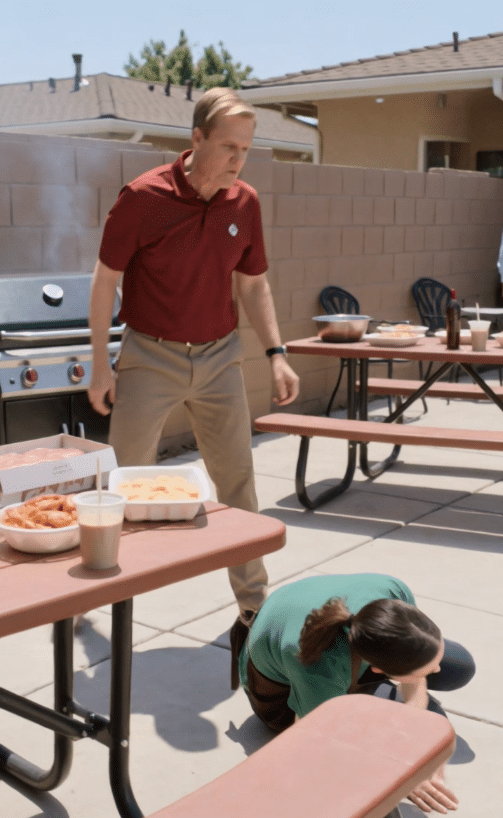
Sarah Mitchell stood beside the outdoor grill in the apartment complex’s shared BBQ yard, one hand resting on the counter and the other holding a pair of tongs. Three simple portions of food were cooking over the heat, and a row of paper plates sat on the picnic table nearby, waiting for the children who had gathered with their families that afternoon.
Then a man slammed a box of expensive meat onto the table.
“Trash. Shared grills are not for people like you.”
Sarah turned.
The man standing in front of her was Richard Hayes, a forty-five-year-old resident known for his luxury watch, expensive clothes, and habit of treating shared spaces as if they belonged exclusively to him. His red polo shirt was immaculate, his khaki pants were pressed, and his expression suggested that waiting two minutes was an insult no reasonable person should have to endure.
Sarah kept her voice steady.
“I’m almost finished. You can use the grill right after me.”
Richard stared at the food on the grill, then at the plates arranged for the children.
“I’m not talking about waiting.”
“Then what are you talking about?”
He stepped closer.
“Look at this setup. Cheap food, paper plates, people taking over the whole yard. This place is supposed to be a premium community.”
Sarah glanced at the picnic tables. Families had gathered around them, some with homemade dishes, others with drinks and snacks bought on the way home from work. Children sat safely away from the grill, laughing over a board game while their parents talked.
It was an ordinary afternoon.
That was what made Richard’s contempt so startling.
Sarah wore a green T-shirt beneath a brown apron, with jeans that had seen years of cooking, cleaning, and running errands. She had arrived early to prepare food for several children whose parents were working late or struggling to stretch their grocery budgets until payday.
She wasn’t hosting a private party.
She was making sure a few families had something warm to eat.
“There’s plenty of room,” she said. “Nobody’s stopping you from using the grill.”
Richard’s face reddened.
“You don’t get to decide how this place operates.”
“I’m not deciding anything. I’m just asking you to wait two minutes.”
He slammed his palm against the picnic table.
Several children turned toward the noise.
Sarah instinctively glanced at them before looking back at him.
“Please don’t do that. You’re frightening them.”
Richard followed her gaze and gave a humorless laugh.
“Then feed your kids somewhere else.”
The words fell into the yard like a stone through glass.
Sarah’s expression changed.
“They aren’t all my children.”
“I don’t care whose children they are.”
“They’re children,” she replied. “And they’re hungry.”
For a moment, Richard seemed unable to process the answer. He had expected embarrassment, perhaps an apology, maybe even a hurried attempt to clear the grill so he could claim it.
Instead, Sarah stood her ground without raising her voice.
He interpreted her calmness as defiance.
“You know what your problem is?” he demanded. “People like you move into a nice building and immediately start acting like you own the place.”
Sarah set the tongs down.
“I live here. I follow the rules. And the grill is shared.”
Richard stepped directly in front of her.
“Not when I’m using it.”
She looked at him in disbelief.
“You haven’t even started cooking.”
That was the last thing he wanted to hear.
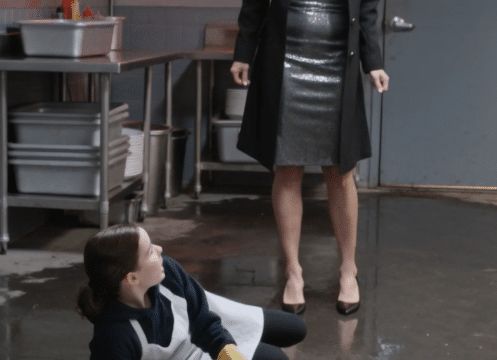
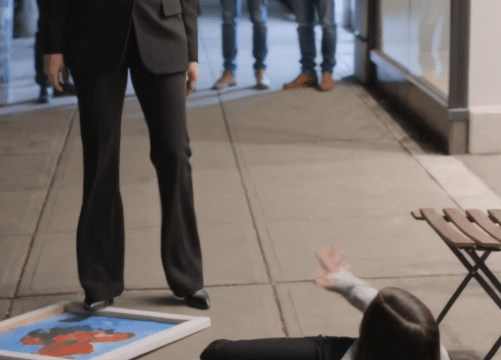
Richard kicked her directly in the chest.
Sarah fell beside the picnic table, catching herself badly as her elbow scraped the ground. One of the paper plates slid beneath a bench, and the tongs clattered across the concrete.
Before she could rise, Richard stepped closer and kicked her twice more in the back and ribs.
The families froze.
A woman covered her mouth. A father pulled his young son away from the table. One of the children began to cry as Sarah curled on the ground, trying to shield herself and avoid knocking over the plates of food.
Richard stood over her, breathing hard.
“Feed your kids somewhere else.”
Nobody moved.
For a terrible few seconds, the only sounds were the faint hiss of the grill and the frightened breathing of people who had just watched an ordinary disagreement turn into something unforgivable.
Richard adjusted his luxury watch.
He looked at the families as though he expected them to apologize for witnessing the scene.
Then a woman in a simple black suit entered the BBQ yard.
She took one look at Sarah on the ground, the scattered plates, and the children huddled behind their parents.
Her expression went cold.
She crossed the yard, positioned herself between Richard and Sarah, and turned toward the man who had just attacked a neighbor in front of an entire community.
“Every family here is eating because of her.”
Richard blinked.
The property manager looked past him toward the silent families.
Not one person looked surprised by her words.
In fact, several of them looked as though they had been waiting years for someone to say them aloud.
Richard’s confidence faltered.
“Because of her?”
For the first time that afternoon, he had no idea who he had just attacked.
And the truth was far bigger than a barbecue grill.
Act II
Richard Hayes had a particular theory about life.
He believed people revealed their worth through what they could afford, and he had spent years arranging his world to prove himself right.
His apartment had imported furniture. His car occupied one of the most convenient parking spaces in the complex. He ordered expensive groceries and complained when deliveries arrived a few minutes late.
He never described himself as arrogant.
He called himself discerning.
In his mind, there were people who improved a community and people who dragged it down. He believed he belonged in the first category and that everyone else should be grateful to live among people like him.
The shared BBQ yard had become one of his favorite battlegrounds.
He disliked residents who brought inexpensive food, families who stayed longer than he considered appropriate, and anyone who used the outdoor facilities without appearing to match his idea of a luxury lifestyle.
He had complained about children playing near the picnic tables, demanded that residents remove decorations he considered unattractive, and repeatedly challenged people who arrived at the grill before him.
Most neighbors had learned to avoid confrontation.
Some moved their gatherings to different times. Others simply let Richard have his way.
He mistook their exhaustion for respect.
Sarah Mitchell, however, had never been particularly impressed by expensive watches or polished cars.
At thirty-two, she was a single mother who worked long hours coordinating meal deliveries for a small neighborhood nonprofit. Her own finances were modest, and she understood the humiliating arithmetic of choosing between groceries, electricity, and an unexpected bill.
She also understood how quickly a temporary difficulty could become a family crisis.
The idea for the shared meals had begun with a conversation outside the building’s laundry room.
A mother named Denise had mentioned that she was working two jobs while trying to keep food on the table for her two children. Another resident, a retired mechanic, had quietly admitted that he sometimes skipped dinner so his grandson could eat more.
Sarah recognized the embarrassment in their voices.
She had felt it herself.
Rather than offer sympathy that might make them uncomfortable, she suggested that residents begin sharing meals in the common yard. One family could bring rice, another vegetables, another a pot of soup. Whoever had time could help cook.
Nobody needed to explain why they were short on money.
Nobody needed to prove that they deserved a plate.
At first, the gatherings were small. Sarah cooked extra portions when she could afford the ingredients, and other residents contributed what they had. The children began to recognize the picnic tables as a place where they could count on a warm meal and friendly faces.
Soon, the arrangement grew beyond anything Sarah had imagined.
A retired teacher organized a collection of school supplies. A mechanic repaired broken bicycles for children whose parents couldn’t afford replacements. A grocery clerk arranged occasional donations of food that would otherwise go unsold.
Residents began checking on elderly neighbors and helping families who had fallen behind on bills.
It wasn’t a formal charity.
It was a community discovering that people could support one another without making anyone feel small.
Sarah never called herself the leader.
She simply showed up.
When someone needed help, she found a way to organize it. When a parent had to work late, she made sure the children had dinner. When a family was embarrassed about accepting food, she insisted that everyone had something to contribute, even if all they could offer was company.
Over time, the property manager, Monica Reed, became aware of what was happening.
Monica had managed the complex for six years. She had seen residents argue over parking, complain about noise, and send angry emails about the smallest inconveniences. She had also watched families struggle quietly behind apartment doors while pretending everything was fine.
Sarah’s gatherings changed the atmosphere.
People who had barely spoken began greeting one another in the hallways. Older residents started spending time outdoors again. Parents who had felt isolated found someone they could call when an emergency arose.
Monica quietly made sure the shared yard remained available for the gatherings as long as residents followed the safety rules.
She also noticed something else.
Sarah never asked for recognition.
When Monica thanked her for organizing the meals, Sarah usually pointed toward someone else who had helped. When a resident offered to pay her for the extra work, she suggested buying groceries for the next gathering instead.
And when Richard complained that the BBQ yard was being used by people who did not appreciate the building’s luxury amenities, Sarah refused to be drawn into an argument.
She believed the space belonged to everyone.
Richard believed it belonged to people who could afford to claim it.
That difference had been building toward a collision for months.
Neither man nor woman had yet realized that the afternoon’s assault would expose not only Richard’s cruelty, but also the network of quiet generosity that had transformed the complex.
Because Sarah had done something Richard could not understand.
She had built influence without demanding obedience.
And the people who depended on her were about to show him just how much that mattered.
Act III
Monica Reed did not raise her voice.
She didn’t need to.
The property manager knelt beside Sarah and checked whether she was conscious. She asked a nearby resident to call emergency services, then directed the others to give Sarah room.
Only after she was satisfied that help was on the way did Monica stand between Sarah and Richard.
“Step back,” she told him.
Richard looked offended.
“I’m the one who was trying to use the grill.”
Monica stared at him.
“And that gave you the right to kick her?”
“She was being difficult.”
“She told you she’d be finished in two minutes.”
“She was disrespectful.”
Monica glanced toward the families.
“Did anyone here see Sarah threaten him?”
No one answered immediately.
Then Denise, the mother of two children who regularly attended the meals, stepped forward.
“No,” she said. Her voice trembled, but she did not look away. “She was cooking dinner.”
Another resident nodded.
“I saw the whole thing.”
A third spoke from beside the picnic table.
“He kicked her when she wasn’t touching him. Then he kicked her again while she was on the ground.”
Richard’s expression hardened.
“You people are making this into something it isn’t.”
Monica reached into her bag and took out her phone.
“The yard’s security camera recorded the incident.”
For the first time, Richard looked toward the camera mounted above the outdoor entrance.
He had seen it countless times.
He had simply never imagined that it might matter to him.
Monica continued.
“The footage will be preserved, and the incident will be documented. The appropriate authorities will be notified.”
Richard laughed nervously.
“You can’t threaten me because of a little argument.”
“This is not about an argument.”
She turned toward the residents.
“Can someone bring a blanket for Sarah? And please move the children away from the grill.”
Several people finally began moving with purpose. A neighbor brought a clean towel for Sarah’s scraped elbow. Another gathered the scattered plates, while Denise sat beside the children and reassured them that help was coming.
Richard watched the scene with growing irritation.
He had expected the property manager to ask both parties for their side of the story, perhaps remind everyone to be civil, and send them back to their apartments.
Instead, Monica was treating the attack as a serious incident.
Worse, the residents were speaking.
He looked at Denise.
“You’ve been here long enough to know how things work.”
Denise swallowed.
“Yes,” she said. “I have.”
“Then you should know better than to get involved.”
Her face went pale, but she stayed where she was.
Monica stepped forward.
“Do not intimidate the witnesses.”
Richard fell silent.
The ambulance arrived shortly afterward, and Sarah was taken for medical evaluation. Monica accompanied her to the entrance while another staff member remained in the yard to collect witness information and secure the scene.
Before leaving, Monica looked back at the families.
“I need anyone who witnessed the incident to provide an accurate account. You won’t be asked to exaggerate anything. Just tell us what you saw.”
People nodded.
For years, some of them had watched Richard turn minor disagreements into public confrontations. They had heard his complaints about their children, their belongings, their cooking, and their use of the shared spaces.
They had told themselves it was easier to ignore him.
Now, after watching Sarah fall beside the picnic table, they could no longer pretend his behavior affected only the person he happened to target that day.
The following morning, Monica reviewed the available footage and began preparing a formal incident report. The recording confirmed the witnesses’ accounts, including the sequence of the attack and the fact that Sarah had been attempting to finish cooking when Richard approached her.
But as Monica reviewed the incident, she also opened a folder of older complaints.
There were emails about intimidation near the parking area. Written reports about confrontations in the laundry room. Messages from residents who said Richard had tried to dictate who could use the courtyard and when.
Several complaints had been withdrawn.
Others had been described as misunderstandings.
Some residents had asked that their names not be shared more widely because they feared retaliation.
Monica had kept the records, but until now, she had lacked clear evidence connecting the repeated disputes to a consistent pattern of conduct.
The footage from the BBQ yard changed that.
It did not prove every earlier allegation. Those reports would still need to be assessed individually. But it gave the management team a documented example of Richard responding to an ordinary disagreement with deliberate violence.
Monica also had something else.
The meal gatherings were not an informal arrangement that Sarah had imposed on the property. They had been approved under the community’s shared-space policies, with clear safety guidelines and a rotating schedule that allowed other residents to use the grill.
Richard had received the same notices as everyone else.
He knew the rules.
He had simply believed they should not apply when he wanted something.
Monica closed the folder and looked through the office window toward the BBQ yard.
A few residents were already gathering around the picnic tables to check on Sarah’s children and discuss how they could help.
She understood why they had rallied around Sarah.
She also understood why Richard had made such a serious mistake.
He had assumed that the woman in the green T-shirt was alone.
He had never noticed the community standing behind her.
Act IV
Richard expected the building to return to normal within a day or two.
He was accustomed to conflict fading once people became tired of discussing it. He assumed that residents would eventually decide they had better things to do than testify about an incident in the BBQ yard.
He was wrong.
By the end of the week, Monica had received statements from multiple witnesses. The security footage had been preserved, and the incident had been referred to the appropriate authorities.
The property management team also began reviewing Richard’s prior conduct under the building’s policies.
The process was formal, not theatrical. Monica explained that the management team would document the evidence, follow the community’s governing rules, and allow Richard an opportunity to respond. Any sanctions would need to be authorized by the applicable policies and imposed through the proper procedures.
Richard interpreted that fairness as weakness.
He sent a lengthy email accusing Monica of targeting him. He complained that the community was being turned against him and insisted that Sarah had provoked the confrontation by refusing to give up the grill.
He demanded that the incident report be withdrawn.
Monica refused.
She informed him that the recording would be retained and that his complaints about Sarah’s behavior could be reviewed separately, provided he supplied specific evidence of an actual rule violation.
He supplied none.
Instead, he began approaching residents individually.
Some refused to speak with him. Others told him that they had witnessed the attack and would describe it accurately if asked.
Richard could not understand why the usual pressure tactics were failing.
He had spent years convincing himself that people stayed quiet because they knew he was right.
He had never considered that they might simply be afraid of him.
Now they were beginning to realize that they no longer needed to be.
At the next community meeting, Monica addressed the residents without naming private details that did not belong in a public discussion.
She confirmed that the BBQ yard incident had been documented, that the relevant footage was being preserved, and that the management team was following the required procedures.
She also reminded everyone that shared facilities were governed by the same rules for all residents.
“No one has the authority to decide that another resident is less entitled to use a common space because of what they wear, what they eat, or how much money they have,” she said.
The room grew quiet.
Richard sat near the back, his jaw clenched.
Monica continued.
“Violence and intimidation are not acceptable ways to resolve a disagreement. Residents who have concerns should report them through the proper channels. They should never attempt to enforce their own rules through threats or physical force.”
Nobody applauded.
Nobody needed to.
The message was clear.
Then Monica asked whether any residents wished to share practical concerns about the shared spaces and the community meal gatherings.
Denise stood.
She explained that the meals had helped families during difficult months. She spoke about parents who worked late, older residents who lived alone, and children who had found friendship around the picnic tables.
Other residents added their own experiences.
One man described how Sarah had helped him organize meals after surgery left him unable to cook. A retired woman explained that the gatherings had given her a reason to leave her apartment and feel connected to the community again. Another parent said the children had begun looking forward to seeing their neighbors rather than spending every afternoon isolated indoors.
Monica listened.
Then she looked toward Richard.
“This is what those gatherings mean to the people who participate in them.”
Richard shifted in his chair.
He wanted to dismiss the stories as sentimental nonsense. He wanted to remind everyone that he paid substantial fees to live in the building and had every right to expect quality amenities.
But the residents were not asking for special privileges.
They were describing how a shared space had helped them look after one another.
And Sarah had made that possible.
The truth behind Monica’s statement began to emerge in full.
Every family here is eating because of her.
Not because Sarah personally paid for every meal. She hadn’t. The food came from dozens of small contributions, and the effort depended on many willing hands.
But Sarah had been the person who started the gatherings, organized the schedule, welcomed the families, and made it possible for people to help without feeling ashamed.
She had created a system of generosity that had grown beyond any single person.
Richard had seen paper plates and inexpensive food.
He had failed to see the community.
The management team completed its review under the building’s rules, and the evidence of the assault was referred through the appropriate channels. Richard faced the consequences authorized by the applicable policies, while the broader complaints about his behavior continued to be assessed on their own merits.
His threats did not erase the recording.
His money did not make the witnesses disappear.
And his insistence that Sarah had provoked him did not change what the camera had captured.
For the first time, Richard could no longer dictate how the story was told.
He had believed that being wealthy made him powerful.
Now he was learning that power without restraint could become a liability, especially when the people he dismissed finally stood together.
But the most painful part was still waiting.
Because when Sarah returned to the BBQ yard, she would not come back alone.
Act V
Sarah returned several days later, moving carefully and still recovering from the assault.
She had been shaken by what happened. The memory of Richard stepping toward her remained vivid, and the thought of standing beside the grill again made her stomach tighten.
Her children had been frightened, too.
They had seen their mother attacked in a place that had always felt safe, surrounded by people they knew. Sarah spent the first few days reassuring them that what happened was not their fault and that adults were responsible for keeping shared spaces safe.
She considered stepping away from the meal gatherings.
For the first time, she wondered whether organizing everything had made her a target.
Monica visited her to discuss the incident report and check on her recovery. She did not pressure Sarah to return or pretend that a few kind words could undo what had happened.
Instead, she told her something Sarah needed to hear.
“You don’t owe the building your time. If you want to stop organizing the meals, that’s your decision.”
Sarah looked down at her hands.
“I know.”
“But I also want you to know that you don’t have to carry them alone.”
Monica explained that several residents had offered to help with the cooking, shopping, setup, and cleanup. The management team would continue to ensure that the shared yard was available under the community’s normal rules.
Sarah had started the gatherings.
She had never been expected to sustain them by herself.
That realization mattered.
On the following Saturday, Sarah returned to the BBQ yard wearing her familiar green T-shirt and brown apron.
She expected to find a few neighbors waiting near the tables.
Instead, she found nearly a dozen residents preparing the space.
Denise was arranging plates. The retired teacher was helping the children organize their games. A young couple had brought vegetables and bread, while an older resident was carefully setting out containers of food donated by a local grocery store.
Someone had cleaned the grill.
Someone else had repaired a loose bench.
There was even a handwritten schedule taped beside the outdoor counter, listing the residents who had volunteered to help with future gatherings.
Sarah stopped at the entrance.
“What is all this?”
Denise looked up.
“Lunch.”
Sarah laughed, though tears had already begun gathering in her eyes.
“I can see that.”
“Then stop standing there and let us help.”
The words were gentle, but they carried the weight of everything that had happened.
Sarah had spent months making sure other people never felt embarrassed about needing help. Now the people she had supported were giving her the same kindness.
She had not realized how much she needed it until she saw it waiting for her.
As the afternoon unfolded, families filled the picnic tables. Children played safely away from the grill. Residents who had barely known one another before the meal gatherings now shared dishes and stories.
The yard felt ordinary again.
And that was a victory.
Richard did not appear.
In the weeks that followed, he could no longer use the shared spaces as though his preferences automatically outranked everyone else’s. The incident remained part of the formal record, and the community’s review of his conduct continued according to the applicable rules.
He had not suddenly become a kinder man.
There was no dramatic apology that erased what he had done, and the residents did not owe him instant forgiveness.
But his behavior could no longer be dismissed as harmless complaining.
The camera had recorded the assault. The witnesses had spoken. The management team had acted.
And the people he had treated as insignificant had proved that they were capable of standing together.
One afternoon, as Sarah prepared another round of food, Monica joined her beside the grill.
“You know,” Monica said, “when I first heard about these gatherings, I thought they were just a nice way for neighbors to spend time together.”
Sarah smiled.
“They are.”
Monica shook her head.
“They’re more than that. You gave people a way to help each other without making anyone feel like a burden.”
Sarah glanced toward the picnic tables.
A father was helping another resident carry groceries. Two children were sharing a plate of fruit. Denise was laughing with the retired teacher, while an elderly man sat in the shade, talking with a neighbor who had recently moved into the building.
Nobody was asking who had the most expensive clothes.
Nobody was measuring anyone’s worth by the price of their dinner.
They were simply there for one another.
“I didn’t do it alone,” Sarah said.
“No,” Monica replied. “But you made it possible for everyone else to begin.”
Sarah looked back at the grill.
The insult Richard had thrown at her still hurt. So did the memory of lying on the ground while frightened families watched.
But she no longer thought of the BBQ yard as a place she needed to reclaim from him.
It had never belonged to Richard.
It belonged to the community.
And the community had shown up.
As the children gathered for dinner, Sarah began arranging the plates. This time, other hands reached forward to help before she could ask.
For a moment, she watched them and remembered the words Richard had used.
Shared grills are not for people like you.
He had meant it as a declaration of superiority. He believed the building’s luxury, the residents’ fees, and his expensive possessions gave him the right to decide who deserved a place at the table.
He had looked at Sarah’s simple clothes and inexpensive food and decided she was beneath him.
He had never bothered to discover who she was.
He had never asked why the families trusted her, why the children gathered around her, or why the property manager treated her with such respect.
He saw a woman cooking a few simple portions and assumed she had nothing.
Instead, he had attacked the person who helped hold the community together.
And when the truth emerged, he discovered that the residents he had spent years dismissing were the very people whose support gave the building its warmth, its trust, and its sense of belonging.
Sarah had not needed a luxury watch to earn their respect.
She had not needed money, influence, or a powerful family to defend her.
She had earned their trust one meal at a time.
That was why Monica’s words had silenced the yard.
“Every family here is eating because of her.”
It wasn’t a claim that Sarah owned the building or controlled the people inside it.
It was a reminder that the most valuable person in a community is not always the one who can afford the most expensive things.
Sometimes, it is the person who makes sure nobody gets left behind.
And Richard Hayes had learned that lesson in the worst possible way.
He had kicked a woman because he believed she didn’t belong beside him.
But when the truth came out, it was Richard who found himself standing outside the one thing he had never understood how to buy.
The respect of the people around him.